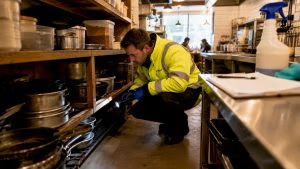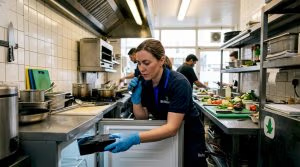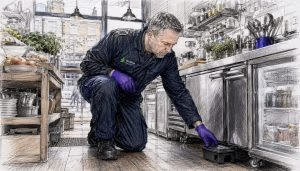


Pest evidence is one of the quickest ways to lose a food hygiene rating: droppings, live insects or missing pest records can lower the scores for your premises and your food safety management, and an active infestation can close a business on the spot. To protect your rating, keep pests out, keep proof that you are controlling them and act the same day if anything is found.
This guide covers pest control at a food hygiene inspection: what the environmental health officer looks for, how pest findings affect each part of the score, how to prepare, what to do on the day and how to recover with a re-visit. We have helped London restaurants, cafes, takeaways and food producers prepare for these visits since 2010.
Key takeaways
| Point | Details |
|---|---|
| Legal basis | Premises must be maintained to prevent pest access, with adequate procedures to control pests (Regulation (EC) No 852/2004, assimilated law in Great Britain). |
| Where pests count | Mainly the physical condition of the premises (which includes pest control) and confidence in management. |
| Worst case | An imminent risk to health, such as an active infestation, can lead to a hygiene emergency prohibition notice. |
| No fixed minimum | The law sets no minimum visit frequency and does not require a contract; officers look for effective, risk-based control and records. |
Table of Contents
- What the law requires on pest control
- How pest evidence affects your food hygiene rating
- What the officer checks for pests on the day
- How to prepare: a pest checklist for any day of the year
- What to do during the inspection
- If pests are found: enforcement and what happens next
- How to recover your rating after a pest problem
- Pest control contract or one-off call-outs?
- FAQ
- How BioWise can help protect your food hygiene rating
- Sources
What the law requires on pest control
Food businesses operate under the Food Safety Act 1990 and Regulation (EC) No 852/2004, which is assimilated law in Great Britain. In England it is enforced through the Food Safety and Hygiene (England) Regulations 2013. The pest control duties sit in Annex II of 852/2004.
| Requirement | Source | What the officer looks for |
|---|---|---|
| Premises designed and maintained to protect against contamination and, in particular, to allow pest control | 852/2004 Annex II, Chapter I | Sealed gaps, doors that close properly, proofed pipe and cable entries |
| Openable windows fitted with insect screens where necessary | Annex II, Chapter II | Fly screens on kitchen and prep room windows |
| Refuse stores kept clean and free of pests | Annex II, Chapter VI | Clean bin areas, lids closed, no overflowing waste |
| Adequate procedures to control pests | Annex II, Chapter IX | A working pest control system with checks and records |
| Food safety management based on HACCP principles | Article 5 | Pest control covered in your HACCP plan or Safer Food, Better Business pack |
For a fuller breakdown of the rules, see What Are the Legal Pest Control Requirements for London Commercial Kitchens?
How pest evidence affects your food hygiene rating
Under the Food Hygiene Rating Scheme, ratings run from 0 to 5. The FSA guidance for businesses explains that the officer checks how hygienically food is handled, the physical condition of the business, “including cleanliness, layout, lighting, ventilation, pest control and other facilities”, and how food safety is managed.
| Rating element | Pest-related findings that lower the score |
|---|---|
| Hygienic food handling | Food left uncovered where flies are active, gnawed or damaged packaging still in use, bait or insecticide close to food |
| Physical condition of the premises | Droppings, smear marks, live or dead insects, gaps around pipes and doors, missing fly screens, a dirty bin store |
| Confidence in management | No routine pest checks, no contractor reports, recommendations left undone, staff who do not know what to do if they see a pest |
Pest problems usually hit more than one element. Droppings in a dry store count against the condition of the premises, and if nobody noticed them or recorded what was done, they count against management too. Because the final rating takes account of the weakest element as well as the total score, one serious pest finding can pull an otherwise good rating down. For the wider picture beyond pests, see How To Achieve A 5-Star Food Hygiene Rating.
What the officer checks for pests on the day
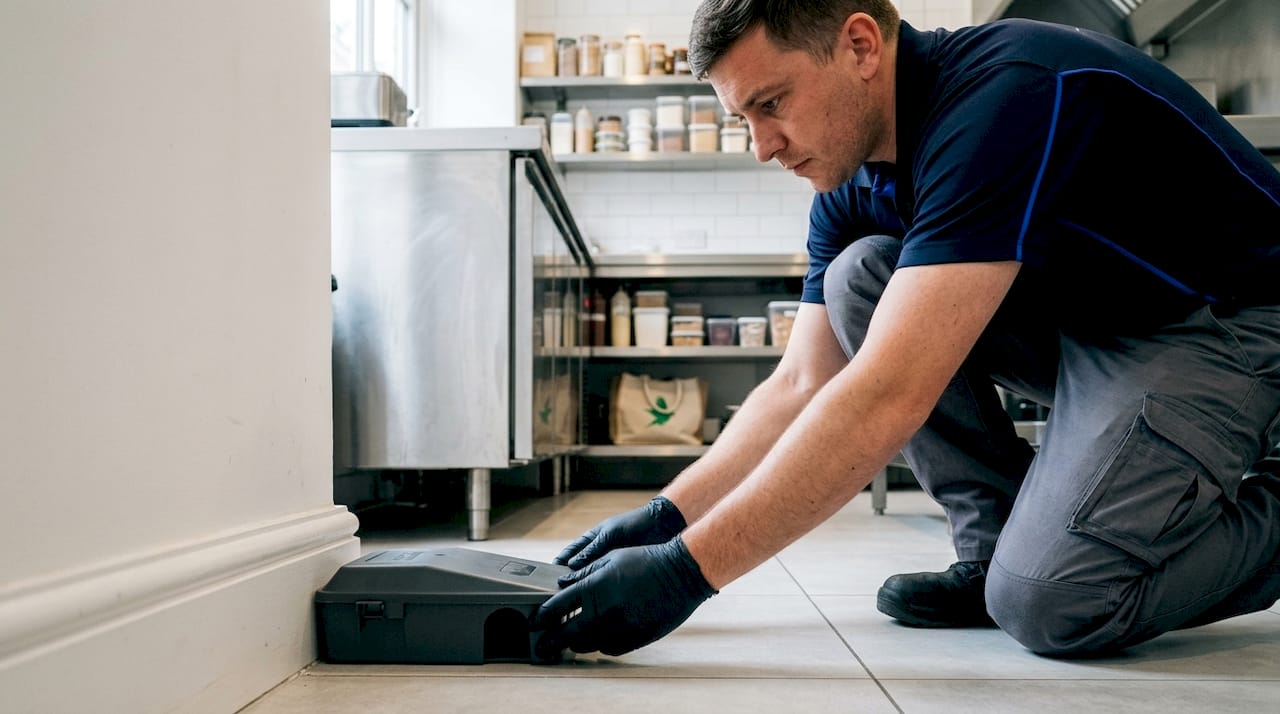
Inspections are usually unannounced. Merton Council, for example, notes that officers can enter “at all reasonable hours and usually without prior notice”. The officer looks at the structure and equipment, talks to staff and reviews records, including pest control, then checks the places pests hide: dry stores, under equipment, sinks, drains, doors, fly screens and the bin store.
| What they find | What it tells them |
|---|---|
| Rodent droppings, gnaw marks or smear marks | Rodents are active, with a contamination risk to food and surfaces |
| Cockroaches seen during the day | Often an established infestation, as cockroaches are mostly nocturnal |
| Flies in food rooms and missing screens | Weak proofing or waste management |
| Damaged packaging or insects in dry goods | Stored product insects or rodents, and weak goods-in checks |
| No records, or recommendations not actioned | Management is not in control of pest risk |
The officer does not need to see a live pest to act: droppings, smear marks and damaged stock are evidence in their own right. Our guide to pests causing food hygiene failures in London kitchens covers the species involved, and Environmental health officer pest control visit: what to expect walks through the visit in more detail.
How to prepare: a pest checklist for any day of the year
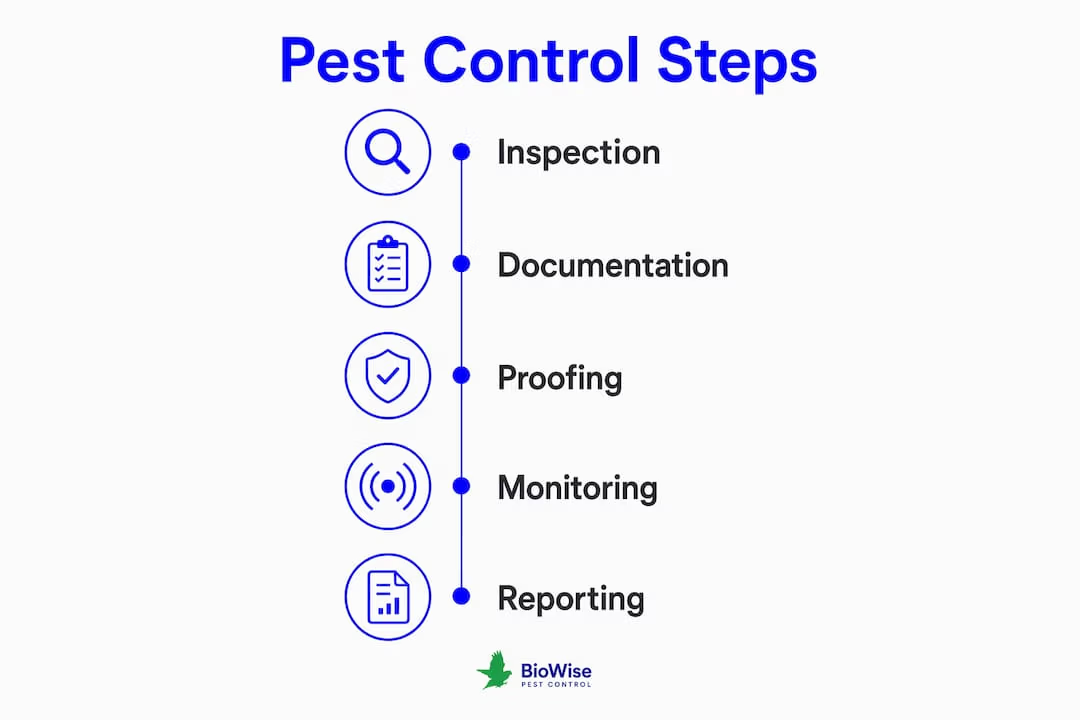
Because visits are unannounced, preparation is a routine rather than a last-minute tidy. The FSA’s Safer Food, Better Business pest control safe method asks you to check the premises regularly, refuse deliveries showing signs of pests and record what went wrong and what you did about it. In practice that looks like this:
| When | Check | Record |
|---|---|---|
| Every shift | Food rooms for droppings, insects and damage; food covered and off the floor; waste removed; external doors kept closed | Opening and closing checks |
| Every delivery | Packaging for gnawing, holes, insects or droppings | Rejected deliveries and why |
| Weekly | Behind and under equipment, dry stores, drains, bin store and back yard | Findings and actions |
| Monthly | Door seals, pipe gaps, fly screens, insect light trap trays; contractor recommendations closed out | Proofing defects and the date fixed |
| Any sighting | Call your contractor the same day, discard affected food, clean and disinfect surfaces | Corrective action with dates and names |
Keep everything in one place and make sure more than one person on each shift knows where it is; as good practice, many auditors expect at least two years of pest records. Our food-safe pest control guide explains which treatment methods are suitable around food.
What to do during the inspection
- Have the pest file or digital reports ready: contractor details, visit reports, recommendations with completion dates, your own checks and a plan of device locations.
- Walk round with the officer and answer honestly. Covering up a problem does far more damage than explaining what you are doing about it.
- If they find evidence, explain what your contractor has done and what happens next, and call your contractor while the officer is on site if needed.
- Note what is said. The written report should separate legal requirements from good practice, so ask if anything is unclear.
The kitchens that do best on inspection day are the ones that can show every pest visit in seconds. With digital service reports the manager on shift does not need to hunt for a folder; they can pull up the last report, the photos and what was fixed. Make sure the login is not held by one person who might be on holiday when the officer arrives.
Monty Gordon, Marketing and Technology, BioWise
If pests are found: enforcement and what happens next
Most pest findings end in advice or a letter, but officers have stronger powers under the 2013 Regulations when the risk is serious.
| Outcome | When it is used | What you need to do |
|---|---|---|
| Verbal or written advice | Minor issues, such as a proofing gap or a missed check | Fix it, record it and keep the evidence |
| Hygiene improvement notice | A breach of the regulations; the notice sets out the measures and a time limit | Complete the work in time; your contractor’s report is your proof |
| Voluntary closure | The business agrees to stop trading while a serious problem is put right | Treat, clean and proof before reopening, with the officer’s agreement |
| Hygiene emergency prohibition notice | An imminent risk of injury to health, such as an active rodent or cockroach infestation in food areas | The business or affected area closes at once; the council must apply to court for an order within three days |
| Prosecution | Serious or repeated breaches | Can lead to unlimited fines and imprisonment on conviction; records support a due diligence defence |
Under FSA guidance, ratings of 0 to 4 are usually published online three to five weeks after the inspection. If you need same-day help, our emergency pest control team covers every London borough.
How to recover your rating after a pest problem
- Deal with the cause. Treatment, proofing and a deep clean, with written contractor reports showing what was done.
- Fix the management side. Restart routine checks, train staff on what to look for and record every action.
- Use the safeguards. The FSA scheme gives businesses in England the options below.
| Safeguard | When to use it | Timing in England |
|---|---|---|
| Appeal | You believe the rating does not reflect the standards found | In writing within 21 days of being notified, including weekends and public holidays |
| Right to reply | To explain the circumstances or the action you have taken | Any time up to your next inspection; published alongside the rating |
| Re-visit request | After making the improvements the officer asked for | Where councils do not charge, a re-rating will not usually happen in the first three months; some councils charge and re-visit within three months of the request |
You will not be told the re-visit date, and the rating can go up, stay the same or go down, so only ask once the work is complete and your records prove it. Display is voluntary in England (unlike Wales and Northern Ireland), but customers can check ratings online at any time.
After a poor visit, the officer wants to see that the cause has been dealt with, not just the droppings cleaned up. We give clients a written report showing the treatment, the proofing completed and anything still outstanding, so the manager can show exactly what has changed before the re-visit.
Matt Ochello, Sales Executive, BioWise
Pest control contract or one-off call-outs?
No law requires a contract, but for most food businesses it is the simplest way to show planned, effective control.
| What the officer wants to see | One-off call-outs | Pest control contract |
|---|---|---|
| Routine monitoring | Only after a problem is noticed | Planned, risk-based visits |
| Early detection | Relies on staff spotting signs | A trained technician checks devices and risk areas |
| Records | Individual invoices or job sheets | A continuous file of reports and recommendations |
Visit frequency should follow the risk. Monthly visits are common for restaurants and other high-risk sites; see How Often Do Restaurants Need Pest Control? (UK Guide).
FAQ
Can you still get a 5 rating if the officer finds signs of pests?
It depends on what is found and how well it is managed. Fresh droppings or live insects in food areas are a serious finding. An old dropping in an area already treated, with contractor reports showing the problem is under control, is viewed very differently from evidence nobody had noticed.
Do I legally need a pest control contract to pass an inspection?
No. The law requires adequate procedures to control pests, not a contract. In practice, a contract with regular reports is the clearest way to show an officer that control is planned and effective.
How often are food businesses inspected?
It depends on risk. FSA guidance says the gap varies from six months for the highest-risk businesses to two years for lower-risk ones, and some very low-risk businesses may wait longer. Visits are usually unannounced.
How quickly can I get re-rated after a pest problem?
Once the improvements are complete, you can request a re-visit from your council. Where it is free, a re-rating will not usually happen in the first three months after the inspection. Some councils charge and re-visit within three months of the request.
Which pest records should I show the inspector?
Contractor visit reports, a plan of device locations, recommendations with the dates they were completed, your own routine checks and corrective actions after any sighting. Keep them together, with at least two years of history as good practice.
How BioWise can help protect your food hygiene rating
We work with restaurants, cafes, takeaways, pubs, hotel kitchens and food production sites across London, and our service is built around what officers ask to see. Every contract starts with a free site survey and a tailored plan, followed by monthly visits with official photo reports and digital service reports you can open on the day of an inspection. Emergency call-outs and unlimited minor pest proofing are included.
If you have found pests, or an inspection is close, we offer same-day call-outs across every London borough, often within hours, with evening and weekend visits planned around trading hours and unmarked vehicles on request. See our food business pest control and restaurant pest control services.
BioWise is a family-run company founded in 2010, trusted by more than 800 commercial clients, with a 4.9-star Google rating. We are BPCA and NPTA members, CHAS accredited, SafeContractor approved and fully insured, with BPCA-certified technicians. Call 0800 988 3568 or contact us for a free survey and a fixed written quote.
BioWise Pest Control Maintenance
13 Hanover Square, London, W1S 1HN
Call 0800 988 3568 or email info@biowiseservices.com
Sources
- FSA: Food Hygiene Rating Scheme guidance for businesses
- The Food Safety and Hygiene (England) Regulations 2013
- FSA: Safer Food, Better Business pest control safe method