

HACCP pest control requirements in the UK come from Regulation (EC) No 852/2004: food premises must be designed and maintained to protect against pests, and you must have adequate procedures to control them, built into your HACCP-based food safety system and backed by records. In practice that means proofing, monitoring, trained staff, a competent contractor and a written trail of checks and corrective actions.
This guide explains the legal basis, where pest control sits in a HACCP plan, a seven-point daily check for kitchens and the records inspectors expect. We have supported London restaurants, hotels and food businesses with pest control and audit-ready reporting since 2010.
Key Takeaways
| Point | Details |
|---|---|
| Legal basis | Regulation (EC) No 852/2004 requires HACCP-based procedures, premises that protect against pests and adequate pest control procedures. |
| Prerequisite first | Pest control is normally a prerequisite programme, not a critical control point, unless your hazard analysis shows otherwise. |
| Prevention first | Proofing, cleaning and waste control come before chemicals. |
| Records are the evidence | Daily checks, contractor reports and corrective actions show your procedures work. |
| No set frequency | There is no legal minimum visit frequency. Set it by risk; monthly visits are common for kitchens. |
What the law requires
Article 5 of Regulation (EC) No 852/2004, now assimilated law in Great Britain, requires every food business operator to put in place and maintain procedures based on HACCP principles. Annex II sets out the hygiene rules that cover pests directly:
| Requirement | Source | What it means in practice |
|---|---|---|
| Premises that allow good hygiene, including pest control | Annex II, Chapter I | Layout, proofing and maintenance that keep pests out and make checks possible |
| Insect-proof screens on openable windows where necessary | Annex II, Chapter II | Removable fly screens on windows that open in food rooms |
| Refuse stores kept free of animals and pests | Annex II, Chapter VI | Lidded bins, clean bin stores and regular collections |
| Adequate procedures to control pests | Annex II, Chapter IX | A documented programme of checks, contractor visits and corrective action |
| HACCP-based procedures | Article 5 | Pest risks covered in your hazard analysis, with proportionate records |
Environmental health officers from your local authority enforce these rules under the Food Safety Act 1990 and the Food Safety and Hygiene (England) Regulations 2013, with equivalent rules in Wales, Scotland and Northern Ireland. They can serve hygiene improvement notices and, where a serious infestation creates an imminent risk to health, hygiene emergency prohibition notices that close the premises. Serious offences can lead to unlimited fines and imprisonment.
There is no legal minimum frequency for pest control visits, and no law says you must have a contract, but you must be able to show your procedures are adequate. Our guide to legal pest control requirements for London commercial kitchens covers the law in more detail.
Where pest control sits in your HACCP plan
The Food Standards Agency’s MyHACCP guidance lists pest control as a prerequisite: a basic hygiene condition that should be in place before you carry out a HACCP study. For most food businesses it is a prerequisite programme rather than a critical control point. It only becomes a control point where your hazard analysis identifies a step at which pest contamination must be specifically controlled, such as a goods-in area with a history of rodent activity.
| HACCP principle | How it applies to pest control |
|---|---|
| 1. Hazard analysis | Identify where pests could contaminate food, from deliveries to service |
| 2. Critical control points | Decide whether any step needs a pest CCP or whether prerequisites cover it |
| 3. Critical limits | Set clear triggers, such as any droppings in a food room meaning immediate action |
| 4. Monitoring | Daily staff checks, contractor visits and monitoring device results |
| 5. Corrective action | What staff do when signs are found, and who they call |
| 6. Verification | Manager review of logs and contractor reports |
| 7. Documentation | Pest logs, reports, corrective actions, site plans and COSHH assessments |
Keep the paperwork proportionate. A small cafe and a hotel kitchen need different levels of detail, but both need written procedures and records.
The pests that matter and where they hide
Most food business infestations involve the same few pests, and each has favourite hiding places that rarely match where staff look first.
| Pest | Typical harbourage | Most reliable sign |
|---|---|---|
| German cockroaches | Fridge and freezer motor housings, behind ovens, inside equipment | Egg cases, small dark droppings and a musty smell in warm voids |
| Mice | Hollow kickboards, ducting, wall voids, behind units | Droppings about 3-6mm, gnaw marks, smear marks |
| Rats | Drains, external bin stores, voids near drainage | Droppings about 12-18mm, burrows, gnawed bins |
| Drain and fruit flies | Floor gullies, drain traps, waste pipework | Steady numbers near one gully, not across the room |
| Stored product insects | Flour, cereals, spices and dry goods packaging | Webbing, live beetles or moths, holes in packaging |
| Ants | Wall voids and skirting gaps near food prep | Trails to sugar or fat spills |

Drain and fruit flies breed in the organic film inside gullies and pipes, so cleaning the room while ignoring the drain changes nothing. German cockroaches are often the most persistent kitchen pest because they shelter deep inside equipment that cleaning cannot reach, which is why treatment needs a professional, survey-led approach.
Prevention first: proofing, cleaning and waste
Integrated pest management puts prevention before chemicals, and it is what inspectors and auditors expect to see. Because Annex II requires premises that protect against pests, proofing is part of compliance rather than an optional extra.
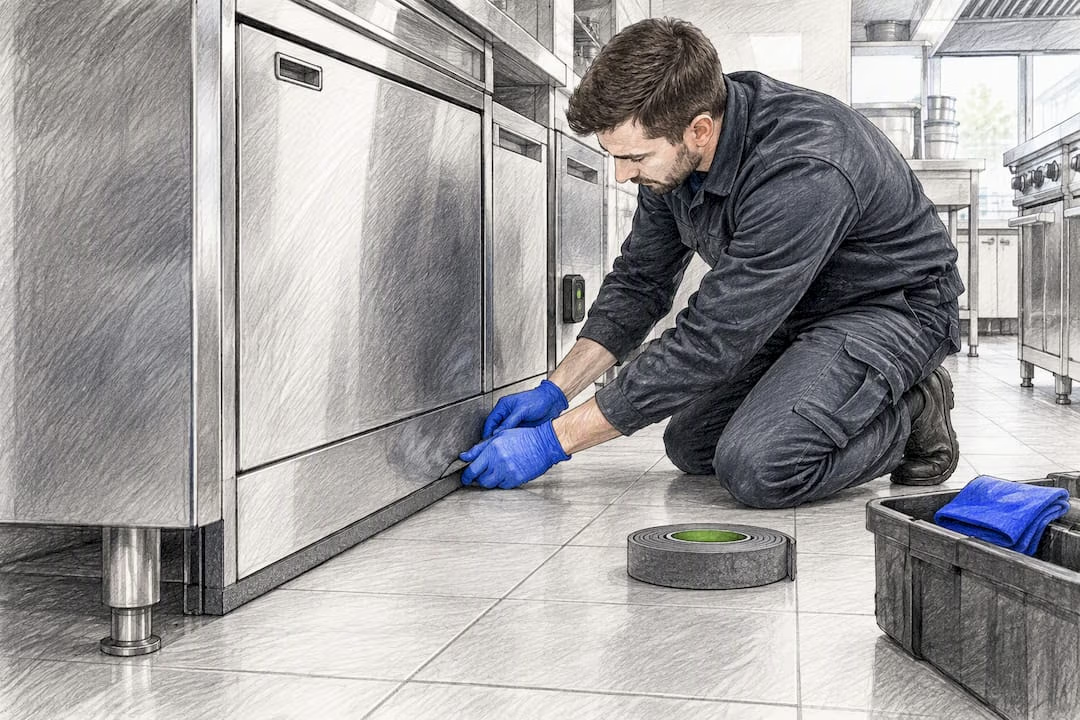
- Proofing: seal gaps around pipes and cables, fit bristle strips to external doors, repair cracked tiles and kickboards, and fit fly screens to openable windows.
- Cleaning: deep clean equipment voids, motor housings and gully traps on a schedule, not just visible floors.
- Waste: use lidded bins, keep bin stores clean and away from doors, and do not leave waste out overnight.
- Deliveries: check goods before they enter the kitchen, reject anything showing signs of pests, unpack away from storage shelving and rotate stock.
- Monitoring: use rodent monitoring stations and insect monitors or fly control units sited away from open food.
Chemical treatment should be targeted and carried out by trained technicians, and shop-bought sprays or bait must never be used near food, utensils or prep surfaces. In England, using glue traps to catch rodents has been an offence without a licence since 31 July 2024, and licences are for exceptional circumstances only; restaurants, pubs and takeaways are unlikely to qualify. Our guide to food-safe pest control explains safe methods in more detail.
A seven-point daily pest check for kitchens
A short check once or twice per shift catches activity early and builds the monitoring record your HACCP plan needs. Once staff know the routine, it takes a few minutes.
- Floor gullies and drain traps: grease build-up, standing water or fly larvae.
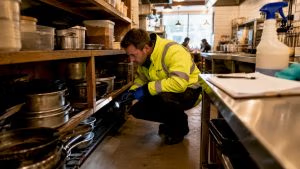
- Behind and under large equipment: droppings or insects around fridge and freezer motor housings.
- Kickboards: where accessible, droppings, gnawing or nesting material.
- Warm voids: cockroach egg cases near ovens, dishwashers and hot cupboards.
- Dry stores: webbing, live insects or damaged packaging.
- Refuse store: split bags, spillage or gnawed bins.
- Deliveries: boxes and packaging checked before they enter the kitchen.
Log the result every time, including “no signs found”, with the time, area and any action taken. If the same sign appears on two consecutive checks, escalate to the manager and your contractor.
Pest control records: what inspectors look for
An inspector cannot see months of pest pressure in one visit, so they look at your records. The pest control section of Safer Food, Better Business asks caterers to check regularly, record problems and what was done, and keep details of contractor visits and action points.
| Record | What it should show | How often |
|---|---|---|
| Daily pest check log | Areas checked, signs found or none, initials | Every shift or day |
| Contractor visit report | Findings, treatments, recommendations, device results | Every visit |
| Corrective action log | What was found, action taken, by whom and when | Each time a problem is found |
| Proofing and repair log | Work identified, who is responsible, date completed | As work is done |
| Site plan and COSHH file | Device locations, safety data sheets, COSHH assessments | When anything changes |
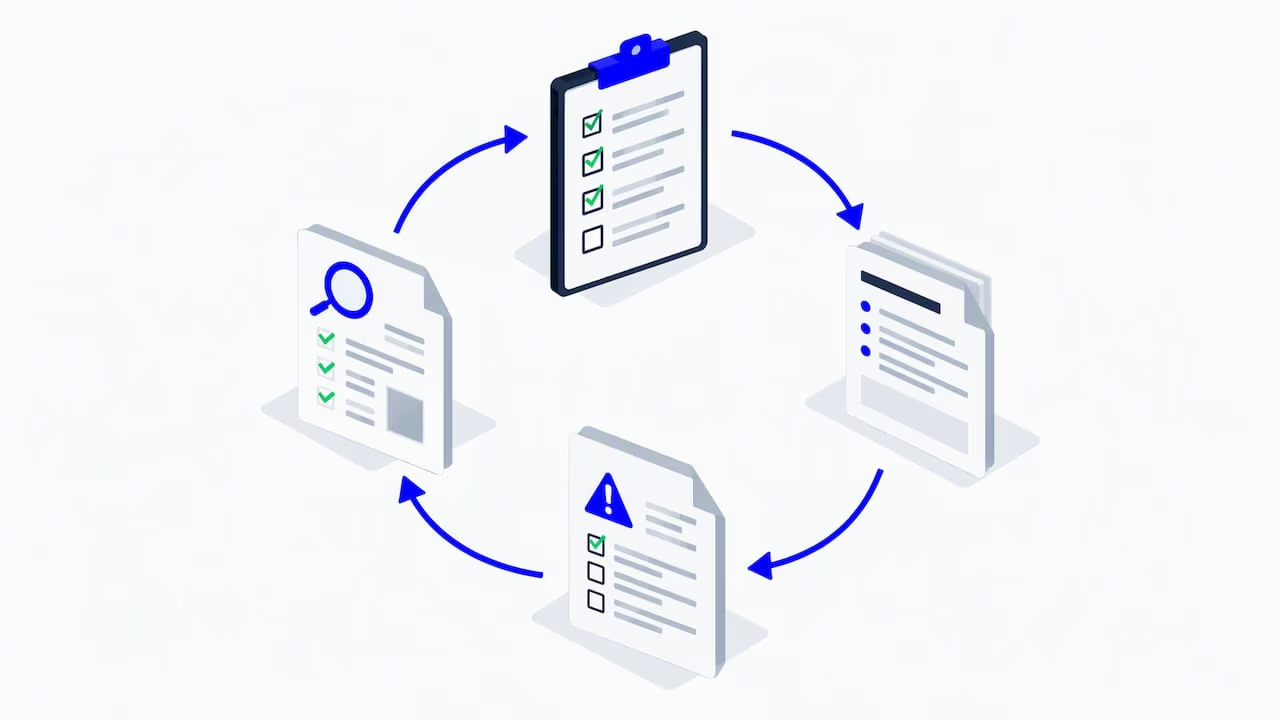
Keep everything in one place, on paper or digitally, so you can hand it over in one go. There is no legal retention period for pest records, but keeping them for at least two years is good practice and many auditors expect it. For what happens on the day, see our guide to an environmental health officer pest control visit.
Most kitchens we work with are doing the checks. The problem is finding the proof on the day. That is why our technicians file digital service reports with photos after every visit, so a manager can pull up a year of visits and actions in a couple of minutes when an officer or auditor asks.
Monty Gordon, Marketing and Technology, BioWise
What to do when you find pests
- Protect food: stop using the affected area and throw away any food pests may have touched.
- Record before cleaning: photograph the signs and note the date, time, location and what you found.
- Clean and disinfect: wash, disinfect and dry affected equipment, surfaces and utensils.
- Call your contractor: ask for a visit and a written report, and use an emergency pest control service for live rodents or active infestations during trading.
- Decide whether to stop trading: if you cannot control the risk of contamination, close the affected area until it is resolved.
- Verify and close out: agree follow-up visits, confirm activity has stopped and have a manager sign off the record.
Choosing and briefing a pest control contractor
A good contractor turns routine visits into usable HACCP evidence. Look for BPCA or NPTA membership, trained and certified technicians, adequate insurance and proof of competence for any professional rodenticide use, which the UK stewardship regime has required of buyers since 1 January 2026. Reports should include a site plan, findings, treatments, proofing recommendations and COSHH information for any products used.
In the contract, set a risk-based visit frequency, an emergency response time, the report format, who carries out proofing work and who owns the records. Ask for a sample report before you sign. For help with frequency, see how often restaurants need pest control.
What food businesses get wrong
The most common mistake is treating pest control as a reaction to a sighting rather than a routine check alongside temperature logs and cleaning schedules. By the time a cockroach appears on the pass, there is usually an established population behind the equipment.
The second is assuming a clean-looking kitchen is pest-free. A grease-filled gully, a gap behind a kickboard or a cracked tile near a fridge motor causes more problems than poor washing-up, and none of them show on a quick walk-through. Repeated spraying without proofing treats the symptom, so the problem comes back.
Officers want to see that you knew about the risk and acted on it. A log that shows a sign, the action taken and the follow-up visit is exactly what they are looking for, and it carries far more weight than a contract certificate on the wall.
Matt Ochello, Sales Executive, BioWise
FAQ
Is HACCP a legal requirement in the UK?
Yes. Article 5 of Regulation (EC) No 852/2004 requires food business operators to put in place and maintain procedures based on HACCP principles. The detail should be proportionate to the business, and many small caterers in England use the FSA’s Safer Food, Better Business pack to meet the requirement.
Is pest control a critical control point in HACCP?
Usually not. Pest control is normally a prerequisite programme that supports the whole HACCP system. It becomes a critical control point only if your hazard analysis shows a step where pest contamination must be specifically controlled to keep food safe.
How often does a food business need pest control visits?
There is no legal minimum frequency. Set it through a risk assessment based on your premises, the food you handle, your location and your pest history. Monthly visits are common for restaurants and other high-risk sites, with daily staff checks in between.
Do I legally need a pest control contract?
No law requires a contract, but you must have adequate procedures to keep pests out and control them, and be able to show it. For most commercial kitchens, a professional contract with regular visits and written reports is the most practical way to provide that evidence.
How long should food businesses keep pest control records?
The law does not set a retention period for pest records. Keeping them for at least two years is good practice and many auditors expect it, because it shows trends over time and how each problem was resolved.
How BioWise can help with HACCP pest control
We support London restaurants, cafes, hotels, bars and other food businesses with pest control built around HACCP. Every contract starts with a free site survey and a tailored plan, followed by monthly visits with photo reports and digital service reports that drop straight into your HACCP and EHO files. Emergency call-outs and unlimited minor pest proofing are included, and larger proofing projects receive a fixed written quote after a survey.
Our BPCA-certified technicians plan discreet visits around trading hours, with unmarked vehicles on request, and treat on the first visit where possible. We offer same-day call-outs across every London borough and a 24/7 emergency line. BioWise is a BPCA and NPTA member, CHAS accredited and SafeContractor approved.

Find out more about our food business pest control and restaurant pest control services, call 0800 988 3568 or contact us to arrange a survey.
BioWise Pest Control Maintenance
13 Hanover Square, London, W1S 1HN
Call 0800 988 3568 or email info@biowiseservices.com
Sources
- Regulation (EC) No 852/2004, Annex II – legislation.gov.uk
- General requirements for each prerequisite – FSA MyHACCP
- Safer Food, Better Business for caterers: pest control – FSA
- Check if you can get a glue trap licence – GOV.UK