

TL;DR:
- Thorough pest control records are essential for legal compliance and inspection success in London hospitality.
- Effective reports include detailed inspection findings, treatment data, signatures, and follow-up actions.
- Digital reporting systems improve accessibility, reduce loss risk, and support audit readiness across multiple sites.
Pest control reporting: Your 2026 guide to compliance
An environmental health officer arrives unannounced at your restaurant or hotel and asks, politely but firmly, to see your pest control records. In that moment, the quality of your documentation becomes the deciding factor between a clean inspection result and a formal notice. For many London hospitality managers, this scenario is not hypothetical. It happens regularly, and the venues that emerge unscathed are invariably those with thorough, well-organised pest control reports. This guide covers everything you need to know about building a reporting system that satisfies regulators, protects your reputation, and keeps your operation running without interruption.
Key Takeaways
| Point | Details |
|---|---|
| Legal compliance | Detailed pest control reports are essential for passing audits and meeting health regulations. |
| BPCA best practice | Following standardised templates ensures all critical details are properly recorded. |
| Digital advantage | Moving to digital systems makes record-keeping and audits faster and more reliable. |
| Proactive workflow | Building clear reporting routines prevents compliance errors and protects your reputation. |
Why pest control reporting matters for London hospitality
Pest control reporting is far more than a procedural formality. In a city as densely built and heavily regulated as London, documented evidence of pest management activity sits at the heart of your legal obligations under food safety and public health legislation. Without it, your business is exposed to serious risk, regardless of how well your physical pest management is actually performing.
The legal framework for food businesses in England requires operators to demonstrate that all reasonable precautions have been taken to prevent contamination, including from pests. This means written records of inspections, treatments, pest sightings, and follow-up actions are not optional extras. They are evidence of due diligence. Our compliance guide explains in detail how London businesses can structure their obligations to stay protected year-round.
When an environmental health inspection takes place, auditors look specifically for documentation that shows a consistent, professional approach to pest management. A verbal assurance that “the pest controller visits monthly” carries no weight without supporting records. Inspectors want dates, findings, treatment details, and signed confirmations.
Common pitfalls that put businesses at risk:
- Missing treatment dates or technician details on reports
- No record of follow-up actions after a pest sighting
- Reports that record treatment but omit inspection findings
- Unsigned documents with no client acknowledgement
- Gaps in the reporting schedule that suggest irregular visits
- No evidence of corrective action when problems were identified
Each of these gaps can be interpreted as negligence during an audit. The consequences range from advisory notices through to formal improvement requirements or, in the most serious cases, closure orders.
Reporting also has a direct bearing on your reputation. A hotel or restaurant that is named in a local authority enforcement notice suffers lasting reputational damage, often amplified through online review platforms. The importance of documentation for London restaurants cannot be overstated, particularly given how quickly poor inspection outcomes spread through review sites and local media.
“BPCA provides standardised treatment report templates with all details required for compliance and expectation management.”
Adopting these standards is the clearest signal to regulators and your guests alike that your business takes pest management seriously. Reporting is your professional credibility made visible.
What makes an effective pest control report?
Knowing the legal importance of reporting naturally leads to the question of what your reports should actually contain. A record that simply states “site visited, no issues found” offers minimal protection. An effective report tells a complete story of the inspection, the findings, and the response.

The British Pest Control Association (BPCA) has established a widely recognised standard for what a pest control treatment report should include. These requirements protect both the service provider and the client by ensuring that nothing material is omitted.
The core components of a compliant pest control report:
- Inspection findings: A clear record of all areas inspected, noting both evidence of pest activity and areas confirmed as pest-free. Both positives and negatives must be documented.
- Treatment details: The specific pesticide or method used, the target pest, application area, and quantities applied.
- Active ingredients: The chemical names and concentrations of any products used, including their registration status.
- Risk assessment notes: Any site-specific risks identified, such as proximity to food preparation areas or water sources.
- Customer instructions: Actions required of the client following treatment, such as ventilation periods, cleaning requirements, or access restrictions.
- Signatures: Both the pest control technician and a responsible member of the client’s staff must sign to confirm the visit and findings.
- Follow-up actions: Clear notation of any outstanding issues requiring a return visit or escalated intervention.
As the BPCA guidance makes clear, reports must be detailed, signed, and include both positive and negative site observations, pesticide specifics, and planned actions to protect all parties and prove due diligence. Digital tools are increasingly being used to produce and store these records for audit purposes.
To illustrate the difference in practice, consider the following comparison:
| Report type | Inspection detail | Pesticide data | Signed | Follow-up recorded |
|---|---|---|---|---|
| Basic log entry | Minimal or absent | Not included | Often unsigned | Rarely noted |
| BPCA-compliant report | Full inspection notes | Active ingredients listed | Both parties sign | Clearly documented |
| Digital BPCA report | Full notes with timestamps | Auto-populated fields | Electronic signatures | Linked to next visit |
For venues subject to regular audits, particularly those in hospitality, the difference between a basic log and a fully compliant report can determine the outcome of an inspection. Understanding your legal kitchen requirements is the essential starting point for aligning your reporting with statutory obligations.
Pro Tip: Always ensure your pest controller records both positive findings and areas of the site where no activity was detected. Inspectors are specifically looking for evidence that the full site has been assessed, not just the areas where problems exist.
Digital vs. paper reporting: Choosing the right approach
With report content defined, the next decision is how to manage and store those records. This is an area where the hospitality sector has seen a clear and accelerating shift in recent years.
Paper-based reporting has been the default for decades. A technician completes a form on site, hands a copy to the site manager, and retains a copy for the company file. It is familiar and requires no technology. However, paper records carry real risks in a busy hospitality environment. Documents get misplaced, damaged by moisture or heat, or simply filed in a location that nobody can locate at short notice during an audit.
Digital reporting systems address these vulnerabilities directly. Cloud-based platforms allow reports to be generated, signed, and stored electronically, accessible from any device at any time. When an auditor requests three years of pest control records, a digital system can retrieve them in seconds rather than hours.
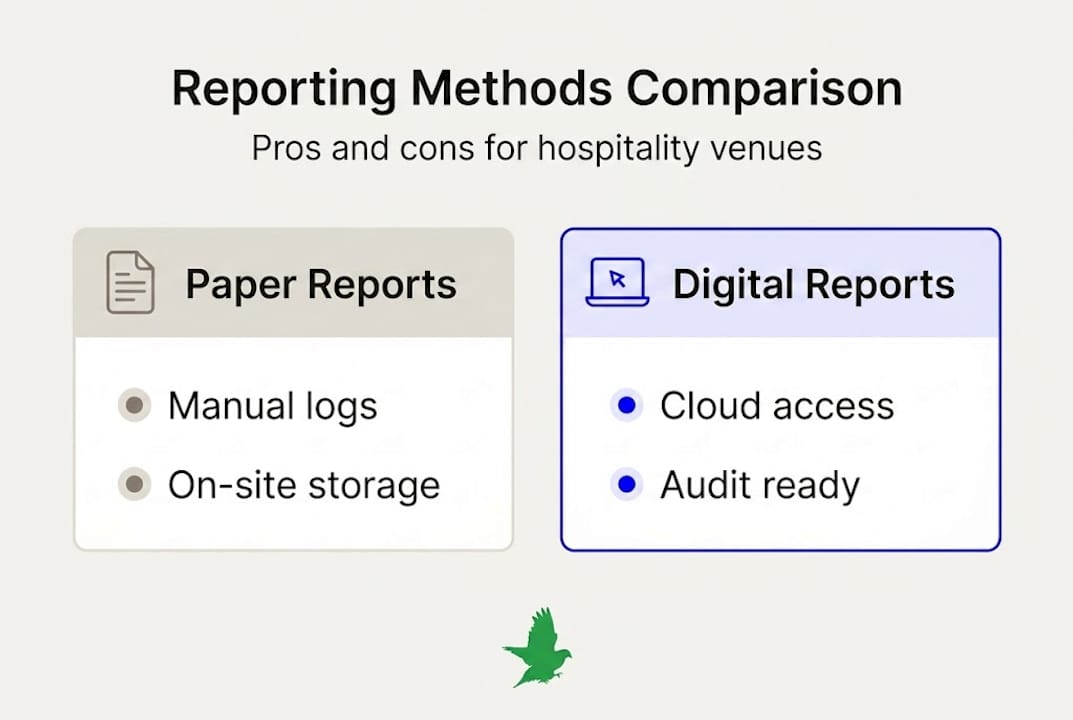
| Feature | Paper reports | Digital reports |
|---|---|---|
| Access speed | Manual retrieval required | Instant, from any device |
| Risk of loss | High, especially in busy venues | Minimal, cloud-backed |
| Version control | No version history | Full edit and access history |
| Audit readiness | Dependent on filing discipline | Consistently audit-ready |
| Sharing with regulators | Physical copies required | Shareable link or export |
| Cost | Low initial cost | Subscription or platform fee |
As the BPCA notes, digital tools are emerging specifically to support audit readiness, and adoption is growing fastest in commercial food and hospitality settings where audit frequency is highest.
For London hotels and larger restaurant groups, digital systems offer an additional benefit: centralised visibility across multiple sites. A general manager overseeing several venues can review pest control activity across all locations from a single dashboard, identifying patterns and addressing problems before they escalate.
Key considerations when choosing your reporting system:
- How many sites need to be covered?
- What level of technical ability do your staff have?
- How frequently are you subject to health inspections or third-party audits?
- Does your pest control provider offer a digital reporting portal?
- What are your data retention obligations under current food safety regulations?
For smaller, independent venues, a well-organised paper filing system with digital backups (scanned copies stored securely) may be a practical middle ground. The approach should match your operational reality. For further context on how these principles translate to residential settings, our residential reporting practices article provides a useful reference point on the underlying documentation principles.
How to implement an audit-ready reporting workflow
With system choices made, the real work is embedding reporting into your daily operations so that it becomes habitual rather than reactive. Many businesses have the right system in place but still fail audits because the workflow breaks down between visits.
A structured workflow ensures that every pest sighting, every treatment, and every follow-up action is captured and filed correctly, without depending on any single individual’s memory or diligence.
A practical step-by-step reporting workflow for hospitality managers:
- Establish a pest sighting log. Provide staff with a simple form or digital entry point to record any pest sighting immediately, noting the date, time, location, and nature of the sighting. This creates a real-time evidence trail.
- Notify your pest controller promptly. Any sighting log entry should trigger a formal communication to your pest control provider, with a copy retained in your records.
- Accompany the technician on inspections. A senior staff member should always be present during scheduled visits. This individual is responsible for reviewing the report, flagging any concerns, and signing on behalf of the business.
- Review the completed report before signing. Never sign a report without reading it. Verify that all areas inspected are listed, findings are accurate, and any follow-up actions are clearly noted with expected completion dates.
- File the report immediately. Whether paper or digital, reports must be stored in a location that is accessible to management and retrievable at short notice.
- Track follow-up actions to completion. Assign a named staff member to monitor outstanding actions and confirm when they have been resolved. Update the record accordingly.
- Conduct your own internal review quarterly. Set aside time each quarter to check your records for completeness, identify any gaps, and ensure your pest controller’s visit schedule is being maintained.
As BPCA guidance confirms, reports must be detailed and signed, capturing all relevant positives and negatives, pesticide specifics, and audit-critical information to protect the business in the event of any regulatory challenge.
Pro Tip: Schedule a quarterly mock audit internally. Treat it exactly as you would a real inspection by asking a colleague unfamiliar with the pest control records to locate a specific report from 18 months ago. If they cannot find it quickly, your filing system needs improvement before a real auditor discovers the same problem.
The financial and operational consequences of poor record-keeping are significant. Our article on the cost of non-compliance sets out in clear terms what London businesses stand to lose when documentation is treated as an afterthought.
The uncomfortable truth: Reporting is your best defence, not your worst chore
In our experience working with London hospitality businesses since 2010, the most common attitude towards pest control reporting is resigned tolerance. Managers see it as an administrative burden that comes with the territory, something to endure rather than leverage. That perspective is understandable, but it is also a missed opportunity.
The businesses that have genuinely mastered their reporting systems are not simply better prepared for inspections. They are operationally sharper. A complete, well-maintained pest control record reveals patterns: recurring ingress points, seasonal surges in rodent activity, treatment methods that work and those that do not. That intelligence is genuinely useful for managing your premises more effectively.
We have also seen, on multiple occasions, how a robust paper trail has protected businesses from unfair blame. When a guest complaint involves an alleged pest sighting, a venue with comprehensive records can demonstrate precisely when the last inspection took place, what was found, and what action was taken. Without that documentation, the venue has no credible defence.
The shift required is straightforward: treat your long-term compliance strategies not as obligations to satisfy minimally, but as operational assets to be maintained actively. Reporting is not your enemy. Neglecting it is.
Next steps: Expert pest control solutions for London hospitality
If you’re ready to bring your pest control reporting up to the standard that London’s hospitality sector demands, working with an experienced provider makes the process significantly more straightforward.
At BioWise, we have supported over 600 London clients since 2010, including restaurants, hotels, and food production businesses. Our fully qualified pest controllers produce BPCA-compliant reports as standard, and we offer digital reporting access so your records are always audit-ready. Understanding why pest management matters for your venue is the first step. For tailored advice and a compliance consultation, explore our London commercial pest solutions and get in touch with our team today.
Frequently asked questions
What details must a pest control report include for compliance?
It must include inspection findings, treatments used with active ingredients, quantities applied, risk assessments, customer instructions, and signed approval from both technician and client, in line with BPCA standardised templates.
Are digital pest control reports acceptable for health audits in London?
Yes, digital audit tools are increasingly accepted and can make inspections quicker by providing instant access to all required records.
What happens if I cannot provide pest control reports during a health inspection?
Failure to present records may result in non-compliance penalties or temporary closure, as standardised records are essential for proving due diligence and avoiding regulatory action.
Who is responsible for signing the pest control report?
Both the pest control technician and a responsible member of your staff must sign, confirming that the visit occurred and the findings are accurate, as required by BPCA reporting standards.