

If you find cockroaches in your restaurant, act the same day: isolate and throw away any food they may have touched, photograph and log the evidence, and get a professional pest controller in before the next service. One cockroach seen in daylight usually means an established colony behind your equipment, so treat it as an infestation, not a one-off.
This guide covers how cockroaches get into restaurant kitchens, the signs to check for, your legal duties as a food business, a step-by-step response plan and how to prevent roaches coming back with monitoring and integrated pest management. It is based on what we see on site: BioWise has provided restaurant pest control across London since 2010, including cockroach control for food facilities from small takeaways to busy hotel kitchens.
Speed matters because cockroaches carry bacteria such as Salmonella and E. coli, breed quickly in warm kitchens and put your food hygiene rating at risk. The Safer Food, Better Business (SFBB) safe method for an active cockroach infestation says stricter hygiene procedures are needed while the problem is active, and that you may need to close temporarily until a pest controller has assessed the risk.
Immediate action checklist (use this now):
- Remove and safely discard any food that cockroaches may have contacted.
- Seal and label all remaining open food in pest-proof containers.
- Photograph the evidence: droppings, shed skins, live insects and the exact location.
- Record the time, location and names of any staff witnesses in an incident log.
- Increase cleaning frequency in the affected area immediately.
- Place monitoring traps under equipment and near drains in the affected zone.
- Call your pest contractor. If you have no contract in place, book emergency pest control in London rather than waiting for a routine slot.
- Decide whether to contact your council’s environmental health team for advice, based on the scale of what you have found.
Pro Tip: Photograph everything before you clean. Inspectors and contractors need to see the evidence as it was found. A timestamped photo on a phone is useful evidence; a scrubbed surface is not.
Key takeaways
A cockroach infestation in a restaurant is a food-safety and regulatory emergency that requires immediate isolation of contaminated food, documented incident logging, and professional pest-control intervention within hours, not days.
| Point | Details |
|---|---|
| Isolate and document first | Remove contaminated food, photograph evidence, and open an incident log before cleaning anything. |
| Daytime sightings mean escalate now | Live cockroaches during service indicate a large, established colony, so book an emergency callout immediately. |
| DIY products are not enough | Consumer aerosols scatter infestations and provide no compliance documentation; professional treatment is required. |
| Monitoring prevents recurrence | Weekly sticky-trap checks with logged results give early warning and demonstrate due diligence to inspectors. |
| How BioWise helps | Same-day call-outs across London, targeted cockroach treatment and monthly contracts with photo reports for restaurants and food businesses. |
Table of Contents
- Why cockroaches appear in restaurants and how they get in
- How to recognise a cockroach infestation: reliable signs to check for
- Health risks and legal consequences for food businesses
- Step-by-step immediate response for managers
- Prevention and integrated pest management for restaurants
- Monitoring and detection: tools and record-keeping that give early warning
- Control options: DIY measures versus professional treatment
- How to hire a professional pest contractor and what to expect
- What managing cockroaches in restaurants actually teaches you
- How BioWise can help with cockroaches in your restaurant
- Sources
- FAQ
Why cockroaches appear in restaurants and how they get in
Restaurants are, from a cockroach’s perspective, close to ideal: constant warmth, abundant food residues, reliable moisture from sinks and drains, and plenty of undisturbed harbourage behind heavy equipment. Remove any one of those conditions and you reduce the risk significantly. Remove all four and you make your premises genuinely inhospitable.
The most common attractants in commercial kitchens are:
- Food debris: crumbs under fryers, grease build-up on extraction filters, and spilled dry goods in storage areas
- Open or overfull bins: particularly wet waste bins left uncovered overnight
- Standing water and condensation: around dishwashers, under refrigeration units, and in floor drains
- Cardboard packaging: cockroaches travel inside delivery boxes and nested in corrugated board; this is one of the most frequently overlooked entry routes
- Drains and service ducts: Oriental cockroaches in particular use drain systems as highways between premises
Operational guidance specifically recommends checking incoming deliveries for pest evidence and ensuring equipment is accessible for cleaning to reduce harbourage. That advice is worth taking seriously: a delivery of dry goods from a supplier with their own pest problem can introduce cockroaches directly into your dry-goods store.
Common entry points include gaps around pipework and service ducts, poorly fitted door sweeps on back entrances, cracks in brickwork near ground level, and shared drainage systems in multi-occupancy buildings. In older premises, the voids beneath fixed tiling and behind built-in cabinetry are particularly high-risk because they are warm, dark, and rarely disturbed.
Species differences matter operationally. German cockroaches (Blattella germanica) are small (roughly 10-15mm), light brown with two dark stripes behind the head, prefer warm food-preparation areas and equipment voids, and reproduce rapidly. A female carries an egg case holding up to about 40 eggs, and in a warm kitchen a new generation can reach adulthood within a few months. Oriental cockroaches (Blatta orientalis) are larger, darker and favour cooler, damper places such as drains, basements and external bin stores. Knowing which species you are dealing with shapes where your contractor will focus treatment.
How to recognise a cockroach infestation: reliable signs to check for
Cockroaches are nocturnal, so by the time you see one during a lunch service, the colony behind your equipment is likely already substantial. The SFBB caterers pest control pack lists the primary evidence items inspectors expect to find: live insects, droppings, moulted skins, egg cases, and dead cockroaches.
Visual signs to check for:
- Live sightings during daylight: the single most urgent indicator; cockroaches usually only come out in the light when the colony is large enough to force them from their harbourage
- Droppings: tiny dark specks like ground pepper or coffee grounds for German cockroaches, or larger cylindrical pellets for Oriental cockroaches; found along skirting boards, behind equipment and in dry-goods stores
- Shed skins (exuviae): pale, translucent casings left behind as nymphs moult; often found in clusters near harbourage sites
- Oothecae (egg cases): brown, purse-shaped capsules about 8mm long for German cockroaches (larger and darker for Oriental cockroaches); German females carry them until shortly before hatching, so empty cases are often found in warm, sheltered spots
- Grease and smear marks: dark, greasy streaks along walls and surfaces where cockroaches repeatedly travel
The telltale musty or oily odour produced by cockroach pheromones is often strongest under refrigeration units, behind ovens, and in dry-goods stores. If you can smell it before you can see the insects, the infestation is already advanced.
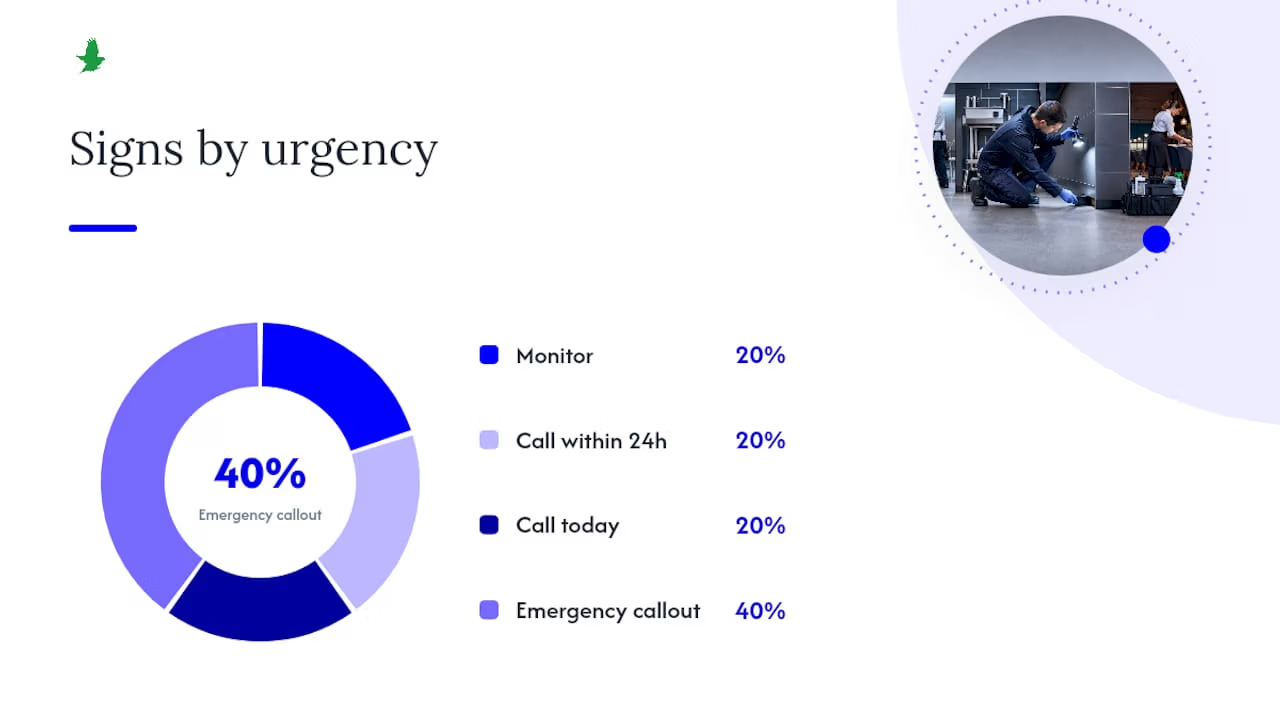
Significance ranking for managers:
| Sign | Likely implication | Urgency |
|---|---|---|
| Musty odour only | Early or low-level activity | Monitor closely; set traps |
| Droppings only, no live sightings | Established but not yet large | Call contractor within 24 hours |
| Shed skins and oothecae | Active breeding colony present | Call contractor today |
| Live sightings at night | Moderate to large colony | Emergency callout |
| Live sightings during the day | Large, advanced infestation | Emergency callout; consider closure |
When photographing evidence for an inspection or enforcement action, capture: the exact location with a reference object for scale, the type of evidence (droppings, skin, egg case), any harbourage sites nearby (gaps, voids, pipework), and the date and time visible in the image metadata.
Health risks and legal consequences for food businesses
Cockroaches are not passive carriers. They move between drains, waste areas, and food-contact surfaces, depositing pathogens at every stop. The organisms most commonly associated with cockroach contamination include Salmonella spp., E. coli, Staphylococcus aureus, and various parasitic organisms. Staff and customers are both at risk, and the contamination route is often invisible: a cockroach walking across a prep surface overnight leaves no obvious trace.
Beyond direct pathogen transfer, cockroach debris (shed skins, droppings and body parts) is a recognised allergen and asthma trigger. In a kitchen where staff work long shifts in close proximity to these materials, occupational health implications are real.
The regulatory consequences are equally serious. Under the Food Safety Act 1990 and Regulation (EC) No 852/2004, food premises must be kept in a condition that keeps pests out and you must have adequate pest control procedures. If an inspection finds an infestation, environmental health officers can serve a hygiene improvement notice or, where there is an imminent risk to health, a hygiene emergency prohibition notice that closes the business straight away (Food Safety and Hygiene (England) Regulations 2013). Your Food Hygiene Rating Scheme score can drop, and serious cases can lead to prosecution, unlimited fines and even imprisonment. A publicly visible drop from 5 to 2 can cost a restaurant more in lost bookings than the treatment would have cost. Our guide to an environmental health officer pest control visit explains what inspectors look for.
Keep a dedicated pest control file containing treatment reports, monitoring logs, contractor invoices and photographs. Environmental health officers expect to see documented evidence of proactive management, and a well-kept file can make the difference between formal enforcement and informal advice.
Insurance and supply-chain contracts often include pest-control compliance clauses. A closure or enforcement notice can trigger a policy review or a contract suspension with a food-service client, compounding the financial impact well beyond the immediate remediation costs.
Step-by-step immediate response for managers
Speed and documentation are both critical. The following sequence covers the first 24-72 hours.
- Isolate the affected area. If cockroaches have been found in a specific section of the kitchen, restrict access and remove all food items from that zone.
- Remove and discard contaminated food. Any open or unsealed food that may have been in contact with cockroaches should be disposed of safely and recorded.
- Secure remaining stock. Transfer all other food to sealed, pest-proof containers. Do not leave anything in cardboard packaging.
- Perform an urgent deep clean of the affected area, paying particular attention to floor voids, behind equipment, and drain covers.
- Set monitoring traps. Place sticky monitoring traps under equipment, near drains, and along wall junctions in the affected zone.
- Open an incident log. Record every action taken, with times, locations, and staff names.
- Notify your pest contractor. If you have a maintenance contract, invoke it now. If not, treat this as an emergency callout.
- Decide on environmental health notification. If live sightings are widespread, if you have found oothecae, or if the contractor confirms a large colony, contact your local environmental health team. SFBB guidance recommends this step when infestations persist or when the scale of the problem warrants it.
- Consider suspending service in the affected area until the contractor has completed an initial assessment and confirmed it is safe to continue.
Incident log: minimum fields to record
- Date and time of discovery
- Location (specific area, equipment, or surface)
- Type of evidence found (live insect, droppings, egg case, etc.)
- Staff witness names
- Photographs taken (file names or timestamps)
- Actions taken and by whom
- Contractor notified (name, time of call, expected response time)
- Environmental health notified (if applicable)
Who to contact and when:
- General manager and head chef: immediately, regardless of scale
- Pest contractor: within the hour; BioWise offers same-day emergency call-outs for commercial clients across London
- Local environmental health team: same day if the infestation is widespread, if you are considering closure, or if the contractor advises it
- Insurers: if closure or significant stock loss is involved
Prevention and integrated pest management for restaurants
Integrated pest management (IPM) is the approach recommended by the British Pest Control Association (BPCA): proactive, evidence-based, and combining physical controls, sanitation, and targeted treatments rather than relying on reactive chemical applications alone. For a restaurant, IPM starts with making the premises as inhospitable as possible before any treatment is needed.
Sanitation standards
- Clean as you go throughout service, not just at the end of the shift.
- Perform a full deep clean of all food-preparation surfaces, equipment, and floor areas at the end of every service.
- Degrease extraction filters and canopies weekly; grease build-up is a primary attractant.
- Flush and treat floor drains daily with an appropriate drain cleaner; standing organic matter in drains is a significant harbourage and food source.
- Clean beneath and behind all moveable equipment at least weekly.
Storage and waste control
- Store all dry goods in sealed, hard-sided containers, not in the original cardboard or paper packaging.
- Keep bin lids closed at all times; use foot-pedal bins in food areas.
- Empty internal bins at the end of every service; do not leave wet waste overnight.
- Position external bins away from the building and on hard standing, not directly against the wall.
- Inspect every delivery before it enters the building. Check cardboard boxes for droppings, shed skins, or live insects. Unbox deliveries in a designated area, not directly in the kitchen.
Proofing and maintenance
- Seal all gaps around pipework, service ducts, and cables with appropriate filler or mesh.
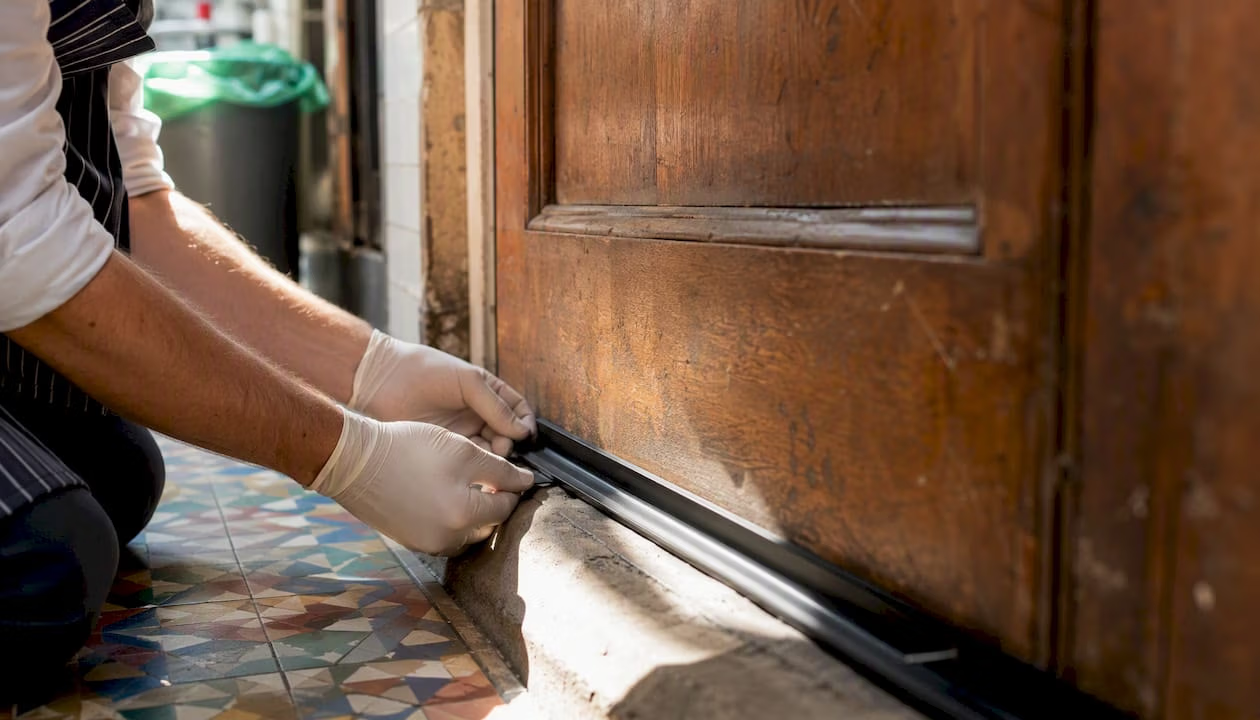
- Fit door sweeps to all external and back-of-house doors.
- Install screens on any ventilation openings.
- Mount equipment on lockable wheels wherever possible so the floor beneath can be cleaned without moving fixed units.
- Repair leaking pipes and condensation issues promptly; moisture is as attractive to cockroaches as food.
For a full list of proofing jobs to work through with your maintenance team, see Your complete pest-proofing checklist for UK properties. The same principles apply to cafes, takeaways and food production sites, which we cover under food business pest control.
Sample opening and closing checklist (key line items):
- Opening: check sticky monitors and the floor behind cooking equipment for live insects, droppings or shed skins
- Opening: check overnight deliveries and dry stores before stock moves into the kitchen
- Closing: degrease and clear under fryers, ovens and dishwashers, leaving no food or wet waste out
- Closing: empty internal bins, close external bin lids and check drain covers are in place
- Both: record the check, any findings and who carried it out in your pest log
Build a five-minute pest check into the opening and closing manager walkround. When it is part of the routine, staff stop seeing it as an extra task and start treating it as normal practice, and that is what catches problems early.
Monitoring and detection: tools and record-keeping that give early warning
Monitoring is what separates a reactive response from a managed programme. Sticky monitoring traps placed strategically beneath equipment and near drains are the most cost-effective early-warning tool available to kitchen managers. Catching even one cockroach in a trap is a signal to escalate to a contractor for a full survey before the population grows.
Where to place monitoring traps:
- Beneath refrigeration units and dishwashers
- Behind ovens and fryers, along the wall junction
- Inside dry-goods stores, particularly in corners
- Near floor drains and under sink units
- Inside service ducts where accessible
- Near delivery and waste areas
Check traps at least weekly and record the results. Operational checklists recommend daily recorded checks for droppings or dead insects behind and beneath equipment, a discipline that pays off when an environmental health officer asks for your pest control records. Use the same walkround to look for rodent evidence too: Signs of Mice in a Restaurant: A Manager’s Checklist lists what to look for.
Sample monitoring log:
| Date | Trap location | Insects caught | Photograph taken | Action taken |
|---|---|---|---|---|
| Example | Under fridge unit 2 | 0 | No | None required |
| Example | Behind main oven | 1 nymph | Yes | Contractor notified |
| Example | Dry-goods store, NE corner | 3 adults | Yes | Emergency callout booked |
Escalation thresholds:
- Zero catches across all traps for four consecutive weeks: maintain current programme.
- One or two catches in a single location: increase check frequency; notify contractor for advisory visit.
- Three or more catches, or catches across multiple locations: treat as an active infestation; book a professional survey immediately.
- Any daytime live sighting: emergency callout, regardless of trap data.
Pro Tip: Draw a simple floor plan of your kitchen and mark every trap location. Rotate trap positions quarterly to cover different harbourage zones. When catches cluster in one area, that is where the source site is most likely to be, so give that information to your contractor before they arrive.
Control options: DIY measures versus professional treatment
The honest answer is that DIY control in a commercial kitchen has very limited value. Consumer aerosol sprays can scatter cockroaches into new harbourage sites, making the infestation harder to locate and treat. They rarely penetrate the voids and cracks where colonies actually live, and repeated use without professional follow-up can contribute to insecticide resistance in local populations.
What in-house teams can reasonably do:
- Intensify cleaning and sanitation immediately
- Set and monitor sticky traps
- Remove cardboard packaging and clutter that provides harbourage
- Seal obvious gaps with temporary filler pending professional proofing
What they cannot reliably do: locate and treat harbourage sites, apply gel baits correctly, or use the professional-grade residual insecticides and dusts that reach into voids. The BPCA is explicit that professionals have access to monitoring systems and restricted-use products not available to the public, and can identify harbourage sites that DIY approaches routinely miss.
DIY vs professional treatment: a practical comparison
| Factor | In-house action | Professional treatment |
|---|---|---|
| Harbourage location | Limited; surface-level only | Full survey with monitoring data |
| Products available | Consumer aerosols and traps | Gel baits, residual insecticides, dusts, heat treatment |
| Food-area safety | Risk of misapplication | Applied to correct sites at correct rates |
| Documentation for compliance | None | Written treatment reports and monitoring logs |
| Recurrence prevention | Low | High, with follow-up visits and proofing |
| Regulatory standing | Not accepted as evidence of control | Accepted by environmental health |
Professional methods used in food premises include gel baits applied to harbourage sites (highly targeted, low environmental impact), residual insecticides applied to wall junctions and voids, insecticidal dusts in inaccessible cavities, and heat treatment for severe infestations where chemical use is restricted. For when proofing works versus chemical treatment is the right approach, see our practical guide for commercial operators.
Call a professional when:
- You see live cockroaches during daylight hours
- Monitoring traps catch insects across multiple locations
- You find oothecae or shed skins (evidence of active breeding)
- Consumer products have been used without resolving the problem
- An environmental health inspection is imminent or has flagged a concern
How to hire a professional pest contractor and what to expect
Not all pest contractors are equal, and in a food business the stakes of choosing the wrong one are high. The BPCA recommends that businesses adopt proactive, professionally managed pest control rather than reactive fixes. When vetting a contractor, the following checklist covers the minimum you should expect.
Service checklist: what a qualified contractor should provide
- A documented site survey before any treatment begins
- A written treatment plan specifying methods, products, and target areas
- Evidence-based application: gel baits and residual products applied to confirmed harbourage sites, not blanket spraying
- Safe application methods appropriate for food premises, with clear re-entry intervals
- Follow-up monitoring visits with written reports
- Recommendations for proofing works to prevent recurrence
- Compliance documentation suitable for environmental health inspection
Questions to ask before you appoint a contractor:
- Are your technicians BPCA-qualified or hold a recognised industry qualification?
- What IPM approach do you use for cockroach infestations in food businesses?
- Do you carry out proofing works as part of the service, or is that a separate arrangement?
- What monitoring systems do you use between treatment visits?
- What documentation will you provide after each visit?
- What is your guaranteed response time for emergency callouts?
- Can you provide references from other food-business clients?
What a proper maintenance contract should include:
- Scheduled inspection and monitoring visits (there is no legal minimum, but monthly is common for restaurants; see How Often Do Restaurants Need Pest Control? (UK Guide))
- Written treatment reports after every visit
- A monitoring log showing trap results and trends over time
- A schedule of recommended proofing works with timelines
- A named technician or account manager for continuity
- A clear emergency callout clause with a defined response time
BioWise has served London businesses since 2010 and now works with more than 800 commercial clients. We offer tailored cockroach control programmes for restaurants and commercial kitchens, including emergency call-outs, targeted treatment plans, monthly maintenance contracts and proofing works.
What managing cockroaches in restaurants actually teaches you
The restaurants that handle cockroach discoveries well are almost never the ones with the most sophisticated treatment programmes. They are the ones where the manager has already decided, before anything goes wrong, exactly what they will do if it does.
That sounds obvious, but most kitchens operate without a written pest-response protocol. When a cockroach appears during a Friday dinner service, the decision about whether to close a section, who to call, and what to document gets made under pressure by whoever happens to be in charge. That is when mistakes happen: evidence gets cleaned away, the incident goes unlogged, and the contractor is called three days later when the problem has grown.
The other thing worth saying plainly: professional pest control in a food business is not a cost to minimise. A monthly maintenance contract with a qualified contractor costs far less than the lost trade from a single closure or enforcement notice, and nothing like the reputational damage of a hygiene score drop that stays visible on the Food Standards Agency website for months. The businesses that treat pest management as a compliance overhead tend to be the ones who end up paying the most for it.
Fast, discreet professional intervention is not just about the cockroaches. It is about keeping your staff confident, your customers safe, and your business open.
How BioWise can help with cockroaches in your restaurant
London restaurants face constant cockroach pressure from shared drains, warm equipment voids and daily deliveries, and routine cleaning alone rarely fixes it. BioWise is a family-run London company, founded in 2010, with more than 800 commercial clients, BPCA and NPTA membership, CHAS and SafeContractor accreditation and BPCA-certified technicians.

For an active infestation we offer same-day call-outs across every London borough and a 24/7 emergency line. Our technicians survey the kitchen, target harbourage with gel baits and residual treatments applied safely around food areas, and close the entry points that let cockroaches back in. Our restaurant pest control contracts include monthly visits with photo reports, digital service reports for your EHO file, emergency call-outs and unlimited minor proofing, with visits planned around service and unmarked vehicles on request.
If you have seen cockroaches, contact us to book a free site survey, or call 0800 988 3568 for urgent help.
BioWise Pest Control Maintenance
13 Hanover Square, London, W1S 1HN
Call 0800 988 3568 or email info@biowiseservices.com
Sources
The following resources are worth downloading and keeping in your pest-control file.
- Pest control in a food business: cockroaches (London Borough of Bromley)
- Safer Food, Better Business: managing an active cockroach infestation
- Safer Food Better Business: caterers pest control pack
- BPCA: cockroach advice sheet
This article is general information, not a substitute for advice from a qualified doctor. Consult a qualified healthcare professional about your own circumstances before acting on anything here.
FAQ
Can I still serve food if a cockroach was found in the kitchen?
Not without taking immediate action first. Remove and discard any food that may have been in contact with the cockroach, deep clean the affected area, and assess the scale of the infestation before resuming service. If the infestation appears widespread, consider suspending service in the affected zone until your contractor has completed an assessment.
What does finding a cockroach in a restaurant kitchen actually mean?
A single cockroach during daylight hours almost always indicates a larger colony already established in a harbourage site nearby. Cockroaches are nocturnal; daytime sightings occur when population pressure forces individuals out of hiding. Treat it as a confirmed infestation, not an isolated incident.
What are the symptoms of food poisoning linked to cockroach contamination?
Cockroaches are associated with Salmonella, E. coli and Staphylococcus aureus, all of which can cause nausea, vomiting, diarrhoea, stomach cramps and fever. Symptoms typically appear within hours to a few days of eating contaminated food, depending on the pathogen. Anyone who feels unwell should speak to a GP, pharmacist or NHS 111.
What smell do cockroaches dislike?
Cockroaches are repelled by strong scents including cedar, eucalyptus, and certain essential oils, but these have no practical value as a control method in a commercial kitchen. They do not eliminate an infestation or reach harbourage sites. Professional gel baits and residual insecticides, applied by a qualified contractor, are the only reliable control approach for food businesses.
How quickly can BioWise respond to cockroaches in a restaurant?
We offer same-day call-outs across every London borough, often within hours, plus a 24/7 emergency line for out-of-hours problems. Visits can be planned around service, with unmarked vehicles on request. Call 0800 988 3568 or see our 24-hour emergency pest control page. Contract clients have emergency call-outs included.