


Landlords are usually responsible for pest control when an infestation stems from the property’s condition, such as damp, structural gaps, or disrepair; tenants are liable when their own neglect causes the problem. This split is set out in the Homes (Fitness for Human Habitation) Act 2018 and Section 11 of the Landlord and Tenant Act 1985, with local councils able to enforce compliance. Report any infestation in writing straight away and keep photographic evidence.
TL;DR:
- Landlords are responsible for pest infestations caused by structural issues or pre-existing conditions, including repairs to entry points and shared areas.
- Tenants are liable when infestations result from neglect, such as leaving food exposed, improper waste disposal, or failing to treat pets for fleas.
- Proper documentation, including written reports and photographic evidence, is crucial for tenants reporting infestations and proving landlord responsibility.
- Landlords should carry out inspections, combine chemical and preventive treatments, and keep records of all actions taken to address pest problems.
- Local councils can enforce pest control requirements, issuing notices or entering properties if landlords do not respond promptly to serious infestations.
Table of Contents
- Landlord pest responsibilities UK: what the law actually requires
- When are tenants responsible for pests in a rented property?
- What should a landlord do about a pest problem?
- How do I report a pest problem to my landlord?
- What can tenants do if the landlord won’t act?
- Quick pest prevention checklist for tenants and landlords
- Why written evidence changes everything in a pest dispute
- Get professional pest control help in London
- Where to check your rights and find local help
- Sources
- FAQ
Landlord pest responsibilities UK: what the law actually requires
Landlords in England have to keep rented homes fit for human habitation, both when a tenancy starts and throughout its length. The Homes (Fitness for Human Habitation) Act 2018 covers serious hazards including pest infestations, and it applies to both private and social rented sectors. Alongside this, Section 11 of the Landlord and Tenant Act 1985 puts repairing obligations on landlords for the structure, exterior, and installations of a property. When a crack in the brickwork lets rats in, or a broken drain attracts flies, that falls squarely on the landlord’s side of the line. Our guide to rodent-proofing drains for landlords and managers covers one of the most common repairs.
Several situations tend to trigger landlord responsibility specifically:
- Pre-existing infestations present before the tenant moved in
- Structural defects such as gaps around pipework, damaged roofing, or rotten window frames
- Communal areas in blocks of flats, including bin stores and shared hallways
- HMOs and social housing, where landlords often carry extra statutory duties
Once notified, a competent landlord should inspect the property, arrange professional pest treatment, and repair any entry points that let the pests in. Access needs proper notice, usually at least 24 hours except in emergencies, and where the risk to health is serious, action should happen quickly rather than being left for a routine repair cycle.
When are tenants responsible for pests in a rented property?
Tenants carry responsibility when their own behaviour, not the building itself, causes the problem. Most tenancy agreements include a duty to use the property in a “tenant-like manner,” and this extends to basic pest prevention.
Common examples of tenant-caused infestations include:
- Leaving food waste exposed or bins uncovered for extended periods
- Letting rubbish accumulate inside or outside the property
- Failing to treat a pet for fleas, leading to an infestation spreading through carpets and furniture (our guide to bed bug bites vs flea bites helps you tell which you have)
- Storing food incorrectly, which draws in ants, mice, or moths
Where a tenant is clearly at fault, they’re expected to pay for eradication themselves, and the cost can be deducted from the deposit at the end of the tenancy under the Total Landlord Insurance guidance on pest infestations. A council can also step in if neglect creates a nuisance affecting neighbouring properties, and persistent problems can complicate future references from the landlord.
What should a landlord do about a pest problem?
A landlord’s response usually follows a fairly predictable sequence, even though the pest and the property will change the details each time.
- Inspect and diagnose. A competent survey identifies not just the pest but the entry point and any contributing conditions, such as damp or a gap under a door. Misdiagnosing the pest often means the wrong treatment gets applied and the problem returns within weeks.
- Choose the right treatment category. Chemical or extermination methods tackle an active infestation quickly but rarely prevent recurrence on their own. Proofing and sealing work address the root cause but take longer and may need building work. Many landlords now combine both, backed by a repeat-visit maintenance plan that catches new activity before it becomes a full infestation again.
- Manage access and safety. Landlords must give proper notice before entering, and for major works such as floorboard removal or wall treatment, temporary rehousing may be the fairest option for a tenant with young children or health conditions.
- Keep records. Quotes, invoices, and post-treatment checks all matter if a dispute later reaches a council or court.
Pro Tip: Framing your report to the landlord around protecting their property, rather than blaming them outright, tends to get a faster response. Landlords generally have a commercial incentive to fix an infestation before it damages the fabric of the building, as noted in guidance from Belvoir on rented property pest responsibility.
Landlords managing several properties often find that a scheduled inspection and treatment programme, rather than reactive call-outs, keeps costs and disruption lower across a portfolio, as covered in this guide to pest control in property management.
How do I report a pest problem to my landlord?
Report the issue in writing, not just by phone or in passing conversation. Send an email or letter describing what you’ve seen, when you first noticed it, and where in the property it’s occurring. Photograph droppings, damage, or the pests themselves, and keep dated copies of every message you send. This record matters enormously if the dispute escalates, since courts and councils rely on written evidence rather than recollection when working out who acted and when, a point emphasised by Contend Legal’s guidance on rental pest duties.
If the landlord doesn’t respond, your local council has real enforcement powers.
- Environmental health officers can inspect the property and assess hazards under the Housing Health and Safety Rating System (HHSRS)
- Councils can issue improvement or prohibition notices where an infestation counts as a statutory nuisance
- In serious cases, councils can enter with a warrant to carry out remedial works themselves, as set out by Citizens Advice on pest infestations in rented homes
- Social housing tenants benefit from Awaab’s law, which requires social landlords to investigate and fix certain emergency hazards within fixed timeframes; private tenants don’t have this specific protection, so “reasonable time” depends on severity and risk to health
If informal escalation fails, the pre-action protocol for housing disrepair sets the formal route toward a county court claim, and social housing tenants can also raise unresolved complaints with the Housing Ombudsman.
What can tenants do if the landlord won’t act?
Ignoring written notices doesn’t make the legal position go away, and tenants have several lawful routes open to them.
- Contact environmental health at your local council. Most councils offer a pest control service for a fee, sometimes reduced for people on means-tested benefits.
- Send a follow-up letter and get quotes. If you’re considering paying for treatment yourself and reclaiming the cost, get three quotes and keep every receipt, since courts scrutinise both the paper trail and whether you gave the landlord fair warning first.
- Consider formal legal action. A disrepair claim through the county court can secure both repairs and compensation, but take advice before withholding rent, since doing so without proper legal grounds can put your own tenancy at risk.
- Ask about temporary rehousing. This applies mainly where the infestation poses a genuine health risk and remedial works make the property unsafe to occupy meanwhile.
Quick pest prevention checklist for tenants and landlords
Small habits prevent most infestations before they start, and the checklist works differently depending on which side of the tenancy you’re on.
- Tenants: keep bins covered, store food in sealed containers, treat pets for fleas regularly, and report early signs (droppings, gnaw marks, unusual smells) before they become a full infestation
- Landlords: carry out regular inspections, proof obvious entry points, keep on top of damp and leaks, and agree a maintenance plan rather than waiting for complaints
- Shared buildings: talk to neighbours about communal bin areas and report block-wide issues to the freeholder or building manager promptly
A written pest-proofing checklist gives both parties a shared reference point, which cuts down on disputes over who noticed what and when.
Why written evidence changes everything in a pest dispute
Most pest disputes we see come down to one thing: who can prove what, and when. Tenants who assume a phone call to the letting agent counts as “reporting” the problem are often the ones left covering costs later, simply because nothing on paper shows the landlord knew. That’s not a legal technicality, it’s how the whole system is built to work, from Section 11 obligations through to a county court disrepair claim.
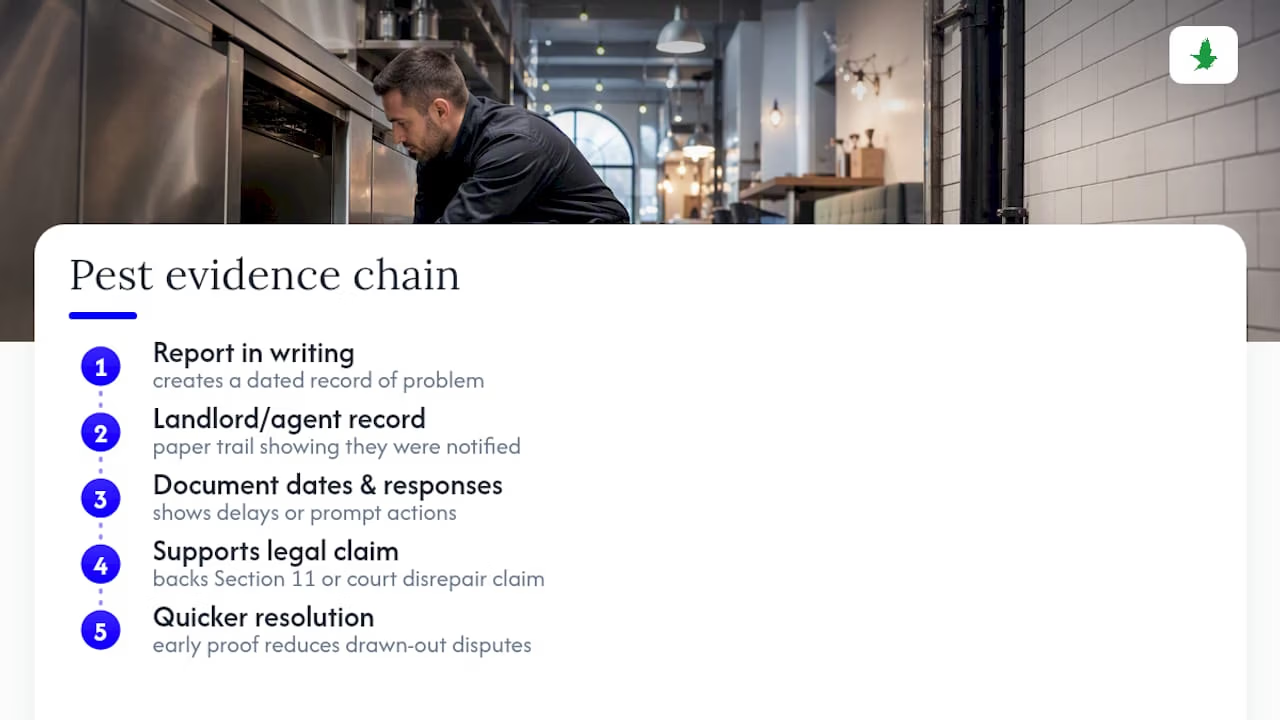
The bigger misconception, though, is that pest control is purely reactive. Landlords who treat a maintenance plan as an unnecessary expense usually end up paying more over time in emergency call-outs, damaged stock, or lost tenants, than those who build inspection and proofing into their annual costs. Tenants benefit from this too, since a proactive landlord rarely lets a minor mouse sighting turn into the kind of infestation that ends up in front of environmental health.
Working with London’s rented housing stock, we have seen both patterns play out repeatedly, and the difference between a quick resolution and a drawn-out dispute often traces back to how early and how clearly the problem was documented. If you manage or rent a property in London, our seasonal pest control checklist is a genuinely useful starting point, whichever side of the tenancy agreement you’re on.
Get professional pest control help in London
BioWise has been treating homes and businesses across London since 2010, working with more than 800 clients on everything from one-off emergency treatments to ongoing maintenance contracts. If you’re dealing with a severe, recurring, or structurally linked infestation, whether that’s rats getting in through an old airbrick or a flea problem that’s spread through soft furnishings, this is exactly the point where a professional survey saves you weeks of guesswork and repeat call-outs.

The company works directly with landlords, housing associations, and tenants across the capital, offering eco-conscious treatments and tailored maintenance plans rather than one-size-fits-all call-outs. If you need a proper inspection and a clear treatment plan, get a quote for domestic pest control and we’ll talk you through what’s actually going on before any treatment starts.
Where to check your rights and find local help
For the legal detail behind this guide, go straight to the source rather than a summary.
- Homes (Fitness for Human Habitation) Act 2018 guide and the full text of Section 11, Landlord and Tenant Act 1985
- Practical guidance from Citizens Advice on rented pest problems
- Find your local council to report infestations or request an environmental health inspection
This article is general information, not a substitute for advice from a qualified lawyer. Consult a qualified legal professional about your own circumstances before acting on anything here.
Sources
- Homes (Fitness for Human Habitation) Act 2018: guide for tenants
- Landlord and Tenant Act 1985, section 11
- If there are pests or vermin in your rented home
- Are tenants or landlords responsible for pest infestations?
FAQ
Is my landlord responsible for pest control in the UK?
Usually, yes, when the infestation links to the property’s condition, such as disrepair or structural gaps, under the Homes (Fitness for Human Habitation) Act 2018 and Section 11 of the Landlord and Tenant Act 1985. If the infestation results from tenant neglect instead, responsibility shifts to the tenant.
Can I refuse to pay rent if there is mould or pests in my UK rental?
No, withholding rent without legal advice is risky and can put your tenancy at risk, even where the landlord is clearly at fault. Pursue written notice, council involvement, and formal disrepair claims instead of stopping rent payments.
Is it the tenant’s responsibility to get rid of rats?
Only if the tenant’s own actions caused the infestation, such as leaving food waste accessible or failing to maintain basic hygiene, according to Total Landlord Insurance’s guidance on pest responsibility. Where rats enter through structural defects, that responsibility sits with the landlord.
How long does a landlord have to fix a rodent problem in the UK?
There’s no fixed statutory deadline for private landlords; what counts as reasonable depends on the severity of the risk and how quickly the landlord responds once notified. Social housing tenants have stronger protection through Awaab’s law, which sets emergency timeframes for hazards that pose an imminent risk to health.
What evidence should I keep if I report a pest problem?
Keep dated photographs, copies of every email or letter sent to your landlord, and notes on when you first noticed the problem. This record becomes essential if the dispute later reaches a council, court, or affects your deposit return.