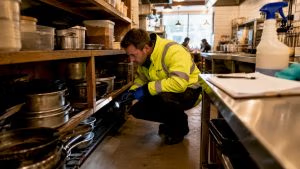
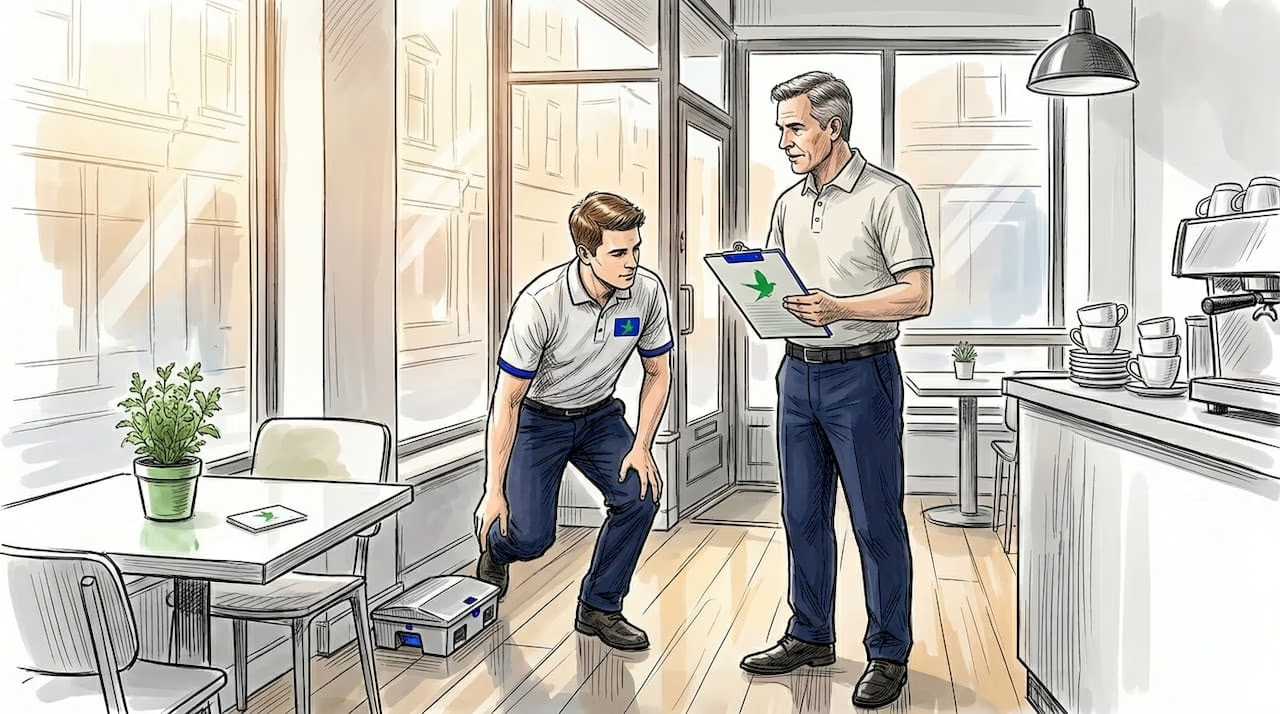

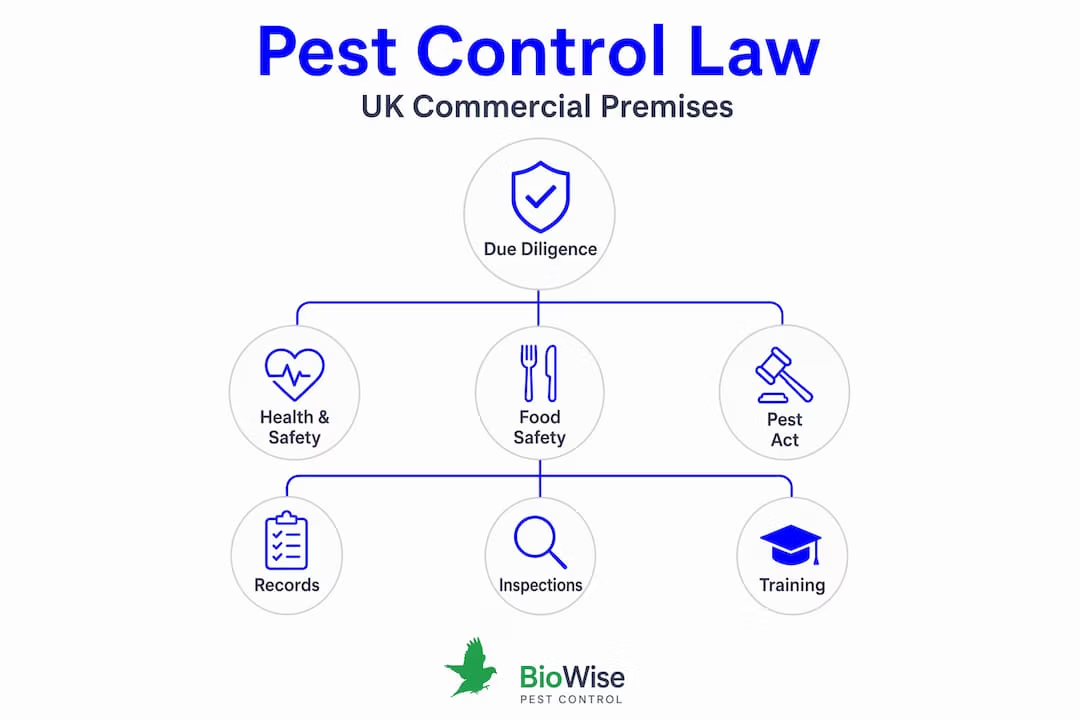
There is no single HSE pest control regulation, but UK law still requires commercial premises to be kept clean, safe and free from pests. Your duties come from the Health and Safety at Work etc. Act 1974, the Workplace Regulations 1992, COSHH 2002 and RIDDOR 2013, plus food safety law and the Prevention of Damage by Pests Act 1949, and you must be able to show that pests are under control.
This guide sets out what each law requires, what employers must actually do, what inspectors check (often a council environmental health officer rather than HSE), the penalties for getting it wrong and how documented commercial pest control demonstrates due diligence. BioWise has helped London businesses meet these duties since 2010, from office pest control and warehouse pest control to food businesses and healthcare sites.
Key takeaways
| Point | Details |
|---|---|
| Legal framework is layered | Several laws apply (HSWA 1974, the Workplace Regulations 1992, COSHH 2002, RIDDOR 2013, food law and the 1949 Pests Act), enforced by HSE or the local authority depending on the premises. |
| Records are your evidence | Written records of inspections, treatments and sightings are the clearest way to show due diligence, and food businesses need them as part of HACCP-based procedures. |
| Inspectors check the evidence trail | Inspectors (HSE or council officers) check the condition of the premises, your pest control arrangements and your records. |
| Non-compliance has serious consequences | Penalties range from improvement notices and fines to full business closure and lasting reputational damage. |
| Professional contracts demonstrate due diligence | No law requires a pest control contract, but a managed service gives you the paperwork and regular visits that inspectors expect to see. |
The legal framework governing pest control in the UK
Pest control in commercial premises is covered by several pieces of legislation, each placing distinct obligations on business owners and facilities managers. There is no specific “HSE pest control regulation”; the duties come from general health and safety law, food law and pest-specific law. Understanding how they fit together is the starting point for genuine compliance.
The Health and Safety at Work etc. Act 1974 places a general duty on employers to keep the workplace safe for employees and visitors. Pest infestations undermine that duty directly: rodents contaminate surfaces, insects can cause allergic reactions and some infestations damage the building itself. The Act is enforced by HSE or, for most offices, shops, restaurants, hotels and many warehouses, by the local authority’s environmental health team. Both have powers to inspect premises, issue improvement and prohibition notices and prosecute where standards are not met.
The Workplace (Health, Safety and Welfare) Regulations 1992 make the duty more specific. Regulation 9 requires workplaces, furniture and fittings to be kept sufficiently clean and waste not to accumulate except in suitable receptacles, and regulations 20 and 21 cover toilets and washing facilities (with guidance in the Approved Code of Practice L24). A rodent or cockroach problem in a staff kitchen, washroom or waste store is a breach waiting to happen; our guide Mice in the Office: What Employers Must Do covers the most common office case.
The Control of Substances Hazardous to Health Regulations 2002 (COSHH) apply to the pest control products used on your premises and to biological hazards such as rat urine. Products must be used according to a COSHH assessment, with safe storage and re-entry times; see our pest control COSHH regulations guide for the detail.
RIDDOR 2013 requires employers to report certain work-related diseases. Leptospirosis (Weil’s disease), which rats can carry, is reportable where it is linked to work, for example in staff who handle waste or work in drains and basements.
The Prevention of Damage by Pests Act 1949 is older but still in force. Section 3 requires occupiers (other than of agricultural land) to notify the local authority in writing if rats or mice are living on or resorting to their land in substantial numbers. Under section 4 the council can serve notice requiring treatment or structural work, carry out the work itself if the notice is ignored and recover the cost from the owner or occupier.
The Food Safety Act 1990 and Regulation (EC) No 852/2004 apply to any business handling, preparing or selling food: premises must be designed and maintained to keep pests out and there must be adequate procedures to control pests. Environmental health officers enforce this through the Food Safety and Hygiene (England) Regulations 2013, which provide for hygiene improvement notices, hygiene emergency prohibition notices and prosecution, independently of any health and safety action.
Products used for pest control in buildings, such as rodenticides and insecticides, are biocides. In Great Britain they must be authorised under the GB Biocidal Products Regulation, which HSE regulates, and used according to the label, which is legally binding. Since 1 January 2026, anyone buying professional-use rodenticides must show proof of competence under the UK Rodenticide Stewardship Regime.
Key statutory duties across these frameworks include:
- Maintaining premises in a condition that does not attract or harbour pests
- Notifying your local authority in writing if rats or mice are present in substantial numbers (1949 Act, section 3)
- Making sure any pest control product used on your premises is authorised, used according to its label and covered by a COSHH assessment
- Keeping food premises pest-proofed and food areas free from pest activity, which also feeds into your food hygiene rating
- Cooperating with HSE and local authority environmental health inspections
The legal requirements for commercial kitchens in particular are strict, and food businesses should treat this framework as a baseline, not a ceiling.
Employer duties under HSE pest control requirements
Knowing which laws apply is only the beginning. The practical question is what you are actually required to do, day to day, to meet those legal obligations across your commercial premises.
-
Conduct regular inspections and risk assessments. You cannot respond to a pest problem you have not identified. Regular walkthroughs of your premises, including storage areas, plant rooms, waste stores, and roof spaces, allow you to spot early signs of activity such as droppings, gnaw marks, or nesting material. A written risk assessment should record vulnerable points and the control measures in place.
-
Implement and maintain a pest control plan. A pest control plan sets out the frequency of treatments, the types of pests addressed, the products used, and the name of the operator carrying out the work. This document is the centrepiece of your compliance position and should be updated after every service visit.
- Use a competent pest control operator. No law says you must have a pest control contract, but using a qualified, insured operator (for example a BPCA member with certified technicians) is the simplest way to make sure products are used legally and safely. Only authorised active substances can be used in products marketed in Great Britain, and professional rodenticides can only be bought with proof of competence.
- Keep detailed treatment records. After each visit, your operator should provide a written report covering the findings, the products applied, the locations treated and any recommendations. This is particularly important in food premises, where pest control records form part of the HACCP-based procedures required by Regulation (EC) No 852/2004.
- Manage treatments carried out outside business hours. Many treatments happen outside operating hours, so you need a simple process to make sure re-entry times on the COSHH assessment are followed, products are stored correctly and the responsible manager is briefed before staff return. On multi-tenant buildings and estates, facilities management pest control brings this under one schedule and one set of reports.
Pro Tip: Designate a named member of staff as your pest control point of contact. Their role is to receive treatment reports, maintain the pest control file, log any sightings between visits, and liaise with your provider. This single step significantly strengthens your due diligence record.
Training staff to recognise signs of pest activity and report them promptly is another underrated duty. Your pest control file should show a consistent cycle of inspection, treatment, review and corrective action. It is often the first thing an inspector asks to see, and a gap in records makes it much harder to show that you took reasonable steps.
What HSE inspectors check on site visits
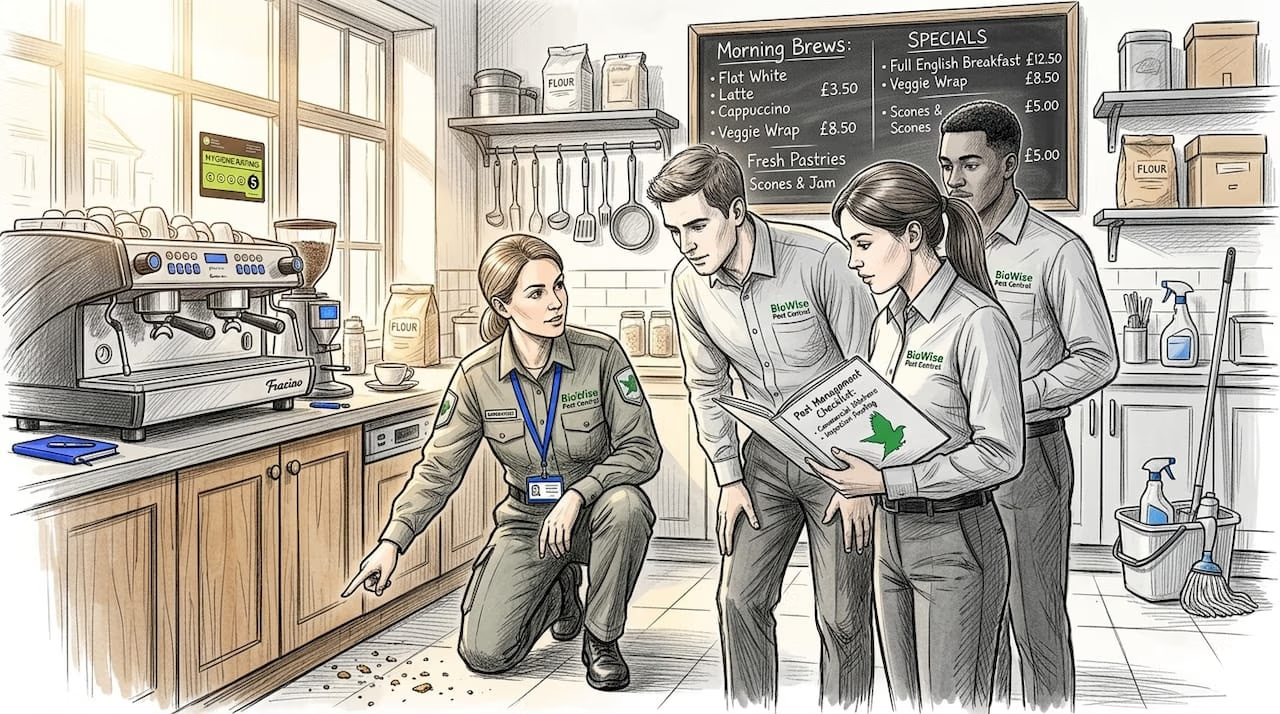
Pest control comes up in health and safety visits and, for food businesses, in food hygiene inspections. For most offices, shops, restaurants and hotels the inspector will be a local authority environmental health officer rather than HSE, and food hygiene inspections are usually unannounced. Whether a visit is routine or triggered by a complaint or incident, the approach follows a consistent pattern, so knowing what inspectors look for keeps you ready at all times.
Food hygiene inspections form part of the official controls described in the multi-annual national control plan for Great Britain, and health and safety visits can be proactive or reactive. The following areas are consistently checked:
- Physical condition of the premises. Inspectors will look for structural vulnerabilities such as gaps around pipes, damaged seals on doors, broken air bricks, or uncovered drains, any of which can allow pest ingress.
- Active signs of infestation. Droppings, smear marks, gnaw damage, nesting material, or live pest sightings will all be noted and can trigger immediate enforcement action.
- Pest control plan and service records. The inspector may ask to see your current pest control arrangements, your provider’s contact details and recent treatment records (keeping at least two years is good practice). Informal arrangements with no paperwork will raise concerns.
- Provider credentials. Your pest control operator should hold a recognised industry qualification, and the products they use must be authorised under GB biocides rules. Inspectors may ask to see this.
- Pesticide storage and usage compliance. If you store any pesticides on site, they must be stored appropriately, with correct labelling and access restrictions, and a record of use should be maintained.
- Staff awareness and reporting procedures. Inspectors may speak directly to staff to assess whether they know how to report pest sightings and who to contact.
Across our pest control compliance guide for London businesses, the consistent lesson is that businesses with a professional service contract and an up-to-date pest control file get through inspections with minimal disruption, while those relying on informal arrangements tend to run into problems.
Penalties and consequences of non-compliance
The consequences of failing to meet pest control compliance standards are not theoretical. Enforcement actions occur regularly, and the impact on a business can be severe and long-lasting.
Under the Health and Safety at Work etc. Act 1974, the enforcing authority (HSE or the local authority) can serve an improvement notice requiring remedial action within a set time, serve a prohibition notice stopping an activity where there is a risk of serious personal injury, or prosecute serious breaches. Fines on conviction can be unlimited, and the reputational damage can hit a business harder than the penalty itself.
For food businesses, environmental health officers can serve a hygiene improvement notice or, where there is an imminent risk to health, a hygiene emergency prohibition notice that closes the premises straight away, followed by an application to the magistrates’ court for an emergency prohibition order. The food hygiene rating can drop as low as zero, and ratings are published on the Food Standards Agency website. Serious offences can lead to prosecution, unlimited fines and imprisonment. The reputational consequences of a low public rating often outweigh the fine.
Inspectors know pests are part of life in London. What gets businesses into trouble is an infestation with no records showing that anyone noticed or acted. When a client’s file shows regular visits, logged sightings and quick follow-up, the conversation with the EHO is usually about improvements, not enforcement.
Matt Ochello, Sales Executive, BioWise
Beyond the legal penalties, consider the commercial impact. A restaurant closure during peak trading, a hotel inspection result reported in the press, or office floors closed while a rodent problem is cleared all carry costs that far exceed any savings made by cutting corners on pest control. Professional pest control partnerships reduce this risk substantially, because they generate the evidence trail that regulators expect to find.
How professional pest control demonstrates due diligence
There is a meaningful difference between having pest control done and being able to demonstrate that it was done correctly and consistently. The second requirement is what regulators actually assess.
Documented pest control plans and treatment records demonstrate due diligence and help businesses through inspections without enforcement action. A professional service contract with a competent operator delivers this systematically, rather than relying on individual staff members to keep records by hand.
The table below compares the compliance position of businesses using different approaches to pest control:
| Approach | Documentation produced | Inspector outcome |
|---|---|---|
| No formal arrangement | None | High risk of enforcement action |
| One-off treatments when needed | Partial, inconsistent | Likely to raise compliance concerns |
| Annual contract, quarterly visits | Basic records, possible gaps | Marginal, may pass depending on sector |
| Monthly managed service contract | Full treatment reports, ongoing monitoring logs, sighting records | Strong compliance position |
BioWise provides commercial clients across London with a fully documented service: monthly visits with photo reports, digital service reports for your EHO and audit files, and records kept audit-ready between visits. Our BPCA-certified technicians use only authorised products, applied according to the label and COSHH assessments.
Pro Tip: When reviewing a potential pest control provider, ask specifically for a sample treatment report and a sample pest control plan. If the documentation is vague or generic, the compliance value will be limited. A strong provider produces reports specific to your premises, your pests, and the products used.
A maintenance plan built around regular scheduled visits is far more effective than reactive treatment at both preventing infestations and building a defensible compliance record; our comparison of one-off pest control vs monthly contracts sets out the trade-offs. The frequency of visits should reflect the type of premises, the sector and the level of risk found in the initial survey; there is no legal minimum.
Our honest take on where businesses go wrong
The pattern we see most often across London commercial premises is this: a business invests in pest control after a problem occurs, spends considerably more than a prevention programme would have cost, and then relaxes once the immediate issue is resolved. The compliance file falls out of date, the contract lapses, and a year or so later they are in the same position again.
The deeper misunderstanding is about what documentation is for. Many business owners treat treatment reports as paperwork to be filed and forgotten. In reality, those records are your main evidence of due diligence. If an inspector finds signs of past or present pest activity, your documented response has a big influence on whether you receive advice or formal enforcement.
The businesses that fare best during inspections are rarely the ones with no pest history. They are the ones whose records show consistent monitoring, prompt responses to sightings and an ongoing relationship with a qualified operator. Inspectors understand that pests are an urban reality in London. What they do not accept is indifference or inaction.
Our advice is straightforward. Treat pest control as a compliance function, not a maintenance task. Use a competent operator, keep the file current and review your risk assessment at least once a year. The cost of getting this right is modest compared with the cost of getting it wrong.
Treatment reports only help if you can find them on the day. We send every report digitally so the file is complete when an inspector or auditor asks, and the gaps we see most are missing sighting logs between visits, not missing visits.
Monty Gordon, Marketing and Technology, BioWise
How BioWise can help with pest control compliance

BioWise is a family-run London company that has supported commercial premises since 2010, and we now work with more than 800 commercial clients. We are BPCA and NPTA members, CHAS accredited and SafeContractor approved, and our BPCA-certified technicians use only authorised products.
Every commercial pest control contract starts with a free site survey and a tailored plan, then monthly visits with photo reports, digital service reports for your EHO and audit files, emergency call-outs and unlimited minor pest proofing. We work across offices, warehouses and food businesses, and our healthcare pest control service covers clinical settings, with visits planned around your operating hours and unmarked vehicles on request. If you need help between visits, we offer same-day call-outs across London, with technicians covering central London, north London, east London, south London and west London, plus a 24/7 emergency pest control line.
Whether you need a monthly service contract or an initial compliance survey, contact us or call 0800 988 3568.
BioWise Pest Control Maintenance
13 Hanover Square, London, W1S 1HN
Call 0800 988 3568 or email info@biowiseservices.com
FAQ
What are the HSE requirements for pest control?
There is no single HSE pest control regulation. Employers must keep workplaces safe and clean under the Health and Safety at Work etc. Act 1974 and the Workplace (Health, Safety and Welfare) Regulations 1992, assess pest control products and biological hazards under COSHH 2002, and report certain work-related diseases, such as leptospirosis, under RIDDOR 2013. Food and pest-specific laws add further duties.
Is pest control a legal requirement for businesses?
Controlling pests is. Food businesses must keep premises pest-proofed and have adequate pest control procedures, employers must keep workplaces clean and safe, and occupiers must tell the council about substantial rat or mouse problems under the Prevention of Damage by Pests Act 1949. No law requires a pest control contract or BPCA membership, but a contract is the simplest way to show due diligence.
What does an HSE inspector check for regarding pests?
Inspectors (HSE, or for most offices, shops and food businesses a local authority officer) look at the physical condition of the premises and signs of infestation, review your pest control arrangements and treatment records, check your operator’s credentials and look at how pest control products are stored and used. Businesses with no documented arrangements are at the greatest risk.
What happens if HSE finds a pest infestation on my premises?
The inspector can give advice, serve an improvement notice requiring action by a deadline, serve a prohibition notice where there is a risk of serious injury, or prosecute. For food businesses, environmental health officers can serve hygiene improvement notices or, where there is an imminent risk to health, a hygiene emergency prohibition notice closing the premises, and the published food hygiene rating can fall.
How often should commercial premises have pest control visits?
There is no legal minimum. Frequency should depend on the premises type, sector and risk found in an initial survey. High-risk environments such as food businesses and hospitality venues typically have monthly visits, while some lower-risk premises such as offices may need fewer routine visits, provided there is monitoring and a fast emergency response in between.