

TL;DR:
- A pest control service agreement defines technician qualifications, response standards, and documentation needs for effective pest management. Clear SLAs specify responsibilities, response times, and reporting practices to ensure enforceability and compliance. Clarity in the contract helps prevent operational disruptions and liability disputes during inspections or audits.
A pest control service level agreement (SLA) is the formal contract that defines the exact duties, response expectations, technician qualifications, and documentation standards required for effective commercial pest management. Without a well-drafted SLA, facilities managers and property professionals have no enforceable basis for holding a contractor accountable. A vague contract is not merely inconvenient. It is a compliance risk. Regulatory bodies including the British Pest Control Association (BPCA) and the National Pest Technicians Association (NPTA) set the professional benchmarks that a sound pest control SLA must reflect. Biowise Pest Control Maintenance Services uses these standards as the baseline for every commercial contract it issues.
What essential elements must a pest control SLA include?
A compliant UK commercial pest control SLA must specify the provider’s registration, the precise scope of service, visit frequency, and mandatory written reports after every visit. Essential documentation includes trend analysis, trap maps, and annual treatment certificates required for official audits and licensing. Each of these elements serves a distinct protective function for the facilities manager.
The core components every SLA must contain are:
- Provider registration and qualifications. The contract must name the contractor’s BPCA membership status and confirm that operatives hold a minimum RSPH Level 2 Award in Pest Control. UK best practice also requires public liability insurance of at least £5 million, rising to £10 million for high-risk contracts.
- Exact pest species and methods covered. The SLA must list every target species by name, such as rats, mice, cockroaches, or bed bugs, and specify the treatment methods permitted. Generic wording like “rodent control” is insufficient.
- Service visit frequency. Visit cadence must align with the site’s risk profile. A food production facility carries a different risk level than a serviced office, and the contract must reflect that difference explicitly.
- Documentation standards. Every visit must generate a written or digital report. The SLA must specify that COSHH data sheets, risk assessments, and treatment records are provided and retained.
- Access and confidentiality provisions. The contract must define who grants site access, under what conditions, and how sensitive operational data is handled.
- Emergency response protocols. The SLA must state the maximum response time for emergency callouts and the procedure for escalating urgent infestations.
Pro Tip: Request a sample visit report from any prospective contractor before signing. If the report template lacks fields for trap locations, chemical batch numbers, and corrective recommendations, the contractor’s documentation standards will not meet audit requirements.
How to structure response times and visit schedules in the SLA
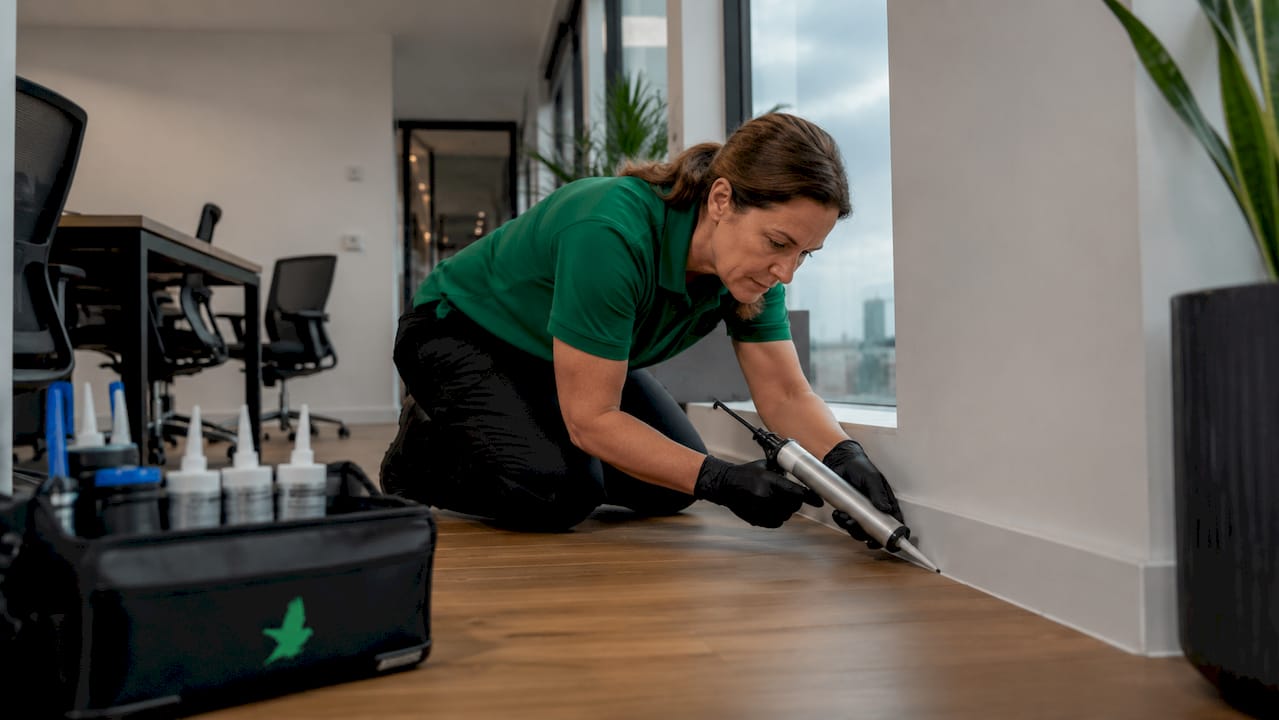
Response time commitments are the most frequently disputed element of any pest management contract. Effective SLAs must include explicit performance metrics such as a 24-hour response time for emergencies, defined resolution expectations, and penalties such as service credits for missed obligations. That benchmark exists because pest activity in food-handling or healthcare environments can trigger regulatory closure within hours of discovery.
A well-structured SLA separates response obligations into three tiers:
- Emergency callouts. The contract must state a maximum response time, typically 24 hours, for confirmed active infestations or pest sightings in critical risk zones such as kitchens, food stores, or patient areas.
- Routine service visits. Frequency depends on sector risk. High-risk sites such as restaurants and hotels typically require monthly visits. Lower-risk commercial offices may operate on a quarterly schedule. The SLA must state the exact number of visits per year and the permitted scheduling window.
- Advisory and monitoring visits. Some contracts include interim monitoring visits between treatments. The SLA must define whether these are included in the base fee or charged separately.
- Escalation thresholds. The contract must specify the pest activity level that triggers an unscheduled visit or a change in treatment method. Setting detailed action thresholds avoids unnecessary treatments while ensuring prompt responses for critical risk zones.
- Penalty clauses. The SLA must define the financial or service remedy applied when the contractor misses a scheduled visit or breaches a response time commitment. Without this clause, the agreement is unenforceable in practice.
The visit schedule should be attached as a signed appendix to the main contract, not embedded in general terms. This makes it easier to audit and easier to enforce.
What qualifications must pest control technicians meet in the SLA?
Technician qualifications are non-negotiable in any credible pest management contract. The SLA must name the minimum certification required for every operative attending the site, not just the company’s lead technician.
The qualification requirements a facilities manager should demand are:
- RSPH Level 2 Award in Pest Control as the minimum operative standard for all technicians.
- BPCA membership for the contracting company, which confirms adherence to a professional code of conduct and access to ongoing technical guidance.
- BS EN 16636 compliance. The NPTA recommends auditing contractors against BS EN 16636, the European standard for Pest Management Services, which provides objective assurance of operational and ethical standards above basic membership status. Accreditation under this standard signals a contractor that has been independently assessed, not merely self-declared.
- COSHH training. Every operative must hold documented competence in the Control of Substances Hazardous to Health regulations. The SLA must require proof of this training on request.
- Continual professional development. The contract must state that technicians complete annual training updates and that the contractor notifies the client of any change in operative qualifications.
The SLA must also include a verification mechanism. This means the contractor agrees to provide copies of operative certificates within a defined timeframe, typically five working days, upon written request.
Pro Tip: Ask for the operative’s individual BPCA membership number, not just the company’s. Individual registration confirms the technician has passed the relevant assessments, not just that their employer is a member.
How to incorporate documentation, reporting, and review processes
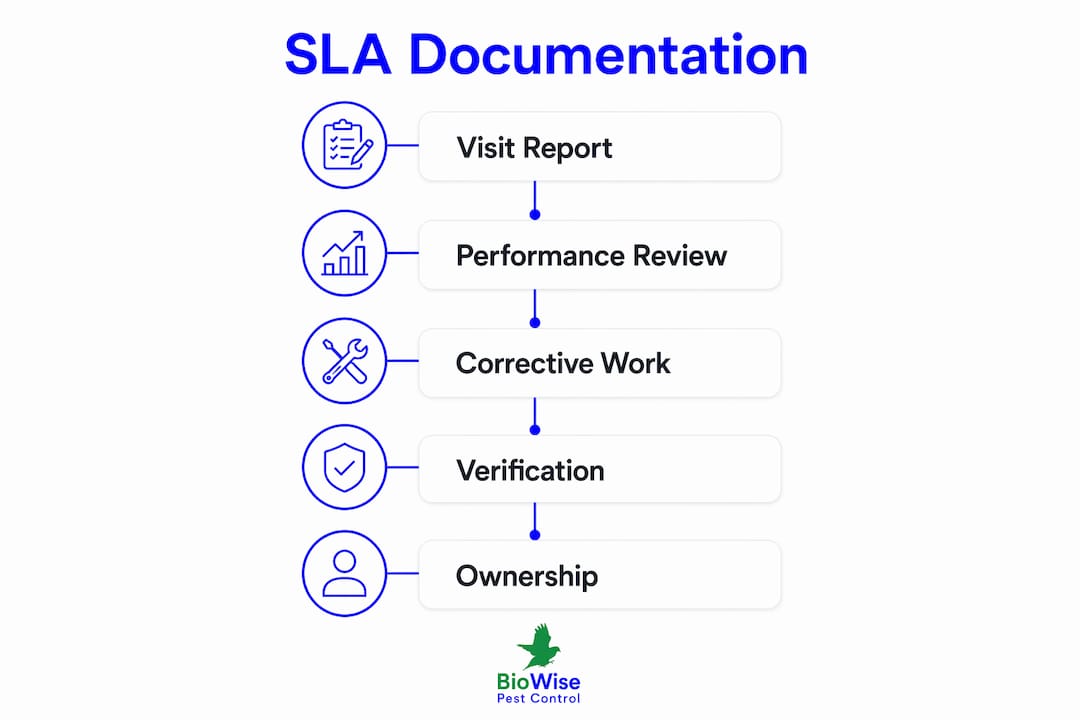
Documentation is the evidence base that protects a facilities manager during a local authority inspection, a food hygiene audit, or a legal dispute. The SLA must define reporting obligations with the same precision as service obligations.
| Documentation type | Minimum SLA requirement |
|---|---|
| Visit report | Issued within 24 hours of each service visit, in writing or digital format |
| Trap map | Updated after every visit, showing bait station and trap locations |
| Photographic evidence | Required for all active infestations and corrective recommendations |
| COSHH data sheets | Provided for every chemical product used on site |
| Annual treatment certificate | Issued at contract year-end for audit and licensing purposes |
| Corrective action plan | Required within 48 hours of any critical pest finding |
Beyond individual visit records, the SLA must include a scheduled contract performance review. This is typically a quarterly or annual meeting at which both parties assess KPI performance, review trend data, and agree any changes to the service scope. Shared accountability and clear escalation protocols minimise pest-related operational risks. A contract with no review mechanism drifts. Pest pressure changes with seasons, building use, and neighbouring activity, and the service must adapt accordingly.
The SLA should also specify who owns corrective work. If a technician identifies a structural gap that is enabling rodent entry, the contract must state whether proofing work is included, quoted separately, or the client’s responsibility. Leaving this undefined is one of the most common sources of dispute in commercial pest contracts.
What are the common red flags in pest control SLAs?
A weak SLA creates more risk than no SLA at all, because it gives a false sense of protection. Facilities managers should reject any contract that contains the following weaknesses:
- Vague scope wording. Phrases like “general pest control” or “rodent management as required” are unenforceable. The contract must name species, methods, and locations.
- No defined response times. A contract that states the contractor will respond “as soon as reasonably practicable” provides no accountability. Specific hour commitments are required.
- Absent penalty clauses. Without a service credit or remedy clause, a contractor faces no consequence for missing visits or breaching response times. The SLA must state the remedy explicitly.
- Ambiguous client responsibilities. Commercial contracts must define customer responsibilities clearly to allocate risks for recurring infestations, particularly regarding hygiene, structural conditions, and site access. Failure to do so allows contractors to refuse liability for re-infestations caused by conditions the client controls.
- Unrealistic treatment guarantees. A guarantee of “complete eradication” without conditions is a red flag. Legitimate guarantees are conditional on the client maintaining agreed hygiene and structural standards.
- Unclear cancellation terms. Cancellation and refund policies must clearly state terms for deposits, missed appointments, and call-out fees. Transparent cancellation terms reduce disputes and reflect the practical realities of commercial pest operations.
“Pest control contracts are primarily risk management tools. Defining corrective work ownership, such as responsibility for structural repairs, is the single most important clause for preventing recurring infestations. Without it, both parties assume the other will act, and neither does.”
Key takeaways
A pest control SLA is only as effective as the specificity of its terms. Every clause must assign a named obligation, a measurable standard, and a defined consequence for non-performance.
| Point | Details |
|---|---|
| Define scope precisely | Name every target species, treatment method, and site location covered by the contract. |
| Set tiered response times | Specify 24-hour emergency response, routine visit frequency, and escalation thresholds in writing. |
| Demand verified qualifications | Require RSPH Level 2, BPCA membership, and BS EN 16636 compliance for all operatives. |
| Mandate structured reporting | Require visit reports, trap maps, COSHH sheets, and annual certificates as contractual obligations. |
| Clarify client responsibilities | Define hygiene, access, and structural repair duties to prevent disputed liability for re-infestations. |
Why SLA clarity matters more than most facilities managers realise
I have reviewed a significant number of pest control contracts on behalf of multi-site facilities operations, and the pattern is consistent. The contracts that cause the most operational disruption are not the ones with the worst pest problems. They are the ones with the weakest paperwork.
A facilities manager managing a portfolio of commercial properties in London cannot afford ambiguity. When a food safety inspector arrives unannounced and asks for the last three pest control visit reports, a verbal assurance from a contractor is worthless. The SLA is the document that either protects you or exposes you.
What I find most underestimated is the client obligations clause. Facilities managers often focus entirely on what the contractor must do and overlook what the contract requires of them. If your SLA states that the contractor is not liable for re-infestation where structural defects exist, and you have not actioned a proofing recommendation from six months ago, you carry that risk entirely. Understanding your responsibilities as a facilities manager is as important as understanding the contractor’s obligations.
The best SLAs I have seen treat the contract as a living document, reviewed annually, updated when site conditions change, and signed by both parties each time. That discipline alone separates professional pest risk management from reactive firefighting.
— Ana Hasula
Biowise Pest Control Maintenance Services: SLA-backed contracts for London facilities
Biowise Pest Control Maintenance Services has delivered facilities management pest control across London since 2010, serving over 600 commercial clients with contracts built on the standards described in this guide. Every Biowise contract specifies technician qualifications, visit schedules, emergency response commitments, and full documentation obligations from the outset.

For facilities managers and property professionals who need a contract that holds up under audit, Biowise Pest Control Maintenance Services provides transparent, SLA-backed pest control with BPCA-aligned technicians and same-day emergency response across London. Whether you manage a single commercial building or a multi-site portfolio, Biowise structures service levels to match your risk profile precisely. Contact Biowise Pest Control Maintenance Services to request a contract review or a tailored quote.
FAQ
What should a pest control SLA include?
A pest control SLA must include the provider’s qualifications, a precise list of target pest species and treatment methods, visit frequency, emergency response times, documentation obligations such as visit reports and COSHH sheets, client responsibilities, and penalty clauses for non-performance.
How often should a commercial pest control contract include visits?
Visit frequency depends on the site’s risk profile. High-risk environments such as food businesses and hotels typically require monthly visits, while lower-risk commercial offices may be scheduled quarterly. The SLA must state the exact number of visits per year.
What qualifications should a pest control technician hold?
Technicians must hold a minimum RSPH Level 2 Award in Pest Control, and the contracting company should hold BPCA membership. Facilities managers should also require compliance with BS EN 16636, the European standard for Pest Management Services, as independently verified accreditation.
What happens if a pest control contractor misses a scheduled visit?
The SLA must include a penalty clause specifying the remedy, such as a service credit or a rescheduled visit within a defined timeframe. Without this clause, a missed visit carries no contractual consequence and the agreement becomes unenforceable in practice.
Who is responsible for structural pest-proofing under a pest control SLA?
The SLA must define this explicitly. Contractors identify entry points and recommend proofing work, but responsibility for carrying out structural repairs typically rests with the client. Leaving this undefined is a common source of disputed liability for recurring infestations.