

TL;DR:
- London businesses must manage hazardous substances in pest control to ensure worker safety and regulatory compliance. Proper documentation, including risk assessments and service records, must be maintained for at least two years, and compliance depends on qualified contractors with current certifications. Failing to meet COSHH requirements risks health hazards, legal consequences, and invalidates food safety systems like HACCP.
The Control of Substances Hazardous to Health Regulations 2002, universally known as COSHH, legally require every London business to manage hazardous substances used in pest control operations to protect worker health and maintain regulatory compliance. This obligation extends beyond the pest control contractor to the business itself. Whether you manage a restaurant in Soho, a hotel in Kensington, or a warehouse in Stratford, pest control COSHH regulations for London businesses apply to you directly. Biowise Pest Control Maintenance Services works with over 600 London clients, providing fully COSHH-compliant treatments, documented risk assessments, and trained technicians who understand exactly what these regulations demand.
What do COSHH regulations mean for pest control in London?
COSHH is defined as the legal framework that controls how businesses identify, assess, and manage hazardous substances in the workplace. In a pest control context, this covers pesticides, rodenticides, biocides, insecticides, and fumigants applied on your premises, as well as the biological hazards that pest activity itself creates.
The substances most commonly used in commercial pest treatments fall into several categories:
- Pesticides and insecticides: Products containing active ingredients such as cypermethrin or deltamethrin, which require specific ventilation controls and re-entry intervals after application.
- Rodenticides: Second-generation anticoagulant rodenticides (SGARs) such as brodifacoum and bromadiolone, subject to tightened rodenticide certification requirements effective January 2025 and 2026 under CRRU UK rules.
- Biocides: Disinfectants and surface treatments used alongside pest management to reduce contamination risk.
- Biological hazards: Rodent urine, droppings, and insect debris are classified as hazardous substances under COSHH and require formal assessment alongside chemical products. This broadens the compliance scope considerably for any business dealing with an active infestation.
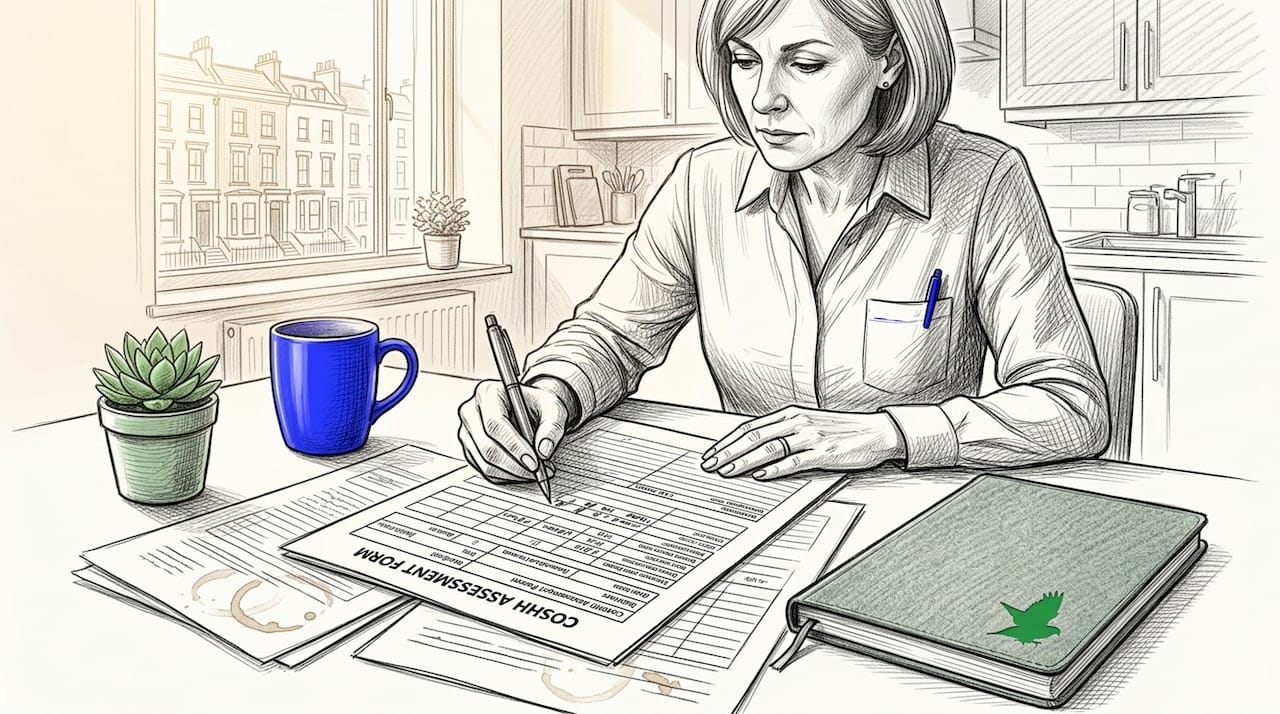
A COSHH assessment for pest control must cover risk identification, exposure controls, PPE requirements, ventilation, application methods, re-entry intervals, and storage and disposal procedures. The assessment must reference the product’s safety data sheet and reflect the actual conditions on your site. Employer duties under COSHH include commissioning these assessments, providing appropriate PPE, training staff who may be exposed, and keeping records of all treatments carried out.
Pro Tip: Using COSHH templates and tools designed specifically for pest control can significantly reduce the administrative burden of maintaining up-to-date risk assessments, PPE guidance, and emergency procedures across multiple sites.
What COSHH documents must London businesses keep?
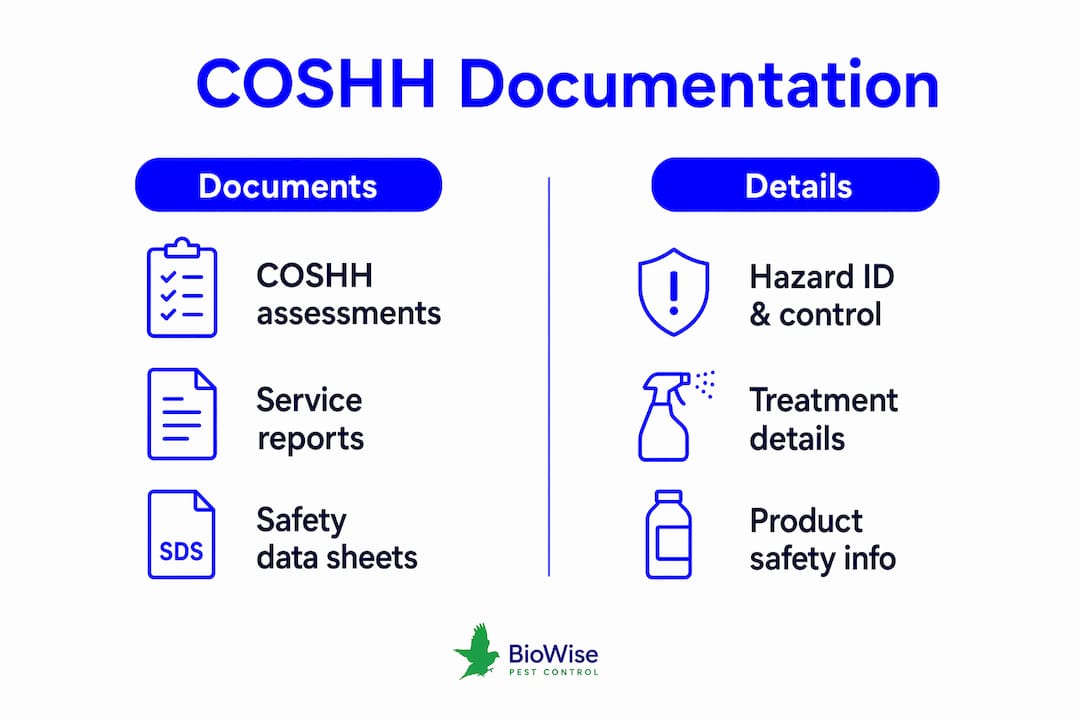
COSHH compliance pest control is not just about what happens during a treatment visit. It is equally about what you can produce when an Environmental Health Officer or food safety auditor asks to see your records. London businesses must retain pest control COSHH assessments, service reports, and corrective action logs for a minimum of two years to satisfy regulatory audits.
The table below summarises the core documents, their content, retention periods, and who holds responsibility for them.
| Document | Content | Retention period | Responsibility |
|---|---|---|---|
| COSHH assessment | Hazard identification, exposure controls, PPE, SDS reference | 2 years minimum | Pest contractor, copy held by business |
| Service report | Date, technician, products used, quantities, areas treated | 2 years minimum | Pest contractor provides; business retains |
| Pest activity log | Bait station checks, sightings, trap results | 2 years minimum | Pest contractor and business |
| Corrective action log | Actions taken following pest activity or treatment failure | 2 years minimum | Business with contractor input |
| Site map | Location of bait points, traps, monitoring devices | Current version always maintained | Pest contractor updates; business holds copy |
| Pest control contract | Scope of service, chemical products, visit frequency | Contract duration plus 2 years | Both parties |
| Staff training records | COSHH awareness, notification of treatments | 2 years minimum | Business |
Your pest control contractor should provide service reports after every visit, detailing the products applied, the quantities used, and the specific areas treated. These reports form part of your pest control compliance documentation and cannot be reconstructed after the fact if they are not issued promptly. Staff notification records are equally important. If a treatment requires a re-entry interval or specific ventilation before employees return to an area, that communication must be documented.
Safety data sheets for every product used on your premises must be held on site or be immediately accessible. These are not the contractor’s documents alone. As the business owner or manager, you are responsible for knowing what substances are present in your workplace.
What are the risks of using a non-COSHH compliant pest contractor?
Non-compliance with COSHH regulations in pest control can lead to health risks, legal prosecution, and reputational damage that no London business can afford to ignore. The risks fall into three distinct categories.
Health risks are the most immediate concern:
- Chemical exposure from incorrectly applied pesticides can cause contact dermatitis, respiratory irritation, and in severe cases, acute toxicity.
- Biological hazard exposure from rodent droppings or urine, if not properly assessed and controlled, can transmit Weil’s disease (leptospirosis) and hantavirus.
- Staff working in areas treated without proper re-entry intervals face disproportionate exposure to active chemical residues.
Legal and regulatory risks are equally serious:
- Environmental Health Officers have enforcement powers under both COSHH and the Food Safety Act 1990, including the authority to issue improvement notices, impose fines, and pursue prosecution.
- A business that cannot produce valid COSHH assessments or treatment records during an inspection has no defence, regardless of whether the contractor was at fault.
- Under the Management of Health and Safety at Work Regulations 1999, the duty to manage hazardous substances sits with the employer, not the contractor.
Business and operational risks compound the above:
- Failed food safety audits caused by missing pest control documentation can invalidate your HACCP system entirely.
- Reputational damage from a pest-related enforcement action or public health incident is difficult to recover from in competitive London markets.
- Insurance claims related to pest damage or chemical exposure incidents may be rejected if COSHH compliance cannot be demonstrated.
To verify contractor compliance, request copies of their current COSHH assessments for the products they intend to use, evidence of technician training and certification, and examples of the service reports they provide after each visit. Membership of the British Pest Control Association (BPCA) or the National Pest Technicians Association (NPTA) provides an additional layer of assurance.
Pro Tip: Ask any prospective pest contractor to show you a completed COSHH assessment for a rodenticide product before you sign a contract. A contractor who cannot produce one promptly is unlikely to maintain the documentation standards your business requires.
How does pest control COSHH compliance fit within food safety and HACCP?
Pest control is a mandatory prerequisite programme within HACCP. Without valid pest control documentation, the entire HACCP system may be considered invalid during an Environmental Health Officer inspection. This is a fact that surprises many food business operators who treat pest control as a separate operational matter rather than a core component of food safety management.
The Food Hygiene (England) Regulations 2006, which implement EC Regulation 852/2004, require food businesses to operate documented HACCP-based food safety management systems. Pest control sits within this as a prerequisite programme (PRP), meaning it must be managed, monitored, and documented before HACCP critical control points can function reliably. Here is a practical workflow for maintaining compliance and audit readiness:
- Appoint a named responsible person within your business who holds the pest control file, liaises with the contractor, and receives service reports after every visit.
- Schedule regular monitoring visits at a frequency appropriate to your risk level. A central London restaurant will typically require monthly visits as a minimum; higher-risk sites may need fortnightly attendance.
- Record all pest activity between contractor visits, including sightings, droppings, or damage. These records feed directly into the corrective action log and demonstrate active monitoring.
- Communicate treatment schedules to staff in advance, documenting who was notified, when, and what re-entry requirements apply. This satisfies both COSHH staff notification duties and general health and safety obligations.
- Review your COSHH assessments annually or whenever a new product or method is introduced. Annual review of COSHH assessments and treatment records is best practice endorsed by pest control professionals to maintain continuous compliance.
- Integrate pest control records into your HACCP file so that auditors can review them as part of a single coherent food safety management system rather than as a separate folder.
For London food businesses, this integration is not optional. Restaurants, hotels, and food manufacturers that treat pest control as a standalone service rather than a documented safety system consistently perform worse in Environmental Health inspections. Reviewing your food business compliance guide alongside your pest control programme is a practical starting point for getting this right.
Key takeaways
COSHH compliance in pest control requires London businesses to maintain documented risk assessments, treatment records, and staff training logs, and to use only qualified contractors who can evidence their compliance at every visit.
| Point | Details |
|---|---|
| COSHH scope in pest control | Covers both chemical products and biological hazards such as rodent droppings and urine. |
| Document retention | Service reports, pest logs, and COSHH assessments must be kept for a minimum of two years. |
| HACCP dependency | Missing pest control documentation can invalidate an entire HACCP food safety system during inspection. |
| Contractor verification | Request COSHH assessments, training records, and BPCA or NPTA membership before signing any contract. |
| Regulatory updates | CRRU UK rodenticide certification rules effective 2025 and 2026 require contractors to hold current qualifications for SGAR use. |
Why COSHH compliance in pest control is more demanding than most businesses realise
Having worked closely with London businesses across hospitality, retail, and property management, I have seen a consistent pattern: most operators assume that hiring a pest control contractor transfers all COSHH responsibility to that contractor. It does not. The duty to manage hazardous substances in your workplace remains with you as the employer, and that distinction catches businesses out during inspections more often than any other compliance gap.
The second misunderstanding I encounter regularly is the belief that a COSHH assessment is a one-time document. In practice, it must reflect the actual products being used on your specific site, and it must be updated whenever those products change or when new rodenticide certification requirements come into force. The 2025 and 2026 CRRU UK changes to SGAR regulations are a good example. Businesses whose contractors had not updated their assessments to reflect the new certification requirements were technically non-compliant from January 2025, even if their contractor held the correct certification.
The businesses that handle this best are those that treat pest control documentation as a live system rather than a filing exercise. They review records quarterly, ask their contractor direct questions about product changes, and keep their HACCP file current. That level of engagement is not excessive. It is simply what the regulations require, and it is what protects your business when an Environmental Health Officer arrives unannounced.
— Ana Hasula
How Biowise Pest Control Maintenance Services supports your COSHH compliance
Biowise Pest Control Maintenance Services has delivered COSHH-compliant pest management to London businesses since 2010, with technicians trained to complete site-specific COSHH assessments that incorporate current rodenticide certification requirements and biological hazard considerations. Every service visit generates a detailed treatment report covering products used, quantities applied, areas treated, and re-entry requirements, giving you the documentation your business needs for regulatory audits.

Whether you operate a single restaurant or manage a portfolio of commercial properties, Biowise Pest Control Maintenance Services tailors its commercial pest control contracts to your risk level and sector. For businesses seeking a reliable, fully documented pest management service, our London commercial pest control team is ready to carry out a site assessment and provide a written COSHH-compliant proposal. Contact Biowise Pest Control Maintenance Services today to discuss your requirements.
FAQ
Do pest control chemicals fall under COSHH?
Yes. All pesticides, rodenticides, and biocides used in pest control are classified as hazardous substances under the Control of Substances Hazardous to Health Regulations 2002, requiring formal risk assessment before use. Biological hazards such as rodent droppings and urine are also covered under COSHH scope.
What COSHH records should a pest contractor provide?
A compliant pest contractor must provide a COSHH assessment for each product used, a service report after every visit detailing products, quantities, and areas treated, and a current site map showing bait point and trap locations. These records must be retained by your business for a minimum of two years.
How do I check my pest contractor is COSHH compliant?
Request copies of their COSHH assessments for the products they use, evidence of technician training and certification, and confirmation of BPCA or NPTA membership. A contractor who cannot produce current documentation for second-generation anticoagulant rodenticides is not compliant with the 2025 CRRU UK certification requirements.
Does pest control documentation affect my HACCP system?
Pest control is a mandatory prerequisite programme within HACCP, and missing or incomplete pest control records can render your entire food safety management system invalid during an Environmental Health Officer inspection under the Food Hygiene (England) Regulations 2006.
How often should COSHH assessments for pest control be reviewed?
COSHH assessments should be reviewed annually as a minimum and updated immediately whenever a new product or method is introduced, or when regulatory changes affect the products in use. The 2025 and 2026 CRRU UK rodenticide rule changes are a recent example of why annual review is not sufficient on its own.