

TL;DR:
- Pest control in London schools requires documented IPM programs, certified contractors, and treatments scheduled outside school hours.
Pest control for schools in London is governed by a statutory framework that includes Ofsted inspection standards, local authority hygiene requirements, and UK pesticide legislation. Failure to meet these obligations puts pupils at risk and exposes school leadership to regulatory sanction. Integrated Pest Management (IPM) is the recognised best-practice approach, and specialist contractors such as Biowise Pest Control Maintenance Services provide the certified expertise schools need to stay compliant. This guide sets out exactly what London school administrators and facility managers must know to meet every requirement.
What are the key compliance standards for pest control in London schools?
Pest control compliance in London schools is defined by overlapping legal and regulatory obligations, not simply by whether a pest has been treated. The UK Pesticides National Action Plan 2025 requires professional users to take all reasonable precautions to protect human health and the environment. For schools, this means compliance extends well beyond calling a contractor. It means implementing safe systems, maintaining training records, and producing verifiable documentation.
Ofsted and local authority standards require schools to maintain pest-free environments with documented control methods in place. An inspector who finds evidence of infestation without corresponding treatment records, risk assessments, or contractor credentials will treat this as a safeguarding failure. That is a serious outcome for any school.
The core legal obligations every London school must meet include:
- COSHH records: Control of Substances Hazardous to Health regulations require written records of every pesticide application, including the product used, concentration, area treated, and date.
- Treatment timing: Pesticide applications must be scheduled outside school hours to prevent pupil and staff exposure.
- Safe re-entry periods: Schools must observe the manufacturer-specified re-entry interval before allowing occupants back into treated areas.
- Contractor certification: Any operative applying rodenticides must hold the RSPH Level 2 Award in Safe Use of Rodenticides, which demonstrates compliance with the UK Rodenticide Stewardship Regime.
- Written IPM plan: Schools must maintain a documented pest management plan with designated roles, monitoring schedules, and escalation thresholds.
Pro Tip: Request a copy of your contractor’s RSPH Level 2 Award certificate before signing any contract. This single document confirms they are legally authorised to apply rodenticides and that your school is protected from liability.
How does integrated pest management work in school settings?
Integrated Pest Management is the recommended approach for schools because it prioritises prevention and child safety over reactive chemical treatment. IPM is defined as a structured programme that removes pest survival factors, applies scheduled monitoring, and uses pesticides only when monitoring confirms a threshold has been crossed. This approach satisfies both regulatory expectations and the safeguarding duty of care schools owe to pupils.
IPM works in school settings through a clear sequence of steps:
- Site survey and risk mapping. A qualified operative assesses entry points, food storage areas, waste management practices, and drainage to identify conditions that attract pests.
- Removal of survival factors. Structural gaps are sealed, waste storage is improved, and food handling protocols are reviewed. These measures reduce pest pressure without any chemical intervention.
- Scheduled monitoring. Regular inspections, typically monthly, use bait stations, glue boards, and visual checks to detect activity early. Monthly inspection routines generate the documented evidence Ofsted expects to see.
- Threshold-based treatment. Pesticides are applied only when monitoring confirms activity above an agreed threshold. This limits chemical exposure in the school environment.
- Review and reporting. Each visit produces a written report that feeds into the school’s compliance records.
“IPM provides a strong balance between ensuring child safety in schools and proactive, effective pest management.” — Healthy School Buildings 2026
The practical advantage of IPM over reactive pest control is significant. A school that calls a contractor only when a problem becomes visible has already lost control of the situation. By contrast, a school operating a structured IPM programme can demonstrate to Ofsted that pest management is proactive, documented, and proportionate.
Which pests commonly affect London schools?
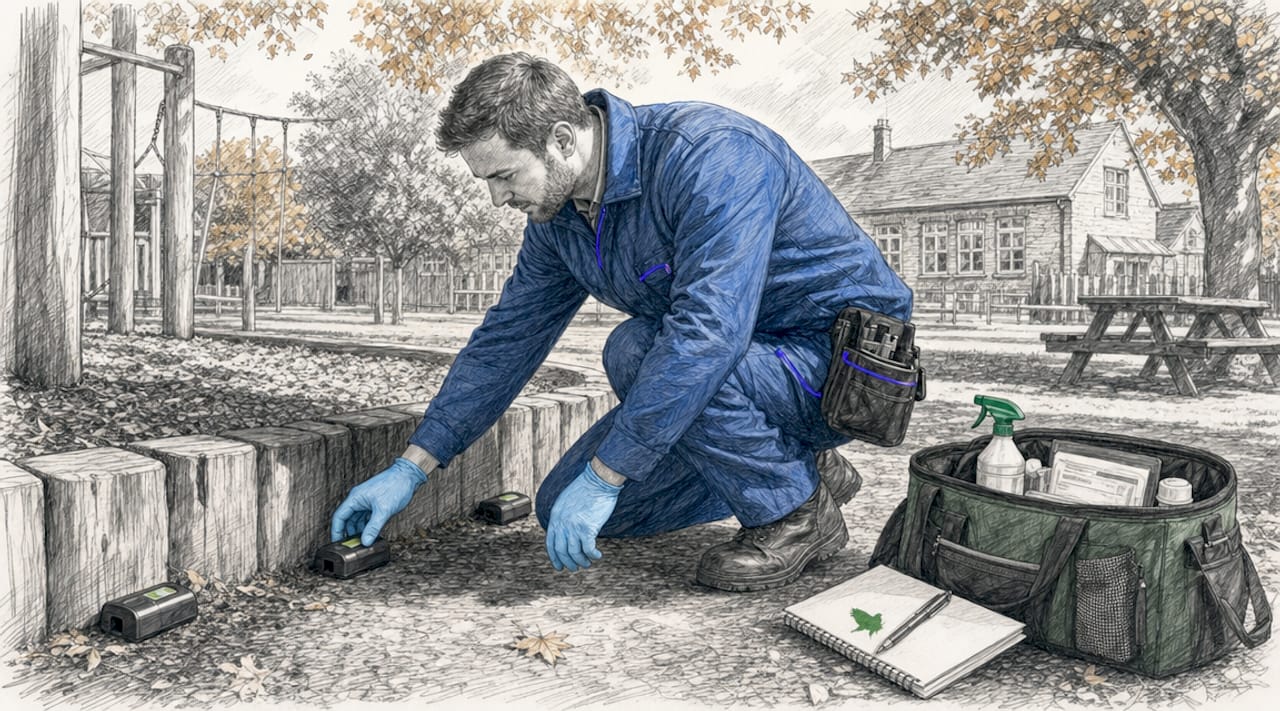
Common pests in London schools include mice, rats, cockroaches, and ants. Head lice are explicitly excluded from pest control programmes as they require a separate medical management approach. Each of the four main pests presents distinct health, hygiene, and operational risks that shape the focus of any school pest management contract.
| Pest | Primary risk | Seasonal peak | Key control measure |
|---|---|---|---|
| Mice | Food contamination, gnawed wiring | Autumn and winter | Proofing, bait stations |
| Rats | Disease transmission, structural damage | Year-round, worse in winter | Rodenticide programme, drainage survey |
| Cockroaches | Allergens, food hygiene failure | Year-round, worse in warm kitchens | Gel bait, deep clean, proofing |
| Ants | Food contamination, nuisance | Spring and summer | Perimeter treatment, food storage review |
London’s urban density makes schools particularly vulnerable. Rats attracted to urban waste from nearby restaurants and takeaways frequently enter school grounds through drainage systems and perimeter gaps. Cockroaches thrive in school kitchen environments where warmth, moisture, and food residue are consistently present. A sharp rise in rodent activity is common each autumn as temperatures drop and rodents seek shelter indoors.
The implications for contract planning are direct. A school in a borough with high restaurant density, such as Westminster or Southwark, needs a rodent programme with greater frequency and more monitoring points than a school in a lower-density area. Pest control planning must reflect the specific environmental pressures of each site.
What should a compliant school pest control contract include?
A compliant pest control contract for a London school must cover more than treatment visits. The contract is a legal document that demonstrates the school has discharged its duty of care. The following comparison shows the difference between a minimum-standard contract and a fully compliant one.
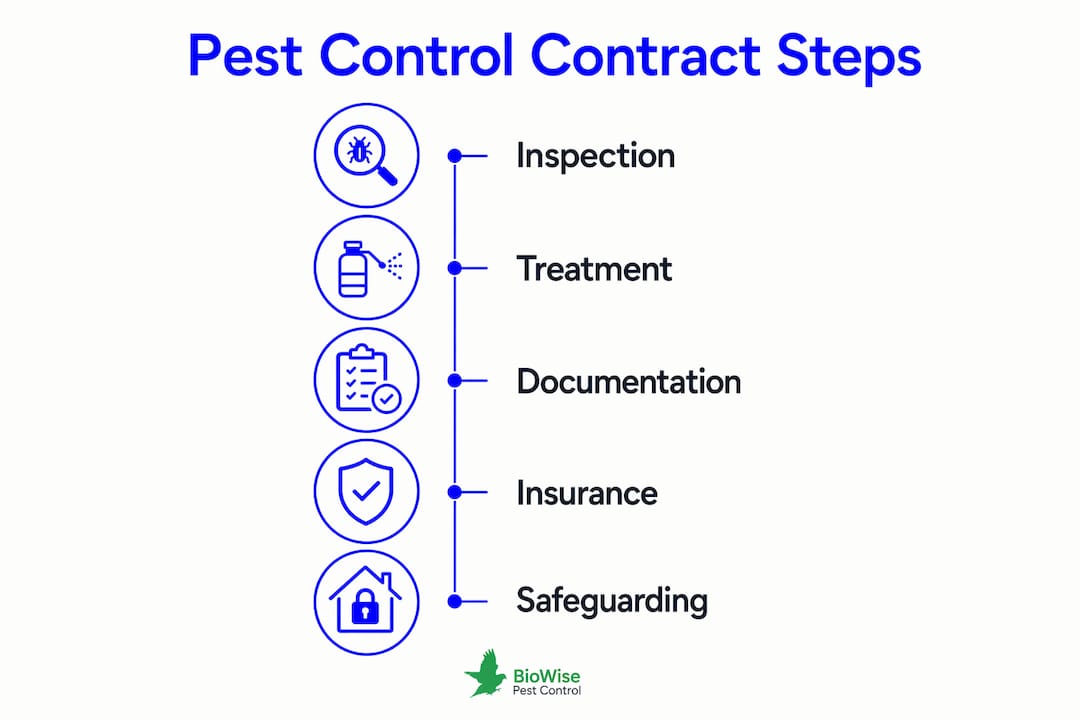
| Contract element | Minimum standard | Fully compliant standard |
|---|---|---|
| Inspection frequency | Reactive, on request | Scheduled monthly visits with written reports |
| Pesticide documentation | Basic treatment record | Full COSHH records, product data sheets, risk assessments |
| Contractor certification | General pest control licence | RSPH Level 2 Award for rodenticides, plus relevant qualifications |
| Treatment scheduling | During school hours | Outside school hours with confirmed re-entry periods |
| Communication protocol | Ad hoc phone calls | Named contact, written reports, escalation procedure |
| IPM plan | None | Written plan with roles, thresholds, and review schedule |
Schools should also verify that their contractor carries adequate public liability insurance and can provide evidence of ongoing training. The UK Pesticides National Action Plan 2025 frames compliance as an ongoing commitment to safe systems, not a one-off treatment record. This means the contract must include a mechanism for annual review and updating of the IPM plan.
Safeguarding requirements deserve particular attention. Treatments must be scheduled for evenings, weekends, or school holidays. The contractor must confirm in writing that safe re-entry periods have been observed before the school reopens. COSHH records must be stored on site and made available to Ofsted or local authority inspectors on request.
Pro Tip: Ask your contractor to provide a sample inspection report before you sign. A report that names the operative, records findings against specific locations, and recommends follow-up actions is the standard you need for audit purposes.
Choosing a specialist with direct experience in educational settings makes a measurable difference. Biowise Pest Control Maintenance Services has worked with London facilities managers since 2010 and understands the specific safeguarding, documentation, and scheduling requirements that school contracts demand. A generalist contractor may be cheaper, but the compliance risk of an inadequate contract far outweighs any short-term saving.
Key takeaways
Compliant pest control in London schools requires a documented IPM programme, certified contractors, COSHH records, and treatments scheduled outside school hours.
| Point | Details |
|---|---|
| IPM is the legal standard | Schools must maintain a written IPM plan with monitoring schedules and escalation thresholds. |
| Contractor certification matters | Operatives applying rodenticides must hold the RSPH Level 2 Award to satisfy UK Rodenticide Stewardship requirements. |
| Documentation is the compliance proof | COSHH records, risk assessments, and inspection reports are what Ofsted and local authorities examine. |
| Treatment timing is a safeguarding requirement | Pesticide applications must occur outside school hours with confirmed safe re-entry periods before pupils return. |
| Contract quality determines compliance | A fully compliant contract includes monthly inspections, written reports, and a named escalation contact. |
What I have learned from years of school pest control compliance
By Ana Hasula
The most common mistake I see in London schools is treating pest control as a facilities afterthought rather than a safeguarding obligation. Administrators often inherit contracts that were set up years ago, have never been reviewed, and contain no COSHH documentation whatsoever. When an Ofsted inspection arrives, the absence of records is treated as evidence of failure, regardless of whether the school has actually had a pest problem.
The second mistake is assuming that any pest control contractor will do. Rodenticide application in a school setting requires the RSPH Level 2 Award. I have seen schools use contractors who could not produce this certificate when asked. That is not a minor oversight. It is a liability.
What actually works is straightforward: a written IPM plan, a contractor who understands school environments, monthly inspections that generate paper trails, and treatments scheduled for school holidays or weekends. The prevention-first approach is not just better for children. It is cheaper over time because it catches problems before they require intensive treatment.
My honest advice to any school business manager is this: review your current contract against the checklist in this article. If it does not include monthly written reports, COSHH records, and evidence of contractor certification, you are not compliant. Fix it before an inspector asks to see the paperwork.
— Ana Hasula
How Biowise supports London schools with compliant pest control
London schools need a pest control partner who understands the regulatory environment, not just the pests. Biowise Pest Control Maintenance Services has delivered compliant facilities pest control across London since 2010, working with over 600 clients including educational and commercial facilities.

Our school contracts include IPM-aligned programmes, certified operatives holding the RSPH Level 2 Award, full COSHH documentation, and treatments scheduled outside school hours. Every visit produces a written report suitable for Ofsted audit. For schools in West London, our Chelsea pest control team provides specialist coverage with rapid response times. Contact Biowise today for a bespoke compliance consultation tailored to your school’s specific needs and site conditions.
FAQ
What pest control do schools legally need?
London schools must maintain a documented pest management programme that includes COSHH records, contractor certification, and an Integrated Pest Management plan. Ofsted and local authority standards require schools to demonstrate proactive, verifiable pest control rather than reactive treatment alone.
Can pest control be carried out in a school during term time?
Pesticide treatments must be scheduled outside school hours, including evenings, weekends, or school holidays, to protect pupils and staff from chemical exposure. Safe re-entry periods must be confirmed in writing before the school reopens, as required by COSHH regulations and UK pesticide safeguarding rules.
What pests are most common in London schools?
Mice, rats, cockroaches, and ants are the four pests most commonly found in London schools, each presenting distinct health and hygiene risks. Head lice are not covered by pest control programmes as they require separate medical management.
What qualifications should a school pest control contractor hold?
Any contractor applying rodenticides must hold the RSPH Level 2 Award in Safe Use of Rodenticides, which demonstrates compliance with the UK Rodenticide Stewardship Regime. Schools should request this certificate before signing any contract.
How often should a London school have pest control inspections?
Monthly scheduled inspections are the standard for a fully compliant school pest control contract, with each visit producing a written report. Reactive-only arrangements do not satisfy Ofsted documentation requirements or the proactive safe systems standard set by the UK Pesticides National Action Plan 2025.