


A spotless kitchen and no visible pests mean you’re compliant, right? Not quite. Environmental health officers can still mark you down or even close your premises if you lack proper pest control documentation, regardless of whether rodents or insects are present. For London restaurants, maintaining detailed records isn’t just good practice, it’s a legal requirement that protects your business licence, reputation, and bottom line. This article explains exactly what documentation you need, why it matters, and how to maintain records that satisfy inspectors whilst keeping your premises pest-free.
Table of Contents
- Key takeaways
- Understanding legal requirements for pest control documentation
- Consequences of insufficient pest control documentation
- How professional pest control contracts aid documentation and control
- Best practices for maintaining pest control documentation
- How BioWise supports London restaurants with pest control documentation
- Frequently asked questions
Key Takeaways
| Point | Details |
|---|---|
| Legal documentation required | UK law mandates comprehensive pest control documentation for London restaurants as part of HACCP and regulatory compliance. |
| FHRS scores affected | Missing records can lower FHRS ratings even when no pests are present. |
| Penalties and closures | Inadequate documentation can trigger penalties including fines up to twenty thousand pounds and potential closure orders. |
| Accredited providers essential | Using BPCA or NPTA accredited technicians helps ensure the documentation meets regulatory expectations. |
| Regular contracts and records | Maintaining regular service contracts and on site records supports proactive pest control and can reduce infestation risks. |
Understanding legal requirements for pest control documentation
UK law mandates that all food businesses, including restaurants, maintain comprehensive pest control documentation. The Food Hygiene (England) Regulations 2013 and EC 852/2004 require restaurants to demonstrate adequate pest control procedures integrated into HACCP prerequisite programmes. This isn’t optional guidance, it’s a legal obligation that environmental health officers verify during inspections.
Your HACCP system must include pest management as a foundational element. This means documenting how you prevent, monitor, and respond to pest activity. Without these records, you cannot prove due diligence, even if your kitchen is immaculate. Environmental health officers expect to see evidence of systematic control measures, not just reactive treatments when problems arise.
The specific documentation includes contracts with accredited providers, visit reports, risk assessments, monitoring device locations, corrective actions, proofing records, and staff training kept onsite for EHO inspections. Each element serves a distinct purpose. Contracts prove you’ve engaged professional services. Visit reports show regular monitoring occurs. Risk assessments demonstrate you understand vulnerabilities specific to your premises. Monitoring device locations confirm systematic coverage. Corrective action logs prove you respond to findings. Proofing records show structural improvements. Training evidence confirms staff competence.
Accreditation matters significantly. Providers certified by the British Pest Control Association (BPCA) or National Pest Technicians Association (NPTA) follow industry standards that align with regulatory expectations. Using accredited technicians ensures your documentation meets legal pest control requirements and carries weight during inspections.
Required documentation includes:
- Service contracts showing frequency and scope of visits
- Detailed visit reports with findings, actions, and recommendations
- Site-specific risk assessments identifying vulnerabilities
- Floor plans marking monitoring device locations
- Corrective action logs tracking responses to pest activity
- Proofing records documenting structural improvements
- Staff training certificates and awareness materials
| Document type | Retention period | Primary purpose |
|---|---|---|
| Service contracts | Duration of contract plus 6 years | Proves ongoing professional engagement |
| Visit reports | Minimum 2 years | Demonstrates regular monitoring and findings |
| Risk assessments | Updated annually, kept indefinitely | Shows understanding of site vulnerabilities |
| Training records | 3 years minimum | Confirms staff competence and awareness |
| Corrective actions | 2 years minimum | Evidences responsive management |
Consequences of insufficient pest control documentation
Environmental health officers prioritise documentation during unannounced inspections. Missing records lead to low Food Hygiene Rating Scheme scores even without active pests, negatively affecting customer trust and business. Your FHRS rating appears on your door and online, directly influencing customer decisions. A poor score due to documentation failures costs you revenue, even if your kitchen operates to high standards otherwise.

The financial penalties are severe. Failure to maintain documentation leads to penalties including closure notices, fines up to £20,000 and beyond, and prohibition orders, with London cases involving £12,000 to £30,000 fines linked to pest infestations. These aren’t theoretical risks. London restaurants face prosecution regularly for documentation failures combined with pest issues.
Consider a Southwark restaurant fined £12,000 after inspectors found mouse droppings and no pest control records. The proprietor couldn’t prove any professional service had occurred. Another case saw a Hackney establishment receive a £30,000 fine and temporary closure after repeated violations, partly because documentation showed no systematic approach to pest management. In both instances, proper records could have demonstrated due diligence and potentially reduced penalties significantly.
Beyond immediate fines, consequences include:
- Mandatory closure until compliance is achieved
- Prohibition orders preventing you from operating food businesses
- Reputational damage through public court listings and media coverage
- Loss of customer confidence and reduced bookings
- Difficulty obtaining insurance or favourable premiums
- Potential director disqualification for repeated serious breaches
“Environmental health officers don’t just look for pests. They look for systems. If you can’t show documented evidence of preventative measures, you’re failing before they even inspect your kitchen. Records prove you take food safety seriously.”
The EHO standards guide clarifies that inspectors assess your food safety management system holistically. Documentation gaps signal systemic failures, not just administrative oversights. This perspective explains why missing records trigger such serious consequences, even when no pests are visible during the inspection itself.
Long-term risks extend beyond individual fines. Repeated offences can lead to director bans, preventing you from running any food business in future. This career-ending consequence underscores how seriously regulators treat documentation requirements. They view comprehensive records as evidence of professional management and genuine commitment to public health protection.
How professional pest control contracts aid documentation and control
Professional contracts deliver dual benefits: effective pest management and compliant documentation. Monthly visits and documented contracts reduce infestation recurrence by 80-90%, whilst contracts provide proof of due diligence and help maintain compliance. This dramatic reduction occurs because regular monitoring catches problems early, before they escalate into infestations requiring expensive remediation.
Contracts with accredited providers guarantee systematic approaches. Technicians follow integrated pest management (IPM) principles, combining monitoring, exclusion, sanitation advice, and targeted treatments. Each visit generates documentation automatically, creating an audit trail that satisfies regulatory requirements whilst improving your pest control outcomes.
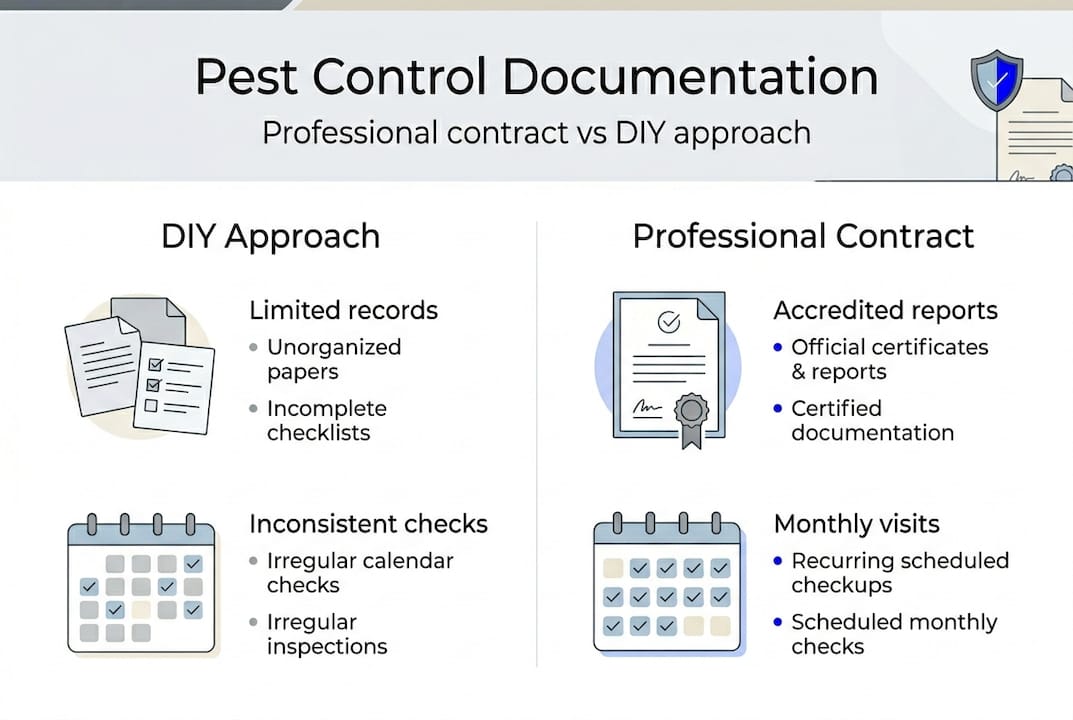
Comparing DIY approaches with professional contracts reveals stark differences:
| Aspect | DIY approach | Professional contract |
|---|---|---|
| Documentation | Minimal or absent | Comprehensive, audit-ready |
| Expertise | Limited to product labels | Trained, certified technicians |
| Monitoring | Reactive, when problems visible | Proactive, regular scheduled visits |
| Compliance | High risk of gaps | Aligned with regulations |
| Cost of infestation | Potentially very high | Minimised through prevention |
| EHO acceptance | Often inadequate | Meets inspection standards |
London’s urban environment creates unique challenges. High-risk sites like older buildings near waste storage face elevated rodent pressure, and EHOs expect detailed records especially in these contexts, with repeated offences potentially leading to director bans. The density of food businesses, interconnected buildings, and constant construction create pest highways that demand professional attention. DIY measures simply cannot provide the coverage and documentation necessary in this environment.
Standard professional contracts typically include:
- Monthly monitoring visits with comprehensive reports
- Unlimited emergency call-outs for urgent issues
- Risk assessments updated annually or after significant changes
- Staff training and awareness materials
- Detailed action plans for any pest activity detected
- Proofing recommendations and installation where needed
Pro tip: Digital documentation platforms offered by modern pest control providers enable real-time access to all records, trend analysis across visits, and instant retrieval during inspections. This technology transforms record-keeping from an administrative burden into a strategic tool for identifying patterns and preventing problems before they develop.
The comparison between pest control contracts versus one-off services reveals that whilst one-off treatments address immediate problems, they create documentation gaps that leave you vulnerable during inspections. Contracts provide continuity, showing environmental health officers that pest management is embedded in your operations, not just an emergency response.
For London hospitality businesses specifically, contract pest control services matter because they align operational needs with regulatory expectations. The investment in monthly contracts pays dividends through reduced infestation costs, better FHRS ratings, and peace of mind that your documentation withstands scrutiny.
Best practices for maintaining pest control documentation
Implementing excellent documentation practices requires systematic approaches and attention to detail. Follow these steps to ensure your records meet inspection standards:
- Establish a dedicated pest control file, either physical or digital, containing all documentation in chronological order for easy retrieval during inspections.
- Ensure your pest control contracts include contracts, visit reports, risk assessments, monitoring records, corrective actions, proofing logs, and staff training evidence, all readily available onsite.
- Review visit reports immediately after each service, signing off on recommendations and documenting any actions you take between visits.
- Maintain a site plan showing all monitoring device locations, updating it whenever changes occur to layout or equipment placement.
- Record all pest sightings by staff, even if minor, creating a complete picture of pest pressure over time.
- Document staff training in pest awareness, including dates, attendees, and topics covered, refreshing training annually.
- Keep proofing records showing structural improvements like sealed gaps, door sweeps installed, or drainage repairs completed.
Onsite availability is critical. Environmental health officers expect immediate access to documentation during inspections. Storing records offsite or in formats requiring special access creates delays that reflect poorly on your management systems. Keep current contracts, the most recent 24 months of visit reports, and current risk assessments readily accessible in your office or manager’s area.
Staff training deserves particular attention. Your team should understand basic pest prevention principles, know how to report sightings, and recognise why documentation matters. Training records prove you’ve invested in building competence throughout your organisation, not just relying on external contractors.
Pest control as a HACCP prerequisite demands trend analysis over time, not just snapshots, and digital tools help busy managers maintain verifiable logs easily. Modern platforms automatically compile data from multiple visits, highlighting patterns that might indicate developing problems. For example, increasing rodent activity in one area over several months might signal a structural issue requiring proofing work. Without trend analysis, you might miss this pattern until it becomes a serious infestation.
Pro tip: After each pest control visit, update your dedicated file within 24 hours whilst the visit is fresh in your mind. Add any observations from your team, photograph any issues raised, and document actions you’ve taken in response to recommendations. This habit ensures nothing falls through gaps and creates a comprehensive record that demonstrates active management.
Digital systems offer significant advantages for busy restaurant managers. Cloud-based platforms provide:
- Automatic visit report uploads from technicians
- Mobile access to all records from any location
- Automated reminders for scheduled visits or overdue actions
- Trend graphs showing pest activity patterns
- Instant report generation for inspections or audits
Even without sophisticated software, simple spreadsheets tracking visit dates, findings, and actions provide valuable oversight. The key is consistency and completeness, not technological sophistication.
Pest control certification from your provider confirms they meet professional standards. Verify your contractor holds current BPCA or NPTA membership and that individual technicians carry appropriate qualifications. This verification forms part of your due diligence and strengthens your documentation’s credibility.
Regularly reviewing pest control contracts for London businesses ensures your agreement remains fit for purpose as your operation evolves. Annual contract reviews should assess whether visit frequency matches your risk profile, whether documentation meets current regulatory expectations, and whether you’re receiving value for your investment.
How BioWise supports London restaurants with pest control documentation
Maintaining compliant pest control documentation whilst running a busy restaurant demands expertise and systems that many operators struggle to implement alone. BioWise Pest Control Services specialises in supporting London restaurants with comprehensive pest management programmes designed specifically for food business compliance.
Our accredited technicians understand exactly what environmental health officers expect during inspections. Every visit generates detailed reports documenting findings, actions, and recommendations in formats that satisfy legal pest control requirements. We don’t just treat pest problems, we create the documentation trail that proves your commitment to food safety.
Our pest control contracts for London businesses include monthly monitoring visits, unlimited emergency call-outs, comprehensive documentation, staff training support, and digital record access. We’ve served over 600 London clients since 2010, building deep expertise in the unique challenges urban restaurants face. Whether you operate in a historic building in Westminster or a modern development in Canary Wharf, we tailor our approach to your specific risk profile.
Beyond commercial services, our expert domestic pest control extends to residential properties, reflecting our comprehensive understanding of pest behaviour across all environments. This breadth of experience informs our restaurant services, ensuring we anticipate problems before they develop.
Pro tip: Partnering with an experienced, accredited pest control provider transforms documentation from a compliance burden into a strategic asset. The right partner doesn’t just meet minimum requirements, they help you exceed standards, improve your FHRS rating, and protect your reputation.
Frequently asked questions
Why is pest control documentation required for restaurants?
UK food hygiene regulations mandate pest control documentation as part of HACCP prerequisite programmes. Restaurants must prove they have systematic pest management procedures in place. Environmental health officers assess these records during inspections to verify compliance, and missing documentation results in lower FHRS scores regardless of whether pests are present.
What specific documents must London restaurants keep for pest control?
Restaurants must maintain service contracts with pest control providers, detailed visit reports from each inspection, site-specific risk assessments, floor plans showing monitoring device locations, corrective action logs, proofing records, and staff training evidence. All documents should be kept onsite and readily available for environmental health officer inspections, with visit reports retained for at least two years.
Can restaurants handle pest control documentation internally without professional contracts?
Whilst legally possible, internal documentation rarely meets environmental health officer expectations without professional support. Accredited pest control providers deliver expertise, systematic monitoring, and compliant documentation formats that DIY approaches struggle to replicate. Environmental health officers view professional contracts as evidence of serious commitment to pest management, significantly strengthening your compliance position during inspections.
How often should pest control visits occur for proper documentation?
Monthly visits represent the industry standard for restaurants and provide optimal documentation frequency. This schedule enables trend analysis, early problem detection, and demonstrates ongoing commitment to pest management. Higher-risk premises or those with previous issues may require more frequent visits. The key is consistency, regular documented visits prove systematic management rather than reactive responses to problems.
What happens during an environmental health inspection regarding pest control records?
Inspectors request immediate access to pest control documentation, reviewing contracts, recent visit reports, risk assessments, and corrective action logs. They assess whether you have systematic procedures, whether monitoring occurs regularly, and whether you respond appropriately to findings. Missing or inadequate documentation leads to lower FHRS scores, improvement notices, or in serious cases, prohibition orders and fines. Comprehensive, well-organised records demonstrate professional management and support favourable inspection outcomes.




