


Facility and property managers in the UK operate under several overlapping duties: the Prevention of Damage by Pests Act 1949 requires occupiers to notify their local authority of rats or mice in substantial numbers, the Glue Traps (Offences) Act 2022 restricts a common trapping method, and COSHH governs any biocide used on site. The first practical step is a documented site risk assessment, followed by a BPCA-competent contractor if treatment is needed.
TL;DR:
- Only licensed contractors and documented risk assessments can ensure compliance with UK pest control laws, especially when using biocides or fumigation methods.
- Glue traps are banned outside licensed exceptions, and using them without a license can lead to criminal penalties and welfare violations.
- Food businesses must maintain detailed records, including bait maps and intervention logs, to meet enforcement standards during inspections.
- Managing bird deterrents requires timing around breeding seasons and avoiding damage to protected nests to prevent legal violations.
- Proper documentation and contractor competence are critical for legal protection, even if pest issues are resolved without a visible infestation.
Table of Contents
- The main laws that govern pest control in the UK
- Occupier and landlord duties, and how local authorities enforce them
- Biocides, COSHH duties and what HSE expects from contractors
- Method restrictions: glue traps, nets, spikes, gels and bird guano
- Cost and durability: spikes versus gel over time
- Enforcement for food businesses and approved establishments
- A practical compliance checklist for managers
- How BioWise can help
- What managers get wrong about pest control compliance
- Book a compliance-focused BioWise survey
- Sources
- FAQ
The main laws that govern pest control in the UK
Four pieces of legislation shape most compliance decisions for managers.
The Prevention of Damage by Pests Act 1949 is the oldest and still the most relevant for rodent problems. It places a duty on occupiers to notify their local authority when rats or mice are present in substantial numbers, and it gives councils the power to serve notices requiring eradication work.
The Glue Traps (Offences) Act 2022 makes it an offence in England to set a glue trap for catching rodents unless a licence has been granted for public health or safety reasons. Breaching this without a licence carries penalties, and the licensing route exists for genuinely exceptional cases rather than routine pest work.
The Wildlife and Countryside Act 1981 protects wild birds, their active nests and their eggs. It is a criminal offence to intentionally kill, injure or take a wild bird, or to damage or disturb a nest while it is in use, which has direct implications for anyone managing pigeon or gull problems on commercial roofs.
Food hygiene law adds another layer for restaurants, hotels and kitchens. Where pest activity threatens food safety, the food law practice guidance sets out how competent authorities assess approval files and when enforcement notices follow. Managers of licensed kitchens should treat this as a parallel duty, not a substitute for the others.

Occupier and landlord duties, and how local authorities enforce them
An occupier must notify the local authority when rats or mice are present in substantial numbers under the 1949 Act. Failing to do so, or ignoring a notice once served, can result in a fine and leaves the occupier exposed if the infestation spreads to neighbouring premises.
A local authority notice typically requires specific treatment work, structural repairs to remove access points, or both, within a stated timescale. The notice will usually name the remedial standard expected rather than dictate a particular product or method.
Managers who receive a notice have two realistic options: arrange the required work through a competent contractor and confirm completion to the council, or query the scope of the notice if the evidence does not support it. Either way, the response needs to be in writing and on file. This duty sits differently depending on whether you are the occupier or the landlord, and the property management guide sets out how responsibility splits between the two. Tenants unsure who should act can also see how to escalate to a landlord under the same framework.
Biocides, COSHH duties and what HSE expects from contractors
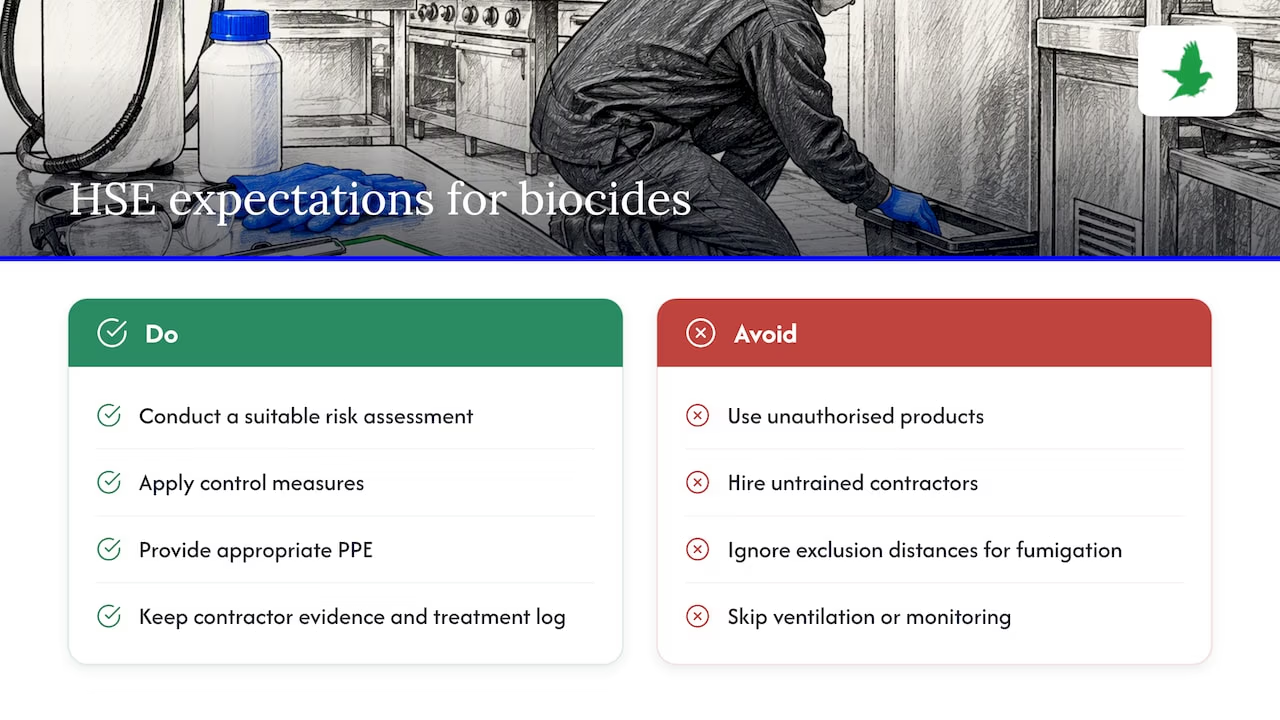
Any use of a hazardous biocide, including most rodenticides, triggers duties under the Control of Substances Hazardous to Health Regulations 2002. HSE guidance on biocides states that employers must carry out a suitable and sufficient risk assessment before use, apply control measures, provide the right personal protective equipment and follow the product’s Safety Data Sheet.
Only products authorised for the stated purpose may be used, and some rodenticides and metal phosphide products are restricted to professional users who can demonstrate competence. This is not a formality: a contractor without the right authorisation and training is a liability risk for the site that hired them.
For fumigation and gas treatments specifically, HSE’s SR8b guidance sets out exclusion distances, often around 10 metres from occupied dwellings, along with ventilation requirements, monitoring equipment and health surveillance protocols. A manager commissioning this work should expect a documented plan and should retain evidence of the contractor’s competence alongside the treatment log. Our COSHH guide for London businesses breaks this down further, and recent changes to rat poison rules are worth checking before renewing any rodenticide contract.
Method restrictions: glue traps, nets, spikes, gels and bird guano
Glue traps for rodents are banned in England outside a licensed exception, and using one without a licence carries both a welfare and a criminal risk. Wild birds, their active nests and their eggs remain protected under the Wildlife and Countryside Act 1981, so any bird deterrent work must avoid disturbing a nest in use and should be timed outside the breeding season where possible.
For pigeon and gull deterrence on buildings, the choice usually comes down to spikes, gel or netting, and each has a distinct role:
- Spikes physically deny the perch and suit narrow ledges, sills and gutters; stainless steel versions last years with little maintenance.
- Gel works as an optical repellent that changes bird behaviour rather than blocking access, so it suits signage, parapets and decorative stonework where spikes would look wrong; only HSE-authorised gels are permitted, and they degrade faster in weather and dust, typically needing reapplication well before a spike installation needs attention.
- Netting or wire outperforms both on larger openings such as warehouse eaves or atria, where spikes are impractical and gel cannot cover the area.
Neither spikes nor gel will hold if the site is not cleaned down first. Guano left in place attracts new birds and is itself a COSHH hazard: HSE guidance on bird droppings warns against high-pressure washing, which aerosolises pathogens, and recommends wet suppression, manual removal and FFP3 respiratory protection instead.
Cost and durability: spikes versus gel over time
Install price rarely tells the full story. Gel needs reapplication as it weathers, while stainless spikes, once fitted correctly, rarely need touching for years.
| Method | Typical role | Durability | Cost consideration over five years |
|---|---|---|---|
| Stainless spikes | Narrow ledges, sills, gutters | Several years with minimal upkeep | Higher install cost, low reapplication cost |
| HSE-authorised gel | Signage, parapets, stonework | Degrades with weather and dust, needs reapplication | Lower install cost, recurring reapplication cost |
| Netting or wire | Large openings, eaves, atria | Long-lasting when properly tensioned | Higher install cost, low ongoing cost |
A lower install price for gel can end up costing more across five years once repeat visits are factored in, particularly on exposed elevations. Spikes and netting cost more upfront but need far less attention once fitted.
Enforcement for food businesses and approved establishments
Food businesses face a distinct enforcement track. A hygiene improvement notice typically follows an inspection that finds an active infestation or poor pest control records, and gives a deadline to correct the failure. A prohibition order is more serious and can stop food-handling activity until the risk is removed.
Competent authorities assessing approval files, per the food law practice guidance, expect to see bait and trap maps, dated intervention reports, and clear links to the site’s HACCP plan. A file with gaps or undated visits reads as a compliance weakness even where no infestation is present.
After an inspection flags a problem, the immediate steps are the same regardless of pest type: commission treatment from a competent contractor, update the bait map and intervention log, and brief staff on any food storage or waste changes needed to remove the underlying cause.
A practical compliance checklist for managers
Turning these duties into weekly actions keeps a site defensible if a council officer or environmental health inspector calls.
- Obtain or carry out a COSHH risk assessment for any biocide used on site, and keep the assessment and Safety Data Sheet on file; our COSHH module partner offers a structured way to do this.
- Ask any contractor to show BPCA competence, a written method statement, current insurance and a waste disposal plan before work starts.
- Keep treatment logs, bait maps, disposal receipts and staff briefing records together in one file, not scattered across e-mail threads.
- Train staff to remove food sources, secure waste and report sightings promptly, and set a clear line for when to escalate to the local authority or a solicitor.
Pro Tip: Date every bait map and treatment log the day the work happens, not the day you file it; a gap of even a few weeks looks bad under inspection.
The HSE-focused commercial premises guide covers documentation expectations for larger sites in more detail.
How BioWise can help
A pest control company has worked with London homes and businesses since 2010, serving several hundred London clients across restaurants, offices and housing associations. Our team carries BPCA competence and builds documented treatment plans as standard, which matters when a council or food inspector asks for records rather than reassurance.
What managers get wrong about pest control compliance
Most managers treat pest control law as something that only matters after an inspection finds a problem. That gets the order backwards. The paperwork, risk assessments, bait maps, contractor competence checks, is what an inspector actually judges, often more than the pest count on the day.
The conventional advice tends to focus on which product or trap to use. That misses the point. The Glue Traps Act and the Wildlife and Countryside Act exist precisely because method choice carries legal weight independent of whether the pest problem gets solved. A manager who solves an infestation using a banned method has traded one liability for another.
Prioritise the file before the fix. A documented, dated, competently sourced treatment plan protects a site even when a pest issue recurs, because it shows due diligence. Chase pest-free premises without that paper trail and you are still exposed.
— Ana Hasula
Book a compliance-focused BioWise survey
If you need a site COSHH assessment, a documented treatment plan, or a contractor who can show the competence records an inspector will ask for, BioWise’s commercial pest control service starts from £100 per quarter. Get in touch to arrange a survey.

Sources
- Prevention of Damage by Pests Act 1949, section 3
- Using biocides: Overview – HSE
- Food law practice guidance (England)
FAQ
Do you need a licence for pest control in the UK?
General pest control work does not require a personal licence, but certain restricted products are limited to professional users who can demonstrate competence under HSE’s biocide guidance. Glue traps specifically require a licence for the narrow public health exception under the 2022 Act.
Do pest controllers need to be registered?
There is no single mandatory national register, but BPCA membership is the recognised industry competence standard that most commercial clients and food inspectors look for. Checking for this before hiring a contractor reduces the risk of non-compliant treatment methods.
Is it illegal to sell a house with rats?
There is no specific offence for selling a house with rats, but a seller who knowingly conceals a known infestation risks a misrepresentation claim, and an occupier who fails to notify the local authority about a substantial infestation can fall foul of the 1949 Act. Disclosing the issue and showing evidence of treatment is the safer route for both buyer and seller.




