

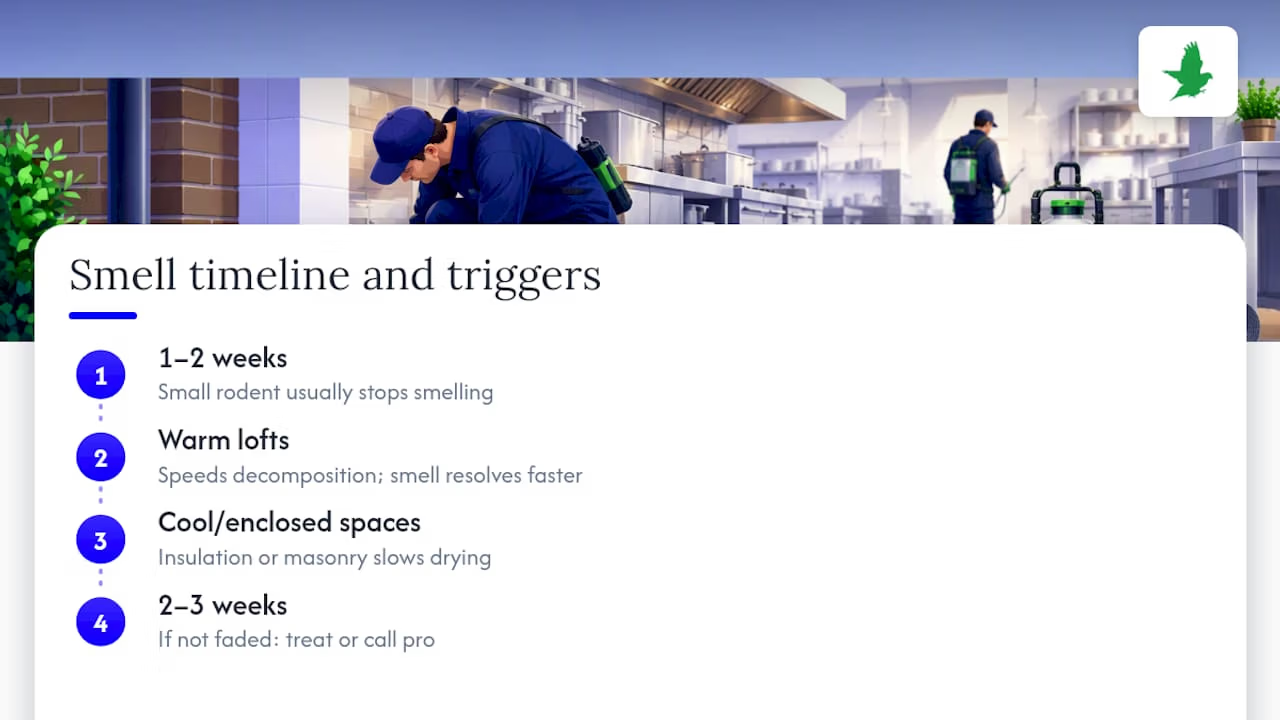
A dead rat in a wall usually smells for about two weeks, sometimes longer, until the carcass dries out; a mouse often clears sooner. If the smell is no better after two to three weeks, or you cannot reach the source, the carcass needs finding and removing, and the gap the rat used needs proofing.
If you are dealing with a rat smell in walls or ceilings, this guide covers how to confirm it is a dead rodent, what affects how long it lasts, how professionals find a carcass without pulling walls apart, which odour treatments work and what to do in commercial or rented premises. BioWise has dealt with rats in London homes and businesses since 2010.
Table of Contents
- How to tell if the smell is a dead rat
- How long does a dead rat smell last?
- Where rats die inside walls, floors and ceilings
- What to do now: a step-by-step plan
- How professionals find and remove a carcass
- Dead rat smell treatments compared
- Health and safety precautions
- Dead rat smells in commercial and rented premises
- How to stop it happening again
- FAQ
- How BioWise can help with dead rat smells
- Sources
How to tell if the smell is a dead rat
A decomposing rodent smells sweet, sickly and rotten, and it is noticeably stronger in one spot, such as a section of wall, a kitchen plinth or part of a ceiling, rather than spread evenly through the room. Other smells get mistaken for it, and some of them matter more.
| Smell | Likely cause | What to do |
|---|---|---|
| Sweet and rotting, strongest in one spot | Dead rodent in a void | Ventilate and follow the steps below |
| Stale and ammonia-like, lingering for weeks | Live rodents nesting nearby | Look for droppings and arrange rodent control |
| Sewage near sinks, gullies or WCs | Drain defect or a dried-out trap | Run water into traps and have the drains checked |
| Rotten eggs | Possible gas leak | Leave, avoid switches and flames, call 0800 111 999 |
| Fishy or burning near sockets | Possible overheating electrics | Stop using the circuit and call an electrician |
| Musty and the same everywhere | Damp or mould | Find the moisture source |
Supporting signs include flies gathering at one window or ceiling light, scratching in the wall that stopped suddenly, greasy smear marks, gnawing and droppings. Rat droppings are about 12-18mm and capsule-shaped, mouse droppings about 3-6mm and pointed (see Mouse vs Rat Droppings: How to Tell the Difference). A recent rodent treatment in your building or next door makes a carcass more likely.
How long does a dead rat smell last?
BPCA guidance on dealing with dead rodent odours says that, left alone, the smell will most likely disappear in a couple of weeks, and that it persists until the carcass has dried out, which can take two weeks or longer. A mouse often clears within one to two weeks.
| Factor | Shorter smell | Longer smell |
|---|---|---|
| Size | One mouse or a young rat | An adult rat, or several rodents |
| Temperature | Warm loft in summer (faster, though stronger at first) | Cool cavity wall, basement or winter |
| Airflow | Ventilated loft or floor void with working air bricks | Sealed cavity or boxed-in pipework |
| Surroundings | Bare joist or hard, dry surface | Insulation, plaster or timber that soaks up fluids and keeps smelling |
If the smell is no weaker after two to three weeks, the carcass is probably somewhere with poor airflow or fluids have soaked into nearby materials, and waiting longer rarely helps.
Where rats die inside walls, floors and ceilings
A sick or poisoned rat retreats to its nest or a sheltered run, and anticoagulant baits take several days to work, so carcasses end up out of sight: in cavity walls, behind dry-lining, under suspended floors, behind kitchen plinths and bath panels, in loft insulation near the eaves, and in suspended ceilings, risers and ducts in larger buildings. Smell also travels along cavities, joists and pipe boxing, sometimes from a neighbour’s side of a shared wall, so the strongest point is a guide rather than a guarantee.
What to do now: a step-by-step plan
- Ventilate. Open windows, close the door to the room and keep children and pets out.
- Map the smell. Note where it is strongest at floor and ceiling level, and check the rooms above, below and next door.
- Check spaces that open without tools. Loft hatch, kitchen plinths, bath panel, airing cupboard, under the stairs and ceiling tiles.
- Do not cut in blind. Walls hide cables and pipes, and HSE advises that any building built or refurbished before 2000 may contain asbestos.
- If you find it, wear disposable gloves, double bag it and put it in a general waste bin with a lid, then disinfect the area. Our guide on how to dispose of a dead mouse safely covers the steps.
- Treat the smell rather than masking it, and find the way in.
- Call a professional if you cannot find it within a few days, it is not fading after two to three weeks, or the premises are a food business or workplace. Our emergency pest control team can usually attend the same day.
Most carcasses we recover are in ordinary places: behind a kitchen plinth, under the bath panel, just inside the loft hatch or under a floorboard by a pipe run. We check every space that opens without tools before anyone cuts a hole. Where the flies gather is often closer to the carcass than where the smell seems strongest.
Ben, Lead Technician, BioWise
How professionals find and remove a carcass
A good technician works from the least invasive option upwards.
- Evidence mapping: following the smell room by room and cross-checking droppings, smear marks, flies and where noises were heard.
- Inspection cameras: a borescope fed through a vent, service hole or small drilled hole shows what is inside a cavity or behind boxing.
- Accessible removal: through loft insulation, ceiling tiles, plinths, bath panels and service hatches.
- Targeted opening: one small, neat access hole where the evidence points, left ready to make good.
- Odour control instead: BPCA notes that demolition is not viable in or behind masonry walls, so a carcass deep in solid masonry is managed with odour control while it dries out, followed by proofing.
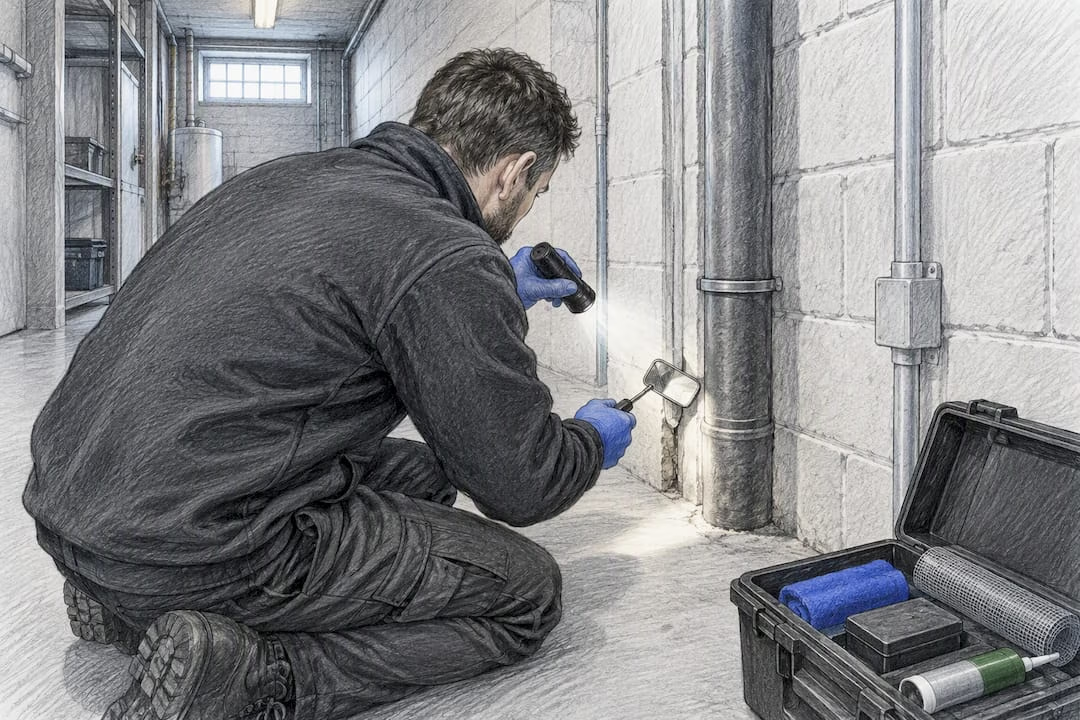
Afterwards the carcass and any soiled insulation are bagged and removed and the area disinfected. Plastering and redecoration are a separate job; BioWise also offers building maintenance for commercial and managed properties if you would rather use one contractor.
Dead rat smell treatments compared
| Treatment | When it works | Limits |
|---|---|---|
| Removing the carcass | Wherever access allows; the only permanent fix | May need a small access hole |
| Enzyme odour treatment | Applied directly to where the carcass lay or to soiled materials | Needs contact with the source; little effect through a solid wall |
| Odour-absorbing pouches | Interim control when the carcass cannot be reached; BPCA suggests about one per 10 square metres of affected space | Reduce the smell while the carcass dries out rather than remove its cause |
| Ventilation | Every case, especially lofts and floor voids | Slow on its own in sealed cavities |
| Ozone generators | Empty rooms only, run by trained operators | Harmful to people and animals, smell returns if the carcass remains; BPCA advises against them |
| Masking sprays | An hour or two | Fade quickly and fix nothing |
Health and safety precautions
For most people the smell is unpleasant rather than dangerous, but the carcass needs care. Rats can carry leptospirosis and bacteria such as Salmonella, and NHS guidance on leptospirosis advises avoiding bare-handed contact with dead animals and covering cuts with waterproof plasters. Wear disposable gloves, spray droppings and soiled areas with disinfectant and wipe them up with paper towels rather than sweeping them dry, and clear flies away from food areas. If you feel unwell after contact, speak to a GP or call NHS 111. If a pet may have eaten a dead or poisoned rodent, call your vet.
Dead rat smells in commercial and rented premises
In a workplace or managed building, a dead rodent smell is a pest control issue rather than just an odour problem: it shows rats have been using the building’s voids.
| Premises | Why it matters | What to do |
|---|---|---|
| Restaurants and food businesses | Food hygiene law requires premises maintained to keep pests out and adequate pest control procedures; flies near food are a contamination risk | Same-day contractor visit (see food business pest control), check food areas and record it in the pest file |
| Offices and hotels | Staff or guest complaints and rooms out of use | Survey ceilings, risers and service voids; take affected rooms out of use |
| Blocks and managed buildings | Shared voids mean the source may be in another flat or a common part | The managing agent coordinates access and proofs the building as a whole |
| Rented homes | Entry through disrepair usually falls to the landlord | Report it in writing (see tenant pest responsibility) |
In a commercial building the smell is never the whole story. If one rat died in a ceiling void, others used the same route, so we survey the whole run, from risers and kitchen points to bin areas and drains, and give the client a written report for their auditor or environmental health officer.
Matt Ochello, Sales Executive, BioWise
How to stop it happening again
Removing one carcass deals with today’s smell; proofing stops the next one. BPCA advises that rats only need a gap of 15mm to get into a structure, and mice can use gaps of about 6mm.
- Seal pipe and cable gaps with wire wool or steel mesh set in quick-setting cement or mortar; expanding foam on its own gets chewed through.
- Fit mesh covers to air bricks so floor voids stay ventilated but rodent-proof.
- Fit brush strips and threshold seals to external doors (see How to Rodent-Proof Exterior Doors Against Mice and Rats).
- Check the drains. Rats in walls and under floors often come from broken or disused drains, and we can arrange a CCTV drain survey and fit rat blockers; our guide to rats in drains explains who is responsible for which pipes.
The control method matters too. Indoors we often favour trapping, so carcasses are recovered rather than left in voids. Where rodenticides are needed, a trained technician uses them within the label conditions: since 1 January 2026 professional products can only be bought with proof of competence, and permanent baiting is limited to sites with a high risk of reinvasion, backed by a documented risk assessment (see Is Rat Poison Legal in the UK? The 2026 Rules Explained).
FAQ
How long does a dead rat smell last in a wall?
Usually around two weeks, sometimes longer, until the carcass dries out; a mouse often clears in one to two weeks. Cool, sealed cavities and fluids soaked into insulation or plaster stretch it out. If there is no improvement after two to three weeks, have the carcass found and removed.
Can I get rid of the smell without removing the rat?
You can reduce it with ventilation and odour-absorbing pouches while the carcass dries out, and in solid masonry that may be the sensible option. Masking sprays only cover it briefly. Where the carcass can be reached, removal plus an enzyme treatment of the spot is quicker and more reliable.
Is the smell of a dead rat harmful?
For most people it is unpleasant rather than harmful, but the carcass, flies and droppings can carry bacteria and leptospirosis. Do not handle carcasses bare-handed, ventilate the room and keep children and pets away. If you feel unwell after contact, speak to a GP or call NHS 111.
Does a dead rat in the wall mean I have an infestation?
Not always, but it shows rodents have been getting into the structure, and others may use the same route. Check for droppings, gnawing and noises, find the entry point and have it proofed. A survey after removal confirms whether there is ongoing activity.
Who is responsible for a dead rat in a rented flat?
It usually depends on the cause. If rats are getting in through disrepair or structural defects, the landlord is generally responsible for removal and proofing; problems caused by a tenant’s behaviour can fall on the tenant. Check your tenancy agreement and report it to your landlord or agent in writing.
How BioWise can help with dead rat smells
If you have a smell you cannot trace, or one that is not fading, we can find the source, remove the carcass where access allows, treat the odour and proof the route the rat used. Our BPCA-certified technicians start with the least invasive option, so walls and ceilings are only opened when the evidence points to a specific spot.
We offer same-day call-outs across every London borough, often within hours, with evening, weekend and out-of-hours cover and a 24/7 emergency response line. For homes and rented properties, see our rat control service and domestic pest control. For offices, restaurants, hotels and managed buildings, our commercial pest control contracts include monthly visits with photo reports, digital service reports for audit files, emergency call-outs and unlimited minor pest proofing, with discreet visits and unmarked vehicles on request.
BioWise is a family-run company founded in 2010, with more than 800 commercial clients and a 4.9-star Google rating. We are BPCA and NPTA members, CHAS accredited, SafeContractor approved and fully insured. Every job starts with a free survey and a fixed written quote. Call 0800 988 3568 or contact us online to book.
BioWise Pest Control Maintenance
13 Hanover Square, London, W1S 1HN
Call 0800 988 3568 or email info@biowiseservices.com