
Yes, rat poison is legal in the UK, but only authorised products may be sold and used, and always exactly as the label directs. Since 1 January 2026, anyone buying professional-use rodenticides must show proof of competence at the point of sale, while shop-bought products come in limited pack sizes and ready-to-use formats.
This guide explains how rodenticides are regulated, what the proof-of-competence rules mean for buyers, where poison can and cannot be used, what happens when it is misused and when a professional is the safer choice. We have treated rats in London homes, restaurants, offices and blocks of flats since 2010, working within the UK rodenticide stewardship rules on every job. Rodenticides sold for mice fall under the same biocides rules, so this guide applies if you need mice control too.
Key takeaways
The rules depend on who is buying and what they are buying.
| Question | Short answer |
|---|---|
| Is rat poison legal? | Yes, if the product is authorised under the GB Biocidal Products Regulation (or EU rules in Northern Ireland) and used as its label directs. |
| Can a homeowner buy it? | Yes. Amateur products are on general sale in limited pack sizes and ready-to-use formats, such as pre-filled bait stations. |
| Do I need a licence? | No licence exists. Professional products need proof of competence instead. |
| Who can buy professional products? | Since 1 January 2026, only buyers with a CRRU UK-approved certificate from the last five years, or an older certificate plus approved CPD membership. |
| Where can the strongest baits be used? | Second-generation anticoagulants (SGARs) only in and around buildings, since 1 January 2025. |
| Is permanent baiting allowed? | Not as routine practice; only where a documented risk assessment justifies it. |
| What if it is misused? | Enforcement under biocides law and, if wildlife is poisoned, possible prosecution under wildlife law. |
Table of Contents
- Is rat poison legal in the UK? The regulatory framework explained
- Proof of competence since 1 January 2026: what buyers must show
- Which rodenticides and placements are restricted
- Using rodenticides safely and staying within stewardship rules
- Enforcement and penalties for misuse
- When to call a professional instead
- Why stewardship, not restriction, is the right way to read this change
- How BioWise can help with rat control
- Where to check the rules yourself
- FAQ
Is rat poison legal in the UK? The regulatory framework explained
Rodenticides are legal, but they are classified as biocidal products, which puts them under a separate regulatory regime from ordinary household goods. In Great Britain, every product must be authorised under the GB Biocidal Products Regulation, which HSE administers; Northern Ireland follows the EU Biocidal Products Regulation instead, as HSENI’s guidance on rodenticide use and supply confirms. If you manage sites in both jurisdictions, check that the products used are authorised for each one.
The conditions of each product’s authorisation are set out on its label, which is why the label is legally binding rather than optional advice. HSE’s rodenticide guidance explains that anticoagulant rodenticides carry higher risks to people, pets and non-target wildlife than would normally be acceptable, so they are only authorised with specific risk-reduction measures, and professional use must follow the UK rodenticide stewardship regime. GOV.UK’s advice to householders makes the same point: use only permitted methods, use poison only for the pest named on the packaging, and stop other animals and birds reaching it, whether that is a hedgehog in the garden or next door’s cat.
Permanent baiting, leaving poison down indefinitely “just in case”, is not routine practice. Stewardship guidance limits it to sites where a documented risk assessment shows a high, ongoing risk of rats coming back and other measures have not been enough.
Proof of competence since 1 January 2026: what buyers must show
Since 1 January 2026, sellers of professional-use rodenticides accept only two forms of proof of competence at the point of sale, as set out on Think Wildlife, the CRRU UK stewardship site:
- Recent certification: a certificate from a CRRU UK-approved training course gained within the last five years.
- Older certification plus CPD: a certificate more than five years old, plus current membership of a CRRU UK-approved continuing professional development (CPD) scheme, which requires rodent control learning every year.
Farm assurance scheme membership on its own no longer counts. That mainly affects farmers and gamekeepers who previously relied on it, as BPCA’s briefing on the change explains. Suppliers must check the evidence and keep records at the point of sale, and the stewardship regime includes auditing of the supply chain.
If you buy professional rodenticides, check the issue date on your certificate now. If it is more than five years old and you are not in an approved CPD scheme, sort that out before your next order rather than at the counter. Homeowners buying amateur products in shops are not affected by this change, although the label rules still apply.
Which rodenticides and placements are restricted
Not every rat poison is treated the same way, and outdoor use is where most confusion happens. The most potent anticoagulants, second-generation anticoagulant rodenticides (SGARs) such as brodifacoum, bromadiolone, difenacoum, difethialone and flocoumafen, carry the tightest limits:
- Sales of SGAR products for use in open areas and at waste dumps ended on 4 July 2024.
- Since 1 January 2025, SGARs may only be used against infestations associated with a building, described in stewardship guidance as use “in and around buildings”.
- Open garden, allotment or field baiting away from a building is therefore outside permitted use for these products.
Whatever the product, the label states exactly where it may be used, and that wording takes priority over anything you read online.
Products for the public and products for professionals are also deliberately different. The table below sets out the main differences.
| Feature | Amateur (shop) products | Professional products |
|---|---|---|
| Who can buy | Anyone | Only buyers with proof of competence (since 1 January 2026) |
| Pack sizes and formats | Limited pack sizes, ready-to-use baits and pre-filled bait stations | Larger packs and a wider range of formulations |
| Where they can be used | Only where the label allows, often inside a bait box | Only where the label allows; SGARs only in and around buildings |
| Stewardship duties | Follow the label | Follow the label and the CRRU UK code of best practice, with a risk assessment and records |
That is also why searching for the “strongest rat poison” rarely helps. Shop products are designed for small, contained problems. A serious or recurring infestation usually needs a survey to find out why rats are getting in, not a stronger product.
Using rodenticides safely and staying within stewardship rules
Chemical control should never be the first move. Integrated pest management (IPM), meaning proofing entry points, removing food and water and tightening up bin storage, is the starting point in UK stewardship guidance, and it reduces both the rat problem and the risk of secondary poisoning that comes with heavy baiting.
Where bait is genuinely needed, follow this sequence:
- Read the label fully before opening the pack; permitted locations, quantities and inspection intervals vary by product.
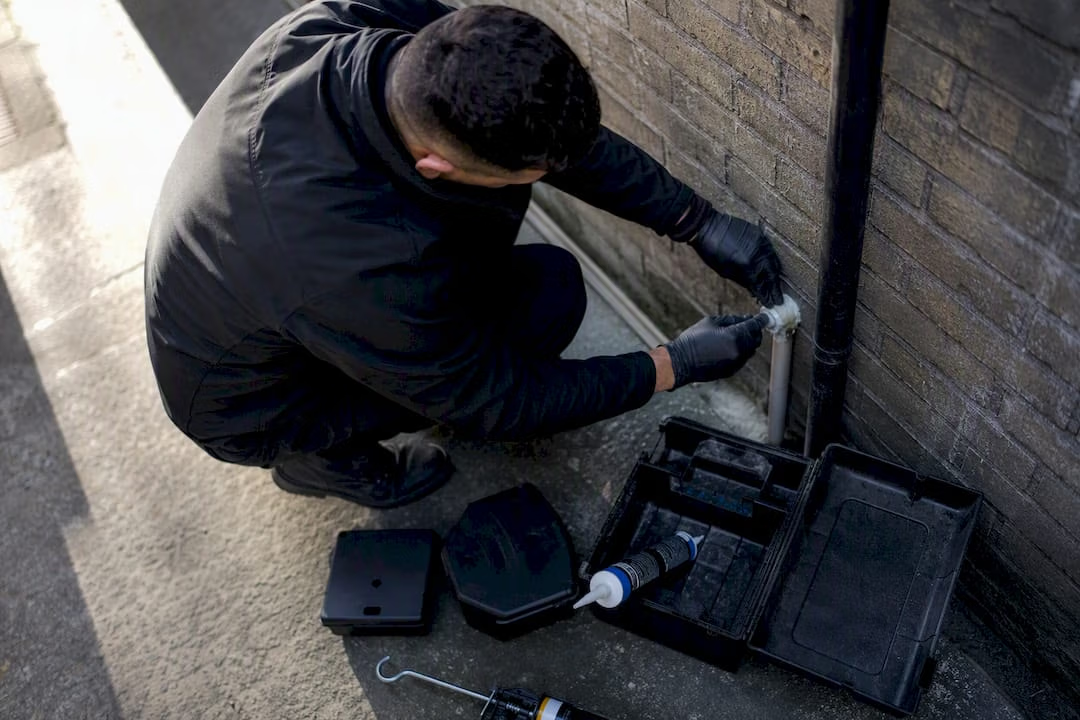
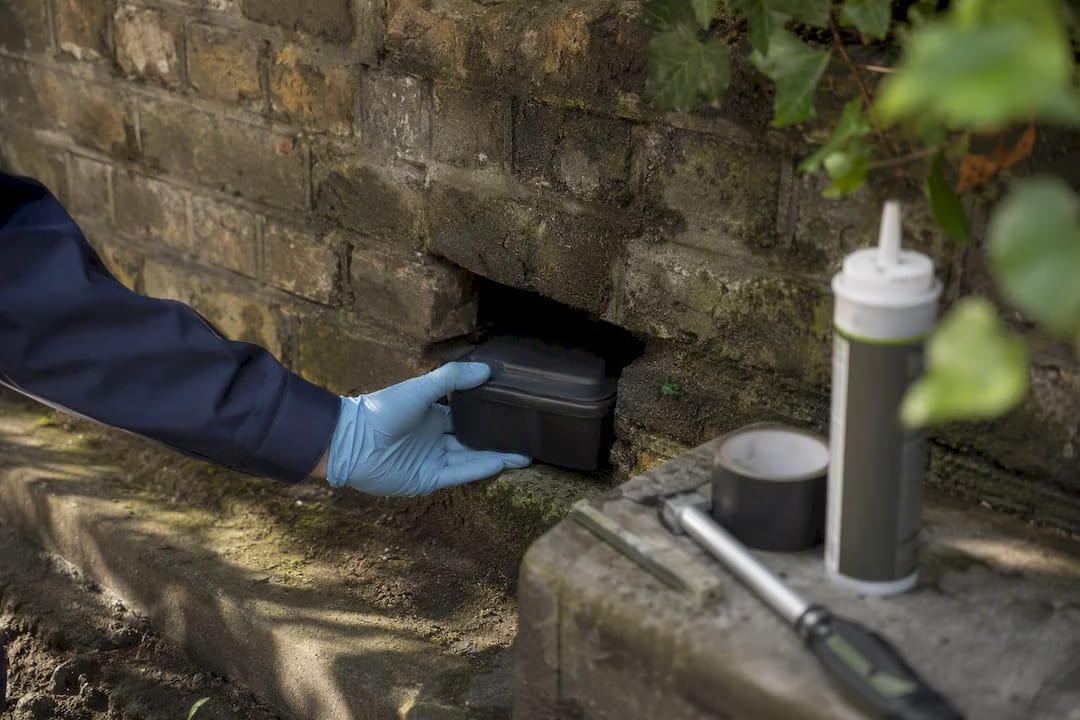
- Use tamper-resistant bait stations rather than loose bait, placed where pets, children and wildlife cannot reach them.
- Record every placement, including location, date and amount used, so you can show what was done if questioned.
- Check stations and search for dead rodents regularly, as the label directs, and remove bodies promptly so wildlife and pets cannot eat them. Our guide on how to dispose of a dead mouse safely covers safe handling.
- Remove all bait when the treatment ends rather than leaving stations down as a permanent fixture.
If you have cats or dogs, read our guide to Pet-Safe Pest Control: How to Protect Cats and Dogs before putting any bait down, and contact your vet straight away if you think a pet has eaten poison.
Pro Tip: Photograph each bait station’s location and log the date on your phone as you place it. If a council officer, auditor or landlord ever asks about your practice, a timestamped record is worth more than your memory.
Enforcement and penalties for misuse
Several authorities can act on rodenticide misuse. HSE’s biocides enforcement guidance states that failing to comply with the conditions of a biocidal product’s authorisation is an offence. Enforcing authorities can inspect premises, take samples, serve improvement and prohibition notices and prosecute. Fines are often unlimited and, in certain circumstances, an individual can face up to two years in prison.
Wildlife law adds a second layer. The Wildlife and Countryside Act 1981 makes it an offence to set out poison in a way likely to injure wild birds, and the use of poison against protected wild animals is tightly restricted. There is a defence where bait was set for purposes such as public health and all reasonable precautions were taken to protect wild birds, which is exactly what locked stations, careful placement and regular checks demonstrate. The Crown Prosecution Service lists the poisoning of birds of prey as a wildlife crime priority, so careless baiting that kills a barn owl or red kite can become a criminal matter.
Suppliers carry responsibilities too. Selling professional products without checking competence risks breaching the conditions those products are authorised under, which is why point-of-sale checks are now strict.
When to call a professional instead
DIY treatment has real limits. Persistent infestations, rats inside the building, properties with difficult access, restaurants and other food premises, and any site where pets, children or wildlife are nearby all point towards a trained, certified rat control technician rather than poison you buy yourself. If rats are active inside a kitchen, shop or home right now, our emergency pest control in London service offers same-day call-outs.
There is no such thing as a rat poison licence in the UK, so do not ask a contractor for one. Ask instead for evidence of a recent CRRU UK-approved certificate or CPD membership, BPCA or NPTA membership, public liability insurance, a written risk assessment and treatment plan, and a service report after every visit. Our guide to commercial rodent control for London businesses covers what that evidence should look like. For food businesses, those records also help show an environmental health officer that pests are under control.
Not sure whether you have rats or mice? Our guide to Mouse vs Rat Droppings: How to Tell the Difference helps you confirm what you are dealing with before you buy anything.
Why stewardship, not restriction, is the right way to read this change
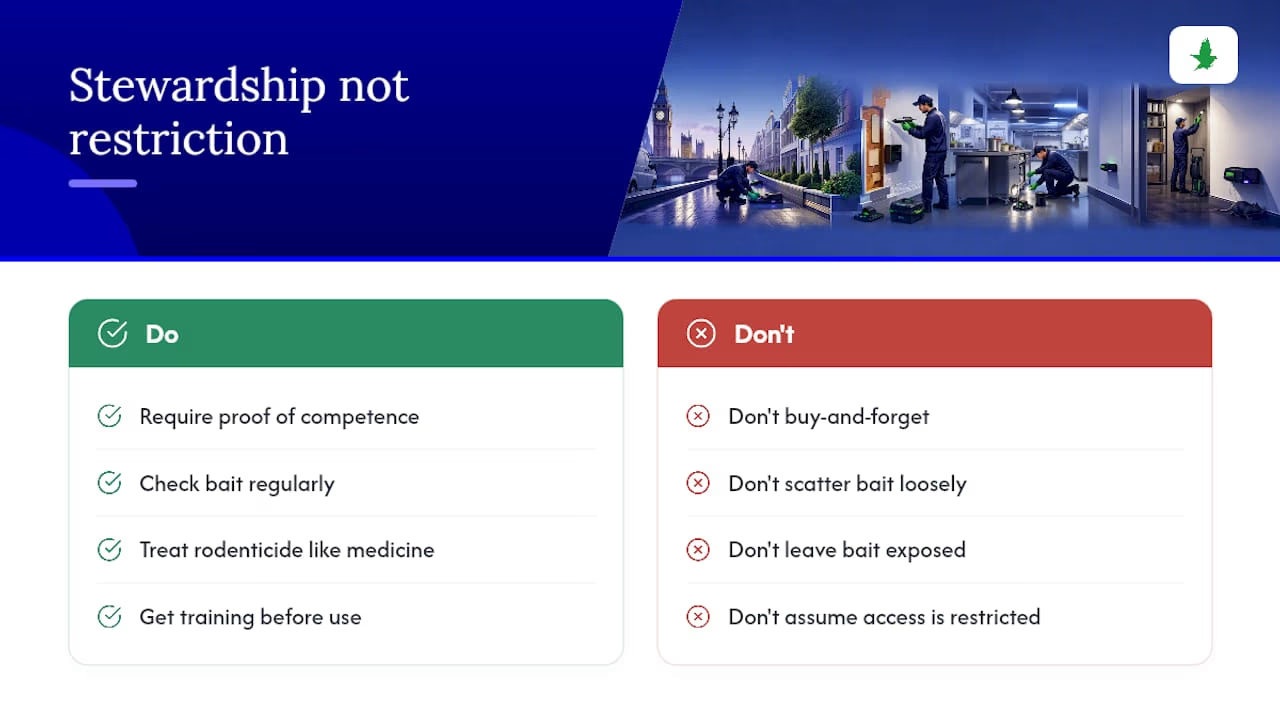
People hear “tighter rules” and assume rat control is getting harder to access. It is not. What the stewardship regime is closing down is “buy-and-forget” poisoning, where someone scatters bait loosely and never checks it again. That habit drives secondary poisoning in barn owls, other wildlife and pets, and it has been a problem for years.
Most rodenticide misuse is not malicious, just untrained. A homeowner who would never overdose a pet with medicine will leave anticoagulant bait exposed in a shed because nobody explained why it matters. The proof-of-competence rules will not stop genuine rat problems being solved; they stop the careless use that causes wildlife incidents.
“Poison is the last part of a rat job, not the first. On most London call-outs the real fix is finding the gap under a door, a broken air brick or a damaged drain and sealing it. When we do use bait, it goes into locked stations, every station is logged and it all comes out again once the activity stops.”
Ben, Lead Technician, BioWise
How BioWise can help with rat control
If you have rats and would rather not buy, place and record poison yourself, our BPCA-certified technicians handle the whole process within the UK rodenticide stewardship rules. We survey the property, find how rats are getting in, proof the entry points and, only where needed, set up tamper-resistant bait stations with a written record of every placement and visit.

See our rat control and domestic pest control services. For restaurants, offices, managing agents and landlords, our commercial pest control contracts include monthly visits with photo reports, digital service reports for EHO and audit files, emergency call-outs and unlimited minor pest proofing. We offer same-day call-outs across every London borough, including central London, north London, east London, south London and west London, plus a 24/7 emergency response line.
BioWise is a family-run London company founded in 2010, a member of the BPCA and NPTA, CHAS accredited and SafeContractor approved. Call 0800 988 3568 or contact us online for a fixed written quote after a free survey.
BioWise Pest Control Maintenance
13 Hanover Square, London, W1S 1HN
Call 0800 988 3568 or email info@biowiseservices.com
Where to check the rules yourself
These official and industry sources set out the rules in full:
- Rodenticides – HSE
- Biocides enforcement – HSE
- Rodenticide use and supply – HSENI
- Training and certification – Think Wildlife (CRRU UK)
- CRRU UK prepares rodenticide users for 2026 certification requirements – BPCA
- Wildlife offences prosecution guidance – CPS
- Pest control on your property – GOV.UK
This article is general information, not legal advice. Speak to a qualified legal professional about your own circumstances before acting on it.
FAQ
Can I put rat poison in my garden in the UK?
Only where the product label allows it, and usually only inside a tamper-resistant bait station. Professional SGARs may only be used in and around buildings, so open garden, allotment or field baiting away from a building is not permitted. Never scatter loose bait, and keep stations where pets, children and wildlife cannot reach them.
Do you need a licence to buy rat poison in the UK?
No licence exists. Amateur products in limited pack sizes are on general sale. Since 1 January 2026, buying professional rodenticides requires proof of competence: a CRRU UK-approved certificate gained within the last five years, or an older certificate plus current membership of an approved CPD scheme.
Has any rat poison been banned in the UK?
Every rodenticide must be authorised, so any product without a GB authorisation (or EU authorisation in Northern Ireland) cannot legally be sold or used. SGARs are restricted rather than banned: products for open areas and waste dumps were withdrawn from sale in July 2024, and since January 2025 SGARs may only be used in and around buildings.
Does shop-bought rat poison work?
It can deal with a small, recent problem if you follow the label and seal the entry point. It rarely solves an established or recurring infestation, because the cause is usually a gap, a damaged air brick or a drain defect that poison does not fix. Finding and proofing the way in matters more than the product.
What should I do if my pet eats rat poison?
Contact your vet straight away, even if your pet seems well, because the effects of anticoagulant poisons can take several days to appear. Take the packaging or product name with you so the vet knows what was eaten. To reduce the risk, use only tamper-resistant bait stations and place them where pets cannot reach.