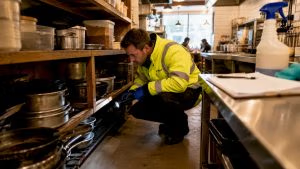


Mouse droppings are about 3-6mm long, thin and pointed at the ends, like a grain of rice; rat droppings are about 12-18mm long, thicker and capsule-shaped with blunter ends. Mice scatter droppings as they move, while rats tend to leave them in small piles along their regular routes.
This guide covers size, shape and colour, what the pattern and location of droppings tell you, common lookalikes, how to clean droppings up safely and what to do next. We have identified and treated rodent activity in London homes since 2010, and in restaurants, offices and warehouses through our commercial pest control work. Droppings are usually the first clue we follow.
Table of Contents
- Mouse vs rat droppings: size, shape and colour at a glance
- What the ends, texture and contents reveal
- Where droppings turn up and what the pattern tells you
- Common lookalikes and how to rule them out
- Health risks and how to clean droppings up safely
- What to do after you’ve identified droppings
- What BioWise sees on site: droppings as a map, not just evidence
- How BioWise can help with mice and rats
- Sources
- FAQ
Mouse vs rat droppings: size, shape and colour at a glance
Size is the fastest sorting tool you have. Cherwell District Council’s guide to telling rats and mice apart puts mouse droppings at around 3-6mm and rat droppings at 12-18mm. Shape backs this up: mouse droppings are slender and pointed at the ends, while rat droppings are thicker and capsule-shaped, closer to a raisin or an olive stone, with blunter ends.
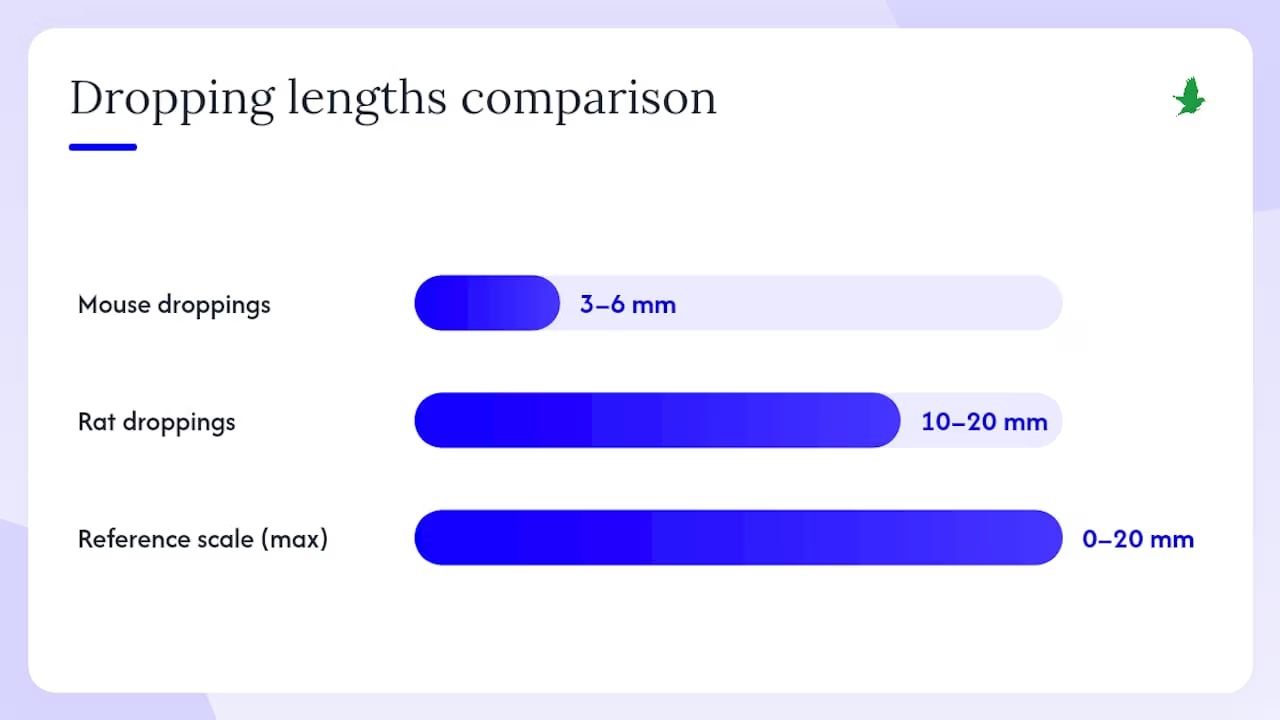
Colour tells you how fresh the droppings are, not which species left them. Both start off dark, almost black, and glossy when moist. Within a few days they dry out, turning dull grey or brown and crumbling easily. A soft, shiny dropping means recent activity nearby; a dry, crumbly one could be weeks old.
Distribution matters as much as the dropping itself. Mice produce droppings as they move, leaving them scattered along their paths and in small clusters near food. Rats are more habitual; they often return to the same spots, building up small piles or latrines along established runways. A concentrated heap rather than a scattered trail is one of the strongest clues that you are dealing with rats, not mice.
| Feature | Mouse droppings | Rat droppings |
|---|---|---|
| Typical length | About 3-6mm | About 12-18mm |
| Shape | Slender, pointed at the ends, like a grain of rice | Thicker, capsule-shaped with blunter ends, like a raisin |
| Usual pattern | Scattered along paths, small clusters near food | Small piles or latrines along runways |
| Usual locations | Cupboards, behind appliances, along skirting boards, lofts | Near drains, along walls, under floors, near bins and burrows |
| What a lot of droppings suggests | Regular foraging, possibly a nest close by | An established route from an entry point, often linked to drains |
What the ends, texture and contents reveal
Length alone will not always settle the question, particularly with old droppings that have dried out, shrunk or crumbled. The shape of the ends is a useful second check: pointed in mice, blunter in rats. Texture then tells you age, which matters as much as species when you are deciding how urgent the problem is.
Professionals sometimes examine what a dropping contains. Rodent droppings often hold fragments of hair and food debris, while rabbit and deer droppings are made of compacted plant fibre. You do not need to do this yourself: breaking droppings open raises dust, and in most cases size, shape and location are enough.
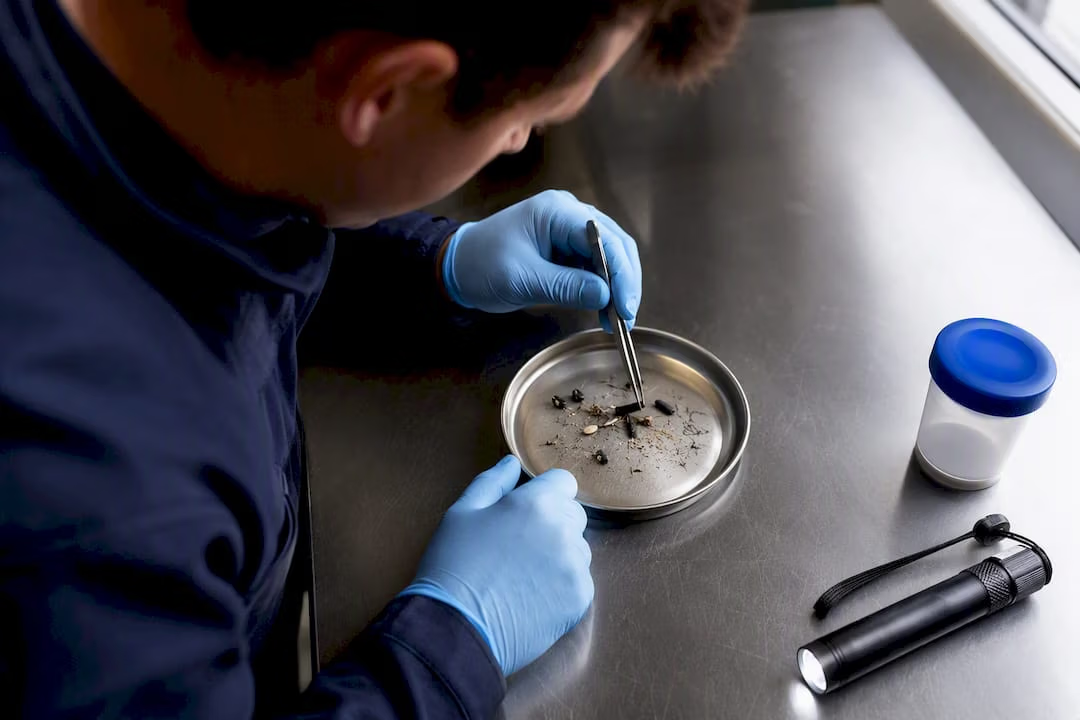
Pro Tip: Photograph two or three fresh droppings next to a ruler or coin before you clean anything up. That image gives you, or a pest professional, a reliable record for remote advice, since dried droppings found weeks later can look deceptively small and lead to a mouse diagnosis when rats are actually present.
A few practical checks worth building into any inspection:
- Compare at least two or three droppings; a single outlier can mislead you.
- Note whether they are soft and glossy (fresh) or dull and crumbly (old).
- Look for other signs nearby, such as gnaw marks, grease smears, nesting material or footprints in dust.
- Photograph everything with a scale object before cleaning the area.
Where droppings turn up and what the pattern tells you
Location narrows the diagnosis almost as well as the dropping itself. Mice favour tight, sheltered spots close to food: inside cupboards, along skirting boards, behind kitchen appliances and in loft insulation. Rats stick closer to structural routes and moisture: near drains, along exterior walls, under floors, close to burrow entrances and around bins. In commercial kitchens, check dry stores, the voids under cooking lines and equipment, behind fridges and around bin areas. Droppings in a restaurant kitchen need action the same day and a note in your food safety records; see our restaurant pest control service.
Reading the pattern tells you roughly how serious the problem is:
- Widely scattered small droppings across several rooms usually point to mice foraging.
- A concentrated pile or latrine in one corner, especially near a wall gap or drain, is a classic sign of rats using an established runway.
- A trail of droppings connecting two points, often with grease smears along the walls, confirms a regularly used route rather than a one-off visit.
- Droppings alongside gnaw marks, shredded nesting material or a strong ammonia smell suggest an active infestation rather than a single passing animal.
Common lookalikes and how to rule them out
Not everything that resembles a rodent dropping is one. These are the lookalikes we come across most often:
- Water vole droppings are about 7-10mm long, according to RSPB biosecurity guidance, so they sit between mouse and rat in size. They are more evenly rounded at both ends and are left in latrines beside rivers, ponds and ditches, not inside buildings. Water voles are protected under the Wildlife and Countryside Act 1981, so never put down poison or traps where they may live.
- Bat droppings in lofts are similar in size to mouse droppings but are dry and crumble into a powder of insect fragments. Bats and their roosts are protected by law, so if you suspect bats, get advice before any treatment or loft work.
- Cockroach droppings are much smaller, like ground pepper or coffee grounds, and often appear as dark smears near harbourages. If that sounds familiar, see our cockroach control page.
- Rabbit droppings are round, fibrous and usually found outdoors on grass.
Indoors, assume mouse or rat until proven otherwise. If droppings turn up in a food business, warehouse or other sensitive site, or the sample looks genuinely unusual, send clear photos with a scale object to a professional rather than guessing.
Health risks and how to clean droppings up safely
Rodent droppings and urine carry more risk than most people assume. UKHSA guidance on reducing the risk of infection from rodents warns that breathing in dust from dried droppings and urine can spread infection, and names leptospirosis, hantavirus, rat-bite fever and LCMV among the infections rodents can carry. Rodents can also spread bacteria such as Salmonella and E. coli onto food and surfaces. Serious illness is uncommon, and UKHSA describes the risk of hantavirus to the public as very low, but leptospirosis (Weil’s disease), spread mainly through rat urine, is worth taking seriously.
The safe approach is straightforward and worth following every time, not just for large finds:
- Ventilate the room before you start and keep children and pets out of the way.
- Wear rubber gloves and, ideally, an FFP1 or FFP2 dust mask, as UKHSA recommends.
- Never sweep or vacuum droppings, urine or nests, as this can put infectious material into the air.
- Spray the droppings with water or disinfectant, then wipe them up with damp kitchen towel.
- Bag the waste, tie it off and put it in your general rubbish bin, then disinfect the surface.
- Wash your hands thoroughly with soap and water, even if you wore gloves.
Take extra care if young children, pregnant people or anyone with a weakened immune system uses the space, and ask someone else to do the clean-up where possible. If you develop flu-like symptoms in the weeks after contact with rodents or their droppings, contact your GP or NHS 111 and mention the exposure. Large build-ups in lofts or voids, especially in insulation, are best removed by a professional as part of a treatment.
What to do after you’ve identified droppings
Once you know roughly what you are dealing with, act on it. Photograph and measure a few droppings, protect food and pet bowls, and clean up safely using the steps above.
- Seal obvious gaps. Mice can get through gaps of about 6mm and rats about 15mm, so check around pipework, vents, air bricks and exterior doors first.
- Remove food sources. Store food in sealed containers, clear up spills and tidy cluttered storage where droppings were found, since both species return to reliable feeding spots.
- In a food business, act straight away. Discard any food or packaging that may be contaminated, clean and disinfect the area, record what you found and what you did, and call your pest control contractor. If you do not have one, our emergency pest control in London service offers same-day call-outs.
Pro Tip: Rats are usually harder to shift than mice because they are wary of new objects, including traps and bait stations, whereas mice explore readily but can use smaller gaps. That difference is why a rat problem usually calls for a professional sooner than a mouse one does.
Call a professional when fresh droppings keep reappearing, when you find a concentrated latrine rather than scattered droppings, when you spot gnawed wiring or structural damage, or when the property is a commercial kitchen, hotel or home with vulnerable occupants.
What BioWise sees on site: droppings as a map, not just evidence
A single dropping rarely tells the whole story; the pattern around it does. Droppings marking a runway between a gap and a food source usually lead straight to the proofing point, and sealing that route alongside targeted treatment holds up far better than trapping alone. That is why our technicians map runways and latrines on every survey, in homes and businesses alike.
“I treat droppings as a map. Fresh ones show me where rodents are active now, the trail shows me which way they are travelling, and it nearly always leads back to the gap they are using. Catch the animals without sealing that gap and another one will usually find it within weeks.”
Ben, Lead Technician, BioWise
How BioWise can help with mice and rats
If you keep finding droppings and are not sure what is leaving them, our BPCA-certified technicians confirm the species, trace the droppings back to the entry points and set up a treatment and proofing plan that follows the UK rodenticide stewardship rules. Where droppings have built up in lofts or voids, we can remove the contaminated material as part of the treatment.

See our mice control and rat control services, or domestic pest control for homes. For restaurants, offices, landlords and managing agents, our commercial pest control contracts include monthly visits with photo reports, digital service reports for EHO and audit files, emergency call-outs and unlimited minor pest proofing.
Before you call, take a few clear photos of the droppings next to a ruler or coin, and note where you found them and roughly how many. BioWise is a family-run London company founded in 2010, a member of the BPCA and NPTA, CHAS accredited and SafeContractor approved, with same-day call-outs across every London borough. Call 0800 988 3568 or contact us online for a fixed written quote after a free survey.
BioWise Pest Control Maintenance
13 Hanover Square, London, W1S 1HN
Call 0800 988 3568 or email info@biowiseservices.com
Sources
- Reducing the risk of human infection from pet rodents – UKHSA (GOV.UK)
- Rats and mice – telling the difference, Cherwell District Council
- Mouse control: how to get rid of and prevent mice – BPCA
- Rat control: how to get rid of and prevent rats – BPCA
FAQ
How can I tell if droppings are from a mouse or a rat?
Measure them. Mouse droppings are about 3-6mm long, slender and pointed at the ends, while rat droppings are about 12-18mm long, thicker and blunter, closer to a raisin. Pattern helps too: mice scatter droppings as they move, whereas rats tend to leave small piles along regular routes.
What should a business do if it finds rodent droppings?
Treat it as active until proven otherwise. Discard any food or packaging that may be contaminated, clean and disinfect the area without sweeping, record what you found and call your pest control contractor. Food businesses must have adequate procedures to control pests, so an environmental health officer will expect prompt action and records.
Are rats easier to get rid of than mice?
Generally not. Rats are wary of new objects such as traps and bait stations, so treatment can take longer, and their droppings often point to drain or structural problems. Mice explore readily but can get through gaps of about 6mm, so proofing has to be thorough. Each species needs a slightly different approach.
What else could be mistaken for rat droppings?
Water vole droppings, at about 7-10mm, are close in size but evenly rounded and found beside water, not indoors; water voles are protected, so never bait near them. Bat droppings in lofts crumble to powder, cockroach droppings look like ground pepper and rabbit droppings are round and fibrous.
Is it safe to clean up rodent droppings myself?
Usually, for small amounts. Ventilate the room, wear rubber gloves and ideally an FFP1 or FFP2 mask, spray the droppings with water or disinfectant and wipe them up with damp kitchen towel. Never sweep or vacuum them. Bag and bin the waste, disinfect the surface and wash your hands afterwards.