

For pigeons on a London commercial building, netting, spikes and tensioned wire systems are the deterrents that hold up. Gulls need parallel wires or netting, because spikes do little against a bird that lands on flat roofs and parapets. Sonic devices rarely work in a city, where birds quickly learn to ignore noise that never leads to anything. Whatever you choose, the law on wild birds, the nesting season and listed building controls decide when and how the work can be done.
This guide is for property managers, facilities teams and owners of commercial and listed buildings. It compares the main options, explains the legal points that catch people out, and shows how bird proofing connects to damp, drainage and the wider pest picture on your site.
Key takeaways
- Match the deterrent to the bird and the surface: netting for open voids and recesses, spikes and wires for ledges and parapets, gel and electric track only where they suit the fabric.
- Wild birds and their active nests are protected. Plan installation outside the nesting season (February to August) and never disturb a nest in use.
- General licence GL41 can cover action against feral pigeons but not gulls, so a gull problem needs a different route.
- Listed buildings may need consent before anything is fixed to the structure. Ask your conservation officer first.
- Deterrents fail when food, water and roosting spots remain. Blocked gutters, leaking flat roofs and waste handling matter as much as the hardware.
Which bird deterrent works for which problem
The right choice starts with identifying the species and the exact place they use. Feral pigeons roost and nest on ledges, in window recesses, under canopies and in plant enclosures. Gulls, increasingly common on London flat roofs, nest on roofs and parapets and defend them aggressively. Starlings and sparrows exploit small gaps in soffits and signage.
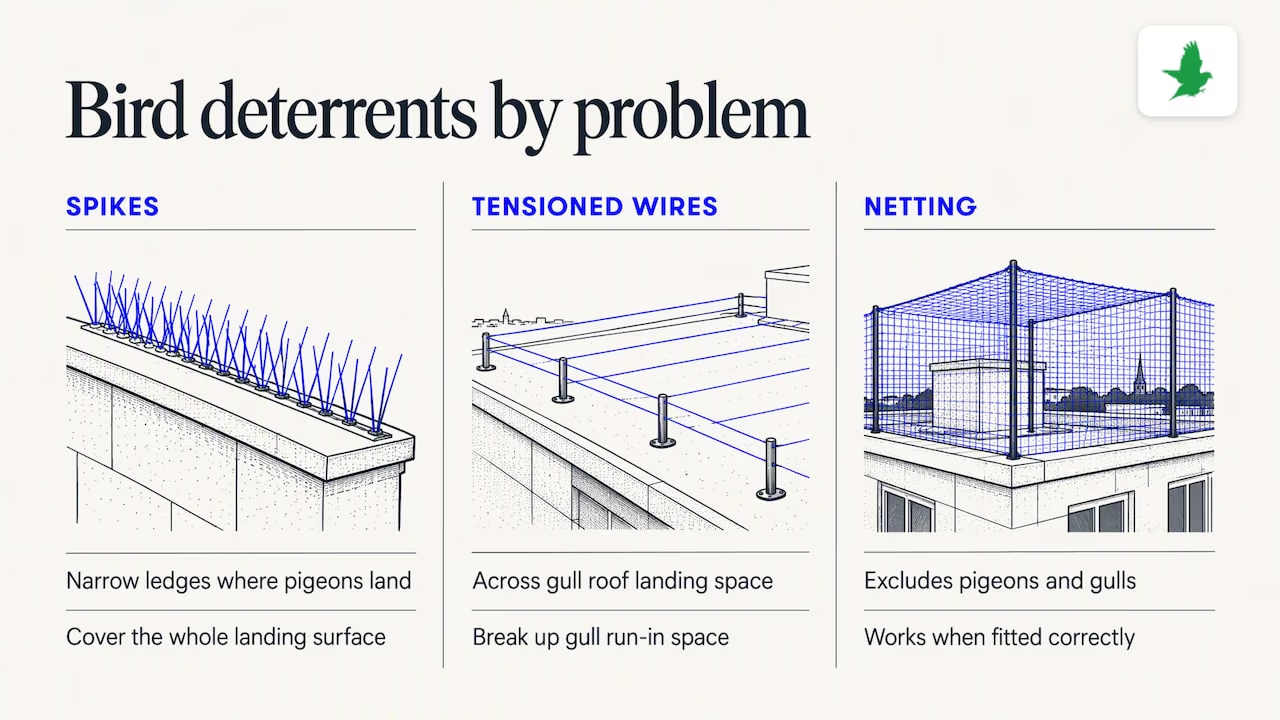
A deterrent that suits one of these can be useless against another. Spikes, for example, suit a narrow ledge where pigeons land, but gulls can settle on a roof surface that spikes cannot sensibly cover. Wires set parallel and tensioned across a roof break up the run-in space a gull needs, and netting excludes both species completely when it is fitted correctly.
Comparing the options
Historic England publishes guidance on managing birds on historic buildings, and it sets out the same range of techniques that we use in practice: netting, spikes, wires, coils, gel, electric track, falconry and sonic devices. The table below summarises how they compare in general terms. Exact lifespan depends on exposure, fixings and maintenance, so treat it as a guide and ask for a written specification for your building.
| Method | Best use | Typical lifespan | Visual impact |
|---|---|---|---|
| Netting | Recesses, voids, courtyards, plant areas, under canopies. The only option that fully excludes birds | Long when fixed to sound fabric and inspected regularly | Low to moderate from the street if fitted tight and colour-matched |
| Spikes | Narrow ledges, sills, cornices, signs and pipework, mainly for pigeons | Long, but needs cleaning where debris builds up | Moderate, more visible on ornate stonework |
| Tensioned wires | Parapets, ridges, flat roofs, rails. Suits pigeons and gulls | Long when kept tight | Low, the thin wire is hard to see |
| Coils | Pipes, rails and narrow edges | Medium to long | Low to moderate |
| Gel | Small, sheltered areas only | Short, needs reapplying and can attract dirt | Can stain porous stone, so poor on many older buildings |
| Electric track | Ledges where a firm, low-profile deterrent is needed | Long if powered and maintained correctly | Low to moderate |
| Falconry | Open sites and short campaigns, as part of a wider plan | Only works while the programme runs | None on the building |
| Sonic devices | Rarely effective in cities | Birds habituate quickly | None |
Netting
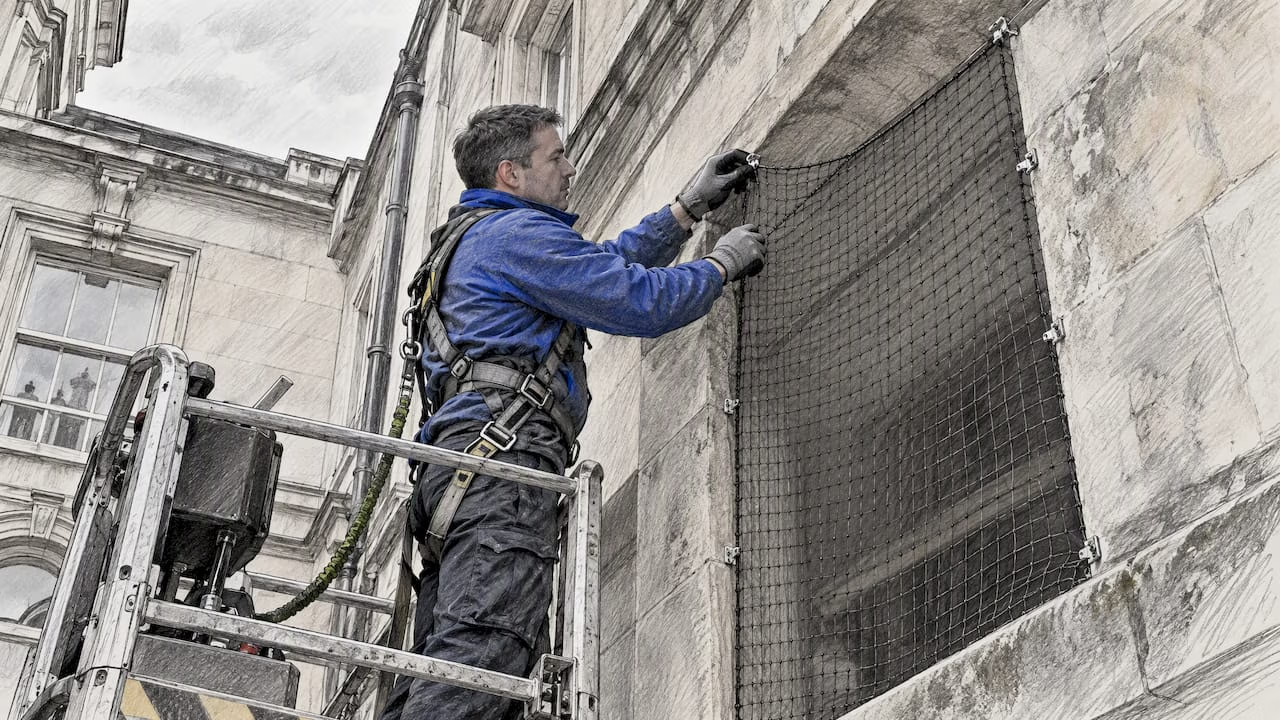
Netting is the most reliable answer where birds are using a void, a recess or a whole roof area. It physically stops access, so it does not depend on the bird’s behaviour. The weak points are poor tensioning, gaps at the edges and fixings that damage masonry. On older buildings, netting is often fixed with systems that avoid drilling into decorative stone, and that detail is worth specifying in advance.
Spikes
Spikes are the familiar choice for pigeons on ledges. They work when the ledge is narrow enough that the spikes cover the whole landing surface. If a bird can find a gap, it will nest among the spikes using debris, so spikes need inspection and cleaning. They are not suitable for every surface and they can look intrusive on a prominent frontage.
Tensioned wire systems
Wire systems are discreet and effective on parapets, rooflines and flat roofs. Their advantage on gull-affected buildings is that parallel wires over a roof deny the space birds need to land and walk. Performance depends on correct spacing and tension, which is why this is a job for trained installers rather than a quick fix.
Coils, gel and electric track
Coils suit pipes and rails. Gel is a short-term measure and can mark porous stone, so we would be cautious about it on a heritage facade. Electric track gives a firm deterrent on ledges where it can be powered safely, though it needs maintenance and a sound electrical installation.
Falconry and sonic devices
Falconry can reduce numbers while it is running, but the birds return when it stops, and it works best on open sites as part of a wider plan. Sonic devices are the weakest option on a busy London street. Pigeons and gulls are used to traffic, building services and crowds, and they tend to ignore a repeated noise that never harms them.
What the law says about birds on your building
The legal position shapes the schedule of any bird proofing project, so check it before you book contractors. For a plain-language summary of the framework we work within, see our page on pest control laws in the UK. The key points for commercial buildings are these.
- Wild birds and active nests are protected. You cannot lawfully destroy or disturb a nest in use by a wild bird, and that includes pigeons’ nests except under licence conditions.
- Install outside the nesting season. The nesting season runs from February to August. Netting and spikes fitted in the autumn and winter avoid trapping birds or sealing a nest. If you find an active nest on site, stop work on that area and take advice.
- GL41 and feral pigeons. Natural England’s general licence GL41 can cover certain action against feral pigeons, but it does not cover gulls. Gulls therefore need a different approach, usually deterrence and exclusion before they settle, or an individual licence where the situation justifies one. Read the current licence terms before relying on it, as general licences are reviewed and can change.
- Listed buildings may need consent. Fixing netting, spikes or wires to a listed building can count as an alteration that affects its character, so you may need listed building consent. Speak to the local authority’s conservation officer before the work is specified.
We recommend you keep a written record of when you inspected the area, what you found and when you installed the deterrent. If an enforcement or insurance question arises later, that record is your evidence.
Listed and older buildings: protect the fabric first
The fabric of an older building is often more vulnerable to the cure than to the birds. Drilled fixings can let water into stone and brick. Adhesive pads and gel can mark surfaces. Historic England’s joint position statement on investigating moisture in traditional buildings is a useful reminder that any work on a traditional structure should start by understanding how the building handles moisture, rather than applying a quick intervention.
In practice, for a listed building we would look for:
- Non-invasive fixings, such as clips, adhesive-free brackets or fixings into mortar joints rather than the masonry itself.
- Colour-matched netting and fine wire that keep the visual impact low.
- Reversible installation, so the system can be removed without lasting damage.
- Written approval from the conservation officer before the first fixing goes in.
Birds, damp and the wider pest picture
Birds and damp are linked more often than people expect. Nests and droppings block gutters, downpipes and roof outlets. Overflowing water then runs down the wall or into the roof void, producing the kind of persistent moisture that damages materials and attracts insects and rodents. Droppings and nesting material left in a void also give other pests food and shelter.
That is why a bird proofing visit should include a look at the water. Check the following when you inspect:
- Gutters, hoppers and flat roof outlets for nest material and debris.
- Staining or damp patches below ledges and parapets where birds have been roosting.
- Roof voids and plant areas where birds have gained access.
- Bin stores and waste areas that offer birds food.
If you manage a food business or a building with catering tenants, the Food Standards Agency’s guidance on food business premises expects premises to be kept in good repair and protected against pests, with holes and gaps dealt with and waste managed quickly. Open vents, broken louvres and unscreened windows are routes for birds as well as for rodents. For how this works alongside rodent work, see our guide to commercial rodent control for London businesses and our pest-proofing checklist for UK properties.
How to choose a bird control approach
Use these criteria when you compare proposals, whatever type of contractor you speak to.
- Species and location. The proposal should name the birds, show where they roost and nest, and explain why the chosen method suits them.
- Timing. Installation should avoid the nesting season, with a plan for any active nest found.
- Building type. For a listed or older structure, the specification should address consent and the fixings.
- Access and safety. Work at height needs proper access equipment and a risk assessment. Ask how the team will work safely over the public highway.
- Cleaning. Droppings can carry health risks, so ask who will clear and disinfect the area before proofing and how the waste is handled.
- Aftercare. Netting and wires need inspection. Ask about follow-up visits and what happens if a system fails.
- Qualifications. Ask for evidence of training and membership of a recognised body such as the British Pest Control Association.
Our perspective
Most of the bird problems we are asked about start as a maintenance problem. A blocked gutter, a broken vent cover or an untidy bin store gives birds a reason to stay, and a deterrent added on top of that rarely lasts. We prefer to deal with access first through proofing, then fix the conditions that attract birds, and only then choose the lightest deterrent that will do the job on that surface.
As a family-run London company, we also see how different each building is. A glass-fronted office, a listed hotel frontage and a restaurant with a rooftop plant area need different answers, and a single product does not suit them all. That is why we survey first and quote against what we find, and why we treat proofing as part of ongoing site care rather than a one-off purchase.
— Anna Hasula
Where BioWise can help
If pigeons are roosting on your building, our team can survey the site and advise on proofing that suits the fabric and the season. Read more about pigeon proofing in London, or see our commercial pest control plans, which start from £100 per quarter, with individual visits from £60 one-off. For an urgent problem, our emergency pest control service is available. Where a building also needs repairs to gutters, roofs or decoration, our building maintenance team can help.
FAQ
Do sonic bird deterrents work in London?
Rarely. Birds in a busy city are used to constant noise and quickly learn that a repeated sound is harmless. Physical methods such as netting, wires and spikes give far more dependable results.
Can I remove a pigeon nest from my building?
You should not disturb an active nest, because wild birds and their nests in use are protected. Wait until it is no longer active, then clear the area and proof it outside the nesting season. Our guide to UK pest control law explains the framework, and you should check current licence terms before acting.
Does GL41 let me deal with gulls?
No. GL41 can cover action against feral pigeons, but it does not cover gulls. For gulls, prevention through wires or netting before nesting begins is the safest route, and anything more needs the correct licensing.
Do I need permission to fit bird netting on a listed building?
Possibly. Anything that alters the character of a listed building may need listed building consent. Contact the local authority’s conservation officer before you specify fixings or colours.
When is the best time to install bird proofing?
Outside the nesting season, which runs from February to August. Autumn and winter give the cleanest window, so planning in October for the quieter months suits most commercial sites.
Sources
- Historic England: Investigation of moisture and its effects on traditional buildings
- Food Standards Agency: Setting up your food business premises
- British Pest Control Association