

TL;DR:
- Placing only traps without environmental management fails to control rodents effectively, risking health, legal, and reputational damage.
- Professional, integrated pest management involves exclusion, sanitation, monitoring, and baiting to prevent infestations proactively.
Placing a few snap traps around the back of your premises and calling it a pest control strategy is a mistake that costs London businesses far more than they expect. Rodent infestations carry serious health, legal, and reputational risks, and traps alone consistently fail when environmental factors like food sources, moisture, and entry points go unaddressed. With commercial rodent control explained properly, you can see why a professional, integrated approach is not a luxury. It is the baseline standard your business needs to operate safely and stay compliant. The same principles apply to rat control in London and mouse control on commercial premises, from restaurant kitchens to managed office blocks.
Key takeaways
| Point | Details |
|---|---|
| Traps alone are insufficient | Effective rodent control addresses food sources, moisture, and entry points alongside trapping. |
| IPM is the professional standard | Integrated Pest Management combines exclusion, sanitation, monitoring, and baiting for lasting results. |
| Contracts outperform reactive callouts | Scheduled visits, digital reporting, and ongoing monitoring prevent infestations before they escalate. |
| Compliance requires documentation | COSHH and BRC audits demand verifiable, time-stamped records that digital systems provide reliably. |
| Technology accelerates response | Smart traps and digital dashboards enable real-time alerts and data-driven risk assessments across multiple sites. |
Commercial rodent control explained: the full process
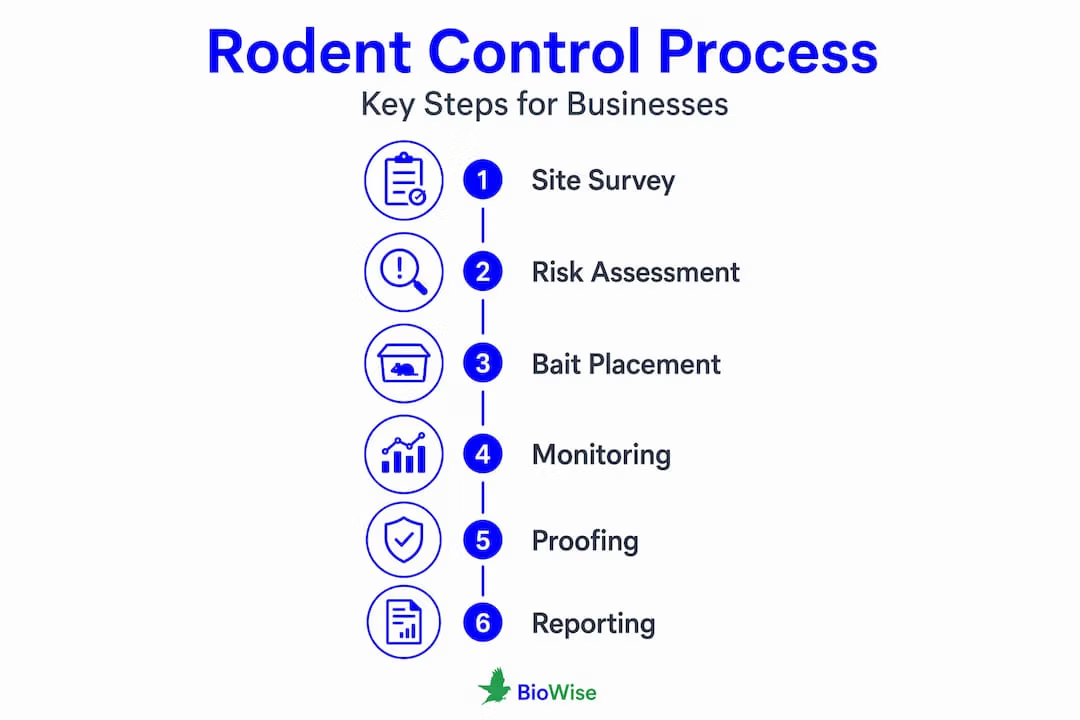
Professional commercial rodent control follows a structured sequence, not a single visit. A well-designed programme includes an initial inspection, bait placement, exclusion work, ongoing monitoring, and full documentation at every stage. Understanding each phase helps you hold your provider accountable and know exactly what your contract should deliver.
Initial site survey and risk assessment
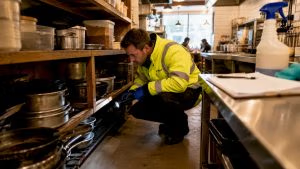
Every professional engagement begins with a thorough site survey. A qualified technician inspects your premises to identify active signs of rodent activity (droppings, gnaw marks, smear trails), assess structural vulnerabilities, and map the areas of highest risk. In a London restaurant kitchen, that might mean checking pipe runs, drainage covers, and goods delivery areas. In a managed office block, it could involve inspecting sub-floor voids and external bin stores. This survey forms the basis of your entire control plan.
Bait station placement and mapping
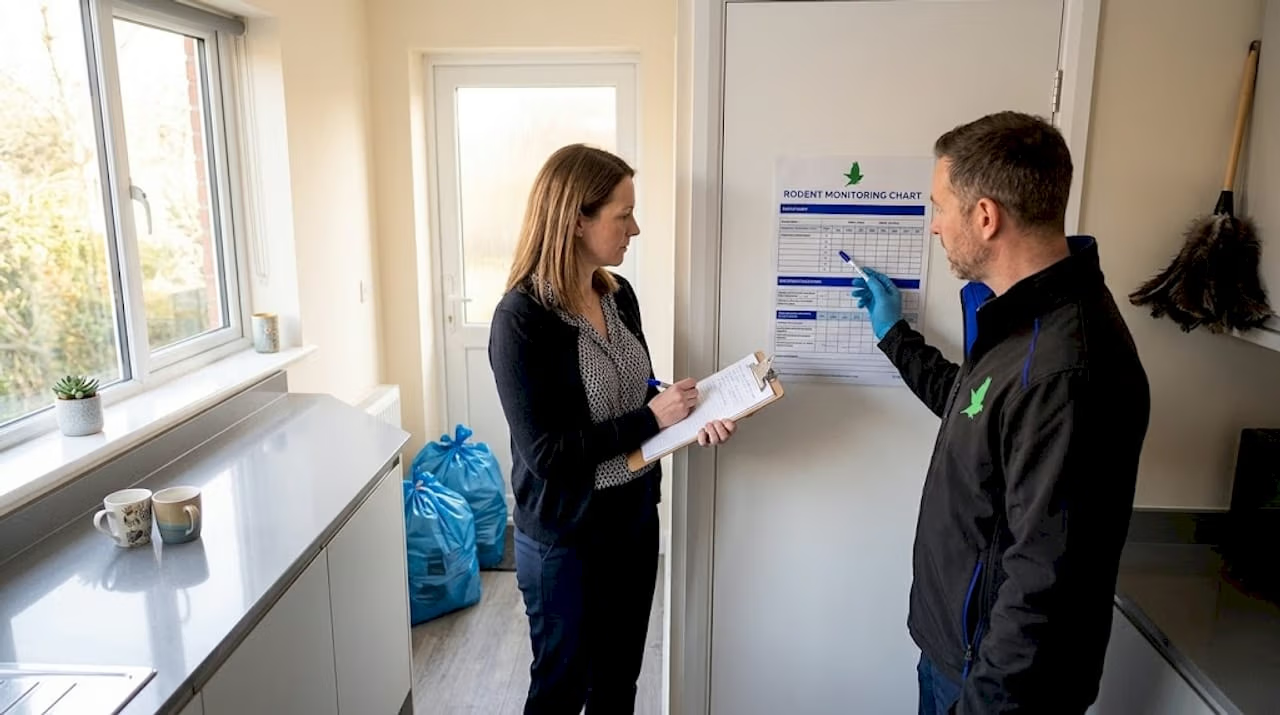
Following the survey, bait stations and traps are placed strategically at identified risk points. Each station is numbered, mapped, and recorded so that every subsequent visit can be checked against a known baseline. This mapping process matters more than most clients realise. If a station is repeatedly disturbed or bait is consistently consumed, it signals active pressure in that zone and prompts an escalated response rather than a routine check.
The key steps in an ongoing service visit typically include:
- Checking and replenishing bait stations according to the site map
- Inspecting for new signs of activity or structural changes since the last visit
- Updating digital records with findings, bait usage, and technician observations
- Recommending remedial action such as additional proofing or sanitation measures
- Issuing a digital service report to the client immediately after each visit
Pro Tip: Ask your provider to share the site map with you at the outset. If they cannot produce one, the service is reactive rather than managed.
Visit frequency and reporting
Reactive callouts differ fundamentally from proactive contracts in both scope and effectiveness. A one-off treatment addresses the symptom. A contract addresses the cause, monitors progress, and adapts the strategy over time. Visit frequency should reflect the nature of your business. Food-handling premises typically require monthly or even fortnightly visits, while a low-risk office environment may be adequately served by quarterly scheduled inspections. Digital reporting after every visit creates an audit trail that is essential for regulatory compliance.
Integrated pest management and rodent-proofing
Integrated pest management is not a single technique. It is a framework that combines multiple complementary strategies to eliminate the conditions that allow rodents to establish themselves in your premises. The four pillars are exclusion, sanitation, population reduction, and ongoing monitoring. No single pillar works in isolation.
Exclusion: sealing the way in
Rodents can enter commercial buildings through gaps as small as 6 mm, which means a mouse can pass through an opening no wider than a pencil. Effective exclusion requires a methodical inspection of all potential entry points: pipe penetrations, utility cable entry points, air brick grilles, gaps beneath roller shutters, and deteriorating door seals. Materials matter too. Expanding foam is not sufficient. Durable exclusion uses galvanised steel mesh, metal flashing, or solid cement to create barriers that rodents cannot chew through. Our guide on how to rodent-proof exterior doors shows how to close the gaps under doors and shutters.
Critically, exclusion should follow population reduction rather than precede it. Sealing entry points prematurely can trap rodents inside your building, worsening a hidden infestation rather than resolving it. A professional programme sequences these steps correctly.
Sanitation and environmental management
The most overlooked factor in commercial rodent control is the attractant environment. Rodents are opportunistic. They stay where food, water, and harbourage are available. In practice, this means reviewing waste management procedures, ensuring external bins have sealed lids, clearing vegetation from building perimeters, and addressing any standing water near the structure. For protecting your property long-term, these environmental controls are as important as any trap or bait station.
Pro Tip: Rodent activity near a loading bay or bin store does not always mean the infestation is confined there. Rodents travel considerable distances from their harbourage to feed, so the source may be 10 to 15 metres away from where signs are first noticed.
The IPM approach closes entry points, removes attractants, and maintains vigilance through scheduled monitoring. Without all three working together, even intensive trapping will produce only temporary results.
Compliance: COSHH, BRC, and documentation
For business owners, pest control is not just an operational matter. It is a legal one. Failing to maintain adequate pest control records can result in enforcement notices, failed audits, or closure orders for food businesses. Understanding your compliance obligations is non-negotiable.
COSHH and rodenticide use
The Control of Substances Hazardous to Health (COSHH) regulations govern how rodenticides are stored, applied, and documented on commercial premises. Only trained and certificated technicians should handle second-generation anticoagulant rodenticides, and every application must be recorded with product name, concentration, quantity used, and site location. Since 1 January 2026, buyers of professional rodenticides must also show proof of competence, as our guide to the 2026 UK rat poison rules explains. Commercial contracts address COSHH requirements as a core deliverable, not an afterthought.
BRC audit requirements for food businesses
The British Retail Consortium (BRC) Global Standard for Food Safety requires documented evidence that pest control is being actively managed. This includes:
| Requirement | What auditors expect to see |
|---|---|
| Pest control contract | A signed agreement with a qualified provider covering scheduled visits |
| Site map | Numbered bait stations plotted on a floor plan of the premises |
| Service reports | Written records for every visit, including findings and actions taken |
| Corrective action records | Evidence that identified risks were followed up and resolved |
| COSHH documentation | Records of all rodenticides used, including quantities and application points |
Failing to produce any of these during a BRC audit can result in a major non-conformance, which directly affects your certification status and, for food suppliers, your ability to trade with major retailers.
Technology and digital reporting in modern contracts
Traditional paper logbooks are no longer fit for purpose in a well-managed commercial pest control contract. The shift to digital monitoring is not simply a convenience. Digital, time-stamped systems provide a more defensible audit trail than handwritten logs, demonstrating consistent due diligence across every inspection.
Smart traps and real-time alerts
AI-enabled smart traps and environmental sensors represent the most significant advancement in commercial rodent management in recent years. Unlike traditional bait stations that are only checked during scheduled visits, smart traps transmit an alert the moment a rodent interacts with the device. For a food distribution warehouse operating overnight, this means a technician can be notified of activity at 2 a.m. and a targeted response can be planned before the morning shift begins.
Commercial contracts now prioritise continuous digital monitoring and automated activity reports, replacing static paper logbooks with real-time data that improves pest management across multiple sites.
Comparison: traditional versus digital monitoring
| Feature | Traditional paper-based service | Digital monitoring contract |
|---|---|---|
| Activity detection | At scheduled visit only | Real-time alert on trigger |
| Report availability | After technician visit | Immediate, via digital dashboard |
| Audit evidence | Paper logbook (variable quality) | Time-stamped digital records |
| Multi-site management | Separate logbooks per site | Centralised dashboard view |
| Predictive capability | Limited | Historical data informs risk modelling |
Pro Tip: When evaluating providers, ask whether their reporting system integrates with your existing property management or compliance software. The best providers can export data directly into your audit files.
Digital monitoring data also allows providers to identify patterns. A cluster of activity in a specific zone over three consecutive months signals a structural or environmental issue that needs addressing, not just a seasonal spike. This is predictive pest management rather than reactive firefighting.
What to expect from a commercial rodent contract
Choosing the right contract means understanding what a professional service actually includes, so you can compare providers on substance rather than price alone. A properly scoped commercial pest control contract for a London business should cover the following as standard:
- A written site survey and risk assessment before service commences
- A numbered, scaled site map showing all bait station and trap locations
- Scheduled visits at a frequency appropriate to your business risk level
- COSHH-compliant use and documentation of all rodenticides
- Digital service reports issued to you after each visit
- Emergency callout provision within a defined response window
- Proofing recommendations as a written output of each inspection
The difference between a one-off treatment and an ongoing contract is the difference between addressing one event and managing ongoing risk. Business owners are increasingly recognising this shift, moving away from short-term fixes towards prevention-led strategies that identify root causes of rodent activity rather than responding only after a sighting.
For food businesses, passing every kitchen inspection depends on having the documentation to prove your pest control programme is active, scheduled, and properly managed. A contract gives you that evidence. A callout does not.
Our perspective on where commercial rodent control is heading
We have seen the difference between businesses that manage rodent risk properly and those that hope a quarterly visit will be enough. Reactive pest control nearly always costs more than prevention. By the time you are calling for an emergency treatment, you have usually lost time, stock, or reputation that a well-structured contract would have protected.
What we find most encouraging is the shift towards genuinely integrated programmes. The best commercial clients now ask about digital reporting as a matter of course. They want to see their service data, understand the trends, and use that information to make decisions about building maintenance and waste management. That is exactly the right approach.
The technology available today, from smart traps to digital dashboards linked with CCTV and HVAC data, means that pest control can function as a genuine operational intelligence tool rather than a box-ticking exercise. The providers who understand this are delivering a fundamentally different service from those still relying on paper logs and spot checks. If your current provider cannot show you a digital audit trail and a mapped bait station report, it is worth asking what exactly you are paying for.
Work with BioWise for professional rodent control in London
BioWise has delivered professional commercial pest control across London since 2010, working with restaurants, offices, warehouses, hotels, and managed properties. Our commercial rodent contracts include a full site survey and risk assessment, numbered bait station mapping, COSHH-compliant treatments, and digital service reports issued after every visit. We hold ourselves to BRC audit standards as a baseline, not an aspiration.
Whether you manage a single premises or a portfolio of commercial properties, our team can design a contract that matches your risk level, visit frequency requirements, and compliance obligations. For offices seeking to prevent infestations proactively or food businesses preparing for their next audit, we offer the documentation and expertise you need. Contact BioWise today to arrange a site survey and receive a tailored contract proposal.
FAQ
What does a commercial rodent control contract include?
A professional commercial rodent control contract includes a site survey, mapped bait station placement, scheduled visits at an appropriate frequency, COSHH-compliant rodenticide use, digital service reports, and emergency callout provision. It provides ongoing monitoring and documentation rather than a single treatment event.
How many pest control visits do I need per year?
Visit frequency depends on your business type and risk level. Food-handling premises typically require monthly or fortnightly visits, while lower-risk offices may need quarterly inspections. A qualified pest controller will recommend a schedule based on your initial site survey findings.
What is integrated pest management for rodents?
Integrated pest management (IPM) is a structured approach that combines exclusion (sealing entry points), sanitation (removing food and harbourage), population reduction (trapping and baiting), and ongoing monitoring. It addresses the root causes of infestation rather than simply responding to visible rodent activity.
How does digital reporting help with BRC audits?
Digital, time-stamped service records provide auditors with verifiable evidence of consistent pest control activity across all scheduled visits. Unlike paper logbooks, digital systems produce exportable reports that demonstrate due diligence clearly and reliably during BRC inspections.
What is the difference between a reactive callout and a proactive contract?
A reactive callout is a single-visit response to a reported sighting, with no ongoing monitoring or documentation. A proactive contract provides scheduled visits, continuous monitoring, mapped bait stations, and regular reporting, making it significantly more effective at preventing infestations rather than simply managing them after the fact.