

Rats, gulls and flies on UK waste sites are driven almost entirely by exposed or poorly managed waste. Secure your containers, fix drains and leachate points, and increase cleaning frequency before spending a penny on treatment elsewhere. Under the Environmental Protection Act 1990, you also carry a legal duty of care to stop waste attracting pests in the first place.
TL;DR:
- Properly sealing doors, drains, and containers is essential, as gaps and open lids are primary entry points for rats, flies, and gulls.
- Regular inspection logs, pest incident reports, and contractor records are required to maintain compliance and track pest activity effectively.
- Flies breed rapidly in warm weather with standing leachate, making daily cleaning and monitoring crucial during peak seasons from March to November.
- Segregating biodegradable waste in sealed containers and maintaining hygiene reduces organic breeding grounds and prevents infestations.
- Engaging certified pest contractors with documented treatment and monitoring plans helps control serious pest signs above routine cleaning levels.
Table of Contents
- Which pests hit waste sites, and why your bin store attracts them
- Legal and permit duties you cannot ignore
- What a proofing and hygiene specification actually covers
- Fly management: monitoring, non-chemical measures and seasonal timing
- Your daily, weekly and monthly checklist
- When to call a pest contractor, and what to put in the brief
- Health risks pests bring onto a waste site
- Integrated pest management for waste facilities
- Waste segregation and storage that cuts pest pressure
- How UK weather patterns shift pest activity through the year
- Publisher perspective: proofing and hygiene first, treatment second
- Book a site survey before your next permit review
- Sources
- FAQ
Which pests hit waste sites, and why your bin store attracts them
Three species account for most complaints on UK waste and recycling sites: the brown rat, gulls and corvids, and houseflies or blowflies. Each one exploits a specific gap in how waste is handled, not bad luck.
Brown rats need three things: food, shelter and a way in. Waste sites hand them all three through gaps under roller shutters, gaps around drainage pipework, and vegetation growing against boundary fences. PestEvidence’s UK reference on waste sites lists brown rat, black rat and herring gull among the primary species regulators expect operators to control. Rats rarely travel far from a reliable food source, so a single overflowing skip left overnight can anchor a colony within weeks. Where rats are already established, rat control in London has to be paired with the proofing steps below.
Gulls and corvids work differently. They scavenge visually, from height, and target loads left in open bays or vehicles without sheeting. Activity spikes during nesting season (roughly April to August), when adult birds need more food and will defend a roost aggressively near processing buildings.
Flies are the fastest-moving problem because their life cycle is measured in days, not weeks. In warm weather, houseflies can complete egg to adult in a matter of days, and nuisance complaints usually cluster within 500 metres of a breeding source.
Recurring design faults create the opportunity for all three:
- Gaps under doors and roller shutters that rats and flies use as entry points
- Broken or propped-open bin and container lids
- Bulk waste stored on open ground rather than in sealed containers
- Uncapped or poorly maintained drains
- Standing leachate and organic film building up in channels and sumps
Legal and permit duties you cannot ignore
Every waste operator in the UK carries a statutory duty of care under the Environmental Protection Act 1990 to stop waste escaping control, including infestations that spread from your site. The Gov sets out the requirement to store waste securely so pests cannot access it, and failure can trigger enforcement from the Environment Agency, Natural Resources Wales or SEPA, depending on jurisdiction.
If your site holds an Environmental Permit, pest management is very likely written into your conditions. Permitted facilities commonly need a documented Pest Management Plan (PMP) covering inspection schedules, fly-count thresholds and waste acceptance controls, as seen in permit supporting documents such as Berkswell Recycling’s PMP.
Practical compliance rests on evidence, not intention:
- Daily and weekly inspection logs, dated and signed
- A pest incident log recording sightings, action taken and who acted
- Contractor visit reports filed against your permit reference
- Photographs of any faults found and fixed
Statutory nuisance under the same Act gives local authority environmental health officers grounds to act on complaints of rats, birds or flies affecting neighbouring premises, separate from any Environment Agency permit action. One follows from the other often enough that a permit breach and an EHO visit arrive in the same week.
What a proofing and hygiene specification actually covers
A proofing spec is not a one-off repair job. It is a fixed standard your site maintains every day, and it has to cover the building, the yard and the containers together, because pests move between all three the moment one is left open.
- Structural proofing. Seal gaps under doors and roller shutters with brush strips or steel kick plates. Cap all drains with pest-resistant covers. Fit anti-perching measures such as bird spikes or netting on roof lines and loading bays where gulls roost.
- Container and bin standards. Every lid must close and latch, not just rest shut. Indoor waste bays need fast-acting roller shutters that stay down between deliveries. Vehicles carrying odorous or putrescible loads need covers or sheeting, both on site and in transit.
- Cleaning specification. Spills get removed the same day they happen, not at the next scheduled clean. Drainage channels and sumps need a pressure-wash schedule, because organic film in standing leachate is a fly-breeding microhabitat that surface sweeping does not remove. Weekly is the minimum for busy sites; daily during summer peaks.
- Named responsibility. Every cleaning and proofing task needs an owner and a sign-off, not a generic “site team” entry in the log.
Pro Tip: Treating the building interior with rodenticide or insecticide while the bin store outside stays open, unsealed and uncleaned is money spent for no result. Rats and flies simply come back through the same gap the day after treatment. Proofing and hygiene have to happen first, or alongside treatment, never after it.
Our pest-proofing checklist for UK properties covers the drainage and structural points in more detail if you’re auditing an existing site.
Fly management: monitoring, non-chemical measures and seasonal timing
Flies respond to cleaning frequency faster than any other pest on site, which makes them the clearest signal of whether your hygiene regime is actually working.
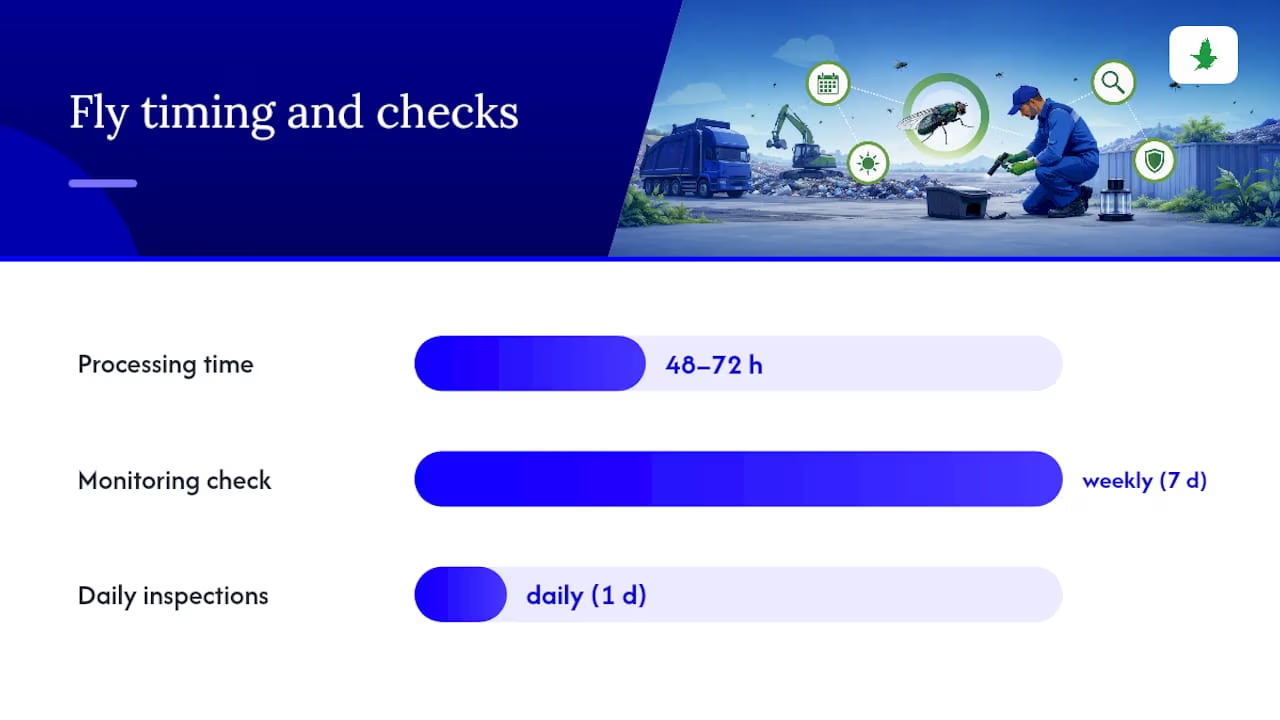
Monitoring is straightforward and cheap: adhesive fly cards placed at fixed points, checked and counted weekly, with counts recorded per square metre so you can spot a trend rather than react to a single bad day. Regulator guidance and industry commentary consistently push non-chemical measures as the first line of defence, not insecticide.
- Turn waste and windrows faster. Processing within 48 to 72 hours where possible starves the fly life cycle of the time it needs
- Get moisture and carbon-to-nitrogen balance right in composting operations, since wet, nitrogen-heavy waste breeds flies fastest
- Remove spills and standing leachate the same day, every day
- Reject visibly infested loads at the gate rather than processing them and dealing with the fallout later
Insecticide use should be a controlled, secondary measure, reserved for confirmed outbreaks rather than routine spraying, partly because overuse drives resistance and partly because regulators expect non-chemical prevention as the default. If counts stay high once cleaning has improved, professional fly control can help find the breeding source.
One threshold worth building into your PMP: example pest management plans from permitted UK sites set daily inspections through the fly season, March to November, with visit frequency increasing during heatwaves when fly generations turn over faster than normal.
Your daily, weekly and monthly checklist
This is the checklist to hand your site team, laid out by frequency so nothing slips between shifts.
- Daily: Walk the bin store and yard. Check every lid closes properly, every drain is capped, and there’s no standing leachate. Remove spills immediately and log any pest sign (droppings, gnaw marks, fly counts) with a photo.
- Weekly: Pressure-wash drainage channels and sumps. Inspect bait stations if you have a contractor’s baiting programme running. Trim vegetation back from fences and buildings, and check bulk waste stockpiles are being turned on schedule.
- Monthly: Confirm the pest contractor’s service visit has happened and review their report. Check inspection logs and fly-count trends for anything creeping upward. Update your PMP if the site layout, waste stream or activity has changed.
A useful pest incident log entry needs four things every time: the time and location, a photograph, the action taken, and who took it. Miss any one of those four and the entry is close to worthless if an EHO or Environment Agency officer asks to see it. Our bin area pest control checklist is built around exactly this structure for communal and commercial bin stores.
When to call a pest contractor, and what to put in the brief
Call a contractor when signs move past routine housekeeping: active burrows near the site boundary, fly counts consistently above 20 per square metre, or gulls establishing a roost on your buildings rather than passing through.
A useful contractor brief spells out scope before quotes come in:
- The PMP itself, including monitoring points and any baiting map already in place
- Reporting cadence you expect, weekly or monthly, in writing
- Risk assessments and COSHH documentation where insecticides are proposed
- Access arrangements and site-specific hazards the contractor needs to know before their first visit
Check three things before signing anyone: recognised training such as BPCA membership, current public liability insurance, and references from other permitted waste sites specifically, not just general commercial premises.
Pro Tip: Ask any contractor how their reports will slot into your existing inspection log and PMP, not just what treatment they’ll apply. A contractor whose paperwork doesn’t map onto your permit conditions creates more work for you at audit time, not less.
Health risks pests bring onto a waste site
Rats, gulls and flies are not just an operational nuisance. Each carries genuine disease risk for staff working around waste, and that risk sits behind a chunk of your health and safety obligations, not just your pest control ones.
Rats can carry Leptospira bacteria, the cause of Weil’s disease, transmitted through contact with urine-contaminated water, surfaces or waste. Staff working near drains, standing water or leachate on a rodent-active site face a real, if low-probability, exposure route, which is one reason proofing drains and sealing leachate matters as much for staff safety as for pest control.
Flies breeding in waste pick up pathogens from decomposing organic matter and can carry them onto food-contact surfaces, packaging destined for reuse, or exposed skin, spreading bacteria like Salmonella and E. coli mechanically rather than by infection themselves. Gulls and corvids scavenging across multiple waste loads can do something similar, carrying contamination between bays and vehicles.
None of this needs to feature in your PMP as a medical document, but it does need to shape your risk assessment and your staff briefing. Anyone handling waste near active infestation signs should know to report it immediately, not wait for the next scheduled inspection, and washing facilities need to be genuinely accessible near waste handling areas, not an afterthought at the far end of the site.
Integrated pest management for waste facilities
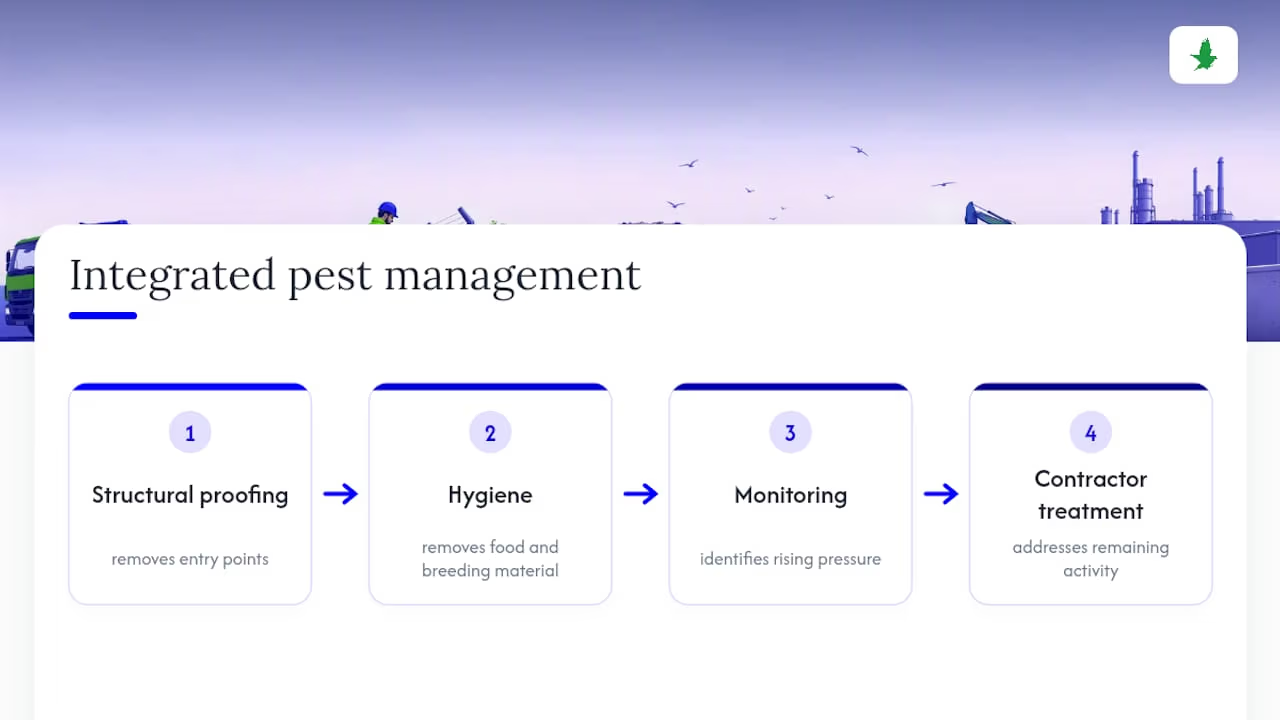
Integrated pest management (IPM) means treating proofing, hygiene, monitoring and contractor treatment as one connected system rather than four separate jobs done by different people on different schedules.
The practical version for a waste site looks like this: structural proofing removes entry points, hygiene removes food and breeding material, monitoring tells you where pressure is building before it becomes an infestation, and contractor treatment deals with what’s left once the first three are actually working. Skip any one stage and the others carry more weight than they can manage. A contractor treating rats monthly while gaps under doors stay open all year is fighting a losing battle every single visit.
Non-chemical measures, meaning daily cleaning, secure containment and controlled waste acceptance, are the most sustainable long-term approach precisely because they remove the reason pests turn up at all, rather than removing individuals after they’ve already established. Chemical and mechanical control still have a place, but as the backstop, not the strategy.
Waste segregation and storage that cuts pest pressure
Segregating waste streams properly does more for pest control than most operators credit it for. Putrescible waste (food waste, organic material, anything that decomposes fast) needs to go into sealed, contained storage separate from general or recyclable waste, and it needs handling on a first-in, first-out basis so nothing sits and rots at the back of a bay.
Guidance for permitted biological waste facilities is explicit that highly putrescible material should be contained within buildings rather than stored in open bays, and that channels and sumps need regular cleaning specifically to prevent pest infestation and odour together. The two problems share a root cause: organic material breaking down somewhere it shouldn’t.
For mixed waste and recycling sites without a formal biological treatment permit, the same principle still applies at a smaller scale. Keep food-contaminated recycling separate from clean streams, store it in lidded containers rather than open cages, and don’t let general waste bulk out into yard space “temporarily” while you wait for collection. Temporary is exactly when infestations start.
How UK weather patterns shift pest activity through the year
Pest pressure on UK waste sites tracks temperature and rainfall closely, which is why a fixed, year-round inspection schedule misses the point. Fly breeding accelerates sharply once temperatures climb, which is why the fly season effectively runs March to November with daily inspection expectations built into permitted-site PMPs, tightening further during heatwaves when generations turn over faster.
Rats shift behaviour with the seasons too. Wet, mild winters mean less outdoor food competition drives them toward buildings and waste stores earlier than a colder year would, while dry summers push them toward any standing water your site has failed to eliminate, drains included.
Gulls follow nesting biology rather than temperature directly, with roosting and scavenging activity concentrated April to August across most of the UK. A site that tightens its bin store discipline only in summer, when fly complaints peak, is leaving itself exposed to rat activity through the milder months when nobody’s watching as closely.
Publisher perspective: proofing and hygiene first, treatment second
A pattern seen across waste sites is consistent: infestations return to bin stores that get treated but never proofed. A monthly contractor visit fixes a symptom for a few weeks. Sealed drains, working lids and a daily cleaning habit fix the cause.
That’s why our approach pairs structural proofing and hygiene work with an ongoing contractor relationship, not one or the other. This view holds for a communal bin store the same way it holds for a commercial kitchen.
Book a site survey before your next permit review
Fixing gaps under doors and capping a few drains yourself buys you time, not compliance. A proper Pest Management Plan needs a baseline survey that maps your actual entry points, drainage weaknesses and waste flow, something a walk-round checklist can flag but can’t fully diagnose on its own.

BioWise Pest Control Maintenance Services runs site surveys for London waste and recycling operators building or reviewing a PMP, working alongside your existing contractor reports rather than replacing your recordkeeping. Commercial pest control plans are quoted after a survey, with individual visits available where a one-off assessment is what you need first. If your site is heading into a permit variation or an EHO has already been in touch, get a survey booked before that conversation, not after it. Get in touch to arrange a visit and we’ll talk through what your bin store actually needs.
Sources
- Gov
- Berkswell Recycling Limited – Pest Management Plan (PMP)
- Waste Management Sites in the UK — PestEvidence
FAQ
What is the most common pest on UK waste sites?
The brown rat is the most consistently reported pest on UK waste and recycling sites, alongside gulls and houseflies. PestEvidence’s UK reference names brown rat, herring gull and housefly as the primary species regulators expect operators to control.
Why does poor waste management create pest problems?
Waste left exposed, in overflowing bins, or in bays with broken lids gives rats, gulls and flies constant access to food and shelter. Recurring design faults such as gaps under doors, uncapped drains and standing leachate turn a normal waste site into a breeding ground within weeks.
How often should bin stores be cleaned to prevent pests?
Daily removal of spills is the minimum standard, with drainage channels and sumps pressure-washed weekly, rising to daily during summer fly season. Example UK pest management plans set daily inspections March to November when fly activity peaks.
Is pest control a legal requirement for UK waste sites?
Yes. The Environmental Protection Act 1990 places a duty of care on operators to store waste securely and prevent pest access, and permitted facilities typically need a documented Pest Management Plan as a condition of their Environment Agency permit.
How much does commercial pest control cost for a waste site?
BioWise Pest Control Maintenance Services offers commercial pest control plans and individual one-off visits. Pricing depends on site size and the scope of proofing work required, so a survey is the best way to get an accurate figure.
Recommended
- HSE pest control requirements for commercial premises
- Your complete pest-proofing checklist for UK properties
- 5 Actions to Stop Bin Area Pests: IPM Checklist for Property Managers
- Pest control on construction sites in London: 2026 guide