

Stored product pests are beetles, weevils, moths and mites that infest grain, flour, dried fruit, nuts, spices, pasta and pet food in storage. In a warehouse, the answer is to identify the species, isolate suspect stock, step up trap monitoring and fix the hygiene or storage conditions that let them breed, bringing in a professional when bulk or packaged stock is affected.
This guide covers the common species, the early signs, prevention and hygiene, treatment options, an outbreak response plan and the records auditors expect. We have supported London warehouses, food businesses and distribution sites since 2010, and most of the problems we are called to started upstream, with residues, a lapsed quarantine area or a trap grid that was too sparse.
If you find evidence of stored product pests, do three things immediately:
- Isolate suspect stock, label it clearly and stop it moving further into your supply chain.
- Monitor with additional traps and physical sampling around the affected zone to establish how far the problem has spread.
- Deep clean and document every action taken, because a written record is what separates a contained incident from a failed audit.
Call a qualified pest management contractor straight away if the infestation involves bulk grain or packaged goods already in the supply chain, or if fumigation looks likely. This is not a job for guesswork.
Key Takeaways
Effective stored product pest control in warehouses depends on correct species identification, a disciplined trap grid, the right storage conditions and rapid, documented action the moment evidence appears.
| Point | Details |
|---|---|
| Identify before treating | Primary pests such as the grain weevil develop inside whole kernels; secondary pests such as flour beetles and saw-toothed grain beetles feed on broken grain, flour and residues. Each needs different detection methods. |
| Space traps 4-5 metres apart | In bulk grain, AHDB advises traps on the surface and about 5-10cm below it, checked weekly until the grain has cooled to 5°C, then monthly. |
| Keep stores cool and dry | AHDB guidance: food safety risk rises above 14.5% moisture content in cereals, and below 13% mites cannot breed. |
| Sequence your response | Sanitation, then monitoring, then targeted treatment, escalating to heat or fumigation only when necessary. |
| Document every action | Keep trap logs, treatment reports and cleaning checklists ready for customer or auditor review. |
| Call a professional early | BioWise provides warehouse surveys, monitoring and contracts for London businesses facing bulk or recurring infestations. |
Table of Contents
- What are the common stored product pests in warehouses?
- How do you spot signs of a stored product pest infestation?
- What prevention and hygiene measures reduce stored product pest risk?
- What control and treatment options work for stored product pests?
- How should you respond to a stored product pest outbreak?
- What operational protocols keep pest management audit-ready?
- What warehouse managers get wrong about pest control
- How BioWise can help with stored product pests in warehouses
- Sources
- FAQ
What are the common stored product pests in warehouses?
Correct identification decides everything that follows: which trap you use, how you sample and whether a surface treatment will even reach the insects doing the damage. Get the species wrong and you can spend weeks treating symptoms while the real population sits safely inside intact grain kernels.
| Pest group | Examples | Typical signs | What it tells you |
|---|---|---|---|
| Weevils | Grain weevil (Sitophilus granarius), rice and maize weevils | Small exit holes in kernels and adults with a long snout; little to see on the surface until adults emerge | Primary pest developing inside whole grain: sample with a probe, not by eye |
| Grain and flour beetles | Saw-toothed grain beetle (Oryzaephilus surinamensis), flat and rust-red grain beetles (Cryptolestes species), flour beetles (Tribolium species) | Small, flattened, reddish-brown beetles in dust, residues and spillage | Secondary pests feeding on broken grain, flour and residues: a hygiene and stock rotation problem |
| Biscuit and cigarette beetles | Biscuit or drugstore beetle (Stegobium paniceum), cigarette beetle (Lasioderma serricorne) | Small, rounded brown beetles and pinholes in packaging | Attack spices, dried herbs, biscuits and packaged foods as well as grain |
| Moths | Indian meal moth, Mediterranean flour moth, warehouse moth | Silk webbing that clumps product together; caterpillars on packaging and walls | The larvae do the damage; pheromone traps pick up adults early |
| Mites and booklice | Flour mites, booklice (psocids) | A fine, moving “dust” on product surfaces; tiny, pale, soft-bodied insects | A sign of damp: check humidity, condensation and moisture content |
Beetles dominate warehouse infestations. The saw-toothed grain beetle (Oryzaephilus surinamensis) and the flat and rust-red grain beetles (Cryptolestes species) are flattened, reddish-brown insects around 2-3.5mm long, easily missed among dust and debris. Flour beetles (Tribolium species) are slightly larger and favour flour and milled products. These are secondary pests, feeding on residues, broken grain and spillage rather than sound kernels. Cigarette beetles and biscuit (drugstore) beetles are common in stores holding spices, dried herbs and packaged foods, and will work through those as readily as grain. Our beetle control page covers treatment for the main species.
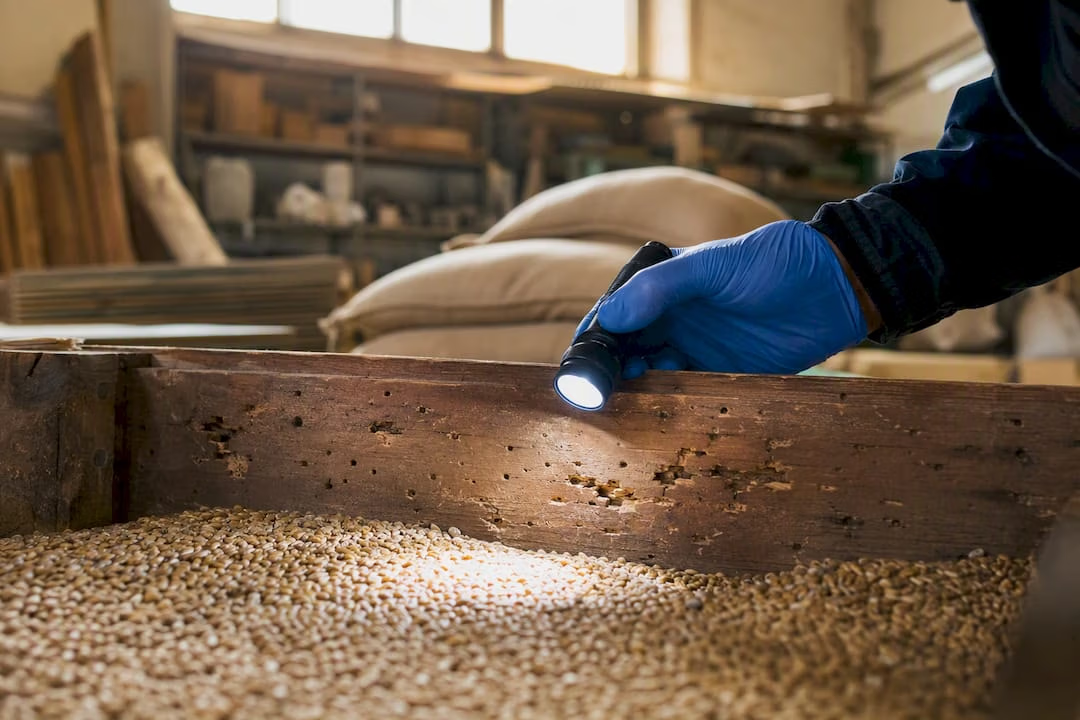
Weevils, particularly the grain weevil (Sitophilus granarius), behave very differently. This is a primary pest: females chew into intact kernels and lay eggs inside, and the larvae develop within the grain itself. That single fact changes your detection strategy, because a visual check of the grain surface will not reveal an active weevil infestation until adults emerge and the damage is already done. AHDB’s guide to insects and mites in stored grain is a useful identification reference.
Moths, chiefly the Indian meal moth and Mediterranean flour moth, are usually spotted first by their larvae rather than the adults. Look for silken webbing that clumps flour, cereal or dried fruit together, along with small caterpillars crawling on packaging or walls near infested stock. See our moth control service for how we deal with them.
Mites and booklice (psocids) are the pests most operators overlook. Mites thrive in slightly damp conditions and look like a fine, moving dust on grain or flour surfaces. Booklice are tiny, pale, soft-bodied insects that favour damp, mouldy conditions and are often an early warning that humidity control has failed somewhere in the building.
Life cycle speed matters more than most managers assume. In warm conditions, many stored product beetles can complete a generation in a matter of weeks, so a small, missed population can multiply several times over between quarterly inspections. That is the strongest argument for monitoring weekly or fortnightly rather than seasonally, particularly through spring and summer when internal temperatures climb.
Pro Tip: Keep a simple reference card at the goods-in desk showing size, colour and typical damage signs for your five most likely pests. Staff spot problems faster when they know exactly what they are looking for.
How do you spot signs of a stored product pest infestation?
Infestations rarely announce themselves with a swarm of adult insects. The earliest signs are quieter, and knowing what to look for buys you weeks of lead time before stock is compromised.
Watch for:
- Frass: a fine, sawdust-like powder left by feeding larvae, often collecting in the seams of sacks or the corners of bins.
- Webbing or clumping: silken threads binding flour, cereal or dried fruit into small clusters, a classic sign of moth larvae.
- Chew marks or holes in packaging, sacking or the grain kernels themselves.
- Live adults or larvae, especially around light fittings, windowsills or stacked pallets near a suspected source.
- Unusual odour: a musty, oily or sweet smell that does not match the stored commodity.
- Heating in bulk grain, where insect and mould activity raises the temperature of a localised pocket, detectable with a probe thermometer.
Sampling backs up what your eyes catch. Probe sampling, pushing a grain probe or spear into different depths of a bulk store, catches primary pests such as weevils that never show themselves on the surface. Dust sampling and sieve checks on floor sweepings or residues pick up what beetles and mites leave behind. A single live insect in a sample is significant enough to act on. It is not proof of a full-blown outbreak, but it is proof the population exists somewhere in that store.
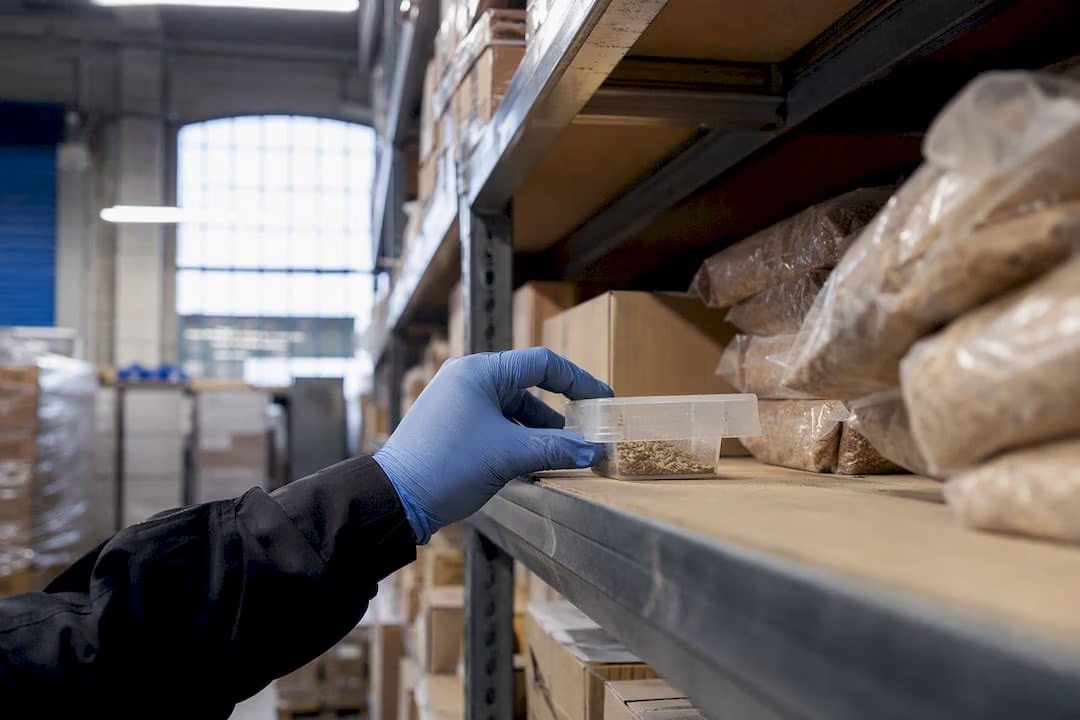
Trap strategy should combine pheromone traps, which lure specific moth and beetle species using species-specific chemical signals, food-bait traps, which attract a broader range of feeding insects, and pitfall traps for crawling insects on floors and along wall lines. In food stores, avoid bait traps containing allergens such as nuts. For bulk grain, AHDB guidance on monitoring grain stores recommends traps 4-5 metres apart, placed both on the surface and around 5-10cm below it, checked weekly until the grain has cooled to 5°C and then monthly. AHDB also notes that traps are up to ten times more effective than grain sampling at detecting low pest numbers. If a trap starts pulling in consistent catches, tighten the grid around it immediately rather than waiting for the next scheduled check.
What prevention and hygiene measures reduce stored product pest risk?
Good store hygiene is the foundation of stored product insect control, and council food safety guidance on stored product insects puts cleaning, store design and stock rotation at the centre of it. It also costs far less than any treatment programme that follows a missed infestation. Even small quantities of old grain dust or residue left in a conveyor can sustain a pest population long after the original stock has moved on.
Start with the building fabric. Seal cracks, gaps around pipework and expansion joints where insects can shelter and breed undisturbed. Choose surfaces that are genuinely easy to clean rather than ones that merely look clean, and make residue removal from conveyors, elevators and processing machinery a scheduled task rather than an occasional one. Drains and areas prone to condensation deserve particular attention, since damp conditions are what draw booklice and mites into an otherwise dry store.
Storage practice matters just as much as the building itself:
- Keep stock off the floor on pallets or racking, never stacked directly against walls.
- Leave ventilation gaps between pallets so air can circulate and heating pockets do not develop unnoticed.
- Apply strict FIFO stock rotation so nothing sits long enough to become a breeding reservoir, and remove old or spilt stock promptly.
- Quarantine incoming goods and inspect sacks, cartons and packaging before they enter the main store, since vehicles and packaging are one of the most common routes into a facility.
Environmental control finishes the job. For cereals, AHDB moisture guidance says food safety risk increases above 14.5% moisture content, and grain stored below 13% effectively stops mites breeding. Cool, stable storage slows insect development too. These targets apply to bulk grain; for packaged dry goods, the priority is a dry, well-ventilated store free from condensation. If you manage a mixed facility with pallets of packaged dry goods alongside bulk storage, a proofing-first approach often prevents more problems than any chemical treatment applied after the fact.
Pro Tip: Audit your quarantine area at least monthly. Incoming pallets sitting there “temporarily” for six weeks defeat the entire point of a quarantine zone.
What control and treatment options work for stored product pests?
Treatment decisions should always follow a defined sequence, not a panic response to the first insect someone spots. The accepted IPM sequence runs sanitation first, then monitoring, then targeted physical or chemical treatment, escalating to heat or fumigation only when those steps fail to resolve the problem. Jumping straight to chemical treatment without fixing the sanitation issue that caused the infestation almost guarantees a repeat problem within a season.
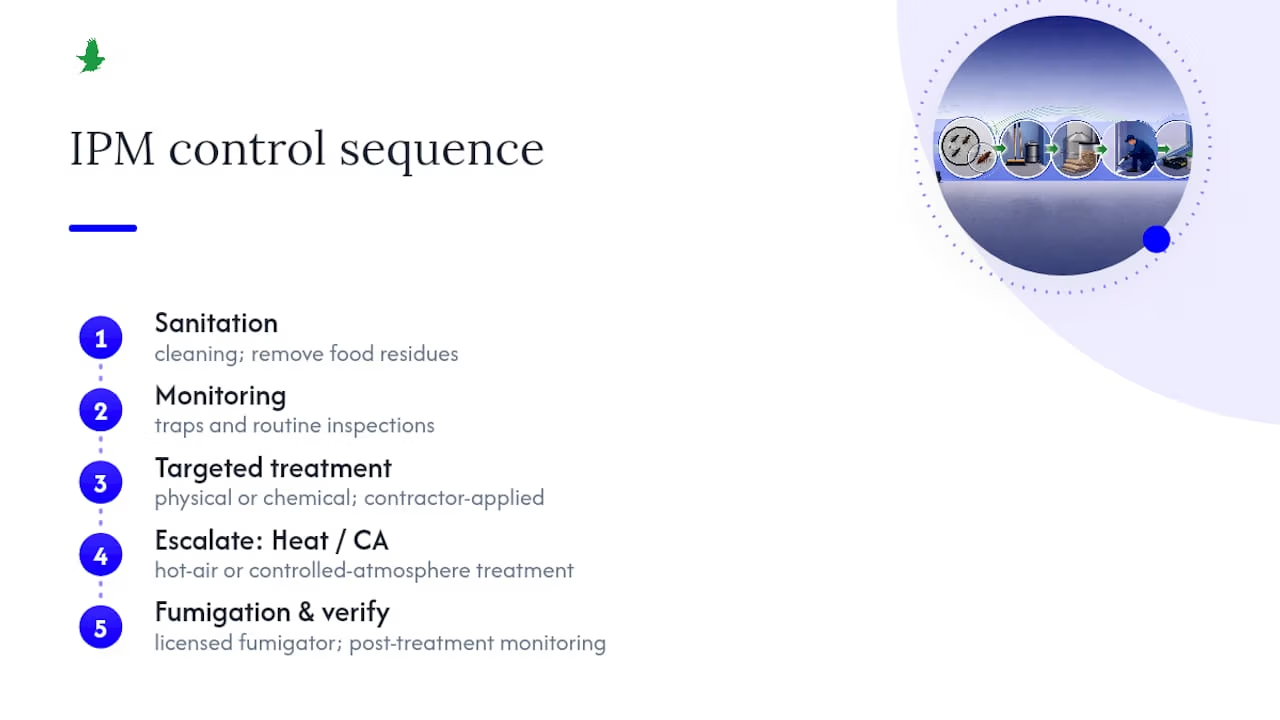
Chemical options fall into three broad groups: residual insecticides applied to empty stores, walls, floors and voids; approved grain protectants applied to bulk grain at intake, which can protect stock for months if storage conditions stay correct; and space treatments for enclosed areas. All of them must be used strictly in line with the product label and food safety rules, by a trained, certificated pest management technician. This is not an area where DIY treatment is a sensible shortcut.
Non-chemical options are increasingly practical. Heat treatment, raising the temperature of an enclosed space or piece of equipment to a level insects cannot survive, works well for processing equipment and some packaged goods without leaving chemical residues. Controlled atmosphere treatment, using reduced oxygen or raised carbon dioxide levels, suits bulk commodities where fumigant use is restricted or undesirable.
Fumigation sits at the far end of the scale, reserved for severe or widespread infestations that other methods cannot reach. It carries real risk: fumigants are highly toxic and must only be applied by trained fumigators working to strict safety procedures. Verification matters as much as the treatment itself, and a proper job always ends with post-treatment monitoring and trap checks to confirm the population has actually been eliminated, not just suppressed.
How should you respond to a stored product pest outbreak?
Speed and documentation decide whether an outbreak stays a minor operational hiccup or turns into a failed audit and a lost contract. Work through this sequence:
- Isolate and label all suspect stock immediately, and quarantine any consignment you believe is the source.
- Dispose of heavily infested stock in sealed bags or containers, following your waste procedure, rather than leaving it to sit while you deliberate.
- Deep clean affected machinery, voids and harbourage points, removing any residues that could sustain a remaining population.
- Increase monitoring density in the affected zone and replace all traps after treatment, so you are reading fresh data rather than counts left over from before the clean-up.
- Investigate the source through sampling, checks on incoming consignments and a review of transport hygiene, since vehicles and packaging are common routes for reinfestation.
- Document every action, including dates, quantities disposed of and treatment records, for review by a customer or auditor.
Escalate to a professional contractor when trap catches stay high after your own clean-up, when contamination reaches stock already destined for dispatch, or when a customer requires third-party intervention before accepting further deliveries. At that point, a warehouse pest control specialist should take over both the treatment and the documentation trail.
What operational protocols keep pest management audit-ready?
Turning good intentions into policy is what separates facilities that pass audits from ones that scramble before them. Set your monitoring routine by season and storage condition: weekly trap checks through warmer months and while bulk grain is still cooling, relaxing to monthly once conditions stabilise, in line with AHDB grain storage guidance.
Set clear action thresholds in advance rather than deciding in the moment. For example, a single live weevil in a probe sample, or a rising catch in any trap, should trigger extra traps around that zone and an investigation of the source. Because traps detect low numbers far better than spot sampling, let trap trends drive those decisions.
If you store food, your warehouse is a food business. Regulation (EC) No 852/2004 (assimilated law in Great Britain) requires adequate procedures to control pests, so environmental health officers and customer auditors, including those working to BRCGS standards, will expect to see your pest control records. There is no fixed legal period for keeping them, but at least two years is good practice.
Assign responsibility clearly: who inspects, who has authority to order treatment and who signs off the record. Keep trap logs, treatment reports, cleaning checklists and supplier notification records in one place, because that pack is exactly what an auditor or customer quality team will ask to see. Our pest control reporting guide explains what a good audit pack contains.
Who handles this and when should you call a professional?
Your own team can handle routine hygiene, trap replacement and first-response isolation. Bring in a qualified contractor for:
- Any bulk grain infestation, suspected fumigation need, or contamination of packaged stock already in your supply chain
- Trap catches that stay high after your own clean-up
- A customer or auditor asking for third-party verification
Expect a proper survey to include a review of trap placement, sampling, and a written treatment and monitoring plan, not just a single visit and a spray.
Warehouse clients often call us after a customer complaint or a difficult audit. The ones who call after the first unusual trap catch have a much easier time, because we are dealing with one bay or one consignment rather than half the store.
Matt Ochello, Sales Executive, BioWise
What warehouse managers get wrong about pest control
Most warehouse pest programmes fail for the same reason: they treat monitoring as a compliance exercise rather than a diagnostic tool. A trap grid checked monthly, filed and forgotten tells you almost nothing useful. A trap grid checked weekly, read properly and used to redirect attention towards hotspots is what actually catches an infestation while it is still a minor problem rather than a recall.
The conventional advice leans too heavily on reactive treatment. Chemical control gets discussed as the solution, when in most infestations the real failure sits upstream: a residue-coated conveyor, a quarantine area that stopped being a quarantine area, or a trap grid too sparse to catch a slow-building population before it spreads.
If you take one thing from this, prioritise the boring work. Sealed gaps, weekly trap checks and a documented quarantine step for incoming stock do more for your audit outcomes than any single fumigation. Treatment matters when prevention has already failed, but it should never be your first line of defence.
Ben, Lead Technician, BioWise
How BioWise can help with stored product pests in warehouses
Your own team can manage basic hygiene and trap replacement, but bulk infestations, fumigation decisions and audit-ready documentation need specialist support. BioWise is a family-run London pest control company, founded in 2010 and working with more than 800 commercial clients, from food businesses to warehouses and distribution sites.

Our BPCA-certified technicians survey your site, set up and review a trap grid that fits your racking and stock, identify the species involved and plan targeted treatment, cleaning advice and proofing. Our warehouse pest control contracts include monthly visits with photo reports, digital service reports for your audit file, emergency call-outs and unlimited minor pest proofing, with pricing surveys for larger proofing projects. Where the stock is food, our food business pest control service is built around what EHOs and customer auditors expect.
We are BPCA and NPTA members, CHAS accredited and SafeContractor approved, with same-day call-outs across every London borough and out-of-hours visits that fit around deliveries and shifts. Contact us to arrange a free site survey and a fixed written quote, or call 0800 988 3568 to speak to the team.
BioWise Pest Control Maintenance
13 Hanover Square, London, W1S 1HN
Call 0800 988 3568 or email info@biowiseservices.com
Sources
- Pest advice for controlling stored product insects (British Pest Control Association)
- Monitoring insect and mite populations in grain stores (AHDB)
- Grain storage moisture targets for cereals and oilseed rape (AHDB)
- Insects and mites in stored grain (AHDB)
- Pest control in a food business: stored product insects (London Borough of Bromley)
FAQ
What are stored product pests?
Stored product pests are insects and mites, including beetles, weevils, moths, mites and booklice, that infest grain, flour, dried fruit, nuts, spices and other dried goods in storage. They contaminate stock with bodies, droppings, webbing and frass, cause spoilage and can lead to rejected deliveries, failed audits or product withdrawals.
What are examples of storage pests?
Common examples include the grain weevil, saw-toothed grain beetle, flour beetles, biscuit (drugstore) beetle, cigarette beetle, Indian meal moth, Mediterranean flour moth, flour mites and booklice. The exact mix depends on the commodity, the building and storage conditions, so accurate identification is always the first step.
How do you get rid of stored product beetles?
Remove the infested stock, then deep clean residues from racking, floors, voids and machinery, because beetles breed in spillage. Use traps to locate any remaining source and check incoming goods before they enter the store. If beetles persist, a certificated pest management contractor can apply targeted treatment within label and food safety rules.
What moisture content stops grain pests?
For cereals, AHDB guidance says food safety risk increases above 14.5% moisture content, and storing grain below 13% effectively stops mites breeding. Cool storage also slows insect development. These targets apply to bulk grain; for packaged dry goods, focus on a dry, well-ventilated store without condensation.
How often should traps be checked in a warehouse?
For bulk grain, AHDB advises weekly checks until the grain has cooled to 5°C, then monthly. In stores of packaged dry goods, weekly or fortnightly checks during warmer months and during any active outbreak are sensible, relaxing once catches and conditions are stable. Record every check.