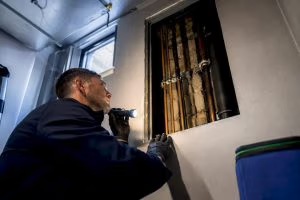
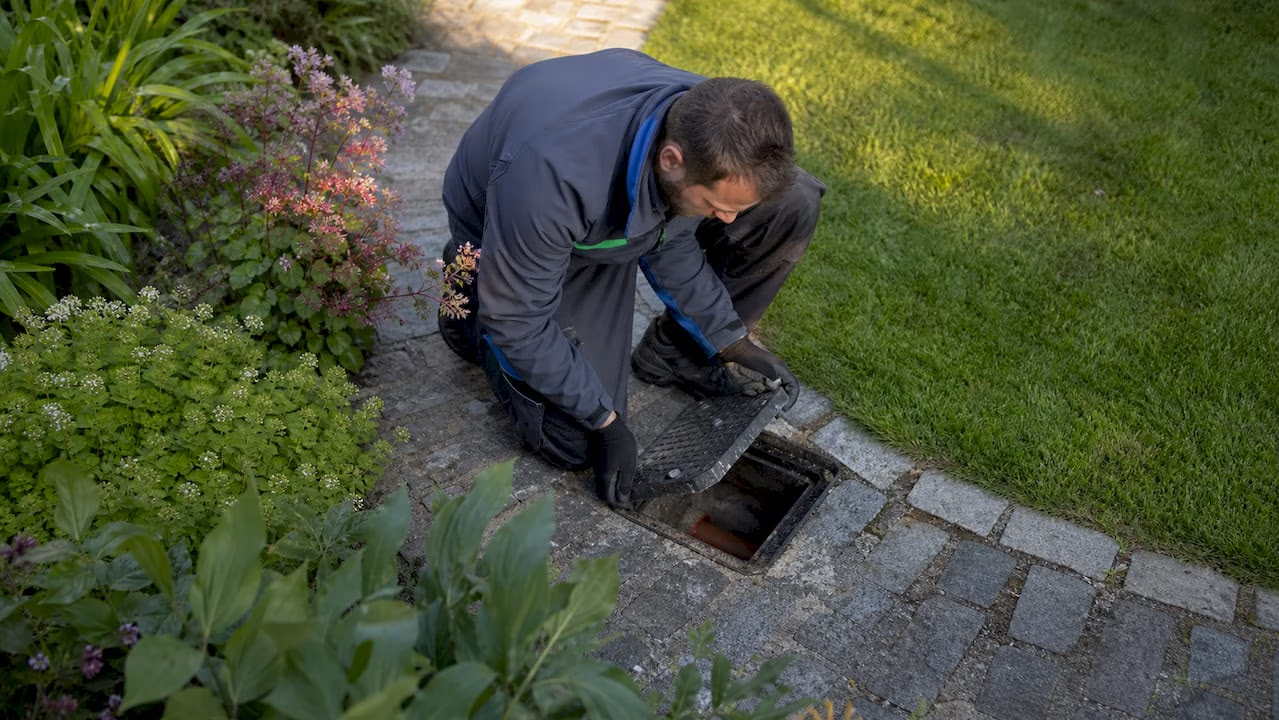

Drains are one of the most common routes rats use to enter UK homes, and the correct first response is to secure visible entry points, document what you have seen, and arrange a professional diagnosis before spending money on surface treatments. BPCA guidance estimates that around 80% of household rat infestations originate from drainage defects, which means baiting alone rarely resolves the problem. Your immediate priorities are:
- Check that all inspection covers in your garden or yard are intact, seated correctly, and not cracked or displaced.
- Note where and when you have seen activity (droppings, grease marks, burrows near covers) and photograph the evidence.
- Contact your local council’s Environmental Health team to report the sighting and get advice on whether the public sewer may be involved.
- If evidence points to the public sewer, contact your sewerage undertaker (Thames Water, Wessex Water, Severn Trent, or whichever company serves your area).
- If the issue is on private pipework within your property boundary, arrange a professional pest controller and, where needed, a CCTV drain survey.
Under the Prevention of Damage by Pests Act, property owners are legally responsible for keeping their premises rodent-free. Pipes and drains within your property boundary are yours to maintain; the public sewer network is the water company’s responsibility. Getting that distinction right from the start determines who pays for the repair.
Key takeaways
Drains are the most common undiagnosed entry route for rats in UK homes, and resolving the problem permanently requires finding and repairing the structural defect, not just treating the surface activity.
| Point | Details |
|---|---|
| Drains are the primary route | Around 80% of household rat infestations originate from drainage defects, per BPCA guidance. |
| Know who is responsible | Private pipes within your boundary are your responsibility; public sewers are the water company’s. |
| CCTV is the diagnostic standard | Many defects are invisible from the surface; a written CCTV report is needed before water companies will act. |
| Surface treatment alone rarely works | Baiting without finding the entry point usually results in reinfestation once the bait is exhausted. |
| BioWise | Provides full-sequence diagnosis, CCTV coordination, proofing, and follow-up treatment for London properties. |
Table of Contents
- How do rats use drains and sewers to get into UK homes?
- What are the signs that rats are entering via drains?
- Which drain components most commonly let rats through?
- Who is responsible for rats in drains: you, your water company, or the council?
- When should you call a professional, and which specialist do you need?
- Practical prevention and proofing steps you can take now
- What are the health and safety risks of rats in drains?
- Why CCTV drain surveys are the diagnostic turning point
- The part most homeowners get wrong
- BioWise: professional diagnosis and treatment for London homeowners
- Sources
- FAQ
How do rats use drains and sewers to get into UK homes?
Rats are well adapted to subterranean life. The UK’s Victorian-era sewer network, combined with decades of piecemeal domestic drainage work, gives them a connected underground corridor that runs beneath most streets and gardens. They use inspection chambers, manholes, and lateral drains as travel routes, moving between the public sewer and private pipework with little difficulty.
The specific entry points into a property tend to fall into a handful of categories:
- Toilet pan connectors and flexi-connectors: Rats can swim through water traps in WCs and waste pipe systems. A flexible pan connector that has split, perished, or pulled away from the soil pipe creates a direct gap into the wall cavity or subfloor.
- Cracked or broken pipework: A fracture in a clay or plastic drain pipe, even a hairline crack, is enough for a rat to gnaw wider over time.
- Redundant uncapped lines: Extensions, loft conversions, and utility works often leave old drain runs disconnected but not sealed. These open pipes can link the public sewer directly to wall cavities or subfloors, bypassing any surface proofing entirely.
- Defective chamber benching: The sloped concrete inside an inspection chamber is designed to channel flow. When it erodes or cracks, it creates voids beneath the benching where rats can shelter and breed.
- Damaged or missing covers and frames: A cover that no longer sits flush, a corroded frame, or a plastic chamber lid that has warped under vehicle weight all create gaps at ground level.
Behaviourally, rats are drawn to drains because they offer warmth, moisture, shelter from predators, and a reliable food source from organic waste. They are strong swimmers and can hold their breath long enough to pass through a U-bend. Once inside a drain run, they follow the pipe until they find a gap, and a gap as small as 15mm is sufficient for a young rat to squeeze through.
What are the signs that rats are entering via drains?
Surface sightings are often the last stage of an infestation that has been developing underground for weeks. Recognising the specific signs that point to a drain source helps you act before the population grows.
Direct signs to look for:
- Rats seen emerging from or disappearing near inspection covers or manhole lids.
- Droppings concentrated around drain covers, along the base of walls adjacent to soil pipes, or near external gully traps.
- Grease or smear marks on the underside of cover frames or along the edges of chamber walls, left by repeated body contact.
- Fresh burrow entrances within 300-500mm of a chamber edge or along the line of a buried drain run.
- Gnaw marks on plastic pipework, particularly on flexi-connectors visible under sinks or behind toilets.
- Unusual gurgling, splashing, or scratching sounds from the toilet or waste pipes, particularly at night.
Pro Tip: Photograph every sign with a timestamp and note its position relative to the nearest drain cover. A written log of dates, times, and locations is exactly what a CCTV surveyor or Environmental Health officer will ask for, and it can significantly speed up the investigation.
Treating surface sightings with bait alone, without identifying the entry point, is usually a temporary measure. Rats will continue to use the same underground route until the structural defect is repaired. Above-ground activity that persists after a standard baiting programme is a strong indicator that the source is underground.
Which drain components most commonly let rats through?
A safe visual inspection of your accessible drain fittings can reveal several of the most common weak points without requiring you to lift heavy covers or enter confined spaces.
What to check from ground level:
- Cover fit and frame condition: Kneel beside each inspection cover and check whether it sits flush in its frame. A cover that rocks, has visible gaps around its edges, or shows cracked concrete surrounds needs attention. Displaced paving slabs or sunken ground immediately adjacent to a cover often indicate a void beneath.
- Plastic chamber lids: Lightweight plastic covers in domestic gardens are frequently cracked by vehicle or foot traffic. Run your hand around the edge to feel for gaps or flex.
- Pipe entries at the wall: Where soil pipes or waste pipes pass through external walls, check for gaps between the pipe and the brickwork. Even a small gap can be widened by gnawing.
- Flexi-connectors: These are the short, corrugated rubber or plastic connectors between the toilet pan and the soil pipe. They perish over time and are one of the most frequently cited entry points in drain-origin infestations.
Pro Tip: Look for fresh soil disturbance or small mounds of earth near cover edges after rain. Rats excavating beneath a chamber will push loose soil upward, and rain washes it into a visible ring around the cover frame.
Some defects are genuinely invisible from the surface. Benching erosion inside a chamber, internal voids in clay pipe joints, and broken seals on redundant lines will not show up in a visual check. A CCTV drain survey is the only reliable way to confirm whether these hidden defects exist, which is why practitioners regard it as the diagnostic standard for persistent or recurring infestations.
Who is responsible for rats in drains: you, your water company, or the council?
The answer depends on where the defect sits in the drainage network, and getting this right determines who arranges and funds the repair.
The legal split:
- Private drains and pipes within your property boundary are your responsibility to maintain and repair. Under the Prevention of Damage by Pests Act, you are legally required to keep your premises free of rodents, which includes addressing structural defects in your own pipework that allow access.
- Public sewers and lateral drains that vest in a sewerage undertaker are the water company’s responsibility. Under section 94 of the Water Industry Act 1991, sewerage undertakers have a statutory duty to provide, maintain, and cleanse public sewers and lateral drains that have vested in them.
- Local council / Environmental Health handles the immediate public-health response. They can issue notices, provide advice, and in some cases arrange treatment on public land.
The practical contact sequence:
- Report the sighting to your local council’s Environmental Health team. They will advise on immediate steps and can confirm whether the area has a known rodent problem linked to public infrastructure.
- If evidence points toward the public sewer (rats seen near a public manhole, activity along a shared drain run), contact your sewerage undertaker directly. Wessex Water and other water companies will attend, perform a CCTV investigation, and arrange remedial works if the defect is confirmed to be on the public network. If the defect turns out to be on private pipework, they will advise you to arrange your own repairs.
- If the issue is clearly within your property boundary, instruct a private pest controller for rodent control and a drainage specialist for the structural repair.
Water companies generally require CCTV evidence before committing to remedial works. Contacting them without that evidence can delay the process; having a preliminary CCTV report from a private surveyor often accelerates their response.
When should you call a professional, and which specialist do you need?
Two distinct professionals are involved in a drain-origin rat infestation: a pest controller and a drainage CCTV specialist. They do different things, and calling the wrong one first can waste both time and money.
What each professional does:
- An accredited pest controller (look for BPCA membership as a quality indicator) will assess the infestation, place bait stations or traps, identify surface entry points, and recommend proofing measures. They cannot repair a broken drain, but a good practitioner will tell you whether the evidence suggests a drainage source.
- A drainage CCTV operator will insert a camera into the drain system, produce timestamped footage, and generate a written report identifying defects, their location, and recommended remedial action. This report is what water companies and insurers need to act.
Decision cues for which to call first:
- Persistent rat activity after a completed baiting programme = strong indicator of an unresolved underground entry point; arrange CCTV.
- Rats seen near inspection chambers, burrows adjacent to cover edges, or evidence of gnawing on pipework = drainage source likely; CCTV first, pest control in parallel.
- Obvious surface burrows in open ground away from drains, or a single sighting with no recurrence = pest controller first.
- Any sign of public-health risk (rats in a shared building, communal areas, or a commercial kitchen) = contact Environmental Health immediately alongside private pest control.
Questions to ask any contractor before booking:
- Are you a BPCA member or hold equivalent professional accreditation?
- Do you carry public liability insurance?
- Will you provide a written CCTV report with location references and defect images?
- What is the estimated timeline from survey to repair, and what follow-up visits are included?
- What is the scope of your guarantee if rats return within a defined period?
For rat control in West London, the same principles apply whether the property is residential or commercial: the diagnostic sequence matters more than the speed of the first treatment.
Practical prevention and proofing steps you can take now
While you are arranging professional diagnosis, several practical measures reduce the risk of further ingress and make the property less attractive to rodents.
Immediate DIY actions:
- Check every inspection cover in your garden and replace any that are cracked, missing, or no longer seated flush.
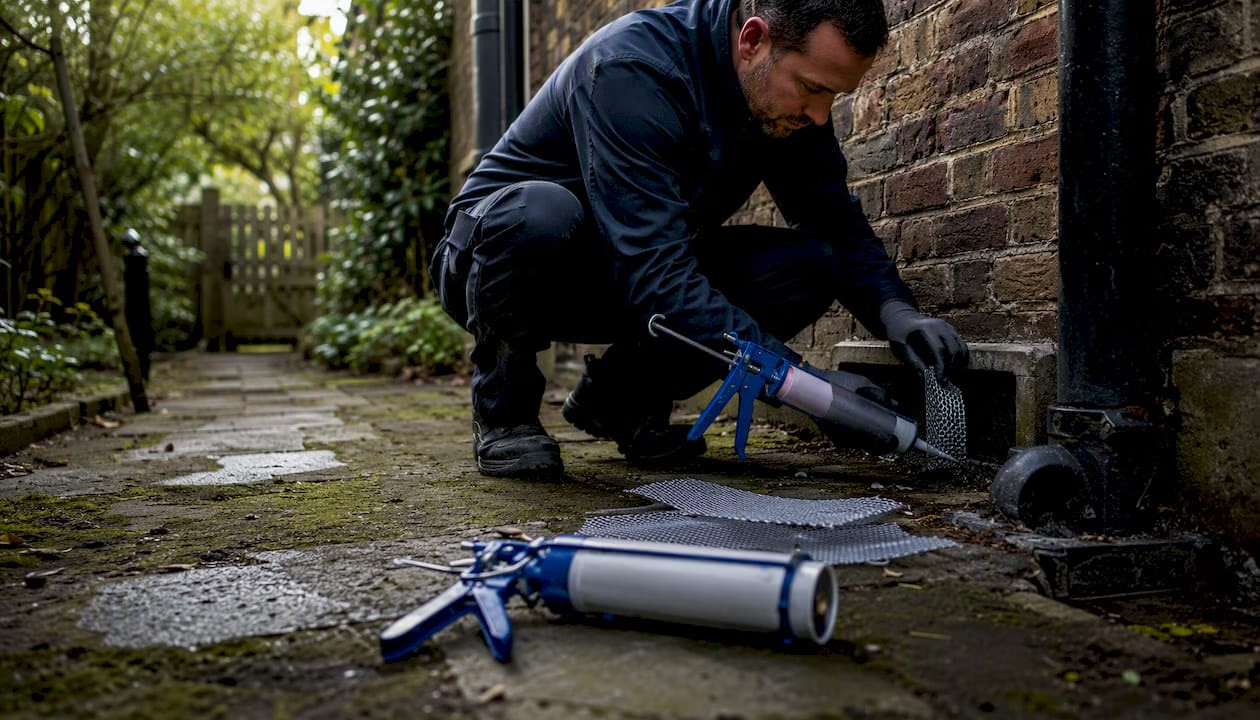
- Cap any disused external pipes visible at ground level or on external walls. A simple push-fit cap costs very little and removes an obvious entry point.
- Seal gaps where pipes pass through external walls using a suitable filler or expanding foam rated for rodent exclusion.
- Secure all bins with close-fitting lids and move composters away from the building perimeter.
- Stop pouring fat, grease, or food waste down sinks. These residues accumulate in drain runs and provide a food source that attracts rats from the public sewer.
- Keep garden areas tidy, particularly around drain covers; dense ground cover and stored materials adjacent to covers give rats shelter and concealment.
Proofing measures to commission professionally:
- Replace damaged inspection covers with heavy-duty cast-iron or steel alternatives rated for the load they will bear.
- Seal chamber frames with appropriate mortar or sealant where the frame has lifted or separated from the surrounding surface.
- Fit correctly sized and properly seated pan connectors; a loose or perished flexi-connector is one of the most straightforward repairs a plumber can make.
- Consider a non-return valve (NRV) as a temporary diagnostic barrier, but understand its limits. BPCA guidance is clear that NRVs can fail or block and are not a permanent fix; the underlying drainage defect must be confirmed by CCTV and repaired for a lasting solution.
What not to do:
- Do not rely on bleach or strong chemical odours as a deterrent. They may temporarily discourage rats but will not prevent re-entry via a structural defect.
- Do not install a bung in an inspection chamber without a prior flow test. An incorrectly placed bung can cause sewage to back up into the property, creating a far more serious problem than the one you were trying to solve.
- Do not use rodenticides without professional guidance. Amateur application increases the risk of secondary poisoning to children, pets, and wildlife, and is less effective than a properly monitored baiting programme.
For a full checklist of property-level measures, the pest-proofing checklist for UK properties covers the key steps in detail.
What are the health and safety risks of rats in drains?
Rats in drainage systems carry a range of pathogens that pose genuine risks to household members, particularly children, elderly residents, and anyone with a compromised immune system.
Key health risks:
- Leptospirosis (Weil’s disease): Spread through rat urine contaminating water or soil. Contact with contaminated water, soil, or surfaces can cause infection, with symptoms ranging from flu-like illness to severe organ damage.
- Salmonellosis: Rats carry Salmonella bacteria and can contaminate food preparation surfaces, water supplies, and garden soil through droppings and urine.
- Hantavirus: Rare in the UK but present; transmitted through contact with or inhalation of dust from rodent droppings, urine, or nesting material.
- Secondary contamination: Rats moving between the sewer and living areas can transfer pathogens from sewage onto kitchen surfaces, food storage areas, and children’s play spaces.
Safe handling practices:
- Never handle droppings, nesting material, or dead rodents with bare hands. Use disposable gloves and a face covering, double-bag waste, and wash hands thoroughly afterwards.
- Do not sweep dry droppings; dampen them first with a disinfectant spray to prevent inhalation of contaminated dust.
- Keep children and pets away from areas where bait stations have been placed.
Legal obligations for landlords and property managers:
Under the Prevention of Damage by Pests Act 1949, local authorities have powers to require property owners to take action against rodent infestations. Landlords who fail to address a confirmed infestation can face formal notices and, ultimately, enforcement action. For property managers overseeing multiple units, a rodent control programme with documented inspection records is the most defensible position if a complaint is escalated.
Why CCTV drain surveys are the diagnostic turning point
A CCTV drain survey does what no surface inspection can: it shows the inside of the pipe run in real time, revealing defects that are invisible from above and that would not cause a blockage for months or years.
Practitioners regard CCTV as the standard diagnostic tool for persistent rat infestations precisely because many drainage defects are invisible from the surface. Benching erosion, internal voids at pipe joints, broken seals on redundant lines, and partially collapsed clay pipes all create entry points that a visual check will miss entirely. Treating the infestation without finding these defects means the rats simply return via the same route once the bait is exhausted.
What a good CCTV report contains:
- Location references tied to a site plan or measured distances from fixed points.
- Timestamped footage stills showing each defect clearly.
- A written description of each defect, its severity, and its likely contribution to rodent ingress.
- Recommended remedial action for each defect, with an indication of urgency.
- An estimated repair scope so you can obtain accurate quotes.
This report is also what your water company needs before it will commit to remedial works on the public sewer, and what your insurer may require if you are making a claim for damage caused by rodents.
A typical workflow with BioWise:
- Initial site assessment and advice: confirm whether the evidence points to a drainage source or a surface entry point.
- Arrange a CCTV drain survey where drainage involvement is suspected, producing a written report.
- Liaise with the sewerage undertaker if defects are identified on the public network, or commission private drain repair if the defect is within the property boundary.
- Implement proofing measures (cover replacement, pipe sealing, pan connector repair) once the structural defect is resolved.
- Follow-up pest control to clear any remaining rodent activity and confirm the infestation has been resolved.
Combined pest-control and drainage site surveys reduce unnecessary treatments and help target remedial work precisely. Experienced surveyors look beyond what the camera shows, reading the wider site context to locate likely defects that footage alone might not capture.
The part most homeowners get wrong
There is a pattern that experienced pest controllers see repeatedly: a homeowner spots a rat, calls a pest controller, completes a baiting programme, and considers the matter closed. Six weeks later, the rats are back. The baiting worked; the drain defect was never found.
Treating surface signs without diagnosing the drain is often temporary and costly. The right diagnostic sequence, starting with a proper site assessment and, where needed, a CCTV survey, saves time, reduces the total amount of rodenticide used, and produces a permanent result rather than a repeated cycle of treatment.
The other common mistake is assuming that because a rat was seen in the garden, the problem is a garden problem. In urban UK properties, particularly in London, the sewer network runs beneath most streets and gardens, and rats move freely between public and private infrastructure. A rat in the garden is as likely to have come up through a defective inspection chamber as it is to have arrived over the fence.
Professional diagnosis is not an upsell; it is the step that determines whether any other action will actually work.
BioWise: professional diagnosis and treatment for London homeowners
Rats entering via drains require two things that surface treatments alone cannot provide: a confirmed diagnosis of the structural defect and a coordinated response that addresses both the rodent activity and the entry point. BioWise has been delivering exactly that for London homeowners and property managers since 2010, working across more than 800 clients in the capital.

Our domestic pest control service covers the full sequence: initial site assessment, CCTV coordination where drainage involvement is suspected, proofing and repair liaison, and follow-up treatment to confirm the infestation is resolved. Before your visit, it helps to have photographs of any signs you have seen, a note of when and where activity was observed, details of any recent building or drainage work at the property, and confirmation of access to all inspection chambers and external drain covers. Property managers overseeing multiple units can also discuss ongoing facilities management pest control arrangements. Contact BioWise to arrange an inspection and get a clear, written assessment of what needs to be done.
Sources
The following official and industry sources are the most reliable references for reporting, legal duties, and practical guidance on rats in drains in the UK:
- Rats, rodents and pest control | Emergencies | Thames Water
- Drainage inspections for rodents
- Water Industry Act 1991, section 94
- Rats and rodents | Wessex Water
- Rats in Drainpipes & Toilets: Who is Responsible? | Metro Rod
FAQ
How do rats get into drains in the first place?
Rats enter the drain network through defects in the sewer infrastructure, including cracked pipes, eroded chamber benching, and open redundant lines. Once inside, they travel along the pipe run and enter properties through gaps at flexi-connectors, broken pan connectors, or any point where the pipework has failed.
Who is responsible for rats in sewers in the UK?
Public sewers and lateral drains that vest in a sewerage undertaker are the water company’s responsibility under section 94 of the Water Industry Act 1991. Private drains and pipes within your property boundary are the homeowner’s responsibility under the Prevention of Damage by Pests Act.
Does bleach in drains deter rats?
Bleach and strong odours may temporarily discourage rats but are not a reliable long-term deterrent. They do not address the structural defect that allows rats to enter, so activity typically resumes once the smell dissipates.
How do you stop rats coming up through drains permanently?
The permanent solution is to locate and repair the structural defect, confirmed by a CCTV drain survey. Non-return valves and bungs can act as temporary barriers but will fail if the underlying pipe defect is not repaired. BioWise coordinates the full sequence from survey to repair and follow-up treatment.
What is a rat’s biggest natural enemy in the UK?
In urban UK environments, rats have few effective natural predators. Owls and domestic cats will take individual rats, but neither controls a population that has access to a reliable underground food source and shelter. Professional pest control remains the most effective method for managing an established infestation.