

TL;DR:
- Pest control in London safeguards health, property, and legal compliance due to high-density housing and year-round warmth. Most infestations require professional treatment, proofing, and ongoing monitoring, especially for rats, mice, cockroaches, and bed bugs. Private providers with BPCA membership are essential for fast, compliant, and effective solutions.
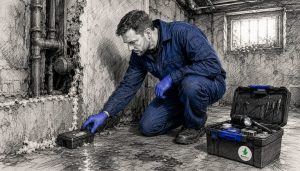
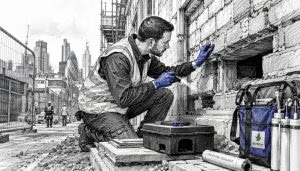
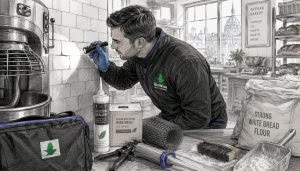
Pest control in London protects your health, prevents structural damage, and fulfils legal duties under UK housing law. The British Pest Control Association (BPCA) and the Homes (Fitness for Human Habitation) Act together set the framework: landlords must keep rental properties free from hazards that affect health and safety, and persistent infestations can trigger enforcement action by local environmental health officers. If you have a concern right now, take these three steps before anything else:
- Carry out a visual check of likely entry points: gaps around pipework, voids beneath kitchen units, and communal waste areas.
- Document what you find with dated photographs and written notes, including any tenant complaints.
- Contact a qualified pest control provider or your local council’s environmental health team if the signs are persistent or pose an immediate health risk.
The sections below explain the urban drivers unique to London, the pests most likely to affect your property, your legal obligations, and how to choose a provider you can trust.
Pro Tip: Keep a simple pest log from day one. Dated entries showing what you found, when, and what action you took are your strongest defence if a council officer or tenant ever raises a formal complaint.
Why pest control in London is a different challenge from anywhere else
London’s combination of high-density housing, ageing Victorian and Edwardian building stock, communal waste streams, and a pronounced heat-island effect creates conditions that favour pest activity year-round. Urban climate factors allow rodent populations to breed continuously rather than seasonally, meaning a single reactive treatment rarely solves the problem for long. Add international connectivity and high tourist footfall, and you have a city where bed bugs, cockroaches, and stored-product insects spread faster than in most comparable European capitals.
The risks are concrete and varied:
- Health: rats and mice carry Leptospira bacteria (Weil’s disease); cockroaches spread Salmonella and trigger asthma; bed bugs cause sleep disruption and secondary skin infections.
- Structural damage: rodents gnaw electrical cabling and insulation, raising fire risk and repair costs.
- Reputational and commercial harm: a single pest sighting in a restaurant or hotel can generate negative reviews and trigger a Food Standards Agency inspection.
- Legal exposure: under the Homes (Fitness for Human Habitation) Act, persistent infestations can constitute a breach of a landlord’s statutory duty, leading to enforcement notices from environmental health officers.
London boroughs logged more than 70,000 pest control calls last year, with ageing buildings and communal waste areas cited as major drivers. The City of London Corporation, for example, does not provide pest treatment for commercial or non-corporation residential properties, meaning owners in that area must arrange professional management themselves. Westminster City Council can investigate and consider enforcement where private owners fail to act, but its treatment services are also limited in scope. The practical implication: most London property owners cannot rely on the council to solve the problem for them.
London’s most common pests and the risks they pose

Understanding which pest you are dealing with determines how urgently you need to act and what treatment is appropriate. The table below summarises the seven pests most frequently reported across London properties.
| Pest | Where found in London | Urban driver | Main risk | Risk level |
|---|---|---|---|---|
| Rats | Sewers, basements, communal bins | Food waste, ageing drainage | Weil’s disease, structural gnawing | High |
| Mice | Wall cavities, under appliances | Converted buildings, shared voids | Contamination, cable damage | High |
| Cockroaches | Commercial kitchens, boiler rooms | Warmth, food residues | Salmonella, allergens | High |
| Bed bugs | Hotels, HMOs, short-let properties | Tourism, high turnover tenancies | Bites, sleep disruption, spread | High |
| Wasps | Roof spaces, garden structures | Urban gardens, warm summers | Stings, anaphylaxis risk | Medium |
| Pigeons | Ledges, flat roofs, courtyards | Food availability, building density | Fouling, disease, blocked gutters | Medium |
| Foxes | Gardens, commercial waste areas | Open bins, urban green space | Noise, waste disruption, mange risk | Low |
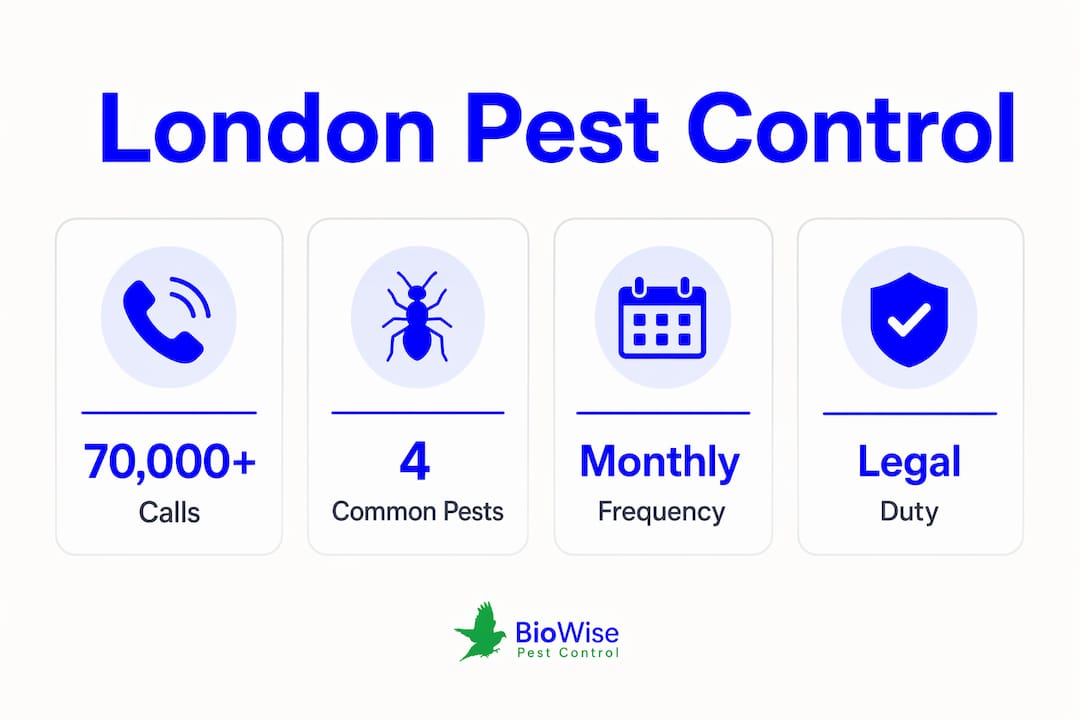
Rats, mice, cockroaches, and bed bugs all require immediate professional attention. DIY products rarely reach the harbourage sites where these pests breed, and incorrect use of rodenticides can create secondary poisoning risks. For London homeowners, proofing and waste management are the most effective first lines of defence, but they work best alongside professional monitoring.
Signs of infestation and when to call a professional
Most infestations give clear warning signs before they become serious. Knowing what to look for means you can act before the problem escalates.
Observable signs include:
- Droppings along skirting boards, inside cupboards, or near waste areas.
- Gnaw marks on food packaging, cables, or structural timbers.
- Nests made from shredded paper, insulation, or fabric in hidden voids.
- Live or dead insects clustering near heat sources or food storage.
- Unusual musty or ammonia-like odours in enclosed spaces.
- Bite marks on skin or blood spots on bedding (bed bugs).
Call a professional immediately if you observe any of the following:
- Rodent activity near electrical wiring or in a food preparation area.
- Bed bugs in a tenanted or short-let property (they spread rapidly between rooms).
- A large wasp nest in a communal area or roof space.
- Persistent activity that returns within days of a DIY treatment.
- Any sign of infestation in a property subject to a food hygiene inspection.
Before you call, gather: dated photographs, a written record of where and when activity was spotted, any tenant or staff complaints in writing, and details of any previous treatments. This information speeds up the professional assessment and strengthens your compliance record.
Pro Tip: If you manage multiple units, ask your pest controller to provide a written site report after every visit. A folder of dated reports is the clearest evidence of due diligence if an environmental health officer visits.
What professional pest control services actually do
Professional pest management follows a structured methodology that DIY products cannot replicate. The standard sequence is: inspection and identification, evidence recording, proofing, targeted treatment, and then monitoring with follow-up reporting.
| Service element | Purpose | Typical approach | Best use | Limitation |
|---|---|---|---|---|
| Inspection | Identify pest, extent, and entry points | Physical survey, monitoring stations | All properties before treatment | Requires access to all areas |
| Proofing | Prevent re-entry | Mesh, sealants, door brushes, structural repairs | Long-term prevention | Not a substitute for treatment |
| Targeted treatment | Eliminate active population | Baiting, gel baits, insecticide application, heat treatment | Active infestations | Must be matched to pest and site |
| Monitoring | Detect early activity | Bait stations, pheromone traps, digital sensors | High-risk and commercial sites | Requires regular visits to be effective |
Qualified technicians carry out a COSHH (Control of Substances Hazardous to Health) risk assessment before applying any pesticide, selecting products that are both effective and appropriate for the site. This matters for food businesses and properties with children or pets. BPCA-assessed members follow Codes of Best Practice, hold a minimum of £2 million public liability insurance, and are audited to BS EN 16636, the European standard for pest management services.
DIY treatments can suppress visible activity temporarily, but they rarely address the root cause. A professional identifies harbourage sites, structural entry points, and environmental conditions that sustain the infestation. Where structural gaps are a factor, sealing them with appropriate materials, or arranging fire door and structural repairs that close off pest entry routes, forms part of a complete proofing plan.
Typical costs and how often London properties need treatment
Cost depends on pest type, severity, property size, access difficulty, and whether rapid response is required. For isolated, low-severity incidents, a one-off treatment is often sufficient. For high-risk properties such as HMOs, restaurants, hotels, or buildings with a history of rodent activity, a maintenance contract with scheduled visits and monitoring is the more cost-effective route over a 12-month period.
Key cost drivers to discuss with any provider:
- Pest type and treatment method required (heat treatment for bed bugs costs more than gel baiting for cockroaches).
- Number of units or floors requiring access.
- Whether proofing works are included or quoted separately.
- Response time: emergency call-outs typically carry a premium over scheduled visits.
- Reporting requirements for compliance purposes.
Preventative schedules reduce emergency call-outs when tailored to local conditions. For most London commercial properties, quarterly inspections represent a minimum; monthly visits are standard for food businesses. Residential landlords managing multiple units often find that a rolling contract costs less per visit than repeated one-off call-outs, and the documentation it generates has real compliance value.
London boroughs logged a very high volume of pest control calls last year, a figure that reflects the scale of reactive demand. Properties on preventative contracts rarely contribute to that number.
Legal responsibilities for landlords and businesses in London
The regulatory picture for London landlords and commercial operators is clear, and the consequences of non-compliance are serious.
For landlords:
- The Homes (Fitness for Human Habitation) Act requires rental properties to be free from hazards affecting health and safety. A persistent pest infestation can constitute a breach, giving tenants the right to seek a remedy through the courts.
- Local environmental health officers can issue improvement notices or take enforcement action where a landlord fails to address a reported infestation.
- GOV.UK guidance sets out which pest control methods are permitted and when councils can intervene on private property.
For businesses:
- Food businesses must demonstrate pest management as part of their food safety due diligence under the Food Safety Act 1990 and associated regulations.
- The Health and Safety at Work Act 1974 requires employers to maintain a safe working environment, which includes freedom from pest-related hazards.
- BPCA commercial guidance notes that pests can cause product recalls, loss of consumer confidence, and legal penalties where due diligence is absent.
- Pest management records, including treatment reports and contractor credentials, must be available for inspection by environmental health officers or food safety auditors.
A practical due diligence checklist for landlords and managers:
- Maintain a written inspection schedule and keep dated records of every visit.
- Retain contractor credentials: BPCA membership certificate, public liability insurance, and COSHH documentation.
- Record all tenant or staff pest complaints in writing with dates and responses.
- Keep treatment reports on file for a minimum of two years.
- Review and update your pest management plan after any enforcement contact or change of use.
For a detailed compliance framework, the pest control compliance guide for London businesses covers the documentation requirements that satisfy most environmental health audits.
How to choose a pest control provider in London
The London market includes a wide range of providers, and the difference between a qualified professional and an uninsured operative can have serious consequences for your property and your compliance record.
Essential credentials to verify:
- BPCA membership (confirms training, insurance, and audit to BS EN 16636).
- RSPH (Royal Society for Public Health) or equivalent qualifications held by the attending technician.
- Public liability insurance of at least £2 million.
- Written method statements and COSHH risk assessments provided before treatment.
- A clear reporting format: written site reports after every visit.
Questions to ask on first contact:
- What is your typical response time for an emergency call-out?
- Will you provide a written survey report before recommending treatment?
- Are you BPCA-assessed, and can you share your membership details?
- What guarantees do you offer, and what are the terms for follow-up visits?
- Do you offer eco-friendly or non-toxic options, and what is your policy on glue traps?
Red flags to watch for:
- Vague or verbal-only guarantees with no written terms.
- Inability or unwillingness to provide COSHH documentation.
- Requests to use methods that are restricted or prohibited under UK guidance.
- No written report after treatment.
BPCA guidance is consistent on this point: hiring a qualified, assessed member is the most effective and safest route, with the added benefit of traceable reporting that supports your compliance record.
Biowise Pest Control Maintenance Services: a local London provider
Biowise Pest Control Maintenance Services has operated in London since 2010 and has served over 600 clients across residential and commercial properties. The company covers central, east, and west London, offering emergency treatments, monthly maintenance contracts, and tailored programmes for restaurants, hotels, offices, and HMOs.
Services relevant to the topics covered in this guide include:
- Proofing surveys and physical exclusion works.
- Rodent monitoring contracts with written site reports.
- COSHH-compliant targeted treatments for cockroaches, bed bugs, wasps, and stored-product insects.
- Eco-friendly options for properties where chemical treatments are not appropriate.
- Rapid-response call-outs for urgent infestations.
- Commercial compliance programmes designed to satisfy food safety and environmental health audits.
Biowise Pest Control Maintenance Services holds BPCA membership and carries public liability insurance. Written method statements and COSHH documentation are provided as standard. For property managers, the company’s property management pest control guide sets out how a structured monitoring programme integrates with a landlord’s compliance obligations.
Why community-level pest management matters in London
Pest control in dense urban areas is rarely a problem that one property can solve in isolation. Rats and mice move freely through shared drainage systems, communal gardens, and the voids between terraced or converted properties. Treating one flat in a block without addressing adjacent units or shared spaces often means the infestation returns within weeks.
Effective community-level pest management involves coordinated action: shared bin areas managed to reduce food availability, communal proofing works agreed between freeholders and leaseholders, and consistent reporting across a building or street. Borough councils play a role here, particularly in social housing, but the BPCA’s national survey data shows that nearly 20% of local authorities have discontinued their pest control services, placing more responsibility on private owners and managing agents. Where a block or terrace has a shared pest problem, a single contract covering all units is usually more cost-effective and more thorough than multiple separate treatments.
Health impacts of London’s most prevalent pests
The health consequences of untreated infestations extend well beyond the obvious. Rats carry Leptospira interrogans, the bacterium responsible for Weil’s disease, which can cause liver and kidney failure in severe cases. Cockroach allergens are a recognised trigger for asthma, particularly in children living in high-density housing. Bed bugs, while not known to transmit disease directly, cause significant sleep disruption and psychological distress, and secondary skin infections from scratching are common.
London’s status as a global travel hub makes it a persistent hotspot for bed bugs. The BPCA’s survey data identified London councils as consistently among the highest for bed bug treatments per thousand residents, driven by tourism density and high housing turnover. Pigeons present a different category of risk: accumulated droppings harbour Cryptococcus neoformans (a fungal pathogen) and Histoplasma, both of which can cause serious respiratory illness in immunocompromised individuals. For food businesses, the contamination risk from any of these pests can result in a failed hygiene inspection and, in serious cases, prosecution.
DIY prevention steps that work for London homes
Professional treatment addresses an active infestation; prevention reduces the likelihood of one starting. These steps are specifically relevant to London’s building types and urban environment.
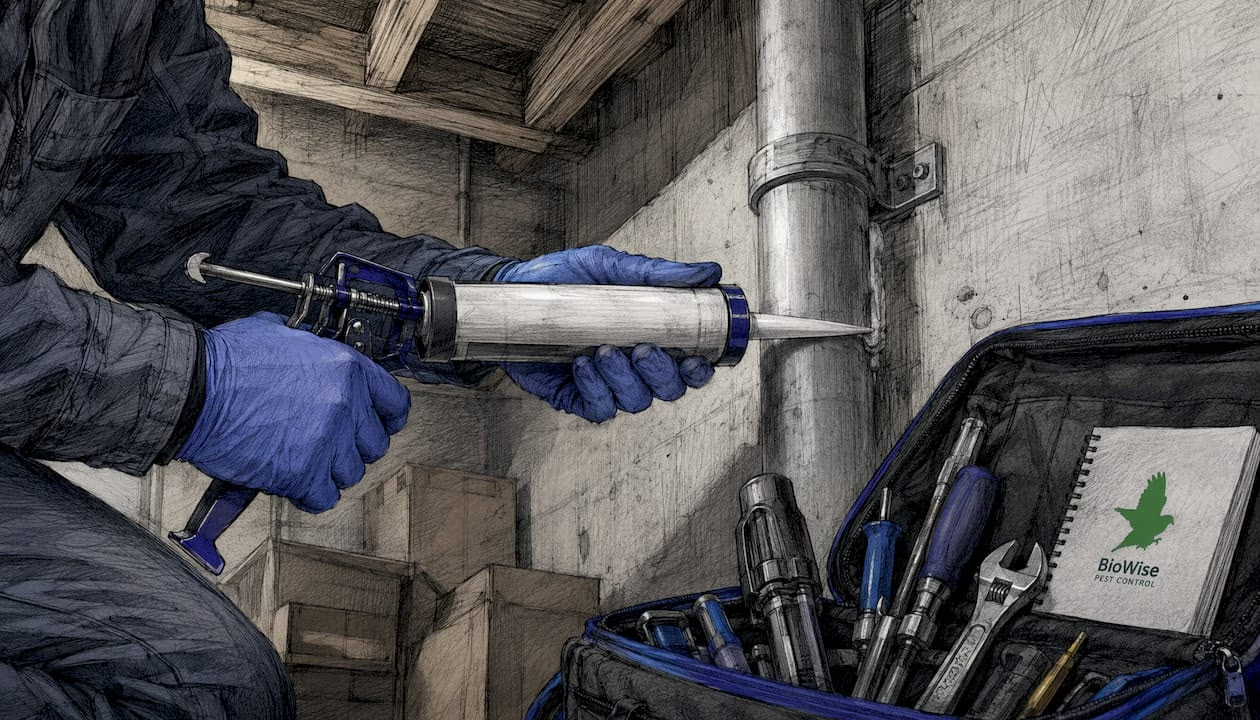
- Seal gaps around pipework: Victorian and Edwardian properties typically have numerous gaps where pipes enter walls. Use wire wool and expanding foam together, as rodents can compress through surprisingly small openings.
- Manage waste consistently: use lidded bins, avoid leaving bags outside overnight, and report damaged communal bin stores to your managing agent or council.
- Check appliance seals: the gap behind a fridge or dishwasher is a common cockroach harbourage point. Clean and inspect these areas regularly.
- Inspect second-hand furniture: bed bugs are frequently introduced via second-hand mattresses, sofas, and upholstered items. Inspect seams and joints before bringing anything into the property.
- Reduce moisture: cockroaches and silverfish thrive in damp conditions. Fix leaking pipes and improve ventilation in bathrooms and kitchens.
- Clear roof and loft access points: pigeons and squirrels enter through damaged soffits and fascias. A periodic check of the roofline, particularly after winter, catches problems early.
For a more detailed prevention plan, the residential pest management guide covers London-specific building types and seasonal risk periods.
Key takeaways
Pest control in London is a legal duty, a health safeguard, and a practical asset management decision — not an optional extra for landlords and commercial operators.
| Point | Details |
|---|---|
| Legal duty is clear | The Homes (Fitness for Human Habitation) Act makes persistent infestations a potential breach of landlord obligations. |
| London’s urban drivers are year-round | Heat-island conditions and continuous food waste mean rodents breed without seasonal breaks, making reactive-only treatment insufficient. |
| High call volumes logged last year confirm the scale of urban pest pressure | |
| BPCA membership is the key credential | Always verify BPCA membership, public liability insurance, and written COSHH documentation before hiring any provider. |
| Biowise Pest Control Maintenance Services | Operating since 2010, serving 600+ London clients with contracts, emergency treatments, and COSHH-compliant programmes. |
A practitioner’s perspective on London pest management
The most common mistake property managers make is treating pest control as a reactive cost rather than a scheduled maintenance item. By the time a rat is visible, the harbourage is usually well established, and the structural entry points have been open for months. In London’s converted Victorian stock, the shared voids between flats are the critical weak point: a gap around a soil pipe on the ground floor can give rodents access to every level of a building.
The one action that consistently reduces recurrence is proofing carried out immediately after treatment, not weeks later. Treatments eliminate the active population; proofing prevents the next one. For high-risk properties, quarterly inspections with written reports are the minimum cadence that gives a landlord or manager any real confidence in their compliance position.
Biowise Pest Control Maintenance Services: request an inspection today
Facing a pest problem in London without a clear plan costs more in the long run than a structured contract. Biowise Pest Control Maintenance Services offers City of London pest control, west London coverage, and east London services for both residential and commercial clients, with emergency response, monthly maintenance contracts, and full COSHH documentation provided as standard.

Eco-friendly treatment options are available for properties where chemical applications are not appropriate, and all programmes are designed to satisfy environmental health and food safety audit requirements. To request an inspection or discuss a maintenance contract, contact Biowise Pest Control Maintenance Services directly through the commercial pest control page or the contact form on the website.
Further reading and official sources
- British Pest Control Association (BPCA) — member directory, pest advice leaflets, and Codes of Best Practice.
- GOV.UK: pest control on your property — official guidance on permitted methods and council powers.
- City of London Corporation: pest control — contact details and scope of services for the Square Mile.
- Westminster City Council: pest control — borough-level service information and enforcement contacts.
- BPCA national survey of local authorities — data on council service provision and treatment volumes across the UK.
When to contact the council versus a private contractor: contact your local environmental health team if you are a tenant reporting a landlord’s failure to act, or if you believe a neighbouring property is the source of an infestation. For all other situations, a private BPCA-assessed contractor will typically respond faster and provide the written documentation your compliance record requires. Save all treatment reports and inspection records for a minimum of two years.
FAQ
What is the main reason for pest control in London?
Pest control in London protects public health, prevents structural damage, and fulfils legal duties under the Homes (Fitness for Human Habitation) Act. London’s high-density housing and year-round urban warmth make professional management a practical necessity rather than a precaution.
How much does pest control cost in London?
Costs vary by pest type, property size, severity, and whether a one-off treatment or a maintenance contract is required. Emergency call-outs carry a premium; scheduled contract visits are typically more cost-effective for high-risk or commercial properties.
How often should I get pest control in London?
Frequency should be risk-based. Food businesses typically require monthly visits; most commercial properties benefit from quarterly inspections as a minimum. Residential landlords with a history of rodent activity are generally advised to move to a rolling contract rather than reactive one-off treatments.
What are the laws about pest control in London?
The Homes (Fitness for Human Habitation) Act requires landlords to keep rental properties free from hazards including persistent infestations. Food businesses must maintain pest management records as part of food safety due diligence. GOV.UK guidance sets out which control methods are permitted and when councils can intervene on private property.