


TL;DR:
- Preventative pest control stops infestations before they happen, reducing legal, health, and reputational risks.
- It involves exclusion, sanitation, monitoring, and targeted treatments, emphasizing ongoing vigilance.
- Adopting a proactive approach enhances compliance, saves costs, and promotes sustainable, eco-friendly pest management.
Most London business owners think about pest control the moment they spot a rat, find droppings near a food prep area, or receive a complaint from a customer. By that point, the damage is already happening. A reactive mindset is understandable, but it carries real risks: regulatory penalties, failed health inspections, and reputational harm that can take months to repair. Preventative pest control turns that model on its head, stopping infestations before they ever take hold. This guide explains what preventative pest control means in practice, how it works, and why it is the most reliable path to compliance and customer confidence for London businesses. It is also the approach behind our commercial pest control contracts.
Key Takeaways
| Point | Details |
|---|---|
| Prevention beats reaction | Stopping pests before they arrive saves money, reputation, and legal trouble compared to dealing with infestations afterwards. |
| Integrated Pest Management works | IPM strategies reduce chemical use and pest numbers by targeting prevention, monitoring, and only necessary treatments. |
| Action is cost-effective | Businesses see infestation reductions of 80% or more within months when they invest in preventative pest control. |
| London-specific compliance | A preventative approach helps businesses in London stay compliant with strict health rules and inspection requirements. |
What is preventative pest control?
With the need for proactive action established, let’s clarify exactly what preventative pest control means for your business.
Preventative pest control is a proactive strategy that stops pest infestations before they occur, primarily through Integrated Pest Management (IPM) principles involving prevention, monitoring, and targeted controls. Rather than waiting for a problem to emerge, this approach builds layers of protection around your premises so that pests never gain a foothold in the first place.
“Prevention is not simply a better option than reactive treatment. For a commercial business in London, it is the only credible option if you want to protect your licence, your staff, and your customers.”
This is fundamentally different from reactive pest management, which focuses on removing pests after an infestation has already been identified. Reactive management means calling in a technician, applying treatments, and then returning to normal operations, until the next outbreak. It addresses the symptom, not the cause. Our emergency pest control in London service is there when an outbreak happens, but a prevention programme means you should rarely need it.
Why does this distinction matter for London businesses specifically? The city’s density, ageing building stock, and year-round urban food waste create conditions that favour rapid pest colonisation. Rats, mice, cockroaches, and flies do not wait for a convenient moment to appear. Without ongoing prevention, any premises with food, warmth, and entry points is a target.
The benefits of pest prevention for commercial operators extend across four core areas:
- Legal compliance: The Food Safety Act 1990 and the Health and Safety at Work Act 1974 both require businesses to maintain premises free from pest hazards. Failure can result in improvement notices, fines, or closure.
- Health protection: Rodents and insects carry pathogens including Salmonella, Listeria, and Hantavirus. A single contamination incident can result in employee illness or customer harm.
- Cost control: Treating an established infestation typically costs far more than maintaining a prevention programme. Structural repairs, product losses, and legal fees compound the financial impact.
- Reputation management: A pest sighting reported on Google Reviews, TripAdvisor, or social media can deter customers far more quickly than any pest can be removed.
One of the most common misconceptions we encounter is the belief that pests will simply be dealt with when they appear. This assumes that detection will happen before serious harm is done, that a rapid treatment will resolve the issue entirely, and that customers and inspectors will not notice. None of these assumptions hold up under scrutiny in a real London commercial environment.
How preventative pest control works: principles and methods
Now that we’ve defined the approach, let’s explore how preventative pest control actually functions in real settings.
A well-designed prevention programme draws on four core IPM steps, each building on the last to create a robust, practical system.
- Exclusion: Identify and seal all potential entry points. For London businesses, this typically means sealing gaps around pipework, fitting bristle strips to exterior doors, installing drain covers, and repairing damaged brickwork or soffits. Even a gap of 6mm is sufficient for a mouse to enter. Our guide to rodent-proofing drains covers the drain side of this work.
- Sanitation management: Remove the conditions that attract pests. This includes structured waste management schedules, correct food storage protocols, regular deep cleaning of hard-to-reach areas such as behind refrigeration units and beneath floor panels, and prompt repair of water leaks that create breeding environments for flies and cockroaches.
- Ongoing monitoring: Deploy monitoring stations, sticky boards, and electronic detection devices throughout the premises. Regular inspection of these tools generates accurate, site-specific data on pest pressure. This step is the foundation for targeted, evidence-based decisions.
- Targeted treatment: When monitoring reveals a risk or early signs of activity, apply the least disruptive, most precise treatment available. This may be a localised gel bait, a pheromone trap, or a targeted insecticidal treatment rather than a broad chemical spray.
Understanding common pest risks in London helps businesses prioritise which steps to implement first and with the most rigour.
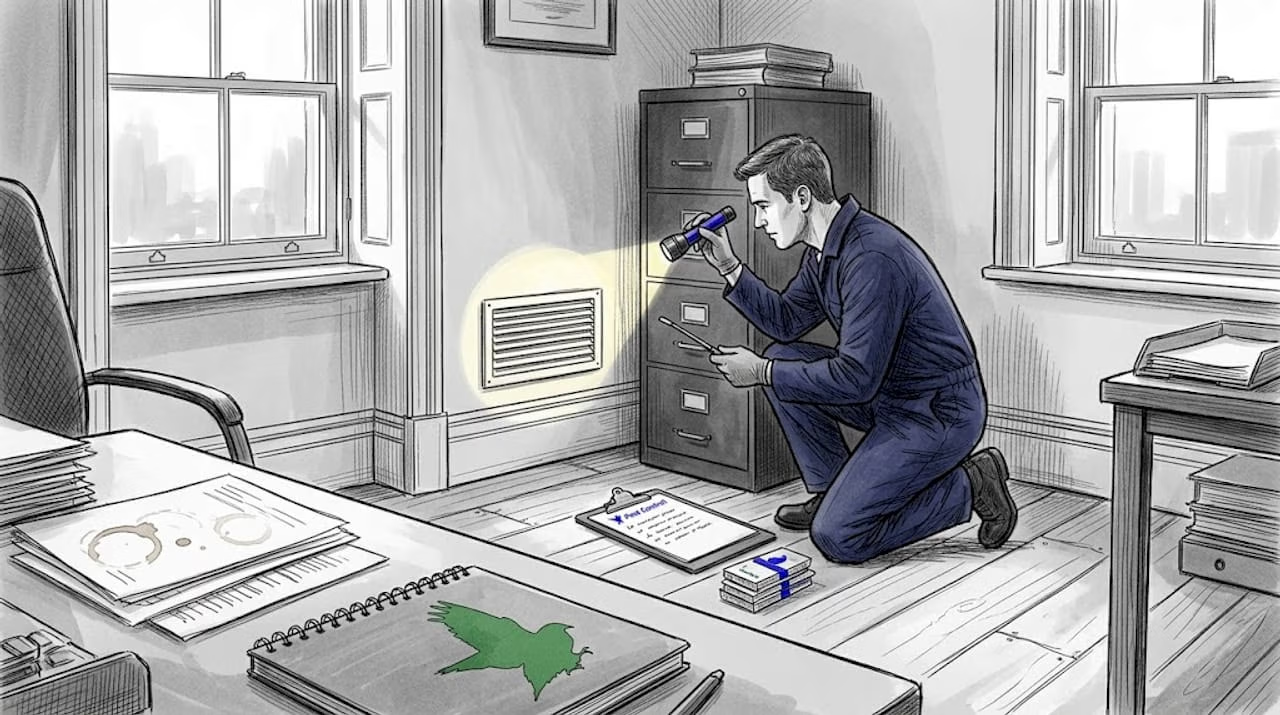
The evidence for this approach is substantial. IPM reduces chemical pesticide use by over 70% in measured cases, with vegetable growers reporting a 35% overall reduction, and professional preventative programmes achieving 80 to 90% infestation reduction within three months.
Pro Tip: Monitoring is consistently the most neglected step in commercial pest prevention. Many business owners invest in exclusion work and sanitation improvements but then assume the job is done. Without regular, documented monitoring, you lose early warning capability. Early detection is what converts a minor pest presence into a manageable situation rather than a full infestation.
| Prevention step | Primary purpose | Frequency |
|---|---|---|
| Exclusion survey | Block physical entry points | Annually or after structural changes |
| Sanitation audit | Remove attractants | Monthly minimum |
| Monitoring station checks | Detect early activity | Fortnightly or monthly |
| Targeted treatment | Address confirmed activity | As required, evidence-led |
| Staff training | Build awareness and reporting | At onboarding and annually |
For businesses seeking eco-friendly pest prevention tips, IPM-based prevention naturally aligns with sustainability goals by reducing chemical reliance and focusing on structural and behavioural solutions. Businesses looking to maintain a pest-free workspace will find that the combination of exclusion, sanitation, and monitoring is far more effective than any single product or treatment alone.
Comparing preventative and reactive pest control for London businesses
With a grasp of the methods, it’s important to see how they stack up against the reactive model most businesses default to.
The financial and operational differences between these two approaches are significant, and worth examining honestly.
| Factor | Preventative approach | Reactive approach |
|---|---|---|
| Cost structure | Regular, predictable contract costs | Variable, often high emergency call-out fees |
| Infestation rate | Reduced by 80 to 90% within 3 months | Recurring outbreaks without root cause resolution |
| Compliance risk | Low, with documentation to support inspections | High, especially during active infestations |
| Business disruption | Minimal, managed during normal operations | Significant, may require temporary closure |
| Brand impact | Neutral to positive | Potentially severe if pest activity becomes visible |
| Chemical use | Low, targeted only when needed | Often high, broad-spectrum treatments applied reactively |
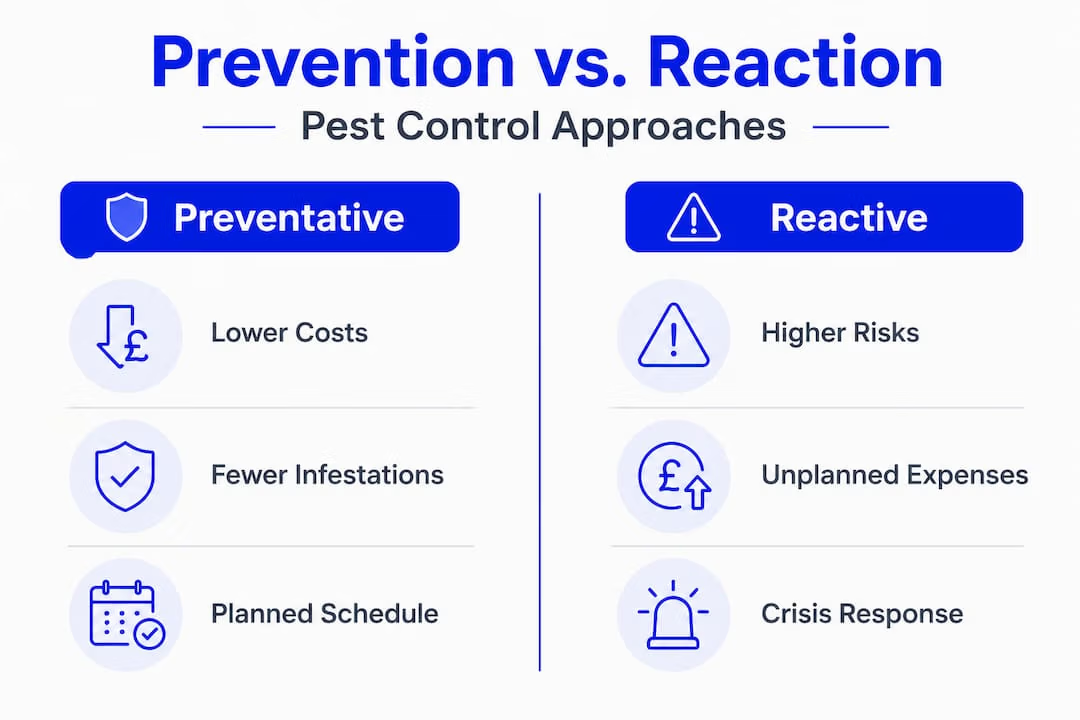
80 to 90% infestation reduction: Professional preventative programmes consistently achieve this level of infestation reduction within three months. This is not a marginal gain. For a food business in London, the difference between an 80% reduction in rodent activity and an active infestation can mean the difference between passing or failing a scheduled Environmental Health inspection.
Businesses that rely solely on reactive management expose themselves to a specific set of compliance risks:
- Pest evidence identified during an unannounced food hygiene inspection, potentially resulting in a zero or one-star Food Hygiene Rating.
- Failure to demonstrate due diligence in the event of a customer complaint or illness claim.
- Breach of lease conditions if a landlord requires pest-free premises, particularly in serviced office spaces and shared commercial buildings.
- Inability to provide an audit trail showing that pest management was actively managed and documented.
The long-term savings case for pest proofing versus chemical control is well-established. Structural pest proofing and routine monitoring require investment, but they eliminate the repeated cost of emergency treatments, product losses due to contamination, and staff time lost to managing pest incidents. Understanding the regular pest control benefits is particularly relevant for property managers overseeing multiple commercial tenants, where a single unmanaged infestation can spread rapidly between units.
The reactive model also creates a false sense of resolution. A technician arriving after an infestation is confirmed will treat the visible problem, but without exclusion and sanitation changes, the root cause remains. The same pest pressure returns, often within weeks, and the cycle repeats at ongoing cost.
Implementation: steps to set up a preventative pest control plan
Having compared the models, here’s how to put preventative pest control into action in your own business.
Setting up a prevention programme does not need to be complex, but it does need to be systematic. The following steps provide a practical framework for London business owners.
- Conduct a site assessment: Walk the entire premises with a critical eye, looking for entry points, food or water sources, harbourage areas such as clutter or wall cavities, and any existing signs of pest activity. If unsure what to look for, a qualified pest controller can carry out a detailed survey.
- Identify site-specific risks: A restaurant in a basement on a busy high street faces very different risks from a serviced office on the fifth floor of a modern building. Tailoring your prevention plan to your specific environment makes it far more effective than applying a generic solution.
- Set up a monitoring network: Install monitoring stations and detection devices at relevant points throughout the premises. Position rodent monitors along wall runs and near entry points; use sticky boards in kitchen areas and food storage rooms. Record all findings at every inspection.
- Train your team: Staff are your first line of observation. Teach them to recognise the early signs of pest activity, including droppings, gnaw marks, smear trails, and unusual odours, and to report these promptly. A staff member who notices and reports a mouse sighting on a Monday morning prevents a far larger problem by Friday.
- Contract a qualified pest prevention specialist: A professional partner brings technical knowledge, legal accountability, and access to regulated products and techniques. Choose a company that provides written reports after every visit, as these form your compliance documentation.
Preventative pest control is grounded in ongoing monitoring, prevention, and timely intervention based on IPM. When choosing a prevention partner, look for:
- BPCA (British Pest Control Association) membership, which confirms adherence to professional and ethical standards.
- Written service reports that document findings, actions taken, and recommendations at every visit.
- Tailored programme design, not a one-size-fits-all contract.
- Clear communication protocols for emergency escalation between scheduled visits.
- Experience with your business type, whether that is food service, hospitality, healthcare, or office environments.
For businesses seeking dedicated office pest prevention services, a tailored programme based on your building’s layout and occupancy patterns will deliver far more reliable results than a standard service agreement.
Pro Tip: Keep a pest control logbook on site, updated after every inspection or treatment visit. During a food hygiene inspection or safety audit, an up-to-date logbook is one of the most effective tools for demonstrating due diligence. It shows that pest management is active, documented, and taken seriously, not just attended to when something goes wrong.
Align your programme with local health and safety standards from the outset. The Food Standards Agency and London Environmental Health departments expect to see evidence of proactive pest management, not just reactive treatments. A properly documented prevention programme supports this requirement directly.
A smarter prevention mindset: lessons London businesses must learn
Before wrapping up, it’s worth sharing a candid perspective on why prevention isn’t just a ‘nice to have’: it is fundamental to future-proofing your business.
In over a decade of working with London businesses, we’ve noticed a consistent pattern. Business owners who resist preventative programmes often cite cost as the reason, but the real barrier is underestimating indirect costs. The price of an emergency treatment is visible on an invoice. The cost of a one-star food hygiene rating, a cancelled corporate contract, or a member of staff who no longer feels comfortable working in the building is far harder to quantify but far more damaging.
Why commercial pest management matters is a question we find ourselves answering not just in terms of pest biology, but in terms of risk management and organisational sustainability. Prevention is not a pest control decision. It is a business resilience decision.
There is also a nuance worth acknowledging. While IPM reduces pesticide reliance, some pesticide risks to non-target invertebrates increased in England due to shifts towards pyrethroids and neonicotinoids, which is why responsible IPM programmes prioritise non-chemical methods first and chemical controls last. This is not a reason to avoid professional pest management. It is a reason to choose a provider who takes ecological responsibility seriously and does not default to broad-spectrum chemical treatments as a first resort.
Prevention must also start with clear internal ownership. Someone in your business needs to be accountable for pest monitoring, staff reporting, and contractor liaison. Without that named responsibility, even a well-designed programme can deteriorate between visits.
Connect with expert pest prevention for your London business
Ready to put prevention first? Here’s how you can take action toward a pest-free, compliant business.
At BioWise Pest Control Services, we’ve been helping London businesses build genuinely effective prevention programmes since 2010. With over 800 clients across the city, we understand the specific pressures that restaurants, hotels, offices, and retail operations face when it comes to health compliance and pest risk.
Our tailored London pest control contracts are designed around your site, your risk profile, and your compliance requirements, not a generic service schedule. Whether you need monthly maintenance visits, a full commercial pest management programme, or an initial prevention audit, our fully qualified pest controllers are ready to help. Get in touch today to arrange a site assessment and take the first step towards pest-free, compliant operations.
Frequently asked questions
How does preventative pest control reduce business risks?
It minimises infestations, helps avoid legal breaches, and reduces the chance of reputational harm by stopping pests before they arrive rather than responding after damage is already done.
Is preventative pest control cost-effective for small London businesses?
Yes. Businesses report significant reductions in infestation costs and chemical use, with professional programmes achieving 80 to 90% infestation reduction within three months, often realising savings well within the first year.
Are preventative methods eco-friendly?
Most modern preventative programmes use IPM to reduce chemicals, prioritising monitoring and targeted action. IPM reduces pesticide use by over 70% in measured cases, making it a significantly more sustainable approach than repeated broad-spectrum treatments.
Can preventative pest control programmes ensure health inspection compliance?
A robust plan using ongoing monitoring and documentation aligns directly with local health regulations, providing the audit trail that Environmental Health inspectors and food hygiene assessors expect to see from London businesses.