


TL;DR:
- Effective pest treatment scheduling requires sector-specific risk assessment, seasonal adjustments, operational coordination, and detailed documentation. Businesses that actively manage and review their schedules, based on pest trends and regulatory requirements, gain better compliance and infestation prevention.
Pest treatment scheduling is defined as the structured process of planning, timing, and documenting pest control visits based on sector risk, seasonal activity, and operational requirements. For facility managers and business owners in London, getting this right is not optional. The Control of Substances Hazardous to Health Regulations (COSHH) require certified technicians to apply biocides, with records kept for a minimum of two years. Food Hygiene Regulations add further obligations, and Environmental Health Officers expect evidence of proactive management, not just a signed contract. A well-built pest treatment calendar is the difference between passing an audit and facing a compliance notice.
How to schedule pest treatments based on sector risk
The starting point for any pest treatment calendar is a risk assessment tied to your sector. Visit frequency matches sectoral risk: food businesses require monthly pest control visits as a minimum, hospitality venues typically operate on a bi-monthly schedule, and offices or lower-risk retail premises can often manage with quarterly visits. These are not arbitrary intervals. They reflect the likelihood of pest activity, the consequences of an infestation, and the expectations of regulatory bodies.
Sector risk classification works as follows:
- Food businesses (restaurants, cafés, food manufacturing): Monthly visits as a minimum. High food waste, warmth, and moisture create ideal conditions for rodents, cockroaches, and flies. Any gap in treatment creates a compliance risk.
- Hospitality (hotels, pubs, event venues): Bi-monthly visits are standard, with increased frequency during peak trading periods such as summer and the festive season.
- Offices and corporate premises: Quarterly visits typically suffice, though buildings with canteens, waste storage areas, or basement plant rooms warrant more frequent attention.
- Retail: Frequency depends on whether food is sold on site. Non-food retail can often operate quarterly; food retail aligns with food business standards.
Building type and usage also influence scheduling. A multi-storey office block with a ground-floor café requires a split approach: monthly treatment for food-handling areas and quarterly for upper floors. Facilities with loading bays, bin stores, or adjacent green spaces face higher rodent pressure and should factor that into their sector-specific risk assessment.
Pro Tip: Document your risk assessment formally and review it annually. Environmental Health Officers treat a written risk assessment as evidence of proactive management, which carries significant weight during inspections.
Does seasonal pest activity affect your treatment schedule?
Seasonal pest behaviour in London follows predictable patterns, and your pest treatment calendar should reflect them. Rat activity peaks in autumn and winter, as rodents seek warmth and shelter when temperatures drop. Wasp pressure builds through summer, particularly in july and august. Cluster flies appear in autumn, often entering buildings in large numbers to overwinter. Ignoring these cycles means your schedule is always one step behind the pest population.
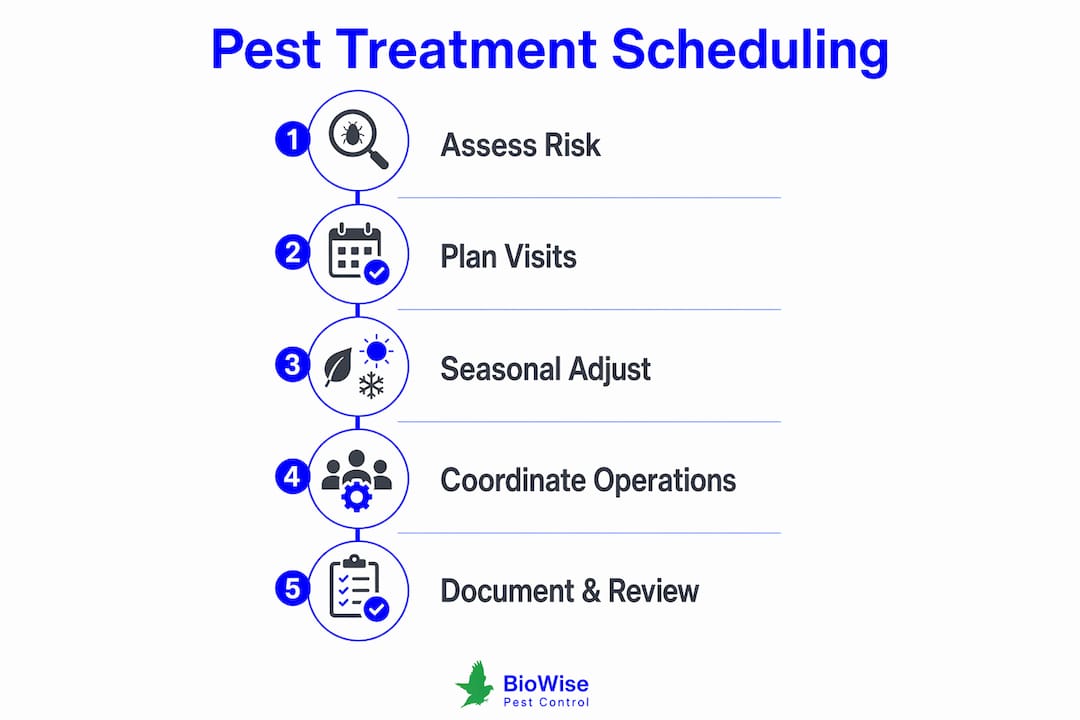
Adjusting your programme seasonally does not always mean adding extra visits. It can mean changing the focus of each visit, the treatment types applied, or the monitoring intensity in specific areas. A food business that runs monthly visits year-round might increase bait station checks in october and november, switch to fly control units in june, and add cluster fly treatments to upper-floor inspections in september.
Key seasonal adjustments for London commercial premises:
- Autumn and winter (september to february): Increase rodent monitoring frequency. Check bait stations and traps more regularly. Inspect entry points, pipe runs, and bin stores for signs of gnawing or droppings.
- Spring (march to may): Ant and cockroach activity rises. Review drain management and food storage practices. This is also the time to assess any structural pest-proofing gaps identified over winter.
- Summer (june to august): Fly and wasp pressure peaks. Ensure fly control units are serviced and correctly positioned. Wasp nest surveys should be part of summer visits for premises with outdoor areas.
- Autumn (september to november): Cluster fly treatments for upper floors and roof voids. Continue elevated rodent monitoring from the autumn peak.
Using pest trend data from your service reports to anticipate these shifts is one of the most underused tools available to facility managers. When your provider records pest activity by type and location over time, patterns emerge that allow you to pre-empt infestations rather than react to them. This is a core principle of Integrated Pest Management, which shifts the scheduling focus from chemical application to consistent monitoring and environmental modification.
Pro Tip: Ask your pest control provider to include trend analysis in quarterly review meetings. A graph showing rodent activity by month over 12 months tells you exactly when to intensify your schedule.
How to coordinate pest treatments around business operations
Scheduling pest treatments without considering your operational calendar creates unnecessary disruption. The most effective approach is to align routine visits with low-traffic periods: early mornings before staff arrive, late evenings after closing, or during planned maintenance shutdowns. For food businesses, treatments must avoid food preparation and service periods entirely, both for safety and regulatory compliance.
- Map your operational calendar first. Identify your busiest trading periods, planned closures, and any upcoming audits or inspections. Build your pest control schedule around these dates, not after them.
- Communicate visit schedules to relevant staff. Facilities teams, kitchen managers, and cleaning contractors all need advance notice of pest control visits. This prevents access issues and ensures areas are prepared correctly before the technician arrives.
- Distinguish routine visits from emergency callouts. Emergency pest treatment protocols should be triggered by specific pest sightings or evidence, such as live rodent activity in a food preparation area or a wasp nest near a public entrance. These are separate from your routine schedule and should be actioned promptly, not deferred to the next scheduled visit.
- Build flexibility into your schedule. Audit requirements, unexpected pest activity, or seasonal spikes may require an unplanned visit. Agree with your provider in advance on how additional visits are requested and what response times apply.
- Use service reports as a communication tool. Every visit should generate a written report. Share these with relevant managers and contractors so that corrective actions, such as sealing a gap or removing a food source, are completed before the next visit.
One area that common facility maintenance oversights often miss is the connection between building maintenance and pest access. A damaged door seal or a blocked drain is not just a maintenance issue. It is a pest entry point, and it belongs on both your maintenance schedule and your pest control record.
Pro Tip: Build a shared digital calendar between your facilities team and your pest control provider. When both parties can see upcoming visits, operational events, and corrective action deadlines, nothing falls through the gaps.
What does an audit-ready pest treatment schedule look like?
An audit-ready pest treatment schedule is one that a visiting Environmental Health Officer can review and immediately understand. Failure to provide detailed visit records may lead to non-compliance notices or prosecution. The documentation standard is specific and non-negotiable.
Each service visit record must include:
- Date and time of the visit
- Name and certification details of the attending technician
- Areas inspected and treated
- Products applied, including product name, active ingredient, dosage, and application method
- Pest activity observed, including type, quantity, and location
- Corrective actions recommended and any follow-up required
- Results of the previous visit’s corrective actions
Beyond individual visit records, your compliance file should contain a pest activity log maintained by your own staff between professional visits. Pest sighting logs must be maintained for at least two years, and they demonstrate a continuous monitoring system rather than a passive reliance on your contractor. Environmental Health Officers assess not only the presence of a pest control contract but also evidence of proactive management, including trend analysis and documented corrective actions.
| Document | Minimum retention period | Purpose |
|---|---|---|
| Biocide application records | 2 years (COSHH requirement) | Legal compliance for chemical treatments |
| Pest activity sighting logs | 2 years | Continuous monitoring evidence for audits |
| Service visit reports | 3–5 years (best practice) | Trend analysis and corrective action tracking |
| Treatments with long-term health risk | Up to 40 years | Extended liability and regulatory protection |
Best practice for commercial contracts recommends retaining records for 3–5 years, and up to 40 years for treatments involving substances with long-term health implications. This goes well beyond the legal minimum, but it protects your business in the event of a delayed complaint or retrospective inspection.
Pro Tip: Store all pest control documentation in a single, clearly labelled folder, whether physical or digital. When an EHO arrives unannounced, the ability to produce records within minutes signals a well-managed operation.
Common mistakes when planning pest control services
The most damaging mistake facility managers make is treating a pest control contract as a passive arrangement. Signing a contract and assuming the problem is managed is a compliance risk. Non-compliance often stems from a reactive pest control strategy. EHOs expect evidence of trend analysis and documented strategic adjustments, not just a stack of visit reports.
Common scheduling errors to avoid:
- Ignoring seasonal pest spikes. A quarterly schedule designed for an office building will not protect a food business through a London rodent peak in november without additional monitoring.
- Failing to maintain a pest sighting log. Staff observations between visits are a legal expectation in food businesses and a best-practice requirement elsewhere. A log with no entries is treated with suspicion during audits.
- Delaying emergency treatments. When a pest sighting meets your emergency threshold, the callout should happen within hours, not at the next scheduled visit. Delay creates both a compliance gap and a reputational risk.
- Not reviewing service reports. Active management of pest contracts requires reading each report, confirming corrective actions are completed, and raising unresolved issues with your provider before the next visit.
- Overlooking documentation gaps. A missing technician certification, an unsigned report, or an incomplete product record can turn a compliant operation into a non-compliant one on paper.
Pro Tip: Set a monthly calendar reminder to review your most recent service report and confirm that all recommended corrective actions have been completed and documented.
Key takeaways
Effective pest treatment scheduling requires sector-specific risk assessment, seasonal adjustment, operational coordination, and audit-ready documentation maintained for a minimum of two years under COSHH.
| Point | Details |
|---|---|
| Match frequency to sector risk | Food businesses need monthly visits; offices quarterly; hospitality bi-monthly as a minimum. |
| Adjust for seasonal pest peaks | Increase rodent monitoring in autumn and winter; add fly and wasp controls through summer. |
| Separate routine from emergency visits | Define clear triggers for emergency callouts and act on them promptly, not at the next scheduled visit. |
| Maintain audit-ready documentation | Keep biocide records for at least two years; best practice recommends 3–5 years for commercial contracts. |
| Review reports actively | Read every service report, confirm corrective actions are completed, and document the outcome. |
Why pest control scheduling is more than a compliance exercise
By Ana Hasula
After working closely with facility managers across London for a number of years, the pattern I see most often is this: businesses invest in a pest control contract and then disengage from it entirely. The contract becomes a line item, the visits happen, and the reports pile up unread. When an EHO arrives, the paperwork is there but the management evidence is not.
What I have found genuinely works is treating your pest treatment schedule as a living document. The businesses that sail through audits are not the ones with the most expensive contracts. They are the ones whose facility managers can walk an inspector through twelve months of pest activity data, point to seasonal adjustments they made in october, and show corrective actions signed off within 48 hours of each visit.
Integrated Pest Management principles matter here because they shift the conversation from “how often do we spray” to “what is the pest pressure telling us and how do we respond.” That is a fundamentally different mindset, and it produces fundamentally different results. A food business that uses trend data to pre-empt a rodent peak in november is not just compliant. It is protected.
My honest view is that the scheduling conversation should happen between you and your pest control provider at least twice a year, not just at contract renewal. Sector risk changes. Buildings change. Seasonal patterns shift. A schedule built in january needs reviewing in july. The businesses that treat pest control as continuous risk management rather than a routine service are the ones that never have to explain an infestation to an EHO.
— Ana Hasula
Bespoke pest treatment scheduling for London businesses
Biowise Pest Control Maintenance Services builds bespoke pest treatment schedules for London commercial clients based on sector risk, building type, seasonal pest patterns, and compliance requirements. Whether you manage a food business requiring monthly visits, a hotel operating on a bi-monthly cycle, or a multi-site office portfolio with varying risk levels, the approach is tailored to your operation.
Every schedule includes clear documentation protocols, service reports after each visit, and support for audit preparation. Biowise Pest Control Maintenance Services has served over 600 London clients since 2010, and the facilities management pest control service is designed specifically for the compliance and operational demands that facility managers face. If you are ready to build a schedule that holds up under scrutiny, contact Biowise Pest Control Maintenance Services for a tailored plan. You can also explore the pest control maintenance plan to understand how structured scheduling reduces infestation risk over time.
FAQ
How often should commercial pest control visits occur?
Food businesses require monthly visits as a minimum; hospitality venues typically schedule bi-monthly; offices and lower-risk premises can operate quarterly. Frequency should increase during seasonal pest peaks or following a pest sighting.
When is pest activity highest in London?
Rodent activity peaks in autumn and winter as rats seek warmth and shelter. Wasps are most active in july and august, and cluster flies enter buildings in large numbers during september and october.
How do I schedule pest control without disrupting my business?
Align routine visits with low-traffic periods such as early mornings or after closing, and communicate visit dates to relevant staff in advance. Emergency callouts should be kept separate from routine scheduling and actioned promptly when triggered by a specific pest sighting.
What records do I need to keep for pest control compliance?
COSHH requires biocide application records to be retained for a minimum of two years. Best practice for commercial pest contracts recommends retaining all service reports and pest activity logs for 3–5 years.
What triggers an emergency pest control callout?
An emergency callout is triggered by specific evidence of active infestation, such as live rodent activity in a food preparation area, a wasp nest near a public entrance, or a pest sighting that poses an immediate health or compliance risk. These should not wait for the next scheduled visit.
Recommended
- What Are the Legal Pest Control Requirements for London Commercial Kitchens? – BioWise Pest Control London
- The Cost of Neglecting Commercial Pest Services: Why Managers Must Act Now – BioWise Pest Control London
- London Commercial Pest Control – Safeguard Your Business
- One-Off Pest Control vs. Monthly Contracts: Which Saves More Money for Businesses? – BioWise Pest Control London