


To rodent-proof an exterior door, close the gap at the base with a screw-fixed, steel-reinforced sweep, dense bristle strip or threshold, seal the side and top edges, then fill pipe and cable gaps nearby with wire wool or steel mesh set in mortar. Mice can get through gaps of about 6mm and rats about 15mm, so every gap counts.
This guide covers the materials that resist gnawing, how to measure and fit a door sweep, the gaps around a door that people miss, ventilation and fire door rules, inspection routines and when to call a professional. We have proofed front doors, kitchen entrances, bin stores and loading bays across London homes, restaurants, offices and warehouses since 2010, both as one-off jobs and as part of our commercial pest control contracts.
Key takeaways
Each part of a doorway needs a different fix, and the cheapest option is rarely the one that lasts.
| Problem area | Best fix | Avoid |
|---|---|---|
| Gap under the door | Screw-fixed steel-reinforced rubber sweep, dense bristle strip or threshold strip | Foam strips and standard draught excluders |
| Side and top edges | Brush seals or thin metal angle strips on the jambs | Leaving jamb gaps open once the base is sealed |
| Pipes and cables near the door | Wire wool or stainless-steel mesh set in mortar, or a steel cover plate | Expanding foam on its own |
| Air bricks and vents | Replace damaged units or fit fine steel mesh | Blocking them up |
| Fire doors | Only seals and fixings compatible with the door’s certification | Unapproved adhesive strips or extra holes in the door leaf |
| Loading bays and roller shutters | Dock seals and screw-fixed threshold guards | Domestic sweeps that wear out under traffic |
Table of Contents
- What stops rodents at doors: materials and why they work
- How do you measure and fit a rodent-proof door sweep?
- Sealing edges, pipework and gaps beyond the bottom sweep
- Do rodent-proofing measures need to preserve ventilation?
- How often should you inspect rodent proofing on doors?
- When should you call a professional pest controller?
- Practical perspective: balancing proofing with everyday building use
- How BioWise can help with rodent proofing
- Sources
- FAQ
What stops rodents at doors: materials and why they work
Door proofing only works if you know how small a gap a rodent can use. BPCA advice is that mice need a gap of only about 6mm, roughly the width of a pencil, and rats about 15mm, roughly the width of a thumb. That single fact should govern every material choice you make: a seal that leaves a 10mm gap under the door looks tidy but will not stop a mouse. If mice or rats are already inside, proofing needs to go hand in hand with mice control or rat control, so you do not seal the problem in.
Rodents also gnaw through soft materials easily. A standard rubber or foam sweep might block a gap on day one, but a determined mouse or rat can chew through it quickly, which is why the pest control trade uses reinforced materials wherever entry pressure is high.
| Material | Best use | Gnaw resistance |
|---|---|---|
| Stainless-steel mesh or wire wool set in mortar | Irregular gaps around pipes, cables, air bricks and brickwork | High |
| Steel-reinforced rubber door strips | Door bottoms and edges on smooth thresholds | High |
| Galvanised or stainless-steel kick plates and edge guards | Lower door panels and frames on busy commercial doors | High |
| Dense bristle strips made for rodent proofing | Uneven floors and older timber doors | Medium; check regularly for wear |
| Standard rubber, foam or plastic draught strips | Draught control only | Low |
Pro Tip: Run your fingers along the base and edges of a door at dusk, when rodents are most active. If you can feel a draught anywhere, a rodent can probably find a way through.
Door sweeps, brush strips and threshold seals remain the standard first line of defence. Choosing between them depends on the door type:
- Bristle strips suit uneven floors and older timber doors where a rigid sweep would jam.
- Rigid steel-reinforced sweeps suit smooth thresholds and give a tighter seal against draughts as well as pests.
- Threshold strips and dock seals suit garage doors, warehouse loading bays and any opening where the gap is too wide for a sweep alone.
- Kick plates protect the lower door panel itself from gnawing, which matters most on timber doors in busy back-of-house areas.
Glass doors need particular care, since seals must not obstruct the closing mechanism and fixings must follow the door manufacturer’s guidance. Fire doors carry their own restrictions, covered below, and industrial roller doors usually need a dedicated seal rather than a domestic sweep.
How do you measure and fit a rodent-proof door sweep?
Getting the fit right matters more than the product you buy. A good sweep fitted with a gap underneath is barely better than nothing.
- Measure the door width at the base, then measure the gap between the underside of the door and the threshold at both ends, since floors are rarely perfectly level.
- Choose the sweep type based on that gap and the floor surface. BPCA advises fitting a door sweep or brush strip to exterior doors where the gap underneath is more than about 4mm. Use a rigid sweep on hard, flat flooring and a bristle strip where the floor is uneven or carpeted. Where the gap is more than about 20mm, fit a threshold strip or have the door adjusted, as a sweep alone will struggle to close it. Our building maintenance team can adjust doors and frames where needed.
- Buy oversized and trim to fit. Most sweeps and brush strips come in lengths you cut down with a hacksaw, so buy one longer than your door width.
- Clean the fitting surface. Remove old sealant, dust and flaking paint from the base of the door and the frame edges before fitting anything new.
- Fix the sweep. Screw-fix wherever the door sees regular use; adhesive-backed strips are faster to fit but tend to lift on doors opened many times a day.
- Test the door through a full swing before finishing, checking it does not drag, stick or fail to latch. A sweep fitted too tightly causes as many problems as one fitted too loosely.
- Check the corners and edges once the door is closed by shining a torch from the inside in a darkened room and looking for light leaking through gaps you have missed.
- Repeat for the side and top gaps using thin metal angle strips or brush seals designed for door jambs, since a perfect bottom seal is wasted if the sides are still open.
Garage doors and industrial roller shutters need a different approach. A dock seal or threshold guard screwed into the frame, rather than glued, holds up far better under repeated vehicle or foot traffic. Adhesive and soft rubber seals wear out quickly on doors in constant use, so screw-fixed steel or steel-reinforced strips are the more durable choice for warehouses, loading bays and busy commercial kitchens.
Fire doors are the exception to the screw-fix rule. A fire door has to perform as it was tested and certified, so any seal, plate or fixing must be compatible with its certification. Check the door’s label or documentation and ask the manufacturer or a competent fire door installer before drilling into the leaf, and use only intumescent or manufacturer-approved seals where the door forms part of an escape route.
Pro Tip: Fit the seal, then leave the door in daily use for a week before calling the job finished. Seals that look perfect on the day often reveal gaps once the door has been opened and closed a hundred times, so a follow-up check catches problems before rodents do.
Sealing edges, pipework and gaps beyond the bottom sweep
A perfectly fitted door sweep still leaves a building exposed if the gaps around it go unchecked. Rodents are opportunists, and a pipe penetration, a loose air brick or a gap where a cable enters through the brickwork near a doorframe is often the easier route in.
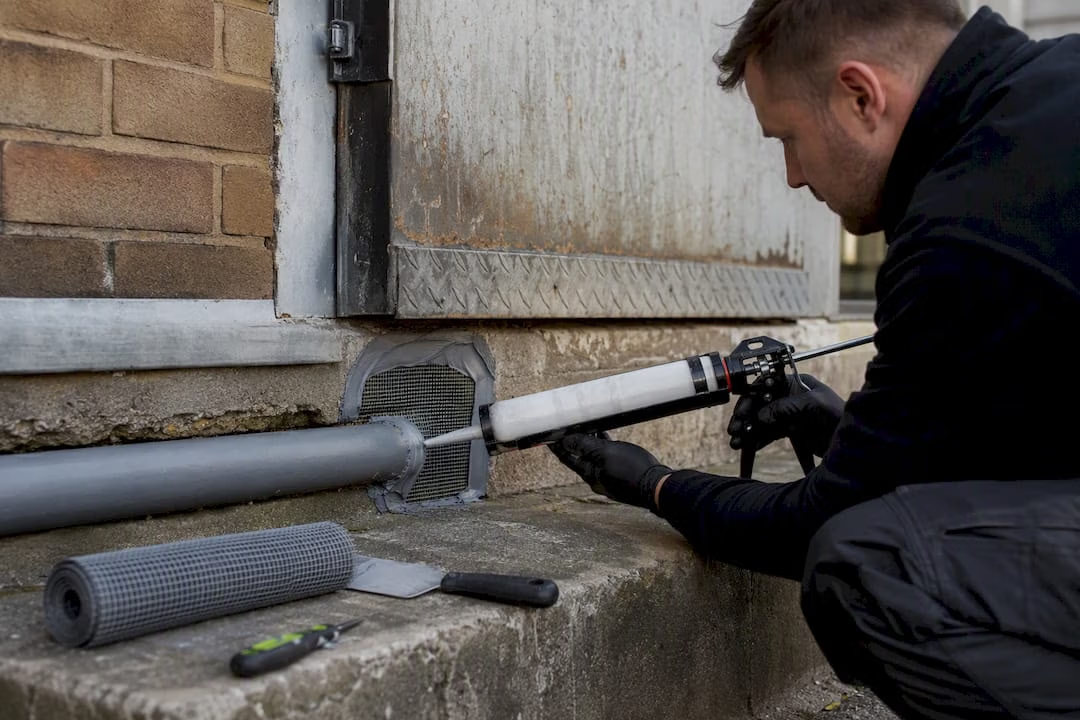
Wire wool or stainless-steel mesh is the standard fix for these irregular gaps. Pack it firmly into the opening and finish with mortar or quick-setting cement, as BPCA recommends, or fit a purpose-made steel cover plate over larger holes. Expanding foam on its own offers almost no resistance once a rodent starts chewing at it.
Commonly overlooked entry points near doors:
- Gaps where pipes or cables pass through the wall within a metre of the doorframe
- Loose or missing pointing in the brickwork next to the frame
- Side and top jamb gaps, fixable with thin metal angle plates or brush seals
- Air bricks and vents near the door that are cracked, broken or missing their mesh
- Small burrow holes at ground level near the foundations, often mistaken for drainage damage
Use metal, not foam, wherever a gap is exposed to gnawing or weather. Foam has a place for insulating small internal cracks that rodents cannot reach, but it should never be the only barrier on an external gap.
A burrow entrance at the base of a wall near a door is rarely a job for sealant alone. Burrows usually mean an active or recent rat infestation, and packing the hole without dealing with the rats behind it just pushes them to find another way in. If you notice soil disturbance, smooth tunnel entrances or fresh digging at the same spot, treat it as a structural issue and read our guidance on protecting your property from rodent structural damage before deciding whether a DIY fix will hold.
Treat any foam, sealant or tape fix as temporary until steel mesh or a proper cover plate can be fitted. Record it in your maintenance log as pending a permanent repair rather than closing it out.
Do rodent-proofing measures need to preserve ventilation?
Yes, and this is where a lot of well-meaning DIY proofing goes wrong. Sealing an air brick shut swaps a rodent problem for a damp or condensation problem, especially under suspended timber floors, and vents that supply air to gas appliances must never be blocked. Replace damaged air bricks, or fit fine stainless-steel mesh behind them, so rodents are kept out while air still flows. The same principle applies to any vent, weep hole or airflow gap near a door.
Fire doors and escape routes carry a separate set of rules worth respecting strictly:
- Never fit an unapproved seal or strip to a fire door, since it can compromise the door’s fire performance.
- Use only intumescent or manufacturer-approved seals on any door that forms part of an escape route.
- In non-domestic premises and the common parts of blocks of flats, the responsible person must keep fire doors maintained under the Regulatory Reform (Fire Safety) Order 2005, so agree any change with whoever manages fire safety for the building.
- In listed buildings, check with the council’s conservation officer before altering historic doors or frames.
Food businesses have an extra reason to get door proofing right: food hygiene law requires premises to be designed and maintained to prevent pest access, so gaps under kitchen, store and delivery doors are something environmental health officers look at closely.
Whatever you change, write it down. Property managers and landlords should log the date, the material used and which door or gap was treated, because that record becomes valuable evidence in a tenancy dispute, an insurance claim or a compliance audit.
How often should you inspect rodent proofing on doors?
Proofing wears out. Rubber perishes, screws loosen, buildings settle and doors that are slammed a dozen times a day wear their seals down faster than anyone expects. A one-off fitting job is not a permanent solution on its own.
Homeowners should walk round the exterior doors roughly every three months, and check more often after severe weather or once autumn brings rodents indoors looking for shelter. Commercial and food premises need a tighter routine. No law sets a frequency, but monthly visits are common on commercial pest control contracts, and auditors and environmental health officers routinely look at gaps under doors.
What to check on every inspection:
- Chew marks or fresh gnawing on sweeps, frames or nearby skirting
- Gaps that have opened up from loose screws or worn adhesive
- Droppings, grease marks or a stale ammonia smell near the base of the door
- Settlement that has widened a threshold gap since the last check
- Air bricks or vents near the door with damaged or missing mesh
| Inspection factor | Domestic property | Commercial or food site |
|---|---|---|
| Suggested frequency | Every 3 months, plus after storms | Monthly is common; set by risk assessment |
| Who usually checks | Homeowner, landlord or managing agent | Contracted pest technician, plus staff checks between visits |
| Record keeping | Simple dated photo log | Dated service reports for audits and EHO visits |
| Common failure point | Worn adhesive strips and perished rubber | High-traffic door seals and loading bay thresholds |
Photograph every seal at each inspection and keep the images with a short note on condition. That habit turns a vague “we checked it” into evidence you can hand to an insurer, a housing association board or an environmental health officer. For a broader routine that covers more than doors, our monthly pest inspection steps for London compliance sets out a fuller checklist.
When should you call a professional pest controller?
DIY proofing handles most single-door problems well. It stops being enough once the signs point to an established population, an access point you cannot reach, or a commercial site where compliance is on the line.
Signs that DIY sealing will not be enough on its own:
- Fresh droppings or gnawing reappearing within days of a repair
- Scratching or scurrying sounds inside wall cavities near the door, suggesting rodents are already established behind the proofing
- A burrow or tunnel entrance at the base of an exterior wall
- Multiple entry points across a large building, where a full site survey is more efficient than door-by-door fixes
- Any food premises, hotel or housing association property with an inspection coming up
A professional visit differs from DIY work in scope, not just skill. Our technicians assess the whole building envelope rather than a single door, decide which gaps need steel mesh, mortar, a cover plate or a larger repair, and leave a documented report that stands up to an audit. Where rodents are already inside, we treat the infestation as well, because sealing entry points without dealing with the rodents behind them just traps the problem. Our guide to pest proofing vs chemical pest control explains how the two work together.
If chew marks keep returning to the same spot, that is rarely bad luck. It usually means the access point has not actually been closed, just disguised, or that rodents are using a second route nearby.
Practical perspective: balancing proofing with everyday building use
Most property managers want the same thing: a fix that works and does not get in anyone’s way. Prioritise kitchen doors, garage entries, bin store doors and loading bays first, since they see the heaviest traffic and the biggest gaps, and they are where rodents have the strongest reason to keep trying.
The temptation is to over-seal, fitting the toughest, tightest seal available everywhere. That backfires on doors used dozens of times a day, where a rigid seal jams or sticks and the door ends up propped open, which defeats the point. Durability and daily use have to be weighed door by door.
“The doors that fail are usually the busy ones. If a new seal makes a kitchen or bin store door hard to close, staff wedge it open and the proofing is wasted. We fit the toughest seal the door can take while still closing properly on its own, then check it again on the next visit.”
Ben, Lead Technician, BioWise
Photograph every seal the day it is fitted, note the material and fixing method and keep that record with your maintenance log. When a tenant, inspector or new facilities contractor asks what has been done, you will have the answer in seconds.
How BioWise can help with rodent proofing
When chew marks keep coming back, a door is only part of the problem, or you manage a restaurant, warehouse or block that needs proofing records, our BPCA-certified technicians survey the whole building envelope, not just the door in question. We fit steel-reinforced sweeps, bristle strips, kick plates, mesh and cover plates, deal with any rats or mice already inside and give you a photo report of the work.

See our rodent control and domestic pest control services. For businesses and managing agents, our commercial pest control contracts include monthly visits with photo reports, digital service reports for EHO and audit files, emergency call-outs and unlimited minor pest proofing. Larger proofing projects are priced after a survey, and our building maintenance team can take on door and brickwork repairs.
BioWise is a family-run London company founded in 2010, a member of the BPCA and NPTA, CHAS accredited and SafeContractor approved, with same-day call-outs across every London borough. Call 0800 988 3568 or contact us online for a fixed written quote after a free survey.
BioWise Pest Control Maintenance
13 Hanover Square, London, W1S 1HN
Call 0800 988 3568 or email info@biowiseservices.com
Sources
- Mouse control: how to get rid of and prevent mice – BPCA
- Rat control: how to get rid of and prevent rats – BPCA
FAQ
How do you rodent-proof a door?
Fit a screw-fixed, steel-reinforced sweep, dense bristle strip or threshold at the base so no gap of 6mm or more remains. Add brush or metal seals to the side and top jambs, then seal nearby pipe and cable gaps with wire wool or steel mesh set in mortar rather than foam.
How do you stop rats getting in under a door?
Rats can get through gaps of about 15mm, so close the gap at the base with a screw-fixed threshold, dock seal or steel-reinforced sweep, and fit a kick plate if they are gnawing the bottom of the door. Check the nearby brickwork, drains and air bricks too, because rats often use more than one route.
What material can rats not chew through?
Rats struggle with stainless-steel mesh, wire wool set in mortar or cement, sheet metal and steel-reinforced rubber strips. Rubber, foam, plastic and soft wood can all be gnawed through, so use metal wherever a gap is exposed to gnawing or weather, and remember a seal is only as good as its weakest point.
What can you put under a door to keep mice out?
A door sweep or brush strip, which BPCA recommends for exterior doors where the gap underneath is more than about 4mm. On smooth, flat floors a steel-reinforced rubber sweep gives the tightest seal; on uneven floors a dense bristle strip works better. Standard draught excluders are too soft to stop mice for long.
Do door sweeps stop mice as well as draughts?
Yes, a correctly fitted sweep blocks both, provided it closes the gap fully. Mice can get through gaps of about 6mm, so a sweep that leaves even a small gap at one end will not stop them. Check the fit with a torch from inside after fitting, and again after a week of normal use.