


TL;DR:
- Managing pest control in Mayfair is critical due to its high-value buildings, regulatory enforcement, and unique environmental risks. A proactive, discreet, and well-documented approach helps prevent infestations that could damage reputation, incur fines, or lead to operational closure. Choosing a qualified, BPCA-verified provider like Biowise ensures tailored, rapid, and compliant pest management solutions in this prestigious district.
If you manage commercial property or run a business in Mayfair, pest control is not a routine administrative task. It is a direct line to your food hygiene rating, your operating licence, and your reputation in one of London’s most scrutinised commercial districts. Pest control Mayfair London commercial requirements are markedly different from those in other parts of the city, and treating them as standard is a costly mistake. This guide covers what drives pest pressure in Mayfair, which pests pose the greatest risk to your premises, what Westminster City Council expects from you, and how Biowise Pest Control Maintenance Services provides the specialist, discreet response that high-value commercial clients require.
Key takeaways
| Point | Details |
|---|---|
| Mayfair has unique pest risks | Georgian buildings, sewer connectivity, and luxury F&B density create a distinct pest environment. |
| Legal exposure is high | Westminster EHO enforcement can result in fines exceeding £50,000 and forced closure. |
| Verify contractor credentials | Only work with BPCA-verified companies to protect your business legally and operationally. |
| Discretion is non-negotiable | Visible pest control activity on a Mayfair premises can cause immediate reputational harm. |
| Contracts outperform reactive treatments | Ongoing pest management contracts reduce infestation risk and demonstrate regulatory compliance. |
Why Mayfair creates unusually high pest pressure
Most commercial pest problems follow predictable patterns. Mayfair adds several layers that make the situation considerably more demanding, and understanding them is the first step towards managing risk properly.
The density of high-end restaurants, private members’ clubs, and luxury hotels in the W1J and W1K postcodes generates a concentration of food waste, deliveries, and kitchen activity that few other London districts can match. More food handling means more attractive conditions for rodents and cockroaches. This is not simply a matter of volume. It is about the frequency of late-night deliveries, inadequately sealed waste storage, and the sheer number of interconnected basement service areas that create ideal harbourage conditions.
The built environment compounds the problem significantly. Georgian and Victorian buildings, which make up much of Mayfair’s commercial stock, were not designed with modern pest exclusion in mind. Their basements frequently feature:
- Rubble-filled cavity walls that provide rodent nesting sites
- Original brick floors and mortar joints that deteriorate and allow entry points
- Connecting service tunnels shared between adjacent properties
- Ageing drainage infrastructure where rodent ingress from the sewer network is common
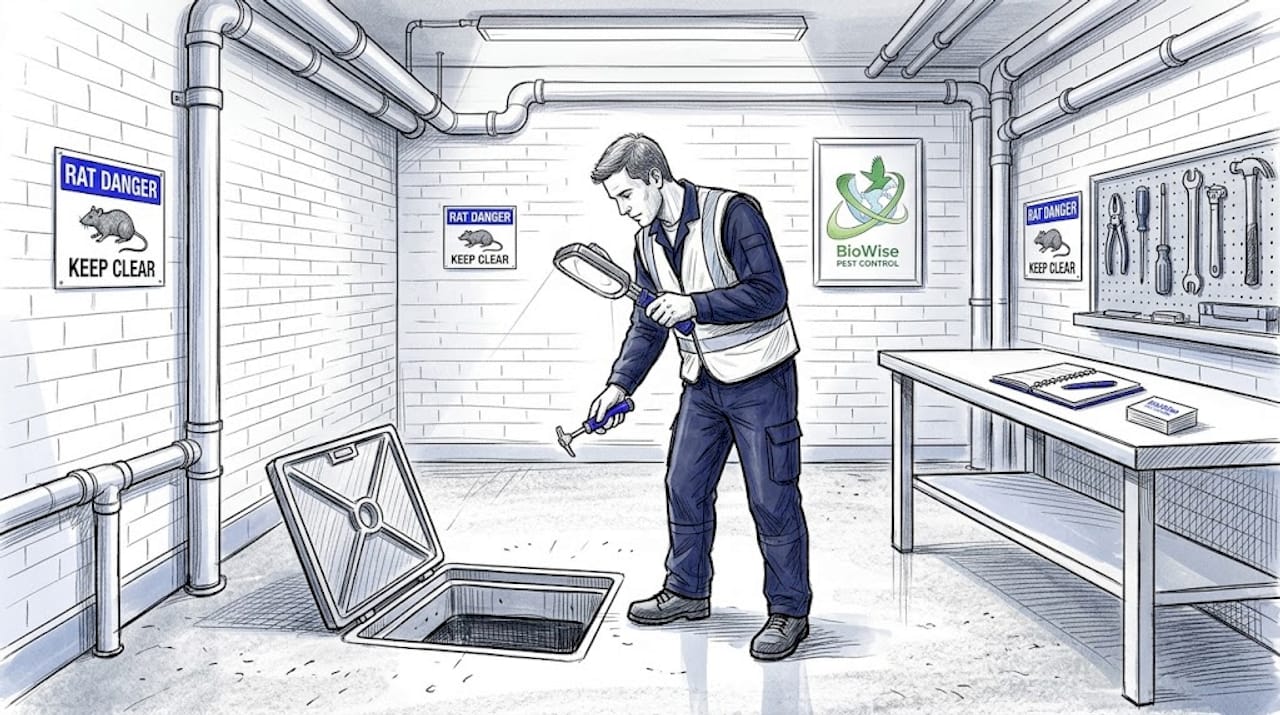
London’s Victorian sewer system runs directly beneath much of Mayfair, and rat activity along these routes is consistent. Rats regularly enter commercial premises through damaged drain covers, broken lateral pipework, and unsealed utility penetrations. Properties on or near Berkeley Square, Grosvenor Street, and the streets surrounding Green Park are particularly exposed due to the park’s proximity, which sustains significant pigeon and urban wildlife populations. The pest pressures specific to Mayfair require a response calibrated to these precise structural and environmental realities, not a generic treatment schedule.
Pro Tip: Commission a CCTV drain survey as part of your pest risk assessment. Identifying collapsed or offset drainage under your premises is often the single most effective step in preventing recurring rat ingress.
Common pests affecting Mayfair commercial premises
Different business types face different pest risks in Mayfair, though some species create cross-sector problems. The table below sets out the most prevalent pests, where they tend to appear, and what they mean for your operation.
| Pest | Most common locations | Primary business impact |
|---|---|---|
| Brown rats | Basements, drainage systems, service areas | Structural damage, contamination, EHO enforcement risk |
| House mice | Restaurant kitchens, storage rooms, wall cavities | Food contamination, hygiene rating failure, customer complaints |
| Cockroaches | Commercial kitchens, boiler rooms, food storage | Rapid reproduction, serious contamination, forced closure risk |
| Bed bugs | Luxury hotel rooms, upholstered furnishings | Guest complaints, review damage, costly room quarantines |
| Feral pigeons | Roof terraces, period facades, air conditioning units | Structural fouling, blocked drainage, health risk from droppings |
Rats entering via sewer systems carry Leptospira interrogans, the bacterium responsible for Weil’s disease, alongside several other pathogens that present direct risks to staff and customers. In a restaurant or hotel kitchen context, a single confirmed rodent sighting triggers an immediate reporting obligation to Westminster City Council’s Environmental Health team.
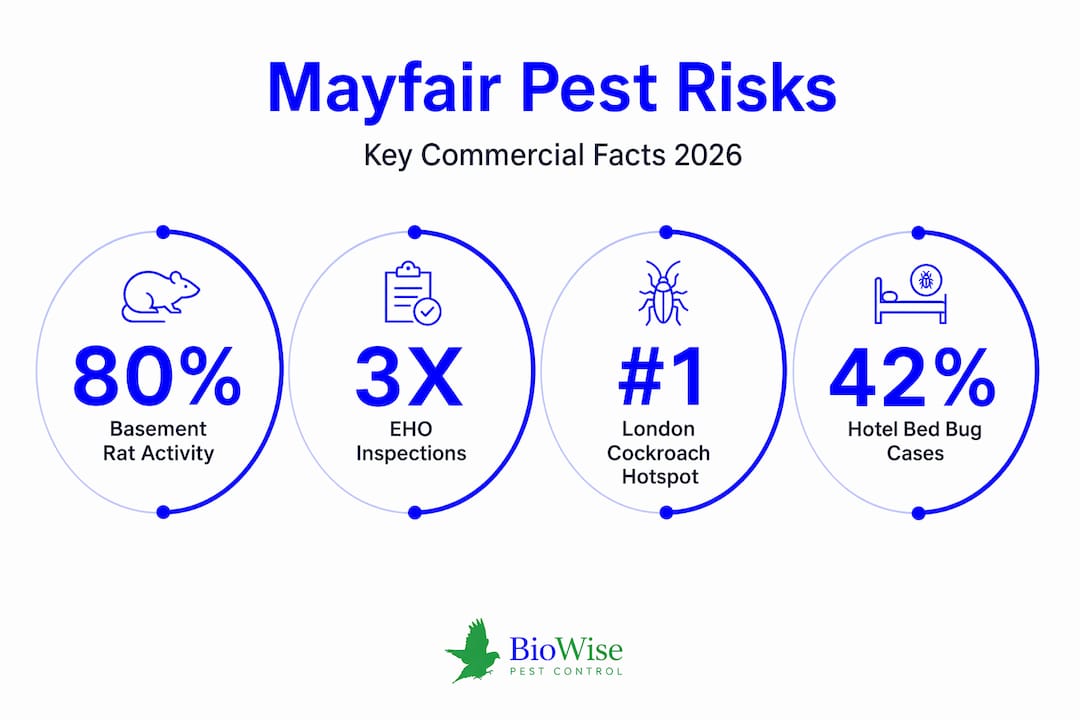
Mice in restaurant basements are often underestimated because of their smaller size, but their gnawing behaviour damages electrical cabling, insulation, and structural materials at a pace that surprises most property managers who have not dealt with an active infestation before.
Cockroaches thrive in the warm, humid conditions behind commercial catering equipment and inside wall voids adjacent to boiler rooms. They reproduce extremely rapidly, and a modest infestation can become a serious one within weeks if not treated by a qualified technician using appropriate insecticide rotation to prevent resistance.
Bed bugs in Mayfair’s luxury hotels represent a particularly sensitive operational challenge. Discretion and fast response are not simply service preferences in this context. They are commercial necessities. A confirmed bed bug complaint posted publicly online can affect booking rates within hours.
Pigeon fouling on Georgian facades causes stonework deterioration, blocks guttering, and creates slip hazards on roof terraces and external walkways. For listed buildings, the choice of deterrent methods is constrained by planning restrictions, which makes specialist knowledge of heritage-compliant solutions particularly valuable.
Westminster EHO enforcement and reputational risk
Westminster City Council operates some of the most active Environmental Health enforcement in London. Commercial properties in Mayfair fall within its jurisdiction and are subject to regular inspections under the Food Safety Act 1990, the Health and Safety at Work Act 1974, and the Prevention of Damage by Pests Act 1949.
The consequences of failing to maintain adequate pest control are not theoretical. In 2026, a London restaurant was fined £25,000 and ordered to close following the discovery of a cockroach infestation and the absence of documented pest management procedures. In a separate case that same year, a pub in west London was ordered to pay over £52,000 including a £37,000 fine, legal costs, and victim surcharge after mouse infestations were identified during inspections.
“The absence of documented pest control procedures was a significant aggravating factor in both cases. Courts and EHOs are not simply responding to the presence of pests — they are penalising the failure to demonstrate proactive management.”
For Mayfair businesses, the stakes are higher than the financial penalties alone. The Food Standards Agency publishes food hygiene ratings publicly. A rating of 1 or 2 displayed on a premises window, or visible on the FSA website, has a measurable effect on footfall for restaurants and walk-in clients. For a luxury hotel, a pest-related complaint that surfaces on a review platform reaches a global audience of high-spending travellers who have no shortage of alternatives.
Pro Tip: Maintain a pest control log with dated service reports, technician sign-off, and photographic evidence of proactive monitoring. This documentation alone can be the difference between a formal notice and a satisfactory EHO outcome.
The financial and legal consequences of inadequate pest management are well documented. What is less discussed is the cumulative reputational cost, which compounds over time and is far harder to reverse than a fine.
Why Biowise Pest Control Maintenance Services for Mayfair
Not every pest control company is equipped to work in Mayfair’s commercial environment. The combination of heritage buildings, high-profile clientele, and stringent regulatory oversight demands a provider who understands the specific pressures of this district and operates with the discretion those clients require.
Biowise Pest Control Maintenance Services has been working with London commercial clients since 2010 and serves over 600 clients across the city. Their approach to commercial pest services in Mayfair is built around several principles that matter particularly in this market:
- Rapid response. Biowise offers fast-response attendance for commercial clients, recognising that an active infestation in a hotel or restaurant cannot wait for a standard booking window.
- Discreet service delivery. Technicians arrive in unmarked vehicles and operate without signage, preserving the professional environment of the premises.
- BPCA-aligned standards. BPCA Premium members carry minimum £2m public liability insurance and operate to audited pest management standards under BS EN 16636. Biowise works within these professional frameworks.
- Tailored treatment plans. Restaurants, hotels, offices, and retail premises each present different pest profiles. Biowise develops site-specific programmes rather than applying uniform treatments.
- Compliance documentation. Every visit produces a written service report, treatment record, and recommendations log, providing the audit trail that Westminster EHO expects to see.
When selecting commercial pest services in Mayfair, always verify credentials directly. The BPCA has issued warnings about logo misuse, and a BPCA Check a Member search confirms which companies hold legitimate, audited membership. This protects you legally as well as operationally.
Effective pest management practices for commercial premises
Good pest management is not purely about treatment. Prevention and early detection consistently outperform reactive interventions, both in cost and in regulatory outcomes. Here is how effective programmes are structured for different Mayfair commercial premises.
-
Conduct a structured baseline survey. Before any treatment programme begins, a qualified technician should survey the full premises including basement areas, drainage access points, roof voids, and kitchen infrastructure. This identifies active harbourage, entry points, and environmental conditions that support infestation.
-
Seal all identified entry points. Rodent-proof mesh, expanding foam, and stainless steel wool should be applied to all penetrations around utilities, pipework, and drainage. On heritage buildings, materials must be compatible with planning requirements and should be specified by someone with knowledge of listed building constraints.
-
Install monitoring equipment. Bait boxes, insect monitors, and digital rodent detection units in high-risk areas provide early-warning data between scheduled visits. AI-powered rodent monitoring systems, now available through specialist providers, can transmit real-time alerts and reduce the detection-to-response window significantly.
-
Rotate chemical treatments appropriately. In commercial kitchens, insecticide rotation prevents resistance development in cockroach populations. Any chemical application must comply with Control of Substances Hazardous to Health (COSHH) regulations and be applied by a trained technician.
-
Manage external pest pressure on period facades. For pigeon control on listed or heritage buildings, physical deterrents such as stainless steel pin systems, tensioned wire, and fire gel can be installed without causing damage to stonework. Netting is effective but requires planning permission in conservation areas.
-
Establish an ongoing contract. Proactive pest management contracts reduce infestation risk, support regulatory compliance, and provide the documented history that strengthens your position in the event of an EHO inspection.
Pro Tip: Brief your front-of-house and facilities staff on early pest indicators: droppings, gnaw marks, unusual odours, and damaged packaging. Staff reporting is often faster than monitoring equipment for detecting new activity in hard-to-access areas.
My perspective on pest control in Mayfair’s commercial sector
I have seen the same pattern repeat itself across Mayfair’s commercial properties. A business operates without a pest management contract because there has been no visible infestation. Then a rodent is spotted by a guest or a member of staff, and the response is reactive, rushed, and invariably more expensive than a prevention programme would have been.
What concerns me more than the cost, though, is the reputational dimension. In most parts of London, a pest incident is a serious operational problem. In Mayfair, it can define how a business is perceived for years. The concentration of high-value clients, the visibility of reviews, and the scrutiny that comes with operating in a prestige district mean that the margin for error is genuinely smaller here.
The legal enforcement trend is equally clear. Fines are increasing, courts are taking pest-related health offences seriously, and documented evidence of proactive management is now a meaningful factor in how cases are assessed. Choosing the best pest control for Mayfair is not about finding the cheapest provider. It is about finding one who understands the environment, can respond without disruption, and produces the paperwork that protects you when it matters.
— Montgomery
How Biowise can protect your Mayfair commercial premises
Biowise Pest Control Maintenance Services works with restaurants, hotels, offices, and commercial property managers across Mayfair, delivering fast, discreet, and fully documented pest control solutions tailored to the specific demands of this district. Whether you need an immediate response to an active infestation or a proactive commercial pest management contract to meet Westminster City Council standards, Biowise has the credentials, the local knowledge, and the response capacity to protect your business. For restaurants and hotels with particular compliance requirements, the guidance on why pest management matters for London restaurants is a useful starting point. Contact Biowise today to arrange a site survey and receive a tailored service proposal for your premises.
FAQ
What pests are most common in Mayfair restaurants?
Brown rats, house mice, and cockroaches are the most prevalent pests in Mayfair restaurants, typically entering via drainage systems and basement service areas. Commercial kitchens providing warmth, moisture, and food residue create near-ideal conditions for all three.
How quickly can Biowise respond to a pest problem in Mayfair?
Biowise Pest Control Maintenance Services offers rapid-response attendance for commercial clients in Mayfair, with same-day or next-day visits available for urgent infestations. Fast response is a core part of their commercial service offer.
What pest control do Mayfair luxury hotels need?
Mayfair hotels require scheduled monitoring for bed bugs, rodents, and cockroaches, alongside discreet treatment protocols that do not disrupt guests or attract attention. An ongoing contract with a specialist provider ensures documented compliance and rapid response to any guest-reported incidents.
How do I verify a pest control company’s credentials in London?
Use the BPCA Check a Member tool to confirm that any pest control company you engage holds verified, audited membership. BPCA Premium members carry minimum £2m public liability insurance and operate to BS EN 16636 standards.
What are the legal risks of inadequate pest control in Mayfair?
Westminster City Council’s Environmental Health team actively enforces pest control standards, and recent London cases have resulted in fines exceeding £52,000 plus forced closure. Businesses without documented pest management procedures face significantly greater legal exposure during inspections.




