

TL;DR:
- London hospitality must implement documented, proactive pest control systems to meet strict legal standards.
- Maintaining thorough records, timely contractor reports, and effective prevention measures are essential for compliance.
- A culture of ongoing pest management benefits reputation, reduces risk, and ensures smooth inspections.
Failing a pest inspection in London is not simply an administrative inconvenience. For restaurant and hotel managers, a poor Environmental Health Officer (EHO) rating can trigger immediate closure notices, attract national media coverage, and destroy the trust you have spent years building with guests. London’s hospitality sector operates under some of the strictest food hygiene standards in the UK, and pest control sits firmly at the heart of those expectations. This guide walks you through the legal framework, practical systems, documentation requirements, and response protocols you need to achieve genuine, audit-ready compliance and protect your business for the long term. We cover the same ground on every restaurant pest control and hotel pest control contract we run in London.
Key Takeaways
| Point | Details |
|---|---|
| Legal obligations | London food businesses must document and demonstrate pest control under UK and local regulations. |
| HACCP integration | Pest control should be part of your HACCP system with written records and evidence for EHOs. |
| Proactive partnership | Regular, accredited pest management and ongoing site documentation greatly reduce compliance risk. |
| Incident response | Immediate action and thorough documentation are vital to satisfy inspectors during pest events. |
| Local council role | London councils can help with intervention, but full compliance requires your own systematic procedures. |
Understanding pest regulations for London hospitality
Having established why pest compliance matters, the next step is to demystify the actual legal requirements and what local inspectors expect.
The foundational legislation covering pest control in UK food businesses is the retained EU Food Hygiene Regulation (EC) 852/2004, read alongside the Food Safety and Hygiene (England) Regulations 2013. Together, these instruments create a clear legal duty: every food business must have adequate pest control procedures in place as a core element of general hygiene requirements. That phrase, “adequate procedures,” is deliberate and broad. It means inspectors are not simply looking for a certificate on your wall. They want to see functioning, documented systems that demonstrate ongoing effort.
Key regulatory expectation: Inspectors assess whether your procedures are proportionate to the risk your premises present, given factors such as building age, waste management, proximity to drainage, and the volume of food stored on site.
What does “adequate” look like in practice? Environmental Health Officers typically want evidence of scheduled contractor visits, written treatment records, identified entry points that have been proofed, and a clear corrective action trail whenever activity is detected. A restaurant in a Victorian terrace near a busy London market, for instance, will be expected to demonstrate more intensive monitoring than a modern hotel kitchen built to current specifications. Our guide to what to expect from an EHO pest control visit walks through an inspection step by step.
London council involvement adds another layer. Many London boroughs, including the Royal Borough of Kensington and Chelsea, provide and charge for pest control interventions at business premises and operate their own booking and inspection processes. This means your compliance obligations may intersect with local authority services, and understanding how those services work is part of running a responsible operation.
| Regulatory requirement | What inspectors look for |
|---|---|
| Food Hygiene (England) Regulations 2013 | Written pest management procedures |
| EC 852/2004 (retained) | Documented HACCP with pest control integrated |
| Local council enforcement | Compliance with service notices and follow-up evidence |
| EHO scoring (FHRS) | Evidence of ongoing monitoring and corrective action |
For a practical overview of how London pest control compliance applies to your specific type of premises, including what an EHO will physically check on arrival, it is worth reviewing the borough-specific expectations alongside national guidance. Reputational risk is also real. A single rodent sighting shared on a review platform can generate hundreds of comments within hours, making regulatory compliance inseparable from brand protection.
Key prerequisites: Hygiene, systems and documentation
Once you know what is required, you must ensure the right systems and records are in place before implementing pest control.
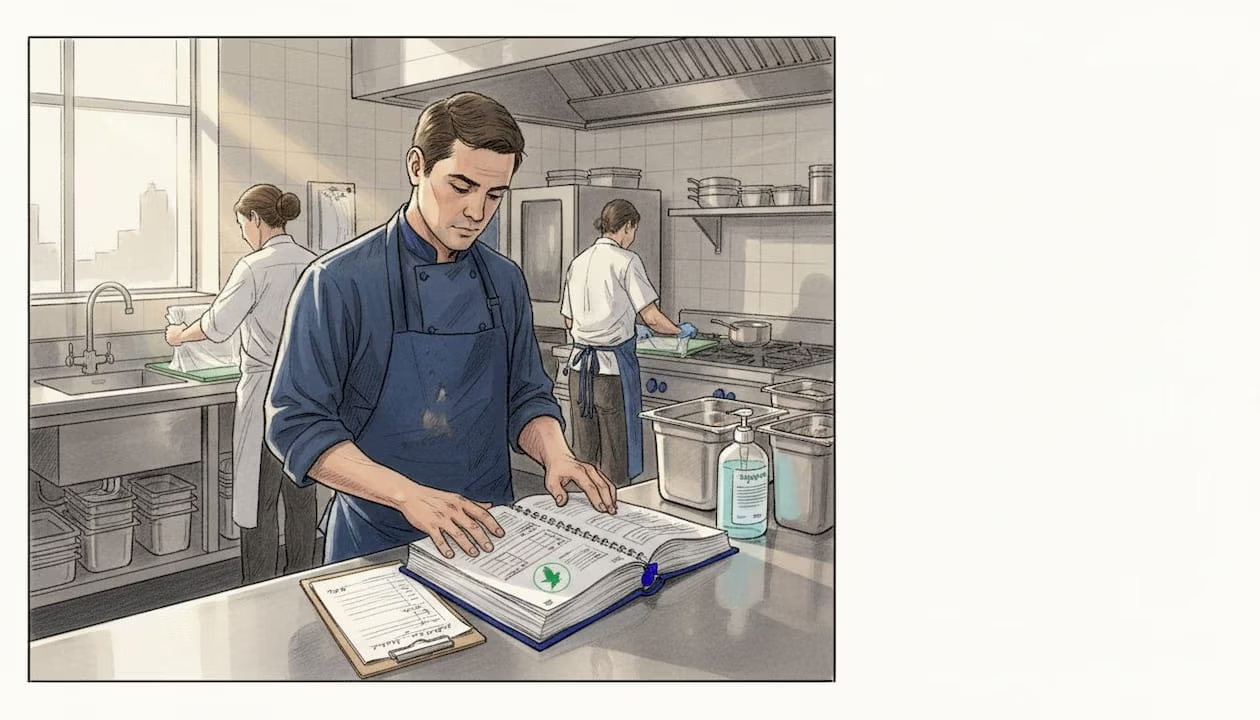
Documentation is not a bureaucratic formality. In the event of a complaint or an unannounced EHO visit, written records are your primary evidence that you have operated responsibly. This is the foundation of the legal concept known as “due diligence,” which allows a business to demonstrate it took every reasonable precaution to prevent an issue.
The HACCP connection is critical. Under food safety law, pest management must be treated as a prerequisite programme within HACCP, meaning it should sit formally within your food safety management system, with its own records, monitoring schedules, and corrective action logs that are reviewed regularly and updated after every contractor visit or pest sighting.
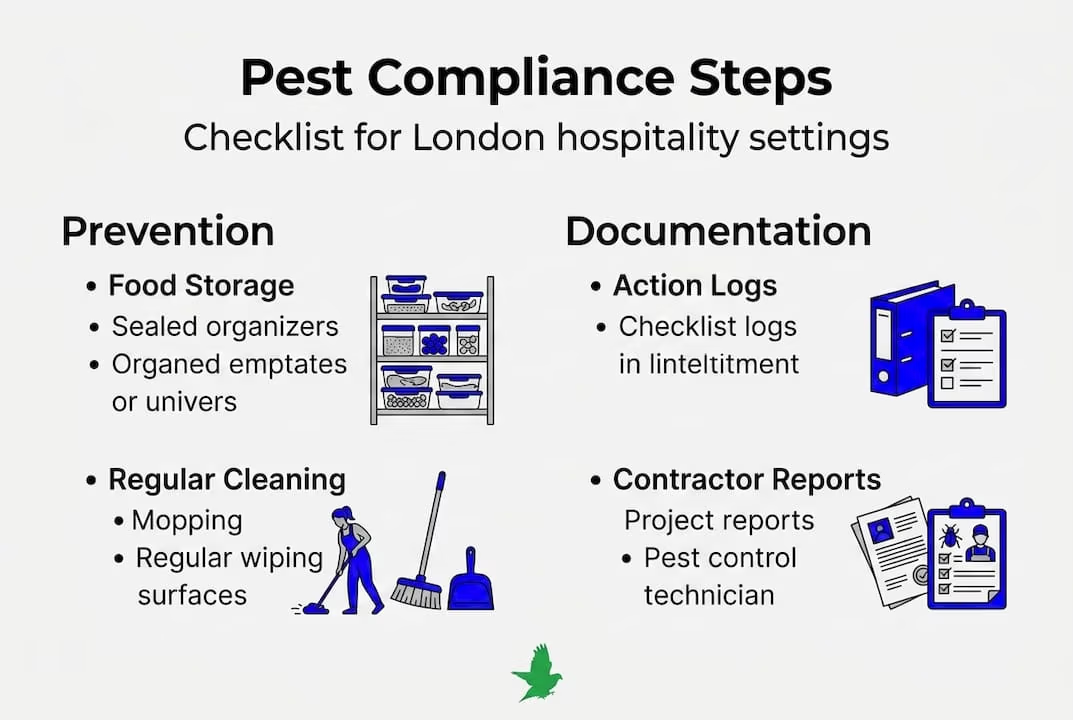
Here is what your documentation system should include at a minimum:
- A written pest control policy, signed by a manager and reviewed annually
- Contractor visit reports for every scheduled and reactive call-out
- A site map showing bait station, trap, and monitoring device locations
- A log of all pest activity including date, location, species, and action taken
- Corrective action records showing what was done and by whom
- Photographic evidence of proofing works and treatment areas
Roles matter too. Your internal staff are responsible for day-to-day hygiene controls: sealing food correctly, reporting sightings promptly, and keeping storage areas clutter-free. Your external pest contractor is responsible for technical assessments, treatments, and written recommendations. Neither role replaces the other. The contractor’s reports carry significant weight during inspections precisely because they come from an accredited, independent professional.
Pro Tip: Assign a named member of staff as your pest control coordinator. This person receives contractor reports, logs all activity, and liaises with the EHO. Having one clear point of accountability reassures inspectors that pest management is actively managed, not simply outsourced and forgotten.
Effective property pest management in a hospitality context also means cross-departmental communication. Housekeeping, kitchen staff, and maintenance teams all play a role in early detection. A quick, structured reporting process, even just a WhatsApp group or a simple paper log near the service entrance, can be the difference between catching a problem early and facing a full infestation.
Implementing a proactive pest management programme
With hygiene and records foundations in place, you can now create and embed a proactive pest management process.
The most effective programmes do not wait for pests to appear. They are structured to make infestation as unlikely as possible, using a layered approach that pest control professionals call Integrated Pest Management (IPM). IPM combines physical exclusion, sanitation, environmental controls, and monitoring to reduce reliance on chemical treatments alone.
Step 1: Select an accredited contractor. Only work with companies that are members of the British Pest Control Association (BPCA) or the National Pest Technicians Association (NPTA). Accredited BPCA contractors are required to keep written reports and inspection records for every site visit, which directly supports your due diligence defence.
Step 2: Commission a full site survey. Before any treatments begin, your contractor should carry out a detailed assessment of your premises, identifying existing entry points, vulnerable areas such as drainage runs, void spaces, and external bin storage, and any existing pest activity. This survey forms the basis of your written pest management plan.
Step 3: Implement proofing and exclusion measures. Physical prevention is the first line of defence. Common measures include fitting brush strip door seals, installing pest-proof covers on drainage inspection chambers, sealing gaps around pipework, and installing fly screens on kitchen ventilation points. These measures address common pests and prevention at the source, before chemical intervention becomes necessary.
Step 4: Establish a monitoring schedule. Bait stations, insect monitors and electronic monitoring devices should be checked, replenished, and recorded at every contractor visit. Trend analysis matters here. If rodent activity at a particular bait station is increasing month on month, that pattern should trigger a review of exclusion measures and an escalation in response, not simply a rebaiting.
Step 5: Build reporting into your contract. Every contractor visit must result in a written report, signed and dated. That report should include findings, treatments applied, any recommendations, and a target date for follow-up. This paper trail is precisely what EHOs expect to see.
“A business that can show a continuous, documented programme of prevention, monitoring, and corrective action is far better placed during an inspection than one that simply reacts to problems.” This reflects the BPCA’s guidance on what constitutes competent, accountable pest management for food businesses.
Responding to pest incidents and inspections
Even with the best programme, incidents may occur. Here is how to credibly respond for compliance.
A pest sighting in a hotel room or a restaurant kitchen does not automatically mean a compliance failure. What matters to an EHO is how you responded. A prompt, documented, and well-evidenced response can actually demonstrate the strength of your management system, provided you follow the correct steps.
Step 1: Document the sighting immediately. Note the date, time, location, species (or suspected species), and who reported it. Do not delay. A record made hours or days after the event carries less credibility than one made at the time.
Step 2: Isolate and contain the affected area. If the sighting is in a food preparation or storage area, take that section out of use until your contractor has assessed the situation. This demonstrates a commitment to food safety that EHOs expect to see.
Step 3: Notify your pest contractor and request an urgent visit. Under most commercial contracts, this constitutes a reactive call-out. Your contractor should attend within 24 hours for high-risk premises such as restaurants and hotels, and BioWise offers same-day emergency pest control in London.
Step 4: Follow corrective action and update your records. Once treatment has been carried out, document the corrective action, including what was done, what was found, any structural or hygiene recommendations, and the outcome. Update your pest management log the same day.
Step 5: Review your programme in light of the incident. Ask your contractor whether the incident reveals a gap in your existing programme. Did a proofing measure fail? Was there a change in waste management that attracted pests? Incorporating lessons from incidents into your programme is precisely what inspectors mean when they look for evidence of ongoing pest control management and continuous improvement.
“Document, contain, act, and update. That four-step cycle is what turns a pest sighting from a potential prosecution into evidence of a well-run food business.”
During a scheduled EHO inspection, be ready to produce your pest management file. Inspectors may ask to see the contractor’s last report, the site map showing monitoring device locations, and evidence that any recommendations have been acted upon.
Working with local authorities: London council pest services
Some pest issues require outside help. Here is how London council services can play a key role.
London’s 32 boroughs each operate their own pest control services, and these can be a relevant resource for hospitality businesses, particularly where infestations have a clear link to the surrounding environment, such as rats attracted to urban waste streams or pigeons nesting on shared building structures.
What council pest teams do and do not cover:
- They typically treat rodent infestations (rats and mice) in both domestic and commercial premises
- They may charge businesses at commercial rates, as RBKC’s treatment charge schedule illustrates
- They do not provide the kind of ongoing contractual programme that commercial premises require for full compliance
- Their attendance does not replace your private contractor’s records in an EHO inspection context
- They can issue notices requiring you to address conditions that are attracting pests
| Service type | Council pest team | Private accredited contractor |
|---|---|---|
| Reactive treatments | Yes, usually chargeable | Yes, included in contract |
| Written reports for EHOs | Limited | Full documented trail |
| Ongoing monitoring | No | Yes |
| Proofing recommendations | Sometimes | Standard practice |
| Compliance documentation | Not typically | Core deliverable |
Engaging City of London pest services or your borough council is most useful when addressing issues on shared or external structures, or when you need to demonstrate to an EHO that you escalated an issue beyond your own premises. However, council action should always be recorded in your pest management log alongside your private contractor visits, creating a complete and transparent activity trail.
Why ‘tick-box’ pest control isn’t enough for London hospitality
We have worked with London hospitality businesses since 2010, and there is a pattern we see repeatedly. A venue signs a pest control contract, receives quarterly visits, and files the reports. On the surface, it looks compliant. But when an EHO arrives, or when a genuine infestation develops, the gaps become visible fast.
The uncomfortable truth is that genuine pest compliance is a management culture, not a paperwork exercise. Inspectors in London are experienced enough to distinguish between a business that actively manages pest risk and one that simply holds a folder of contractor invoices. They will ask whether recommendations from the last visit were implemented. They will check whether bait station records show trends that were acted upon. They will look at whether your staff know what to do when they spot pest activity.
Businesses that embrace a compliance culture, where prevention, monitoring, corrective action, and review are embedded into daily operations, consistently perform better during inspections and face far lower pest-related disruption over time. The cost of a genuine programme is a fraction of the cost of a closure notice, emergency remediation, or a reputational incident shared across social media. For deeper compliance tips that go beyond the basics, the difference lies in treating pest management as a priority rather than a formality.
Working with local experts: How BioWise helps you stay compliant
If you want specialist help meeting these standards, our team brings the expertise and local reputation required.
BioWise Pest Control Services has supported over 800 London clients since 2010, including restaurants and hotels navigating the full range of regulatory expectations. Our London commercial pest control contracts are built around your compliance needs: scheduled visits, written reports, site maps, trend analysis, and reactive call-outs are all included. We offer flexible options ranging from monthly maintenance contracts to one-off audits and eco-conscious treatments where chemical-free approaches are preferred. Whether you need help reviewing your existing programme or want to understand proofing vs chemical solutions, our team can guide you through the most appropriate approach for your premises. Contact us to book a compliance consultation or a full site audit.
Frequently asked questions
What records must we keep to prove pest control compliance?
You must keep written evidence of inspections, pest contractor reports, treatments applied, and corrective actions as part of your HACCP food safety records, reviewed and updated after every visit or incident.
Does using a council pest service guarantee compliance?
A council treatment may help resolve an active issue, but full compliance depends on your documented system, prevention measures, and ongoing records. Council interventions are only one component of a complete compliance programme.
How often should a pest contractor inspect our restaurant?
Frequency depends on the risk profile of your premises, but BPCA guidance recommends at least quarterly visits as a baseline, with all reports retained as evidence for EHO inspections.
Is DIY pest control enough for compliance in hotels?
DIY actions can support prevention efforts in low-risk areas, but accredited contractor programmes providing written reports and treatment records are required for full regulatory compliance, particularly during EHO inspections.
What happens if pests are found during an inspection?
Document the sighting, contain the affected area, contact your pest contractor immediately, implement corrective action, and update your pest management records to demonstrate due diligence to the EHO.