

TL;DR:
- Customer reviews are vital for pest control businesses in the UK, influencing trust, visibility, and conversions. Genuine, detailed feedback from recent clients boosts local rankings, reassures prospective customers, and improves operational insights. Businesses should actively solicit, respond to, and manage reviews across key platforms like Google and Trustpilot to sustain a credible online reputation.
Customer reviews are the single most powerful trust and visibility signal for pest control businesses in the UK. They directly influence whether a prospective client picks up the phone, how prominently your business appears in Google’s local map pack, and whether a one-off job converts into a long-term contract.
Three effects stand out:
- Trust and social proof. Pest control is an inherently personal service. Customers are inviting a technician into their home or commercial premises, often during a stressful infestation. Reviews from people in similar situations provide the reassurance that no marketing copy can replicate.
- Local search visibility. Google Business Profile reviews feed directly into map-pack rankings. Detailed reviews that name the pest and describe the outcome carry more algorithmic weight than a cluster of anonymous five-star ratings.
- Conversion and booking uplift. A steady stream of recent, specific reviews shortens the decision cycle, a dynamic well understood in the broader home services marketplace where strong ratings drive bookings. Businesses with fresh, detailed feedback consistently outperform those with stale profiles, even when the stale profile holds a higher average star rating.
For UK operators, the platforms that matter most are Google Reviews (via Google Business Profile), Trustpilot, and trade directories linked to the British Pest Control Association (BPCA). Getting your review strategy right across these channels is not optional; it is a core part of running a credible pest control operation.
Why the role of customer reviews in pest control is unlike any other trade
Pest control sits in a category of services where trust is non-negotiable before the booking is made. A customer searching for a plumber can usually see the work before paying; a pest control client is committing to a technician entering their property, handling potentially hazardous treatments, and resolving a problem they may find embarrassing to discuss. That combination of vulnerability and urgency makes reviews the primary decision-making tool.
Reviews provide evidence on three dimensions that matter specifically to pest control buyers:
- Safety and professionalism. Does the technician arrive in uniform, explain the treatment clearly, and handle chemicals responsibly?
- Discretion. For residential clients particularly, reviews that mention unmarked vehicles or discreet packaging carry real weight.
- Effectiveness. Did the problem actually go away? Reviews that confirm a follow-up visit was offered, or that the infestation was resolved within a stated timeframe, answer the question every prospective client is really asking.
Fresh, consistent reviews materially improve local visibility and conversion. Businesses that generate a regular trickle of new feedback outrank otherwise higher-rated but dormant profiles in local search. BPCA membership adds a layer of trade credibility, but it works best when supported by a body of genuine client reviews that confirm the standards the association represents.
Where UK customers read and leave pest control reviews
Not all review platforms carry equal weight, and spreading effort too thinly across every available channel is a common mistake. The table below maps the four platforms most relevant to UK pest control businesses.
| Platform | Local search impact | Consumer credibility | Best use case |
|---|---|---|---|
| Google Business Profile | Highest: feeds map-pack rankings directly | High: integrated into search results | Primary platform; prioritise volume and detail here |
| Trustpilot | Indirect: appears in branded search results | High: perceived as independent | External credibility; useful for commercial tenders |
| BPCA member directory | Low: not a ranking signal | High among trade buyers | B2B and property management enquiries |
| Facebook Recommendations | Low to moderate | Moderate: community-based | Local residential audiences; word-of-mouth amplification |
Google Business Profile reviews have the most direct effect on map-pack visibility, while hosted platforms such as Trustpilot add external credibility that matters particularly in commercial contexts, such as facilities management tenders or hotel procurement processes.
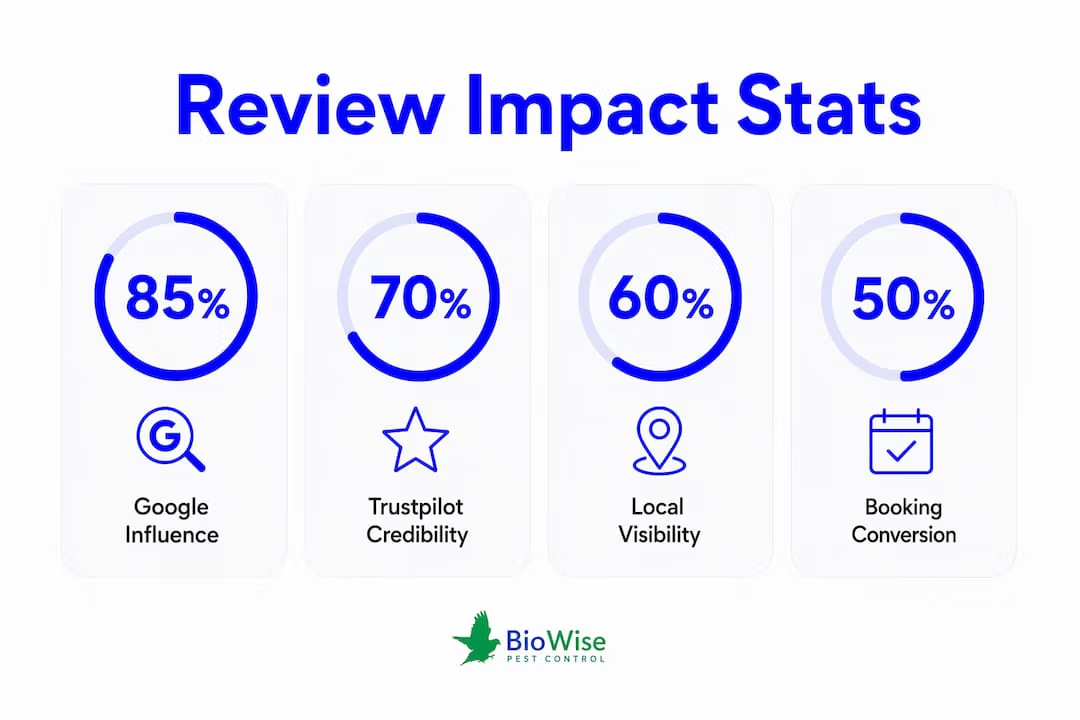
One practical point worth noting: self-hosted testimonials on your own website carry almost no third-party credibility. Prospective clients know you control what appears there. Independent platforms, where you cannot delete an unfavourable review, are where trust is actually built.
Pro Tip: Ask customers to leave their Google review before they leave the premises or immediately after the job. A verbal prompt at the door, followed by an automated SMS with a direct link, produces significantly higher completion rates than a follow-up email sent days later.
How reviews shape a customer’s decision to book
When a prospective client scans reviews before contacting a pest controller, they are not reading every word. They are running a rapid mental checklist, looking for specific signals that answer their underlying concerns.
The signals that carry the most weight:
- Recency. A review from three years ago tells them little about current service quality. Reviews from the past three months confirm the business is still active and performing.
- Specificity. A review that names the pest (mice in a kitchen, a wasp nest in the loft) and describes the outcome (“the problem was resolved in one visit, with a follow-up call two weeks later”) is far more persuasive than “great service, would recommend.”
- Technician conduct. Comments about punctuality, explanation of the treatment, and post-job advice are strong conversion signals for residential clients.
- Response to negative feedback. How a business replies to a critical review tells prospective clients more about its professionalism than the complaint itself.
Consider the difference between these two review excerpts:
Compare that with: “Good, fast, sorted it out.” The second review is not harmful, but it does nothing to address the specific concerns of someone facing a similar infestation. Operators who ask for detail get reviews that actually convert.
Reviewer type also matters. A property manager reading reviews will weight comments from other property managers or commercial clients differently from residential testimonials. Where possible, encourage clients to mention their context (homeowner, restaurant, office building) in their review.
How to ask for reviews ethically and effectively in the UK
The most reliable way to build a strong review profile is to treat review generation as a system, not an afterthought. Companies that integrate a technician ask, an automated follow-up, and a response policy into their service completion workflow consistently outperform those that rely on clients volunteering feedback unprompted.
The four-step process:
- Verbal ask at job completion. The technician thanks the client and says: “If you were happy with the service today, a quick Google review would mean a great deal to us. I’ll send you a direct link.”
- Same-day automated SMS. Send within two hours of job completion. The golden window for review requests is immediately on completion or the same day; response rates drop sharply after 24 hours.
- Single follow-up email. If no review appears within 48 hours, one polite follow-up is appropriate. Do not send more than one.
- Log and track. Record which clients were asked, on which date, and whether a review was received. This data helps you identify which technicians or job types generate the most feedback.
Sample SMS template:
Sample email subject line: “How did we do? One quick question.”
Sample invoice footer text: “Satisfied with our service? A Google review mentioning the pest treated and the outcome helps other customers and takes under two minutes: [link].”
Asking customers to mention the pest type and outcome is not just good manners; it produces SEO-friendly reviews that include the keywords prospective clients are actually searching for.
On incentives: the Competition and Markets Authority (CMA) is clear that offering rewards in exchange for positive reviews, or suppressing negative ones, constitutes an unfair commercial practice. Never offer discounts, vouchers, or free treatments contingent on leaving a review. Asking for honest feedback is entirely legitimate; conditioning a benefit on a positive outcome is not.
How to respond to negative reviews and use feedback to improve
A calm, professional public reply to a negative review often wins more trust from future customers than the original complaint loses. Industry guidance consistently emphasises measured public responses that invite offline resolution and demonstrate procedural competence.
Four-step response framework:
- Acknowledge publicly. Thank the reviewer for their feedback, apologise for their experience without admitting liability, and confirm you take the matter seriously.
- Investigate. Review the job record, technician notes, and any communications before responding further.
- Resolve offline. Invite the client to contact you directly (provide a named email or phone number) to discuss the issue. Keep the resolution conversation private.
- Update publicly. Once resolved, post a brief follow-up comment confirming the matter has been addressed. If the client is willing, ask them to update their review.
Public response skeleton:
Pro Tip: After resolving a complaint, ask the satisfied client to update their review. A revised review that shows a problem was acknowledged and fixed is more persuasive than a string of uncontested five-star ratings.
Beyond individual responses, recurring themes in negative reviews are operational intelligence. If three reviews in a month mention that technicians did not leave written aftercare notes, that is a training issue, not a PR problem. Combining online reviews with post-job surveys yields richer data for staff briefings and process adjustments. Reviews that flag issues with contractor performance are worth examining systematically, not just responding to individually.
Identifying and handling fake or malicious reviews in the UK
Fake and malicious reviews are a genuine problem for small pest control businesses, where a single fabricated one-star post can distort an otherwise strong profile. Recognising the red flags early allows you to act before the damage compounds.
Red flags to watch for:
- No service details: the review describes no specific pest, location, date, or technician.
- Reviewer has no prior review history or has left identical complaints across multiple businesses.
- Timing spike: several negative reviews appear within a short window, often following a competitor’s activity.
- Improbable claims that contradict your job records (a treatment date you have no record of, a pest you do not treat).
Step-by-step response:
- Screenshot the review immediately, capturing the username, date, and full text.
- Check your job records for any match to the reviewer’s name or claimed service date.
- Flag the review to the platform using its official reporting tool (Google’s “Report review” function within Google Business Profile; Trustpilot’s content integrity team).
- Keep a timestamped log of all evidence and correspondence.
- Post a calm, factual public reply noting that you have no record of the described service and have reported the review to the platform.
Responding calmly is usually the most effective immediate defence; legal action is rarely proportionate for a single review. For persistent campaigns, the Defamation Act 2013 (England and Wales) provides a legal framework, but the threshold for a claim is high and the costs are significant. BPCA members can access guidance through the association’s BPCA Quest service before considering any legal route.
Building a substantial base of genuine positive reviews, as BPCA guidance recommends, is the most durable defence. A single malicious post carries far less weight against a profile of many detailed, authentic reviews than against a profile with only a few.
This section provides general information only and is not legal advice. For defamation or legal matters, consult a qualified solicitor.
How Biowise Pest Control Maintenance Services uses reviews to improve operations
Biowise Pest Control Maintenance Services has operated across London since 2010, serving over 800 clients across residential and commercial sectors. The shift from ad hoc client feedback to a structured review system produced a measurable change in both the quality of incoming enquiries and the depth of operational insight available to the team.
Before a systematic approach was in place, reviews arrived sporadically and tended to be brief. The feedback was positive but thin: useful for reassurance, less useful for identifying patterns in service delivery. Once technicians began making a verbal ask at job completion, backed by a same-day SMS with a direct Google link, the volume of detailed reviews increased and the content became richer.
The operational benefit proved equally significant. Recurring mentions of a particular issue in client feedback prompted a review of technician briefing notes, leading to a revised post-treatment reporting process. That change reduced follow-up complaints and improved client retention.
Pro Tip: Link your review request SMS directly to your Google Business Profile review page, not to your website homepage. Every unnecessary click reduces completion rates.
For businesses managing multiple properties, the pest control workflow guide outlines how review requests can be integrated into a broader service completion process, reducing the administrative burden on individual technicians.
A checklist for customers evaluating pest control reviews
Whether you are a homeowner dealing with a mouse problem or a facilities manager selecting a contractor for a multi-site agreement, reading reviews critically takes less than five minutes and can save you a significant amount of time and money.
Before you contact a company, check:
- Are the most recent reviews from within the last three months?
- Do reviews mention the specific pest treated and confirm the outcome?
- Is there evidence of follow-up visits or a guarantee period?
- Does the reviewer’s profile look genuine (prior review history, real name)?
- Are reviews consistent across more than one platform (Google and Trustpilot, for example)?
- How does the company respond to negative reviews? Professionally, or defensively?
When you contact the company, ask:
- Are your technicians BPCA-qualified or hold equivalent certification?
- What is your follow-up policy if the treatment does not resolve the problem?
- Do you provide written treatment records after each visit?
- Is there a service level agreement for commercial contracts?
For property managers, the London pest control property management guide covers what to include in a contractor brief and what review signals matter most for multi-site procurement. Residential homeowners can find a parallel checklist in the residential pest management guide.
Cross-platform verification matters. A company with 200 Google reviews and 15 on Trustpilot, all broadly consistent in tone and detail, is a very different proposition from one with 200 Google reviews and nothing elsewhere. Diversity of platform presence is itself a credibility signal.
Key takeaways
Customer reviews are the primary trust, visibility, and conversion signal for pest control businesses in the UK, and treating review generation as a structured operational process rather than a passive marketing activity is what separates consistently well-ranked businesses from those that plateau.
| Point | Details |
|---|---|
| Prioritise Google Reviews | Google Business Profile reviews have the most direct effect on local map-pack rankings; focus volume and detail here first. |
| Ask immediately after the job | The golden window is same-day; response rates drop sharply after 24 hours, so automate the SMS send. |
| Request specific detail | Ask customers to mention the pest treated and the outcome; this produces SEO-relevant content and more persuasive social proof. |
| Respond to every negative review | A calm, professional public reply demonstrates competence and often converts future readers more effectively than the complaint deters them. |
| Biowise Pest Control Maintenance Services | Has operated across London since 2010, using structured review requests and a published response policy to build a credible, detailed review profile across Google and Trustpilot. |
The part of review strategy most operators get wrong
Most pest control businesses understand that reviews matter. Where they consistently fall short is in treating review generation as a marketing task rather than an operational one.
The conventional wisdom says: “Get more five-star reviews.” That framing misses the point. A five-star rating with no detail is almost worthless for local SEO and only marginally useful for conversion. What actually moves the needle is a review that says: “Treated a German cockroach infestation in our restaurant kitchen. The technician arrived within four hours, explained the treatment protocol, and the problem was confirmed clear at the two-week follow-up.” That review does three things simultaneously: it ranks for relevant search terms, it answers the specific concerns of a prospective commercial client, and it demonstrates that your follow-up process works.
The second oversight is treating negative reviews as a reputation threat rather than an operational signal. A complaint about aftercare notes being unclear is not a PR crisis; it is a training brief waiting to be written. Businesses that read their reviews as operational data, not just as scores, improve faster and retain clients at a higher rate.
There is also a tendency to over-invest in volume at the expense of authenticity. Thirty detailed, specific reviews from real clients will outperform 200 generic five-star ratings in both search visibility and conversion. Quality of content, not quantity of stars, is where the real competitive advantage lies for UK pest control operators in 2026.
Biowise Pest Control Maintenance Services: London’s trusted choice since 2010
Choosing a pest control provider based on reviews alone is a good start. Choosing one that has built its reputation on transparent service, qualified technicians, and a published response policy is better.
Biowise Pest Control Maintenance Services has served over 800 London clients since 2010, covering residential properties, restaurants, offices, hotels, and commercial facilities across the capital. Every job comes with written treatment records, a clear follow-up policy, and technicians qualified to BPCA standards. Our review profile across Google and Trustpilot reflects that consistency, not a review-generation campaign.
For homeowners, the domestic pest control service page covers treatment options and booking. Commercial operators and facilities managers can review service specifications on the commercial pest control page. To verify our credentials, check our BPCA membership status directly through the association’s member directory.
Request a quote or site assessment today by visiting biowiseservices.com.
Useful sources
The following sources are worth consulting directly for further guidance on reviews, platform policies, and UK legal standards.
| Source | Why it matters |
|---|---|
| BPCA guidance on malicious reviews (Pest Magazine) | Industry-standard advice on building genuine review profiles and responding to malicious posts |
| Google Business Profile Help | Official guidance on managing reviews, flagging policy violations, and optimising your profile |
| Trustpilot Content Integrity | Platform’s official process for reporting fake or non-compliant reviews |
| CMA guidance on online reviews | UK Competition and Markets Authority rules on incentivised and fake reviews |
| PPCOnline: dealing with malicious reviews | Practical pest-industry guidance on documentation, platform reporting, and proportionate response |
| LondonPestsControl: detailed reviews and SEO | Explains why review content (not just star ratings) affects local search rankings |
For any defamation or legal matter arising from online reviews, seek advice from a qualified solicitor before taking action. BPCA members may also consult the BPCA Quest service for initial guidance.
FAQ
What is the purpose of customer reviews for pest control businesses?
Reviews serve as third-party evidence of service quality, safety, and effectiveness. They directly influence local search rankings via Google Business Profile and give prospective clients the social proof they need to make a booking.
How should a pest control company handle negative reviews?
Acknowledge the complaint publicly with a calm, professional reply, invite the client to resolve the matter offline, and post a brief update once the issue is addressed. Industry guidance consistently recommends this approach over ignoring or arguing with the reviewer.
What role does customer feedback play in improving pest control services?
Recurring themes in reviews and post-job surveys highlight training gaps and process weaknesses. Feedback about aftercare notes, technician conduct, or follow-up scheduling translates directly into operational improvements when reviewed systematically.
What are the most effective ways to collect feedback from pest control customers?
The most reliable methods are a verbal ask at job completion, a same-day automated SMS with a direct review link, a single follow-up email within 48 hours, and a short post-job survey for commercial clients. Asking customers to mention the pest treated and the outcome produces the most useful responses.
How can I tell if a pest control review is genuine?
Look for specific detail: the pest type, the location treated, the outcome, and any mention of follow-up. Genuine reviews typically come from accounts with prior review history. Cross-check across Google and Trustpilot; consistent feedback across independent platforms is a reliable credibility signal.