


An emergency is defined by risk, not by panic: a rodent seen in a food-prep area mid-service, an active infestation in a public space, contamination evidence, or an Environmental Health Officer notice all warrant immediate escalation. A high-risk case should get prompt triage and an agreed attendance window, often same day. Attendance is not resolution. The first visit assesses, contains, treats where safe, and reports, with follow-up scheduled separately.
TL;DR:
- Emergency pest control responses are justified only in high-risk situations such as pests in food-prep areas, public spaces, or when an EHO notice is issued, not for minor sightings.
- Same-day attendance should be the target for genuine emergencies, but response times depend on call timing, access permissions, and technician availability.
- The first visit should include pest assessment, containment, limited safe treatment, and detailed reporting, but not long-term eradication or proofing.
- Follow-up treatments and proofing are necessary for full resolution, especially with bedbugs and rodent infestations, which cannot be finalized in a single visit.
- Contracts should specify response times, escalation procedures, and documentation requirements to avoid misunderstandings and ensure compliance.
Table of Contents
- What counts as an emergency response. Pest control expectations should cover
- How fast should attendance actually be?
- What does the first emergency visit actually deliver?
- Checklist: what to ask before you sign
- Escalation, documentation and compliance you should expect the same day
- How call-outs are typically charged
- What to do before the emergency team arrives
- What to expect in pest control communication, during and after
- Where emergency pest control stops and scheduled treatment starts
- Which pest issues genuinely justify emergency status?
- What experience actually teaches about emergency response
- Book a BioWise emergency survey today
- Sources
- FAQ
What counts as an emergency response. Pest control expectations should cover
Not every sighting justifies an emergency call-out, and providers who treat every complaint as urgent are usually padding their invoices, not protecting your site. BPCA’s commercial pest advice frames risk in plain terms: pests in food-preparation or public-facing areas, contamination evidence, serious infestations, or an EHO notice all justify immediate escalation. Historic droppings in a locked plant room with no recent activity generally do not.
Cases that should trigger an emergency call:
- A rodent seen in a food-prep area during service, or in a customer-facing space such as a restaurant floor or hotel lobby.
- A live wasp nest near an entrance, terrace, or any area with public footfall.
- Bedbugs confirmed in a let property, particularly ahead of a changeover.
- Visible droppings or contamination on or near exposed food.
- An EHO notice or a formal complaint referencing pest activity.
When you call, expect a competent provider to ask for the exact site and access details, when and how often the pest has been seen, photographs, the type of evidence found, which areas are vulnerable (food storage, public seating), your operating hours, any previous treatments, and what documentation you need for your own file. Incomplete information at this stage is the single biggest cause of a mismatched first visit.
How fast should attendance actually be?
Same-day attendance for genuinely high-risk cases, called in early, is the realistic benchmark. BRCGS guidance points to same-day response where practicable, or within 24 hours as a general guideline, depending on pest type, location, and risk level. Neither BRCGS nor BPCA sets these as statutory guarantees. They’re industry benchmarks a competent contract should build on, not a promise written in law.
Several things move that window in practice: what time you call, whether your site allows out-of-hours access, bank holiday staffing, how far the nearest available technician is, and whatever service-area limits sit in your contract. A call at 8am on a Tuesday and a call at 11pm on Christmas Eve will not get the same clock.
The gap that catches most managers out is between attendance and resolution. Turning up within four hours means inspection and containment, not a cleared site. Rodent problems typically need multiple follow-up visits plus proofing work before they’re genuinely resolved. A wasp nest might be removed in one visit but still needs a follow-up inspection to confirm no activity remains. Bedbug infestations almost always require planned, repeated treatments and a verification check, not a single spray. Before signing anything, BRCGS recommends pinning down exactly what the first visit includes and what follow-up schedule and verification evidence follows it.
What does the first emergency visit actually deliver?
A first attendance is bounded by what’s safe and legally defensible to do on the spot, and a professional visit should deliver four things:
- Assessment – identifying the pest, the extent of activity, and the risk it poses to food safety or public areas.
- Containment – isolating or restricting the affected area to cut exposure while further work is planned.
- Treatment – applying authorised, limited emergency treatment where it’s safe to do so immediately.
- Reporting – a dated site report setting out findings, action taken, and the proposed follow-up schedule.
What it should not promise is complete eradication or long-term proofing on day one. HSE’s COSHH and fumigation guidance is explicit that pesticide use needs a proper risk assessment, and that fumigation in particular requires staged planning, authorised products, safety data sheet controls, and competent operators. Immediate action isn’t automatically the safest action; a technician who insists on doing the job properly rather than instantly is doing you a favour, not stalling.
Pro Tip: If a technician offers to fumigate on the spot with no risk assessment, no SDS reference, and no re-entry instructions, that’s a red flag, not efficiency.
Checklist: what to ask before you sign
Most emergency-service disappointments trace back to a contract that never specified what “emergency” actually meant. Before signing, insist on the following:
- Separate service levels for acknowledgement, telephone advice, attendance, and follow-up, each specified for weekday hours, out-of-hours, weekends, and bank holidays.
- A named escalation contact and a clear geographic or service-area definition, so you know who to call and whether your site is even covered.
- A stated point at which the response clock starts, whether that’s the call being answered or full site details being received.
- A contingency plan for when the primary technician is unavailable.
- Evidence of supplier competence, such as BPCA membership or equivalent certification.
Questions worth asking directly:
- What exactly will the same-day report contain, and will it include photographs and product references?
- Is there an agreed high, medium, low response matrix built around a pest risk assessment for our specific site?
- Who authorises a closure or restricted area, and is that recorded in writing?
- What’s the process if our usual technician is off sick or on leave?
- Are out-of-hours and bank holiday premiums fixed, or open-ended?
A contract that answers all of these before you sign is worth more than any marketing promise about round-the-clock cover. BioWise’s response-time guidance sets out what to send when requesting a call-out to get the fastest possible triage.
Escalation, documentation and compliance you should expect the same day
A workable escalation path runs from the on-site manager, to a named contract manager, to an out-of-hours route, and finally to the EHO if the situation demands it. The contract should record who authorised any closure or restriction, not leave that to memory afterwards.
By the end of the day, you should have in hand:
- A dated visit report covering findings, areas inspected, and action taken.
- Photographs of evidence and treated areas.
- COSHH and safety data sheet references for any product used.
- Immediate risk-assessment notes.
- An agreed follow-up date.
Food-business operators carry a legal duty to act on pest evidence, and EHOs will review your pest-control records during an inspection. A complete file reduces enforcement risk and gives you a clear corrective-action timeline if questions come later. BioWise’s compliance reporting guide sets out what a defensible visit report should contain in more detail.
How call-outs are typically charged
Charging models vary by provider and by contract type, so this is worth pinning down before an incident, not during one:
- A fixed emergency call-out fee, charged regardless of what’s found.
- An emergency premium added on top of normal hourly or flat rates.
- A capped number of emergency visits included within an existing maintenance contract.
- Charge-per-visit pricing if you have no contract at all.
Get these pre-agreed in writing: out-of-hours premiums, any specialist disposal or waste-handling charges, the cost of repeat visits, and separate quotes for proofing or repair work. Ask for an upfront estimate on anything outside routine treatment, a maximum sign-off limit for on-the-spot authorisation, and invoicing broken into line items you can actually audit later.
What to do before the emergency team arrives
The fifteen minutes before a technician arrives matter more than most managers assume. Isolating the affected area first, rather than waiting for the technician to do it, buys time and limits exposure. In a kitchen, that means removing or covering exposed food, restricting staff access to the affected zone, and holding any stock that may have been contaminated rather than discarding it, since it can serve as evidence.
Photograph what you’ve seen before anything is disturbed: droppings, damage, the pest itself if it’s safe to do so, and the exact location. Note the time it was first seen and how many sightings there have been. This single piece of preparation does more to speed up an accurate first visit than anything else you can do.
Have site access sorted in advance. A technician who arrives to find the plant room locked and nobody with a key has just lost thirty minutes of a four-hour attendance window. Pull together any previous pest-control reports for the site, since they tell the technician what’s already been tried and what clearly hasn’t worked.
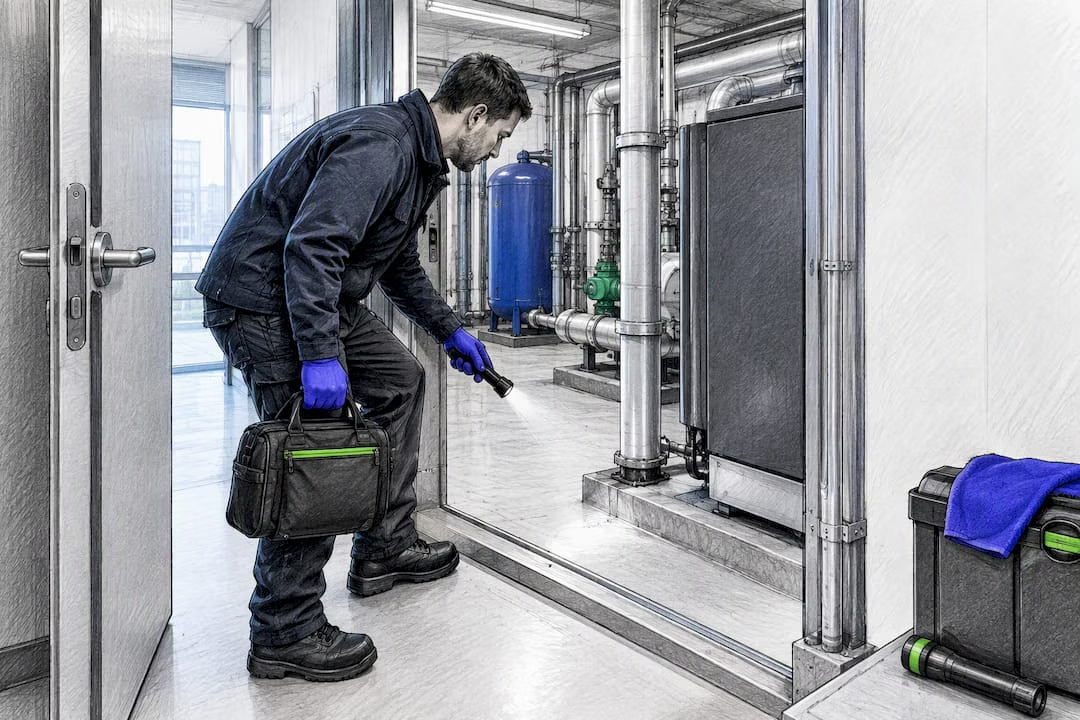
Finally, brief whoever will be on-site to meet the team. They need to know the site layout, where vulnerable areas are, and what your operating hours restrict in terms of access or treatment timing. BioWise’s guidance for restaurant teams covers this preparation step by step, and it applies just as well to hotels and offices.
What to expect in pest control communication, during and after
Communication during an emergency visit should be direct and specific, not vague reassurance. A competent technician tells you what they’ve found, what they’ve done, what they haven’t been able to resolve today, and why. If containment measures are being put in place, such as closing off a section of a kitchen, you should be told exactly what that means for your operation for the rest of the day.
Before the technician leaves, you should receive a verbal summary covering the assessment, action taken, and next steps, followed by the written report the same day, not two days later once someone gets round to it. If a follow-up visit is needed, the date should be agreed before they leave the site, not left as “we’ll be in touch.”
After the visit, ongoing communication should flow through the named contract manager set out in your service agreement, not whichever technician happens to answer the phone. If activity continues or worsens between visits, you should have a direct route to flag that without going through a general call centre queue. Any EHO involvement, or any incident serious enough to warrant closing part of the site, deserves a written record of who was told, when, and what was agreed. BioWise’s EHO visit guidance explains how these records get used during an inspection.
Where emergency pest control stops and scheduled treatment starts
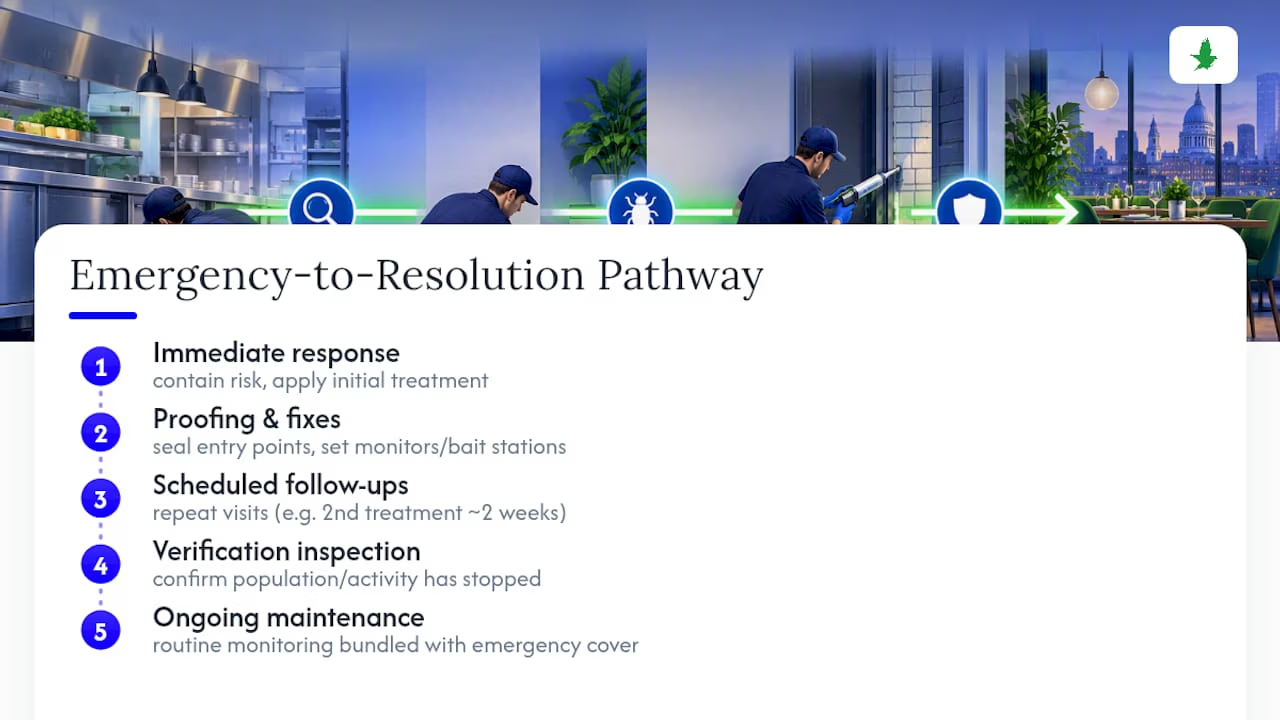
Emergency response solves the immediate risk. It rarely solves the underlying problem, and providers who imply otherwise are setting you up for a repeat call within weeks. A single visit can contain a rodent sighting and apply initial treatment, but proofing entry points, tracking bait uptake over time, and confirming the population is gone all require scheduled follow-up, not a one-off emergency slot.
Wasp nest removal is often genuinely a single job, but even then a follow-up check confirms no secondary nest has been missed nearby. Bedbugs are the clearest case where “emergency” and “resolved” are two entirely different things. Treatment protocols typically involve a first treatment, a second treatment roughly two weeks later to catch newly hatched eggs, and a verification inspection after that. Anyone promising bedbug eradication in a single emergency visit is not being straight with you.
The practical implication for facilities managers is to treat the emergency call-out as the start of a process, not the end of one. Build the follow-up schedule into your operational calendar as soon as the first report lands, rather than waiting to be chased. A maintenance contract that bundles routine visits with emergency cover tends to produce far fewer emergencies in the first place, because ongoing monitoring catches problems before they escalate to the point of needing one.
Which pest issues genuinely justify emergency status?
Severity depends on both the species and where it’s found, not just the presence of a pest. Rodents in a food-prep area during trading hours are an emergency; a single mouse sighting in a storage unit that’s already scheduled for treatment next week probably is not. Cockroach activity in any commercial kitchen tends to escalate fast because of their reproduction rate and the direct food-safety implications, so even a small sighting there usually warrants faster attention than the same insect in a stairwell.
Wasp nests become emergencies when they sit near entrances, outdoor seating, or anywhere with public footfall, particularly from late spring through to early autumn when activity peaks. A nest in an unused loft space, discovered outside of that season, can usually wait. Bedbugs are almost always treated as urgent in guest-facing businesses like hotels, because the reputational and booking-cancellation risk moves faster than the infestation itself.
The consistent thread, as BPCA’s guidance sets out, is exposure: how close the pest activity sits to food, to the public, or to a compliance obligation such as an EHO notice. A severe infestation in a genuinely low-exposure area is still worth prompt attention, but it doesn’t carry the same-day urgency as a minor sighting in a high-exposure one.
What experience actually teaches about emergency response
The trade-off that matters most is speed weighed against safety and evidence, not speed for its own sake. A technician who takes ten extra minutes to check a data sheet before treating near a food-prep surface is protecting your business, not slowing it down. The providers worth working with triage precisely, agree a response window that fits the actual pest and location, and leave you with paperwork you could hand to an EHO without editing it first.
That’s the standard BioWise Pest Control Maintenance Services works to on emergency call-outs: a named response matrix, same-day reporting, and no promises about eradication that a single visit can’t deliver. Facilities managers who understand this trade-off get far more useful outcomes from emergency contracts than those chasing the fastest quoted arrival time on a sales page.
— Ana Hasula
Book a BioWise emergency survey today
A competent pest control provider runs same-day call-outs with a named escalation contact, so clients are not left relying on whoever answers a general enquiry line.

Rather than a blanket “24/7” promise with no detail behind it, reliable providers agree acknowledgement, attendance, and follow-up timeframes as part of the contract itself, covering weekday, out-of-hours, weekend, and bank holiday cover. Every attendance ends with a dated report and a clear next step, whether that’s a proofing recommendation, a scheduled follow-up, or written confirmation the site is clear. For restaurants, hotels, offices, and housing associations across London that need a provider who treats documentation as seriously as treatment, book a site survey through Biowise’s emergency pest control service and get a response plan matched to your actual risk profile before you’re mid-incident.
Sources
FAQ
What are the three C’s of pest control?
The three C’s most commonly used in professional guidance are Check, Clean, and Control: checking for signs of activity, cleaning up conditions that attract pests, and controlling any active infestation with the right method. Emergency response fits into the “control” stage, but the other two matter just as much for preventing repeat call-outs.
What should I expect when pest control arrives on an emergency call?
Expect the technician to assess the site, contain the affected area, apply any treatment that’s safe to carry out immediately, and leave you with a dated report the same day. Full eradication or long-term proofing usually isn’t part of that first visit and gets scheduled separately.
What are the five main methods of pest control?
The five methods generally referenced across the industry are physical (traps, exclusion), chemical (pesticides), biological (natural predators), mechanical (proofing, sealing), and hygiene-based control (removing food and water sources). An emergency visit typically draws on physical and limited chemical methods first, with proofing and hygiene changes following as part of the resolution plan.
What steps happen during a typical pest control procedure?
A typical procedure runs through inspection, identification of the pest and risk level, containment of the affected area, treatment using authorised products where safe, and a written report with follow-up recommendations. BPCA’s guidance frames these steps as risk-led, meaning the pace and intensity of each stage depends on how exposed food, the public, or compliance obligations are.
How does Biowise Pest Control Maintenance Services handle emergency call-outs?
Some pest control providers offer same-day emergency call-outs with a defined escalation contact and a same-day report covering findings and next steps. Pricing for standard commercial contracts starts from £100 per quarter, while emergency and one-off visit pricing is available on request through the emergency pest control page.




