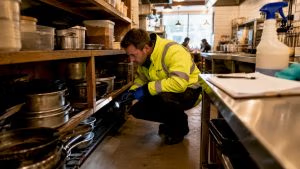


Washroom hygiene in a workplace means providing enough toilets and washbasins, keeping them clean, stocked and well ventilated, and being able to prove it. Under the Workplace (Health, Safety and Welfare) Regulations 1992, toilets and washing facilities must be suitable, sufficient, readily accessible and kept in a clean and orderly condition.
This guide covers the legal requirements, HSE’s minimum numbers of toilets and washbasins, cleaning frequency, supplies, deep cleaning, sanitary waste, record-keeping and how poor washroom hygiene leads to pest problems. We have supported London facilities managers with pest control, commercial cleaning and building maintenance since 2010, and washrooms are where those three most often overlap.
Key Takeaways
| Point | Details |
|---|---|
| Know the legal minimum | Workplace Regulations 1992, regulations 20 and 21: suitable and sufficient toilets and washing facilities, kept clean and orderly. |
| Provide enough facilities | HSE guidance for mixed use: 1 toilet and 1 washbasin for up to 5 people, 2 of each for 6-25, 3 for 26-50, 4 for 51-75 and 5 for 76-100. |
| Clean by footfall | Busy sites need checks several times per shift; offices need at least a daily clean and a consumables check. |
| Log every round | Record the time, operative, tasks and faults. If a clean is not recorded, you cannot prove it happened. |
| Use a licensed sanitary waste contractor | Your waste duty of care means sanitary waste must only go to an authorised waste business. |
| Watch for pests | Dirty drains, damp and boxed-in pipework attract drain flies, cockroaches and silverfish. |
Table of Contents
- What does washroom hygiene actually cover?
- What are the legal requirements for washroom hygiene?
- How many toilets and washbasins do you actually need?
- How often should washrooms be cleaned?
- Which supplies and fixtures make the biggest difference?
- When do you need deep cleaning, and who handles sanitary waste?
- How do you prove washroom hygiene compliance?
- What are the most common washroom hygiene mistakes?
- How does poor washroom hygiene attract pests?
- How we build washroom hygiene into real maintenance contracts
- How BioWise can help with washroom hygiene
- Sources
- FAQ
What does washroom hygiene actually cover?
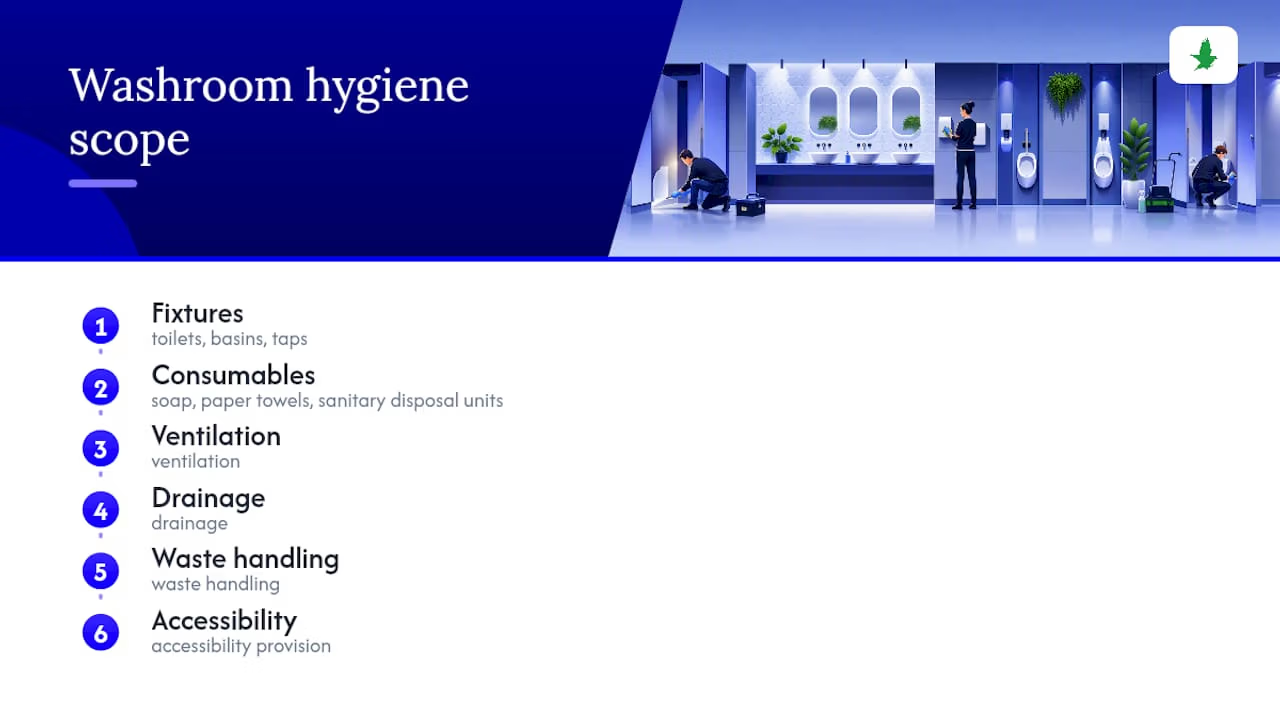
Washroom hygiene spans everything a facilities manager can influence in that room: the fixtures themselves (toilets, urinals, basins, taps), consumables (soap, paper towels, sanitary disposal units), ventilation and drainage, waste handling and accessibility provision. It is a wider brief than most people assume.
A washroom can look spotless and still be a hygiene failure. Visual cleanliness (no streaks, no litter, a pleasant smell) is different from actually reducing germs on high-touch surfaces such as flush handles, taps and dispenser nozzles. A room can smell fine and still carry bacteria on the surfaces people touch most.
That gap matters commercially. Washrooms are one of the few spaces every member of staff and every visitor uses, which makes them a loud signal of how well a site is run, and a common source of complaints when standards slip.
What are the legal requirements for washroom hygiene?
Two regulations in the Workplace (Health, Safety and Welfare) Regulations 1992 set the baseline. Regulation 20 requires suitable and sufficient sanitary conveniences at readily accessible places, in rooms that are adequately ventilated and lit and kept in a clean and orderly condition. Regulation 21 requires suitable and sufficient washing facilities in the immediate vicinity of every toilet, with clean hot and cold, or warm, water, soap or a similar cleaning agent, towels or another suitable means of drying, all kept clean and orderly. Regulation 9 adds a general duty to keep the whole workplace sufficiently clean.
HSE’s leaflet Welfare at work (INDG293) explains what this means in practice: separate facilities for men and women where possible, or rooms with lockable doors where not; walls and floors that are easy to clean, preferably tiled or covered in waterproof material; hot and cold running water, enough soap and a means of drying hands; and a means of disposing of sanitary dressings for female employees. The Approved Code of Practice, L24, gives more detail on each regulation.
These duties are not limited to large offices. There is no size threshold below which they disappear: a two-person office and a two-hundred-person warehouse are held to the same underlying standard, and only the scale of provision changes. In multi-let buildings, duties also fall on whoever controls the premises, typically the landlord or managing agent for shared washrooms. Construction sites are the main exception, because their welfare facilities are covered by the Construction (Design and Management) Regulations 2015 instead.
How many toilets and washbasins do you actually need?
HSE publishes minimum numbers based on how many people are at work, and it is the first thing an inspector or auditor will check. For mixed-use or women-only facilities:
| Number of people at work | Toilets | Washbasins |
|---|---|---|
| 1-5 | 1 | 1 |
| 6-25 | 2 | 2 |
| 26-50 | 3 | 3 |
| 51-75 | 4 | 4 |
| 76-100 | 5 | 5 |
| Over 100 | One more for every additional 25 people | One more for every additional 25 people |
Where toilets are used only by men, HSE allows urinals to make up part of the provision:
| Number of men at work | Toilets | Urinals |
|---|---|---|
| 1-15 | 1 | 1 |
| 16-30 | 2 | 1 |
| 31-45 | 2 | 2 |
| 46-60 | 3 | 2 |
| 61-75 | 3 | 3 |
| 76-90 | 4 | 3 |
| 91-100 | 4 | 4 |
These figures come from HSE’s welfare guidance and they are minimums, not targets. If queues form regularly at peak times, that is a signal to provide more than the baseline. Beyond the count, check three things on any site walk: lighting bright enough to spot soiling, ventilation that actually extracts (not an extractor fan that has been switched off), and surfaces that can be wiped down rather than absorbing moisture and odour over time.
How often should washrooms be cleaned?
The regulations require washrooms to be kept clean and orderly but do not set a frequency, so cleaning should track footfall rather than the clock. A quiet back-office washroom used by a handful of staff needs a different rhythm to a customer-facing toilet in a restaurant or hotel lobby.
- High-traffic sites (retail, hospitality, transport hubs): clean and restock at least twice per shift, with high-touch points such as taps, flush handles and dispenser nozzles wiped more often.
- Moderate-traffic sites (offices, schools): one full clean per day, with a mid-morning or lunchtime check of consumables and bins.
- Low-traffic sites: daily cleaning is still the sensible baseline; skipping days lets build-up develop that makes deep cleaning harder later.
Within each round, work from the cleanest areas to the dirtiest: high-touch surfaces such as taps, handles and dispensers, then basins, then toilets and urinals, and floors last, so you are never re-contaminating a surface you have just cleaned. Log the time, the operative and what was done. A time-stamped note with a photo takes seconds and becomes invaluable the moment a client or inspector asks for evidence.
Which supplies and fixtures make the biggest difference?
The right hardware removes a lot of the guesswork from daily hygiene, and a few choices carry outsized impact.
- Hand drying: paper towels and hand dryers both work if they are kept stocked and in working order. The choice is usually about waste, cost and noise as much as hygiene; what matters most is that one option always works.
- Touchless dispensers: touch-free soap and towel dispensers remove one of the biggest contamination points in any washroom, the dispenser itself, and give a consistent dose so soap does not run out unpredictably.
- Disinfectants: match products to the surface (stainless steel, ceramic, laminate) and leave them on for their stated contact time. Wiping a product off before it has worked wastes both product and effort.
- A written routine: a structured commercial cleaning checklist turns these choices into a repeatable routine rather than decisions made on the day.
When do you need deep cleaning, and who handles sanitary waste?
Routine cleaning keeps daily standards up, but it does not touch limescale, grout discolouration, drains or the ventilation extract that quietly builds up grime over months. A periodic deep clean, monthly on busy sites and less often on quieter ones, deals with descaling, grout, floor gullies, behind panels and extraction: the things a mop and spray never reach.
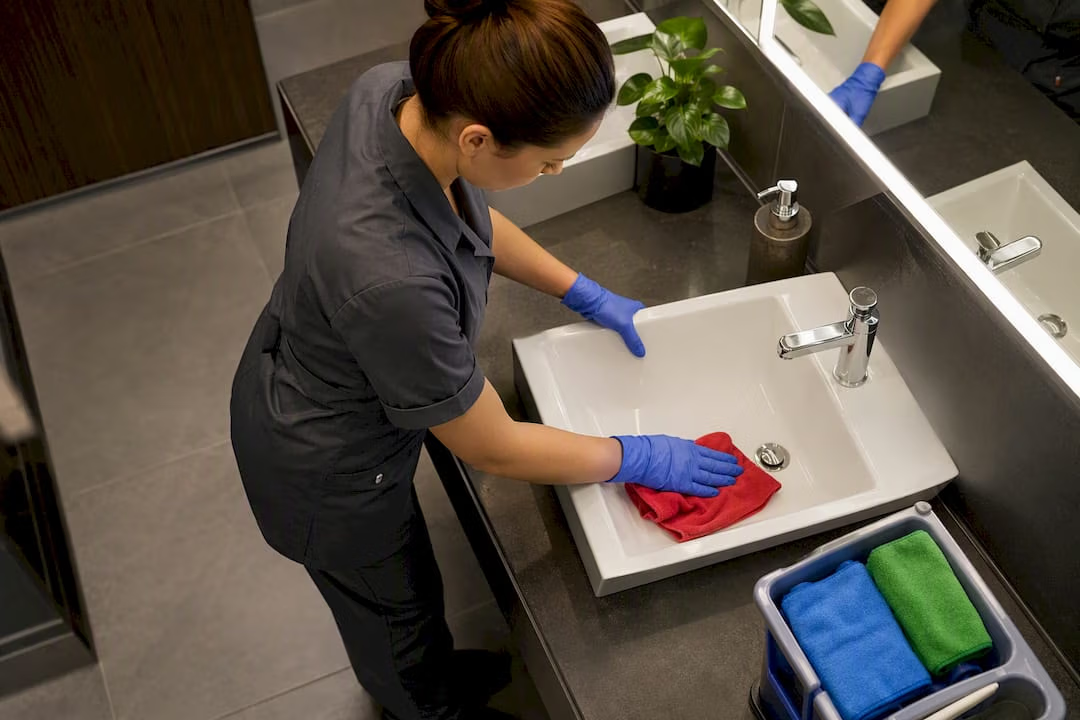
Colour-coded cloths and equipment, with one colour reserved for toilets and urinals (red is the usual choice) and others for basins and general surfaces, stop operatives spreading contamination between zones. Disinfectants only work if they stay on the surface for their stated contact time, so train staff to follow the label rather than spraying and wiping straight off.
Sanitary waste needs its own arrangements. Employers must provide a means of disposing of sanitary dressings, and as waste producers they have a duty of care under section 34 of the Environmental Protection Act 1990 to pass waste only to authorised businesses (see the waste duty of care code of practice). Sanitary waste collection is a specialist service, so in practice that means a contract with a licensed sanitary waste contractor who supplies, services and collects the bins, and keeping the waste transfer records they provide.
Pro Tip: A washroom that smells clean is not necessarily clean. Air fresheners can mask urine scale and dirty grout, so judge a deep clean by visible results, such as descaled urinals and clean grout lines, or by swab tests if your cleaning contractor uses them, not by scent.
How do you prove washroom hygiene compliance?
Record-keeping is where most sites fall down, not because the cleaning is not happening, but because nobody can prove it did. Each cleaning round should note the time, the operative, the products used, any faults spotted and, ideally, a photo.
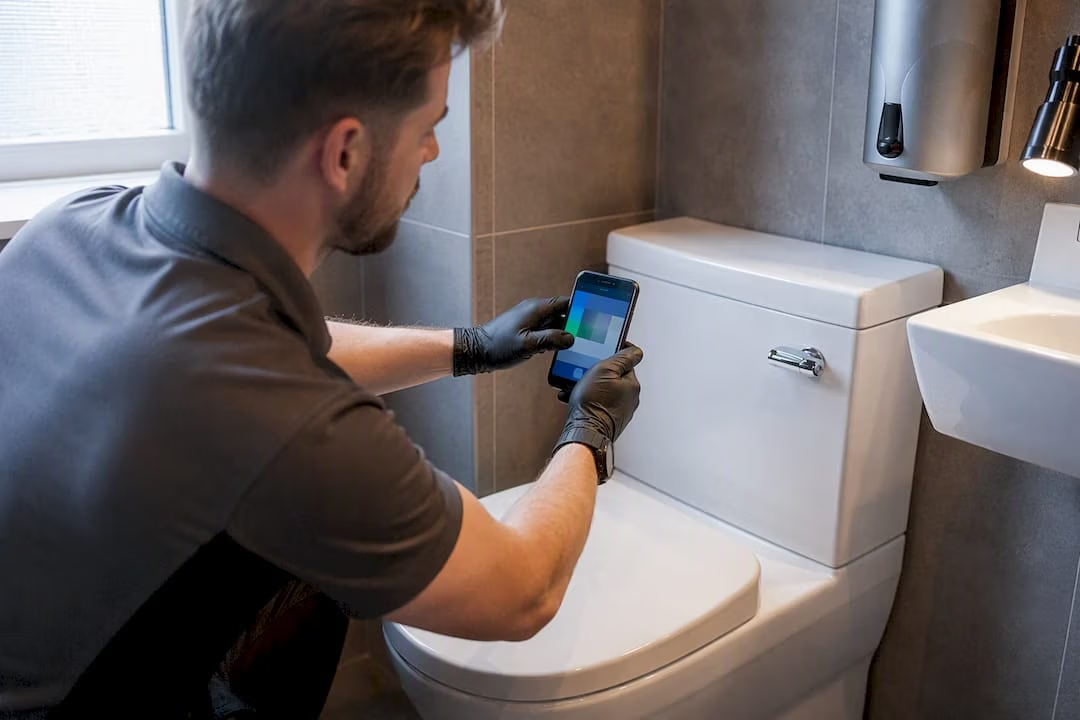
Keep these logs somewhere retrievable, not in a diary that never leaves the cupboard. Documented, time-stamped logs are what auditors and clients increasingly expect to see, rather than a verbal assurance that “it is cleaned regularly”. The same logs double as a management tool: recurring faults point straight to a supplier agreement that needs tightening or a fixture that needs replacing.
What are the most common washroom hygiene mistakes?
Most failures are small, avoidable and repeat because nobody owns the fix.
- Empty dispensers. Assign one person per shift to check soap and towel levels, not “whoever is passing”.
- No working hand-drying option. A dryer that has been broken for a week with no paper towel backup pushes people to skip drying altogether.
- No logging. If a round is not recorded, it is invisible during an audit, however well it was actually done.
- Unserviced sanitary bins. Overflowing bins are unhygienic and a major odour source. Agree a service frequency with your licensed contractor and check it is being met.
- Ignoring drains and voids. A slow floor gully or a toilet nobody uses can become a breeding site for drain flies, and damp boxing around pipes can shelter cockroaches.
None of these needs a large budget. They need a named owner and a checklist that is actually checked.
How does poor washroom hygiene attract pests?
Washrooms combine water, warmth, organic residue and hidden voids, which is exactly what several pests need. These are the ones we find most often in commercial washrooms:
| Pest | What draws it in | Signs | What fixes it |
|---|---|---|---|
| Drain flies (moth flies) | Organic film in floor gullies, rarely used toilets, sinks and drip trays | Small, fuzzy flies resting on walls near drains | Scrub out drains, run water through little-used outlets weekly, fix slow drains |
| Cockroaches | Warmth and damp in boxed-in pipework, ducts and behind panels | Insects seen at night, droppings, egg cases, a musty smell | Professional treatment plus sealing gaps around pipes and panels |
| Silverfish | Damp, humid rooms with poor ventilation | Small, silvery insects on floors and in cupboards at night | Fix ventilation and leaks, reduce humidity, clean out debris |
| Rats | Defective drains and damaged pipework | Droppings, gnawing, smells, unexplained water or debris | Drain survey and repairs, rat blockers, professional treatment |
| Ants | Sugary residues, damp and gaps around fittings | Trails along skirting and pipe runs | Clean residues, seal gaps, professional baiting for persistent nests |
Most of these problems start with the same failures as poor hygiene: drains that are never cleaned, leaks that are left and panels nobody looks behind. Adding a quick check of drains, gullies and pipework boxing to your deep clean catches them early. Our guides to flies in the office and rodent-proofing drains cover the two most common washroom pest routes, and our cockroach control page explains how we treat infestations in pipework and voids.
In office and hospitality washrooms, the floor gully is the first thing I check. If it is slow, smelly or full of slime, there are usually drain flies, and if the pipework boxing is warm with gaps around it, that is where we find cockroaches. Most of it is fixed by cleaning, sealing and repairs rather than spraying.
Ben, Lead Technician, BioWise
How we build washroom hygiene into real maintenance contracts
Every site should have a cleaning rota mapped to its actual footfall, not a generic template. A busy restaurant washroom might get three checks per shift; a small office one thorough clean a day plus a midday consumables check. A good contract then sets out:
- A named owner for each washroom and each shift
- Cleaning tasks and frequencies by area, including periodic deep cleans
- Time-stamped logs, with photos for faults and deep cleans
- Response times for faults such as blocked toilets, leaks and broken dryers
- How cleaning, maintenance, pest control and sanitary waste contractors share information, so nothing falls between suppliers
Washroom problems rarely come from one bad supplier. They come from the gaps between suppliers, where nobody owns the slow drain, the broken extract fan or the sanitary bin. When we survey a building, we look for those gaps first, because that is where hygiene complaints and pest problems start.
Matt Ochello, Sales Executive, BioWise
How BioWise can help with washroom hygiene
BioWise brings together three of the services that keep commercial washrooms hygienic: pest control, commercial cleaning and building maintenance. We are a family-run London company, founded in 2010 and working with more than 800 commercial clients, including offices, restaurants, hotels and healthcare sites.

Our commercial cleaning teams work to rotas built around your footfall, with logged rounds so you have evidence ready for clients, landlords and auditors, and our building maintenance team can pick up the repairs that keep washrooms hygienic and pest-proof. Our facilities management pest control contracts add monthly visits with photo reports, digital service reports for your audit files, emergency call-outs and unlimited minor pest proofing. We work alongside your licensed sanitary waste contractor, so every part of the washroom has a clear owner.
We are BPCA and NPTA members, CHAS accredited and SafeContractor approved, with same-day pest call-outs across every London borough. Contact us for a free site survey and a fixed written quote, or call 0800 988 3568 to speak to the team.
BioWise Pest Control Maintenance
13 Hanover Square, London, W1S 1HN
Call 0800 988 3568 or email info@biowiseservices.com
Sources
- Workplace (Health, Safety and Welfare) Regulations 1992, regulation 20: sanitary conveniences (legislation.gov.uk)
- Workplace (Health, Safety and Welfare) Regulations 1992, regulation 21: washing facilities (legislation.gov.uk)
- Welfare at work: guidance for employers on welfare provisions, INDG293 (HSE)
- Waste duty of care code of practice (GOV.UK)
FAQ
How many toilets does a workplace need by law?
HSE guidance for mixed-use facilities is one toilet and one washbasin for up to five people, two of each for 6-25, three for 26-50, four for 51-75 and five for 76-100, then one more of each for every additional 25 people. Men-only facilities can include urinals. These are minimums, so busy sites may need more.
How often should workplace toilets be cleaned?
The law requires toilets to be kept clean and orderly but does not set a frequency. In practice, offices need at least a daily clean plus a consumables check, while busy sites such as restaurants, hotels and shops need checks several times per shift. Log every round so you can prove it happened.
Do employers have to provide sanitary bins?
Yes. HSE guidance says employers must provide a means of disposing of sanitary dressings for female employees, which in practice means sanitary bins in toilets used by women. They should be serviced and collected by a licensed sanitary waste contractor, with records kept as part of your waste duty of care.
Who is responsible for washrooms in a shared office building?
Usually the landlord or managing agent looks after shared washrooms in common parts, and each tenant looks after washrooms inside its own space, but the lease decides. Employers still have a duty to make sure their staff have adequate facilities, so report problems in writing and keep a copy.
Can poor washroom hygiene cause pest problems?
Yes. Dirty floor gullies and rarely used toilets can breed drain flies, warm boxed-in pipework can shelter cockroaches, and damp, poorly ventilated rooms attract silverfish. Defective drains can also let rats in. Regular drain cleaning, prompt repairs and sealed gaps around pipework prevent most of these problems.