If you find mice in the office, isolate the area, remove any exposed food, record the sighting and call a professional pest controller the same day. Employers have a legal duty to keep the workplace safe and clean, so an infestation needs a prompt, documented response rather than a shop-bought trap.
This guide covers the signs to look for, your legal duties as an employer, a prevention checklist, what to do once mice are confirmed and the records that prove due diligence. We have dealt with mice in London offices since 2010, and the businesses that recover fastest are the ones that act on the first sighting.
Immediate steps on a first sighting:
- Isolate the area and restrict access
- Stop using exposed food, cups or supplies nearby, and throw away anything that has been gnawed
- Log the sighting with the time, location and type of evidence
- Notify facilities, the duty manager or your managing agent
- Call a professional pest controller promptly
- If food is prepared or served on site, consider closing that area until the risk has been assessed
Key Takeaways
Managing mice in the office successfully comes down to fast isolation and reporting, documented prevention, and a professional contractor working within the law and the rodenticide stewardship rules.
| Point | Details |
|---|---|
| Act on first sighting | Isolate the area, log it and call a professional contractor the same day. |
| Know your legal duty | The Health and Safety at Work etc. Act 1974 and the Workplace Regulations 1992 require a safe, clean workplace for staff and visitors. |
| Prevention beats treatment | Sealed waste, a desk-food policy and proofing gaps as small as 6mm stop infestations before they start. |
| Keep a pest log | Record dates, locations, evidence and contractor actions as evidence of due diligence. |
| No glue traps or DIY professional poisons | Using glue traps on rodents without a licence is an offence in England, and professional rodenticides need proof of competence to buy. |
| Work with a qualified contractor | BioWise offers surveys, proofing, treatment and follow-up visits for London offices. |
This article is general information, not legal advice. For your own circumstances, speak to a qualified legal or health and safety adviser.
Table of Contents
- Signs of mice in the workplace and what draws them in
- What are an employer’s legal duties when mice appear?
- Practical prevention checklist for office mice
- What to do when mice are confirmed in your office
- Monitoring, records and contracts that prove due diligence
- What a professional office mouse control visit should include
- The gap between office pest policy and office pest practice
- How BioWise can help with mice in the office
- Sources
- FAQ
Signs of mice in the workplace and what draws them in
Mice rarely announce themselves. Most offices only notice once droppings or a smell give the game away, and by then a few mice can have become an established infestation, because they breed quickly in a warm building with food to hand.
- Droppings: dark, about 3-6mm long and pointed at the ends, often scattered near skirting boards, under sinks, in drawers and along cable runs
- Gnaw marks: on cardboard, cabling, skirting and food packaging. Gnawed cables are a fire risk as well as a hygiene one
- Grease or smear marks: dark smudges along walls and floor edges where mice repeatedly brush past
- Nests: shredded paper, insulation or fabric tucked into quiet voids, under floor boxes or behind kitchen units
- Noises and odour: scratching in ceiling voids, raised floors or wall cavities, and a stale, musky smell in enclosed spaces
Check kitchens and breakout areas, storage cupboards, ceiling voids, raised floors, service risers and loading bays first. These spots combine warmth, quiet and nearness to food or waste. Mice are drawn in by food left on desks or in bins, unsecured waste, clutter that offers shelter, vegetation against the building and any gap that gives easy access from outside or from a neighbouring unit. If you are not sure whether you are dealing with mice or rats, our guide to telling mouse and rat droppings apart will help.
What are an employer’s legal duties when mice appear?
No single law is written specifically about mice in offices, but several general duties apply as soon as you know about them.
| Law | What it means for an office |
|---|---|
| Health and Safety at Work etc. Act 1974 | Employers must protect the health, safety and welfare of employees, and the health and safety of visitors and contractors, so far as is reasonably practicable. |
| Workplace (Health, Safety and Welfare) Regulations 1992 | Regulation 9: the workplace, furniture and fittings must be kept sufficiently clean, and waste must not build up except in suitable containers. |
| Control of Substances Hazardous to Health Regulations 2002 (COSHH) | Risks from hazardous substances, including biological agents in rodent droppings and urine and any pest control products used, must be assessed and controlled. |
| RIDDOR 2013 | Certain diseases linked to work, such as leptospirosis (more often associated with rats), are reportable to HSE. |
| Prevention of Damage by Pests Act 1949, section 3 | Occupiers must notify the local authority in writing if rats or mice are living on or resorting to their land in substantial numbers. The council can then require treatment or structural works. |
| Regulation (EC) No 852/2004 (assimilated law) | Applies where the office runs a food business, such as a staff canteen or cafe: premises must be maintained to prevent pest access, with adequate pest control procedures. |
In practice, that means you should:
- Keep a written record of sightings, actions taken and contractor visits
- Cooperate fully with environmental health officers if they visit
- Establish who holds responsibility (landlord, tenant or managing agent) and confirm it in the lease
- Treat any food storage or preparation area with the same seriousness as a commercial kitchen
Where food is stored or prepared on site, even in a small kitchenette, the Food Standards Agency’s Safer Food, Better Business (SFBB) approach is a useful standard. Council SFBB guidance on managing an active rodent infestation recommends extra hygiene steps while mice are active, including two-stage cleaning of food surfaces before use, throwing away anything rodents have gnawed and, in some cases, temporary closure while the risks are assessed.
Pro Tip: If your office has a shared canteen or kitchenette, apply SFBB-style controls from the first sighting, not after the second. Inspectors look at how quickly you responded, not just the outcome.
Responsibility for pest control in a leased office building often sits with the landlord for common areas and with the tenant for their own space. Get this clarified in writing before an infestation forces the conversation.
Practical prevention checklist for office mice
Prevention beats reaction every time, and it costs far less than repeated emergency call-outs. Build these tasks into your facilities schedule rather than treating them as a one-off clean-up.
- Daily sanitation: store food in sealed containers, wipe down desks and shared kitchen surfaces, empty food bins every evening and clean toaster and appliance crumb trays weekly.
- Desk-food policy: no food stored in desk drawers overnight, and perishables cleared away before staff leave.
- External waste management: use sealed external bins with tight lids, keep them away from the building where possible, and remove harbourage such as stacked pallets or overgrown shrubs.
- Proofing works: inspect for gaps around pipework, vents, cable entries and doors. Mice can squeeze through gaps of about 6mm, roughly the width of a pencil, so fill gaps with steel wool or copper mesh combined with a durable sealant or mortar rather than expanding foam alone, which mice gnaw straight through.
- Door brushes and thresholds: fit brush strips to external and loading-bay doors where daylight is visible underneath. Our guide on how to rodent-proof exterior doors covers the details.
- Staff training and reporting: brief teams on what a sighting looks like and give them a simple way to report it, whether that is an email address, a facilities ticket or a logbook at reception.
- Inspection routine: daily visual checks in kitchens and storage, monthly walk-rounds of the wider office, and regular professional inspections (monthly or quarterly, depending on risk), with follow-ups after any confirmed activity.
Consistent bin schedules and tidy external storage remove one of the biggest attractants before it becomes a problem. Good housekeeping and sealed access points remain the most cost-effective long-term defence against rodents, well ahead of repeated reactive treatments.
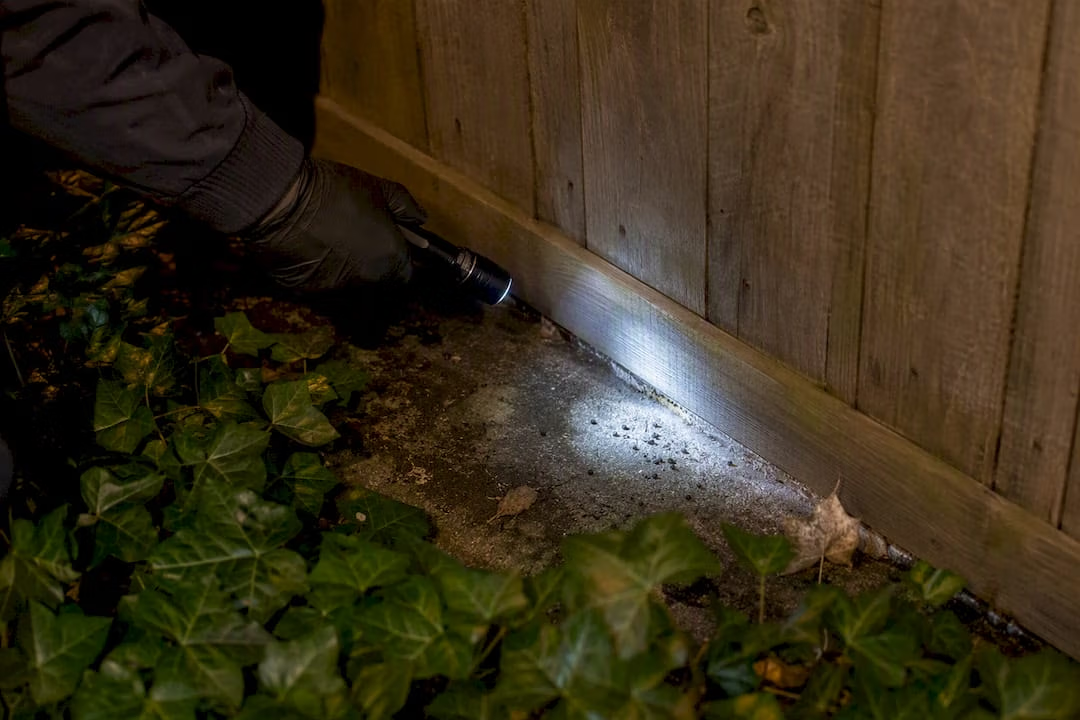
Pro Tip: Walk the building’s perimeter after dark once a season with a torch. Fresh droppings and gnaw marks show up far more clearly under torchlight than they do in daytime office traffic.
What to do when mice are confirmed in your office
Once mice are confirmed, the response needs structure, not panic. A clear sequence protects staff and gives you a defensible record if anyone asks how the situation was handled.
- Restrict access to the affected area and brief anyone who needs to enter
- Give cleaning staff gloves and suitable PPE before they touch contaminated surfaces, and do not dry-sweep or vacuum droppings: dampen them with disinfectant first, then wipe them up
- Never let untrained staff handle or move bait boxes or traps set by a contractor
- Throw away any food or packaging that shows signs of gnawing or contamination
- Do not use glue traps: since 31 July 2024 it has been an offence in England to use a glue trap to catch a rodent without a licence
A reputable contractor will survey the site, identify entry points and nesting areas, and propose a treatment plan with a realistic timeline, usually several visits over a few weeks rather than a single call-out. Cleaning should follow a two-stage process: clean surfaces first to remove debris, then disinfect, in line with SFBB guidance for active rodent infestations.
Rodenticides are tightly controlled. Under the UK Rodenticide Stewardship Regime, professional-use products can only be bought with proof of competence: since 1 January 2026, that means a CRRU UK-approved certificate gained within the last five years, or an older certificate plus membership of an approved CPD scheme. In an office, any baiting should be part of a risk-assessed integrated pest management (IPM) programme run by a trained technician, with bait in secured, tamper-resistant stations. Our guide to the UK rat poison rules explains what changed.
Monitoring, records and contracts that prove due diligence
A pest log is your evidence trail if an inspector or a client ever asks how seriously you take the issue. Record the date and time of each sighting, the exact location, the type of evidence found, the staff member who reported it and any photos taken. Note every contractor action against the same log.
Monitoring stations and trap records, checked on a set schedule, turn anecdotal sightings into a documented pattern that a commercial rodent control contractor can act on quickly.
| Record item | Why it matters |
|---|---|
| Date and location of sighting | Establishes a pattern and shows response speed |
| Evidence type (droppings, gnaw marks, noise) | Helps a contractor prioritise treatment areas |
| Staff witness and photos | Supports the record if it is questioned later |
| Contractor visit notes, treatments and bait station plan | Shows what was done, where and with which products |
| Proofing recommendations and completion dates | Demonstrates that the causes were fixed, not just the symptoms |
There is no fixed legal period for keeping pest records, but keeping them for at least two years is good practice and what many auditors and landlords expect. A log kept alongside a scheduled contract gives you a paper trail that stands up to scrutiny, whether it comes from environmental health, a landlord or a nervous client walking through your office.
The offices that handle an inspection well are the ones that can pull up every visit report, photo and proofing recommendation in a couple of minutes. Our clients get a digital service report after every visit, so the log builds itself instead of living in someone’s inbox.
– Monty Gordon, Marketing and Technology, BioWise
What a professional office mouse control visit should include
Whoever you use, a professional mouse control visit should always include:
- A full survey of entry points, nesting areas and high-risk zones, including ceiling voids, risers and raised floors
- Proofing works or clear proofing recommendations to seal entry points, timed alongside treatment
- Targeted treatment using methods appropriate to the site, with secured bait stations or traps placed out of reach of staff
- A written report of findings and actions, and a scheduled follow-up visit
Before signing a contract, ask about the provider’s rodenticide stewardship practices and whether technicians hold recognised pest management qualifications, such as the RSPH/BPCA Level 2 Award in Pest Management. A vague answer is a red flag. Also check insurance cover, clear terms on visit frequency and response times, and a written commitment to IPM rather than blanket poison use. No law requires an office to have a pest control contract or to use a BPCA member, but both are good signs of a professional approach.
The gap between office pest policy and office pest practice
Most offices have a pest control clause buried in a facilities contract somewhere, and many managers have never read it. That gap is the real risk, not the mice themselves. The usual advice stops at “call a professional”, which is correct but incomplete. It skips the part where a log, a monitoring schedule and a clear escalation path are what actually protect a business when an inspector or a client asks hard questions.

The sequencing matters more than most guidance admits: exclusion and sanitation should happen before treatment is needed, not as an afterthought once mice are confirmed. Businesses that wait for a sighting to start sealing gaps are always working reactively, and reactive pest control usually costs more in the long run than routine inspections.
Prioritise the boring stuff first: sealed bins, a working log and a contractor relationship you have already vetted before you need it urgently. When I survey office buildings, the dramatic response plan matters far less than the unglamorous groundwork that stops you needing one.
– Matt Ochello, Sales Executive, BioWise
How BioWise can help with mice in the office
When mice turn up unannounced, London office managers need a fixed point of contact, not a scramble through directory listings. BioWise is a family-run pest control company founded in 2010, working with more than 800 commercial clients and holding a 4.9-star Google rating. We offer same-day call-outs across every London borough, often within hours, with discreet visits planned around working hours and unmarked vehicles on request.

Our BPCA-certified technicians survey the building, find the entry points and nesting areas, treat the infestation and carry out proofing to stop mice getting back in. A one-off call-out leaves you starting from scratch at every sighting, so our office pest control contracts keep monitoring, proofing and documented visits running continuously, with monthly visits and photo reports, digital service reports for your records, emergency call-outs and unlimited minor pest proofing included. Our mice control page explains how we treat mice in commercial buildings.
We are BPCA and NPTA members, CHAS accredited and SafeContractor approved. Contact us to book a free site survey and receive a fixed written quote, or call 0800 988 3568 to speak to the team today.
BioWise Pest Control Maintenance
13 Hanover Square, London, W1S 1HN
Call 0800 988 3568 or email info@biowiseservices.com
Sources
- Health and Safety at Work etc. Act 1974 (legislation.gov.uk)
- Workplace health, safety and welfare: Approved Code of Practice and guidance L24 (HSE)
- Prevention of Damage by Pests Act 1949, section 3 (legislation.gov.uk)
- Glue Traps (Offences) Act 2022 (legislation.gov.uk)
- CPD and stewardship: proof of competence from 1 January 2026 (CRRU UK)
- Safer Food, Better Business: managing an active rodent infestation (Lancaster City Council)
FAQ
Do I have to report mice in the office to the council?
Under section 3 of the Prevention of Damage by Pests Act 1949, occupiers must tell the local authority in writing if rats or mice are living on or visiting their land in substantial numbers. The Act does not define “substantial”, so a persistent or spreading infestation is the clearest case for notifying. A professional pest controller can help you judge the scale.
What keeps mice away from the office?
Sealed food storage, tight waste management, gaps sealed with steel wool or copper mesh and sealant, and regular inspections are the most reliable deterrents. Ultrasonic repellers and scent-based products have limited evidence behind them and should not be relied on as a primary defence, especially in a building with an existing infestation.
Can I refuse to work if there are rats or mice in my workplace?
Raise it in writing with your manager or health and safety representative first, because your employer must assess and deal with the risk. Employment law protects staff who leave or refuse to return to work because of danger they reasonably believe is serious and imminent, but an occasional mouse sighting is unlikely to meet that test on its own. Acas can advise on your situation.
What should I do if there are rats or mice in my workplace?
Isolate the affected area, stop using any exposed food or equipment nearby, log the sighting and contact a professional pest controller promptly. Tell your facilities team or managing agent too, as the problem may be coming from common parts or a neighbouring unit. For food areas, follow SFBB guidance on two-stage cleaning and consider closing them until the risk is assessed.
Are mice in the office a health risk?
Yes. Mice contaminate surfaces, food and equipment with urine and droppings and can spread bacteria such as Salmonella. They also gnaw cables, which can create a fire risk. The risk to staff is lower when the problem is dealt with quickly and surfaces are cleaned properly. Anyone with health concerns should speak to their GP or call NHS 111.