Food-safe pest control means keeping pests out of food premises with methods that cannot contaminate food, packaging or food-contact surfaces. In practice that means proofing and hygiene first, monitoring and non-toxic controls next, and carefully targeted pesticide use only where it is genuinely needed.
This guide explains the safe methods that work in kitchens, cafés, food production units and stores, how pesticides should be handled around food when they are needed, and what to check in a contractor. We have protected London food businesses from pests since 2010, using the same prevention-first approach on every site.
If you have spotted pest activity today, act now:
- Isolate any suspect stock and stop using the affected area
- Log the sighting with a photo, time and location
- Contact your pest control contractor for an emergency inspection
Key Takeaways
Food-safe pest control prevents pest access first and makes sure any treatment is chosen, placed and recorded so it does not put food, packaging or contact surfaces at risk.
| Point | Details |
|---|---|
| Prevention outranks treatment | Proofing gaps (mice can use gaps of about 6mm), managing waste and checking deliveries reduce pest pressure before chemicals are needed. |
| Non-toxic methods come first | Monitoring, trapping, insect light traps, pheromone monitors and heat treatment handle many problems without pesticides near food. |
| Chemicals need strict control | Any pesticide must be used by a competent person, following the label and a COSHH risk assessment, and kept away from food and contact surfaces. |
| Clean before you restart | Food-contact surfaces should be cleaned after any treatment and before food preparation resumes. |
| Records show it works | Site plans, visit reports and corrective actions are what auditors and EHOs ask to see. |
Table of Contents
- What makes pest control food-safe?
- How do you proof a food premises against pests?
- Are there non-toxic pest control options for food premises?
- How should pesticides be used safely around food?
- What records do pest control audits actually check?
- What should you check before signing a pest control contract?
- Why prevention-first pest control beats the reactive approach
- How BioWise can help with food-safe pest control
- Sources
- FAQ
What makes pest control food-safe?
Food-safe is not a product label. It describes an approach where every pest control decision is made with the food in mind: how pests are kept out, how they are detected, which control method is chosen, where it is placed and how the area is cleaned afterwards. No treatment is completely risk-free, so the aim is to reduce the need for pesticides and to control the risk when they are used.
The legal starting point is Regulation (EC) No 852/2004, assimilated law in Great Britain, which requires food premises to be designed and maintained to prevent pest access and to have adequate procedures to control pests. Pest control is one of the prerequisite programmes that support a HACCP-based food safety management system. The Food Standards Agency’s Safer Food, Better Business pest control guidance is direct on the safety point: never let pest control bait or chemicals, including sprays, come into contact with food, packaging, equipment or surfaces, because they are likely to be poisonous to people.
The British Pest Control Association (BPCA) promotes integrated pest management (IPM), which puts proofing, hygiene and monitoring ahead of routine pesticide use. A programme that leans on chemicals as a first response is already behind what a food auditor expects to see.
The core principles are simple:
- Keep pests out with proofing, screening and good waste control.
- Find activity early with regular monitoring and trained staff.
- Use non-toxic controls first wherever they will do the job.
- Target any pesticide use precisely, away from food, through a competent technician.
- Protect and clean food areas before, during and after treatment.
- Record everything, so you can show the programme is working.
How do you proof a food premises against pests?
Proofing removes access before pests become a problem, and it costs far less than a failed audit or a batch of discarded stock. Most infestations in food premises trace back to a handful of predictable entry points.
- Seal gaps and openings. Mice can get through gaps of about 6mm and rats about 15mm, so door thresholds, cable ducts, pipe entries and drainage need brush strips, wire wool and mortar or metal proofing plates, not expanding foam alone. Our guide to rodent-proofing exterior doors covers one of the most common weak points.
- Screen and drain properly. Fly screens on openable windows and extraction points, plus drains with intact gratings and regular cleaning, close two of the most common routes for flies and rodents.
- Check stock on arrival. Inspect deliveries for signs of pests before goods enter storage, and refuse any delivery that shows them, as SFBB advises. Keep goods in sealed containers and rotate stock so nothing sits long enough to attract attention.
- Keep stock off the floor. Pallets and shelving ease cleaning underneath and remove the dark, undisturbed spaces pests favour.
- Manage the outside first. Bin stores with close-fitting lids, a clean yard and no vegetation against the building fabric stop pests reaching your walls at all.
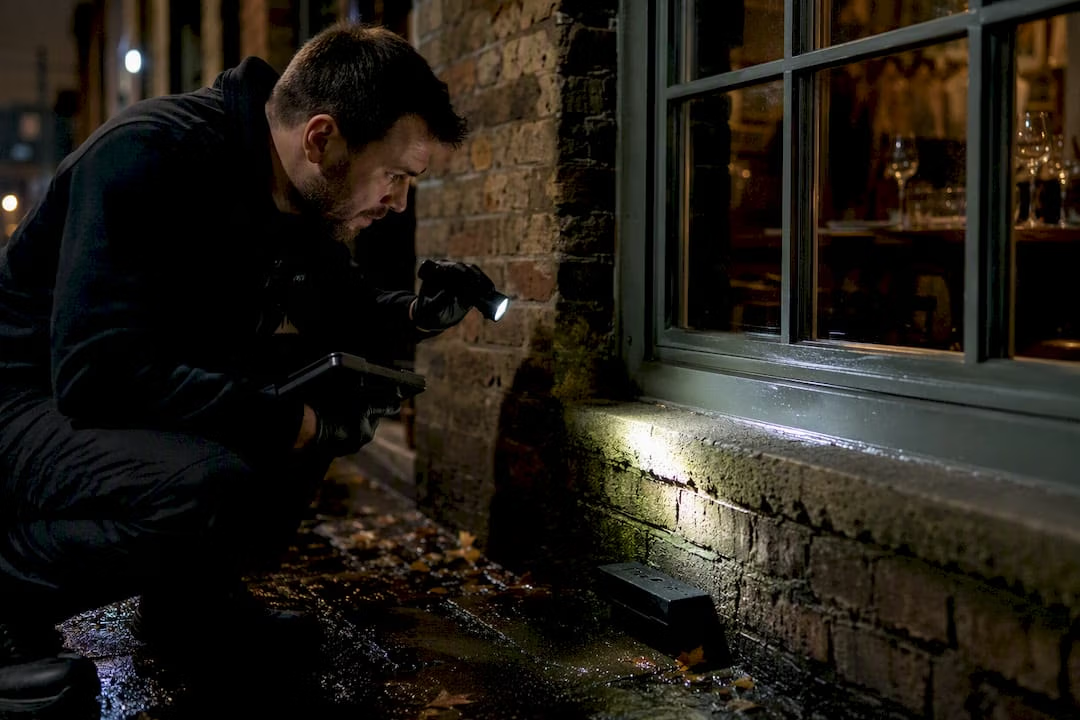
Pro Tip: Walk the perimeter after dark once a month with a torch. Rodent activity and gaps in proofing show up far more obviously at night than in daylight.
For a fuller comparison of the two approaches, see our guide to pest proofing vs chemical pest control.
Are there non-toxic pest control options for food premises?
Yes, and on a well-run food site they do most of the work. Chemical treatment is one tool among several and is rarely the first one used.
| Method | Best for | Food-safety notes |
|---|---|---|
| Proofing and hygiene | All pests | No chemical risk; the foundation of every programme |
| Non-toxic monitoring points | Rats and mice | Show where activity is without placing poison in food areas |
| Snap traps in secured boxes | Mice and rats in food rooms | No poison; must be checked regularly and carcasses removed promptly |
| Insect light traps with glue boards | Flies and other flying insects | Catch insects without spraying; glue-board units avoid scattering insect fragments |
| Pheromone and insect monitoring traps | Stored product moths and beetles, cockroaches | Detect problems early, often before stock damage is visible |
| Heat treatment | Stored product insects, bed bugs | Kills all life stages without chemical residue; needs specialist equipment |
Heat treatment works well against stored product insects such as weevils and moths, but it is not practical for every space. Our guide to stored product pests explains identification and control in more detail.
Glue traps for rodents are a different matter. Under the Glue Traps (Offences) Act 2022, it is an offence in England to set a glue trap to catch a rodent unless it is done by a pest controller under a licence, which is only granted where there is no other satisfactory solution. Insect monitoring boards should be placed where they cannot catch a rodent.
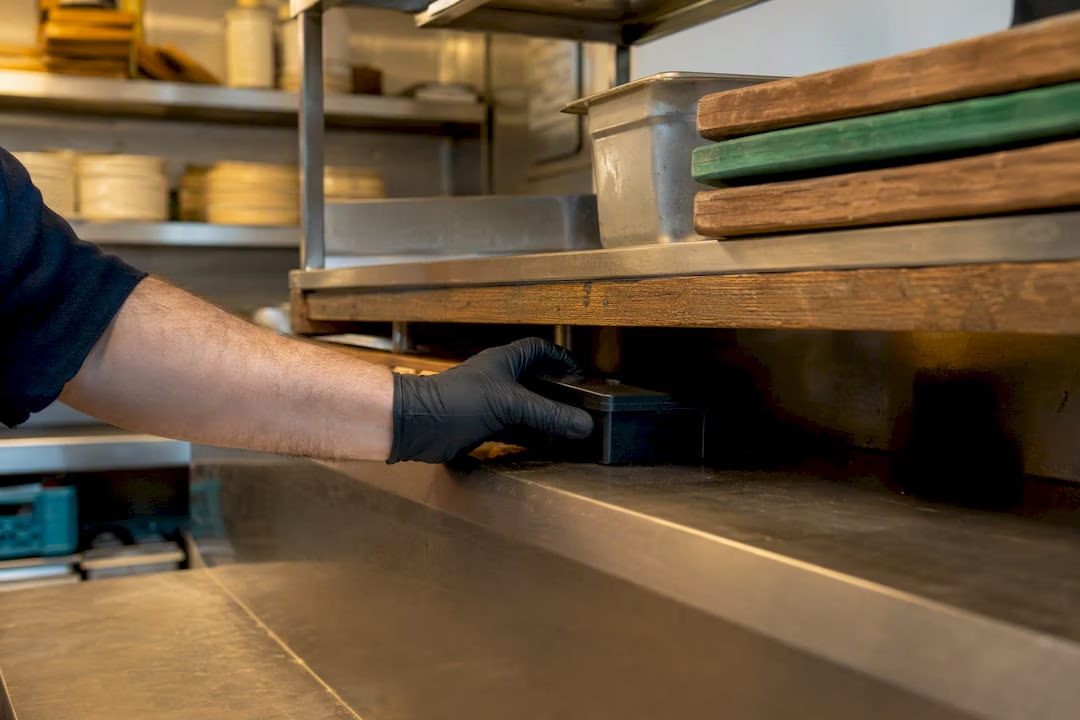
Pro Tip: Ask your contractor which devices contain poison and which do not before you sign a contract. If they cannot answer straight away from the site plan, the plan probably does not exist yet.
How should pesticides be used safely around food?
When monitoring confirms activity that non-toxic methods cannot control, targeted pesticide use may be needed. Done properly it can be used safely in food premises, but the rules are strict:
- Competent technicians only. Professional products should be applied by trained technicians. Since 1 January 2026, professional-use rodenticides can only be bought with proof of competence under the UK rodenticide stewardship regime.
- Follow the label. Product labels are legally binding and set out where and how a product may be used, including any restrictions around food.
- Assess the risk first. Your contractor should provide a COSHH risk assessment and safety information for every product used on site, so you can meet your own duties under the COSHH Regulations 2002. Our COSHH pest control guide explains what to ask for.
- Rodenticides in secured bait stations only. Rodenticide should go in tamper-resistant, secured bait stations, never as loose bait in food rooms, and be used to deal with confirmed activity rather than left out permanently unless a documented risk assessment justifies it. The CRRU UK stewardship guidance explains why: secondary poisoning harms barn owls, other wildlife and pets.
- Gel baits in cracks and crevices. Cockroach and ant gels are applied in small amounts into cracks, voids and equipment housings, away from food-contact surfaces.
- Sprays only with food removed. If a spray is needed, remove or cover food and utensils, keep staff out for the time the technician specifies, and clean food-contact surfaces before reuse.
- Fly killers away from prep areas. Site electric fly killers and insect light traps away from open food and preparation surfaces.
After any treatment, follow your technician’s re-entry and cleaning advice. Our guide to cleaning after pest control treatment explains what is safe and when.
What records do pest control audits actually check?
Records are how you prove a food-safe programme is actually happening. Third-party schemes such as BRCGS expect a documented pest control programme, and EHOs look for the same kind of evidence in a smaller restaurant or café.
- A site plan showing every monitoring point, trap and bait station, and which ones contain poison
- A written report for every visit, noting each device checked, any activity found and the action taken
- COSHH risk assessments and safety information for any products used
- A sighting log with date, location and description, even for a single moth or dropping
- Records of corrective action, such as proofing completed or stock discarded
There is no fixed legal retention period, but keeping records for at least two years is good practice and many auditors expect it. Digital reporting makes audits much quicker because trends across visits are easy to search, and a contractor who spots rising activity at one device should escalate before you have a full infestation.
A site plan, COSHH assessment and monitoring record should exist before the first bait station goes down, not be pulled together after an inspection letter arrives. With digital reports, a manager can bring up a year of visits in seconds when an auditor asks.
– Monty Gordon, Marketing and Technology, BioWise
What should you check before signing a pest control contract?
A contract that looks professional on the surface can still leave gaps an auditor will find in minutes. Before signing, confirm the essentials.
- Certifications and competence. Ask for BPCA or NPTA membership, or certification to the EN 16636 pest management standard, plus technician qualifications and public liability insurance in writing.
- Scope of work. The contract should name the pests covered, confirm internal and external scope, and specify device types and numbers, not just “pest control included”.
- Site plan and COSHH. You should receive a site plan and COSHH risk assessments before the first treatment, not months into the contract.
- Food-safe methods. Ask which devices are non-toxic, where any poison will be placed, and how treatments in food areas will be planned around service.
- Response times. Emergency call-out times should be stated in hours, not “as soon as possible”.
- Reporting format. Confirm whether reports are digital or paper, and how quickly you receive them after each visit.
Keep every certificate, site plan and service report on site and accessible. A contractor reluctant to put any of this in writing is a warning sign worth taking seriously.
What to do immediately if you find pest evidence
Act in this order: isolate any affected product, photograph and log the sighting with time and location, secure the area, then call your contractor for an emergency inspection.
- Throw away any food pests may have touched, following the FSA’s Safer Food, Better Business safe method
- Wash, disinfect and dry affected surfaces and equipment, and get contractor confirmation before returning the area to service
- Record the corrective action taken, not just the sighting, so you can show due diligence to an EHO or auditor
Why prevention-first pest control beats the reactive approach
Many food businesses only think hard about pest control after a failed audit or a customer complaint. Prevention and proofing are cheap compared with discarded stock, a closure or a supply contract lost for repeated non-conformances.
The conventional advice, book a monthly visit and leave it there, undersells what auditors actually want to see. A visit without a site plan, trend analysis or COSHH file behind it looks like no programme at all once someone asks for evidence.
Operators also often assume device placement is entirely the contractor’s responsibility. The food business operator remains responsible for food safety, so review the site plan with your contractor and sign it off; many auditors expect to see that sign-off.
Get proofing right before you worry about which pesticide a contractor uses. A building pests cannot get into needs far less chemical intervention to stay clean, and that is the safest outcome for any kitchen.
– Ben, Service Technician, BioWise
How BioWise can help with food-safe pest control
We build food business programmes around prevention: a free initial site survey, proofing recommendations, non-toxic monitoring as standard and targeted treatment only where activity is confirmed. Our BPCA-certified technicians plan any treatment in food areas around your trading hours, with evening, weekend and out-of-hours visits available.

Our food business pest control and restaurant pest control contracts include monthly visits with official photo reports, digital service reports for your EHO or audit file, emergency call-outs and unlimited minor pest proofing. Larger proofing projects are priced after a survey, and one-off visits are also available.
BioWise is a family-run London company founded in 2010, with more than 800 commercial clients. We are BPCA and NPTA members, CHAS accredited, SafeContractor approved and fully insured.
Before your next audit, call 0800 988 3568 or contact us to book a free survey and a fixed written quote.
BioWise Pest Control Maintenance
13 Hanover Square, London, W1S 1HN
Call 0800 988 3568 or email info@biowiseservices.com
Sources
- Food Standards Agency: Safer Food, Better Business for caterers, pest control safe method
- Food Standards Agency: Starting a food business
- Regulation (EC) No 852/2004 on the hygiene of foodstuffs
- Glue Traps (Offences) Act 2022
- CRRU UK: Think Wildlife (rodenticide stewardship)
- British Pest Control Association (BPCA)
FAQ
What is food-safe pest control?
It is pest control planned so that nothing used can contaminate food, packaging or food-contact surfaces. It relies on proofing, hygiene and monitoring first, non-toxic controls such as traps and insect light traps next, and targeted pesticide use by trained technicians only when activity is confirmed.
Is pest control treatment safe in a commercial kitchen?
It can be, when trained technicians follow the product label and a COSHH risk assessment, but no treatment is risk-free. Food and utensils should be removed or covered, treatments kept away from contact surfaces, and surfaces cleaned before food preparation restarts. Ask your contractor what will be used and when you can reopen.
What is the least toxic pest control option around food?
Non-chemical methods carry the lowest risk: proofing, hygiene, traps, insect light traps, pheromone monitors and heat treatment. Where a pesticide is needed, precise placement matters as much as the product, for example gel baits in cracks and crevices, and rodenticide only in secured bait stations away from food.
Do I need to close my kitchen for pest treatment?
Not usually for routine monitoring, trapping or gel baiting, which can often be done around service. Spraying or larger treatments may mean clearing food and staff from the area for a set time. Your contractor should explain this in advance and schedule visits outside trading hours where possible.
How often should a food business be checked for pests?
There is no legal minimum. Frequency should reflect risk: monthly visits are common for restaurants and other food businesses, with more frequent visits where activity has been recorded. Staff should also carry out daily checks, and every contractor visit should produce a written report.