

TL;DR:
- An integrated pest management strategy focusing on physical proofing and targeted monitoring is most effective for London properties. Proper product selection, routine inspection, and professional documentation ensure legal compliance, safety, and environmental benefits. Investing in proactive, site-specific IPM measures reduces long-term costs and the risk of infestations more than reactive chemical treatments.
The most effective approach for London homes and businesses is an Integrated Pest Management (IPM) strategy that leads with physical proofing, targeted monitoring, and tamper-proof baiting where necessary — not routine chemical spraying. For homeowners, that means low-chemical proofing materials combined with monitoring traps. For business managers, it means a contracted commercial pest control programme with documented monitoring, tamper-proof devices, and records that satisfy Food Safety Act 1990 requirements and BPCA best practice. BioWise Pest Control Maintenance Services has delivered exactly this kind of structured prevention across London since 2010, working with numerous residential and commercial clients.
Table of Contents
- What makes a pest prevention product genuinely ‘best’?
- Which product categories should you actually use?
- Safety, legal, and regulatory notes for UK users
- How to choose the right products and use them effectively
- What should you check, and how often?
- Typical costs and realistic expectations
- Key takeaways
- Why the ‘spray first’ instinct costs you more in the long run
- BioWise Pest Control Maintenance Services: professional IPM for London properties
- Useful sources and further reading
- FAQ
What makes a pest prevention product genuinely ‘best’?
Not all products marketed as pest deterrents are equal, and the criteria that matter for a London restaurant differ sharply from those relevant to a terraced house in Hackney. The evaluation axes below reflect what actually determines whether a product works in practice.
- Effectiveness by pest type: a product must target the specific pest causing the problem — glue boards for crawling insects, pheromone traps for moths, tamper-proof bait stations for rodents.
- Safety for people, children, and pets: non-toxic monitoring stations carry far lower risk than open rodenticide baiting, particularly in homes with young children or in food-preparation areas.
- Suitability for the setting: tamper-proof, secured bait stations are non-negotiable for food businesses; domestic settings have more flexibility.
- Legal and compliance fit: food businesses must meet HACCP-based systems under the Food Hygiene Regulations; products and their placement must support audit evidence.
- Ease of use and maintenance: monitoring traps require regular inspection; electronic fly killers need UV bulb replacement at least annually.
- Environmental impact: green pest control methods such as physical exclusion, pheromone traps, and non-toxic monitors reduce chemical load significantly.
- Cost and lifespan: proofing materials offer long-term value; consumable items such as glue boards require ongoing replacement.
Pro Tip: Prioritise perimeter proofing before investing in any chemical or electronic product. Sealing entry points at low levels around pipework and doors reduces ingress immediately and cuts long-term treatment costs — no product placed inside a building compensates for gaps that let pests in.
Which product categories should you actually use?
The table below covers the main prevention product categories used in UK homes and commercial premises, assessed against the key decision dimensions.
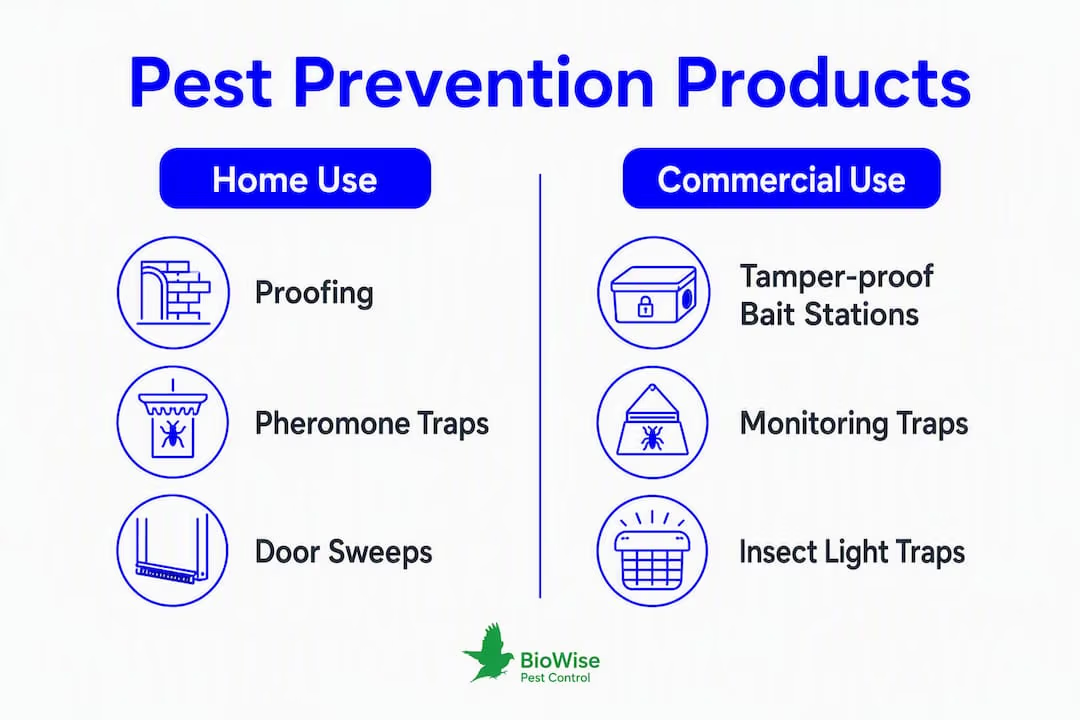
| Category | Pests targeted | Safety (people/pets) | Home vs commercial | Compliance fit | Ease of use | Environmental impact | Typical cost/lifespan |
|---|---|---|---|---|---|---|---|
| Proofing sealants and mesh | Rodents, insects | High | Both | Supports audit evidence | Moderate (installation) | Very low chemical impact | Low cost; long lifespan |
| Door sweeps and brush strips | Rodents, insects | High | Both | Required for food premises | Easy; check annually | Nil | Low cost; 1–3 years |
| Tamper-proof bait stations | Rodents | Moderate (secured) | Commercial essential | Required in food areas | Requires professional servicing | Moderate (rodenticide) | Moderate; ongoing contract |
| Non-toxic monitoring traps | Rodents, insects | Very high | Both | Excellent for audits | Easy; regular inspection | Very low | Low–moderate; replace per schedule |
| Pheromone traps | Moths, cockroaches | Very high | Both | Good audit evidence | Easy; monthly exchange | Nil | Low; monthly replacement |
| Insect light traps (ILTs) | Flying insects | High | Commercial primary | Required in food zones | Moderate; annual bulb change | Low | Moderate; bulbs annually |
| Glue boards | Crawling insects | High (positioned correctly) | Both | Supports monitoring records | Easy; replace per schedule | Low | Low; ongoing replacement |
Proofing materials and door sweeps
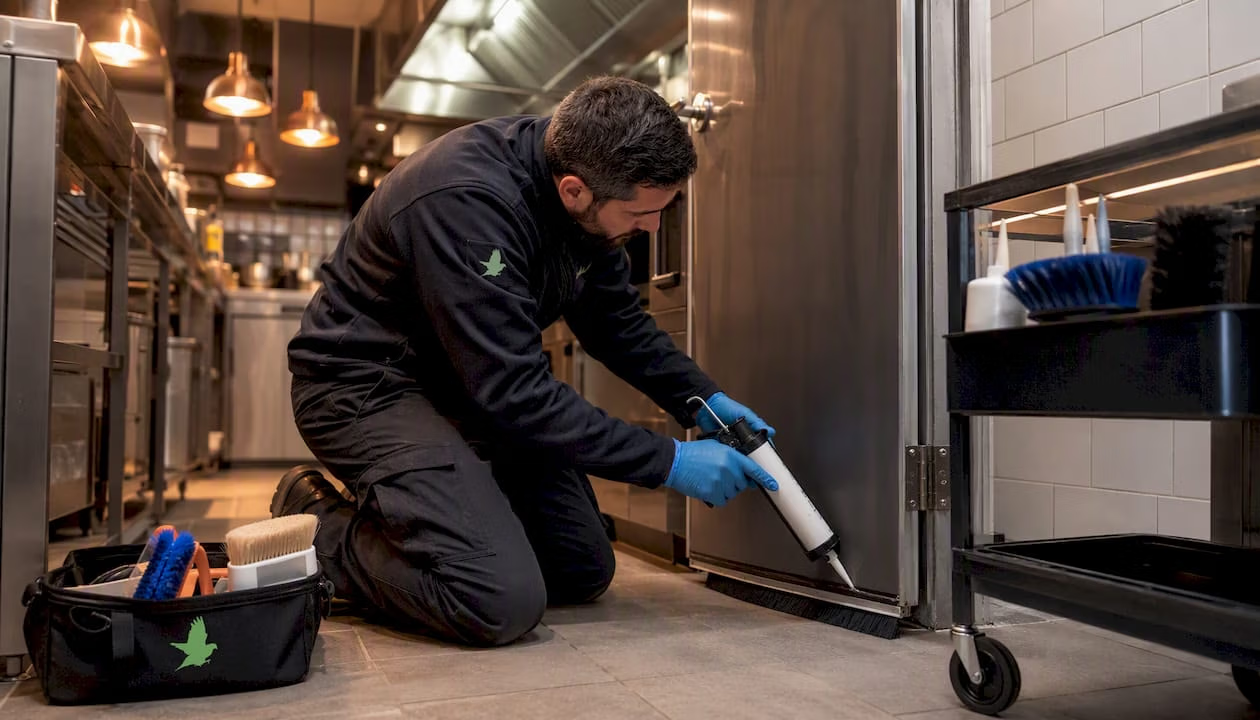
Physical exclusion is the foundation of any IPM programme. Sealing gaps around pipework, installing brush strips on external doors, and fitting mesh over air vents stops pests entering in the first place. Results are immediate: once a gap is sealed, ingress through that point stops. The limitation is that proofing requires a thorough survey first — gaps are often in non-obvious locations such as behind service ducts or beneath floor-level pipe penetrations. Our guide How to Rodent-Proof Exterior Doors Against Mice and Rats shows what to fit.
Tamper-proof bait stations
Where rodent pressure exists, tamper-proof stations are the standard for commercial sites. BPCA guidance recommends replacing routine exposed baiting with non-toxic monitoring stations wherever feasible, escalating to rodenticide only when monitoring confirms active pressure. Rodent population reduction typically takes a few weeks once baiting begins, depending on pressure levels. Stations must be secured in place and positioned away from open food or preparation surfaces.
Monitoring traps, pheromone traps, and glue boards
These are the workhorses of early detection. Pheromone traps for moths and cockroaches, glue boards for crawling insects, and non-toxic rodent monitors all generate the trend data that tells you whether a problem is developing before it becomes an infestation. Glue boards should be exchanged according to manufacturer guidance, typically on a regular schedule, though dusty or warm environments may require more frequent replacement.
Insect light traps
Electronic fly killers and sticky-board ILTs are standard fly control equipment in commercial food environments. UV bulbs must be replaced at least every 12 months, ideally in spring before peak flying-insect season. Position units away from windows and other UV sources, and never directly above open food or preparation surfaces, as electrocution units can expel insect body parts.
Pro Tip: Pheromone traps are often overlooked in domestic settings, yet they are among the most cost-effective chemical-free pest products available. A small investment in moth pheromone traps in a kitchen or pantry can detect a stored-product pest problem weeks before visible damage appears.
Safety, legal, and regulatory notes for UK users
Businesses operating food premises have clear legal duties. Under the Food Safety Act 1990 and the Food Hygiene (England) Regulations 2013, food businesses must adopt HACCP-based systems and maintain premises in a condition that prevents pest access. Failure to do so can result in enforcement action or prosecution.
For rodenticide use specifically, the Biocidal Products Regulation (retained in UK law post-Brexit) requires that only authorised products are used, bait stations are positioned safely, and all applications are recorded. COSHH assessments are required before any pesticide is applied, and these must be reviewed whenever pest species, product, or site conditions change. For food businesses, monitoring protocols, trap inspection records, and corrective actions must all be documented to demonstrate due diligence during third-party audits such as BRCGS or SALSA certification.
Glue traps designed to catch rodents are banned for public use under UK law; only trained professionals operating under specific conditions may use them. Always verify that any trap or poison you deploy is permitted for the target species and follow the instructions on the packaging precisely.
How to choose the right products and use them effectively
Start with an IPM assessment before purchasing anything. Buying products without first identifying the pest species, entry points, and environmental risk factors is the single most common reason prevention programmes fail.
- Conduct a site risk assessment — identify pest species present or likely, map entry points, and note environmental attractants (waste, moisture, clutter, stock storage).
- Match the product to the pest — confirm the product is approved for the target species and suitable for the specific location (indoor, outdoor, food area, domestic).
- Apply safety controls — check suitability for children, pets, and non-target wildlife; use tamper-proof housings where required.
- Plan documentation — for commercial sites, establish monitoring point maps, inspection logs, and corrective action records from day one.
- Confirm maintenance expectations — know the replacement schedule for each product before installation; under-maintained devices quickly become ineffective.
- Assess environmental profile — prefer non-toxic monitoring over routine rodenticide where BRCGS structural disciplines and risk levels permit.
When briefing a supplier or technician, ask specifically about contract scope, monitoring and reporting frequency, tamper-proof device specifications, COSHH and risk assessment documentation, and how evidence will be presented for audits.
DIY products are appropriate for low-risk domestic situations: proofing small gaps, installing door sweeps, deploying pheromone or monitoring traps. Call a professional when the pest species carries health risk (rats, cockroaches), when the infestation is established, when food-handling premises are involved, or when legal compliance documentation is required.
What should you check, and how often?
A repeatable monitoring schedule keeps prevention measures effective and satisfies audit expectations. BPCA guidance is clear that visit frequency should be risk-based and documented, not set by a generic calendar.
- Daily (commercial sites): check waste bins are lidded and emptied; confirm no stock is stored directly on the floor; look for fresh droppings or gnaw marks near entry points.
- Weekly: inspect monitoring trap readings and log any activity; check door sweeps and brush strips for damage; confirm drainage covers are in place.
- Monthly: exchange glue boards and pheromone trap inserts per manufacturer guidance; review monitoring logs for trends; inspect perimeter clear zones — BRCGS guidance specifies a 2–3 metre clear zone around external walls and stock stored at least 0.5 metres from walls.
- Quarterly: full inspection of all proofing (sealants, mesh, pipework seals); review bait station condition and rodenticide rotation if in use; assess whether visit frequency remains appropriate for current risk levels.
- Annually: replace ILT UV bulbs (ideally in spring); commission a full IPM review with your pest control provider; update COSHH assessments if products or conditions have changed.
Monitoring devices should record activity levels, location, and evidence type at every inspection. For commercial sites, these records are the primary audit evidence that your pest management programme is functioning.
Typical costs and realistic expectations
Understanding the cost shape of different prevention approaches helps you plan rather than react.
- Basic proofing materials and door sweeps: low upfront cost, long lifespan, immediate effect on ingress — the highest return on investment of any prevention measure.
- Monitoring traps and pheromone traps: low to moderate ongoing cost; results visible within days as activity data accumulates; no immediate population reduction, but early warning prevents escalation.
- Tamper-proof bait stations with rodenticide: moderate cost per unit plus professional servicing; population reduction typically takes two to four weeks; requires a contracted technician for compliant use in food premises.
- Electronic fly killers: moderate capital cost; ongoing UV bulb and servicing costs; effective immediately but only within the coverage area of each unit.
- Monthly IPM contract: higher ongoing cost than individual products, but includes documentation, audit-ready reporting, and professional-grade monitoring that DIY products cannot replicate.
When a monthly contract saves money versus repeated one-off treatments depends on the site. For any food business, a documented monthly contract is almost always more cost-effective once the cost of a failed audit, enforcement visit, or emergency call-out is factored in. For homeowners, one-off proofing and monitoring is often sufficient unless recurring pressure from neighbouring properties or waste infrastructure makes ongoing monitoring worthwhile.
Key takeaways
IPM-led prevention combining physical proofing, non-toxic monitoring, and tamper-proof baiting where required is the most cost-effective and legally sound approach for both London homes and businesses.
| Point | Details |
|---|---|
| Start with proofing | Sealing entry points delivers immediate results and reduces long-term treatment costs more than any other single measure. |
| Match products to pests | Confirm the product is approved for the target species and suitable for the specific setting before purchasing. |
| Businesses need documentation | Monitoring logs, COSHH assessments, and corrective action records are required for Food Safety Act compliance and audit evidence. |
| Visit frequency is risk-based | BPCA guidance specifies that inspection cadence should reflect assessed site risk, not a fixed generic schedule. |
| BioWise Pest Control Maintenance Services | Provides IPM assessments, proofing, tamper-proof baiting, and documented monitoring contracts for London homes and businesses. |
Why the ‘spray first’ instinct costs you more in the long run
Prevention is routinely confused with reaction. Most property managers who contact us have already spent money on repeated treatments — sprays, one-off call-outs, replacement stock — before addressing the structural and environmental conditions that allowed pests in. The products themselves were not the problem; the sequence was wrong.
The honest reality is that the best pest prevention products are not the most technically sophisticated ones. They are the ones installed in the right place, maintained on schedule, and backed by monitoring data that tells you whether the programme is working. A door sweep costs very little. A missed audit or a food safety prosecution costs considerably more.
London’s density compounds this. Shared drainage, adjacent food businesses, and high-turnover waste areas mean that even well-managed premises face persistent pressure from neighbouring sites. That is why site-specific proofing matters more here than anywhere else in the UK. A generic product list applied without a survey is rarely sufficient.
Businesses that invest in a structured, proactive contract with a qualified provider get something DIY products cannot supply: the documentation that satisfies health and safety audits and demonstrates due diligence. That is not a luxury for larger operators — it is the baseline expectation under current food hygiene law.
BioWise Pest Control Maintenance Services: professional IPM for London properties
For London homeowners and business managers who want prevention done properly, BioWise Pest Control Maintenance Services offers a complete IPM service: site surveys, physical proofing, tamper-proof baiting, pheromone and monitoring trap installation, and fully documented monthly maintenance contracts. Every programme is tailored to the specific site, pest pressure, and compliance requirements — whether that is a restaurant in Chelsea, an office block in Stratford, or a residential property in Peckham.

Commercial clients receive audit-ready monitoring records, COSHH documentation, and a named technician who knows the site. Homeowners get practical, eco-friendly pest control without unnecessary chemical use. BioWise Pest Control Maintenance Services has served a large number of London clients since 2010, and the team holds the qualifications and BPCA-aligned practices that food businesses and property managers require. To book an IPM assessment or request a quote, visit the domestic pest control page or the commercial pest management page and get in touch directly.
Useful sources and further reading
Official guidance and industry standards you should keep to hand, particularly if you manage a food business or commercial property:
- Pest control on your property — GOV.UK: covers what you can and cannot do legally, including permitted traps, poisons, and wildlife protections.
- Integrated Pest Management (IPM) guidance — GOV.UK: the government’s own IPM framework, setting out the prevention-first approach.
- Food Standards Agency (FSA): legal duties for food businesses, including pest control as part of HACCP prerequisite programmes.
- BPCA domestic and commercial pest advice: guidance on choosing qualified contractors, codes of best practice, and what members are required to demonstrate.
- BRCGS Pest Control Best Practice Guideline: structural and operational standards for food manufacturers and retailers, including tamper-proof baiting, monitoring point placement, and record-keeping requirements.
Businesses should bookmark these sources and reference them during internal audits. For rapid support or to discuss a specific compliance requirement, contact BioWise Pest Control Maintenance Services directly.
FAQ
What are the best pest prevention products for a London home?
Physical proofing materials, door brush strips, non-toxic monitoring traps, and pheromone traps are the most effective and lowest-risk options for domestic use. They address entry points and provide early detection without chemical exposure.
Do food businesses in the UK legally need tamper-proof bait stations?
Yes. Under the Food Hygiene (England) Regulations 2013 and HACCP requirements, food businesses must maintain premises that prevent pest access, and tamper-proof, secured bait stations are the required standard where rodenticide is used near food areas.
How long does pest prevention take to show results?
Proofing works immediately by blocking entry points. Monitoring traps generate activity data within days. Rodent population reduction through baiting typically takes two to four weeks, depending on the level of pressure.
When should I hire a professional instead of using DIY products?
Hire a professional when the pest species poses a health risk (rats, cockroaches), when an infestation is already established, when the premises handles food, or when you need documented compliance evidence for an audit or inspection.
What does an IPM contract with BioWise Pest Control Maintenance Services include?
A contract with BioWise Pest Control Maintenance Services covers a site survey, physical proofing recommendations, tamper-proof monitoring and baiting installation, regular technician visits at a risk-based frequency, and full audit-ready documentation including monitoring logs and COSHH records.
Recommended
- 10 Common Pests Found in London Homes and How to Prevent Them – BioWise Pest Control London
- Effective Pest Prevention Strategies for London Restaurants – BioWise Pest Control London
- Pest Proofing vs Chemical Pest Control: Which is Best for Your Business? – BioWise Pest Control London
- Preventative pest control: protect your London business