


London has so many rats because the city gives them everything they need: an extensive old sewer network, plenty of food waste, dense older buildings and constant construction that disturbs established colonies. If you see signs of rats, act quickly: remove food sources, find out how they are getting in and arrange a professional survey so treatment and proofing tackle the cause.
This guide covers why rats thrive in London, the signs to look for, who is legally responsible and what effective control involves. We have dealt with rats in London restaurants, offices, blocks of flats and homes since 2010.
Key Takeaways
| Point | Details |
|---|---|
| Species | Almost all London rat problems involve the brown rat (Rattus norvegicus). |
| Main causes | Defective drains, food waste, gaps in older buildings and disturbance from building works. |
| Act early | Rats breed quickly and nest out of sight, so a few signs can mean an established problem. |
| Treat the cause | Lasting control means finding and proofing entry points, not just baiting. |
| Legal duties | Occupiers, landlords and food businesses all have legal duties to deal with rats. |
Why London has so many rats
The brown rat has lived alongside Londoners for around three centuries, while the black rat, once common in ports, is now very rare in Britain. Several things keep London’s brown rat population high:
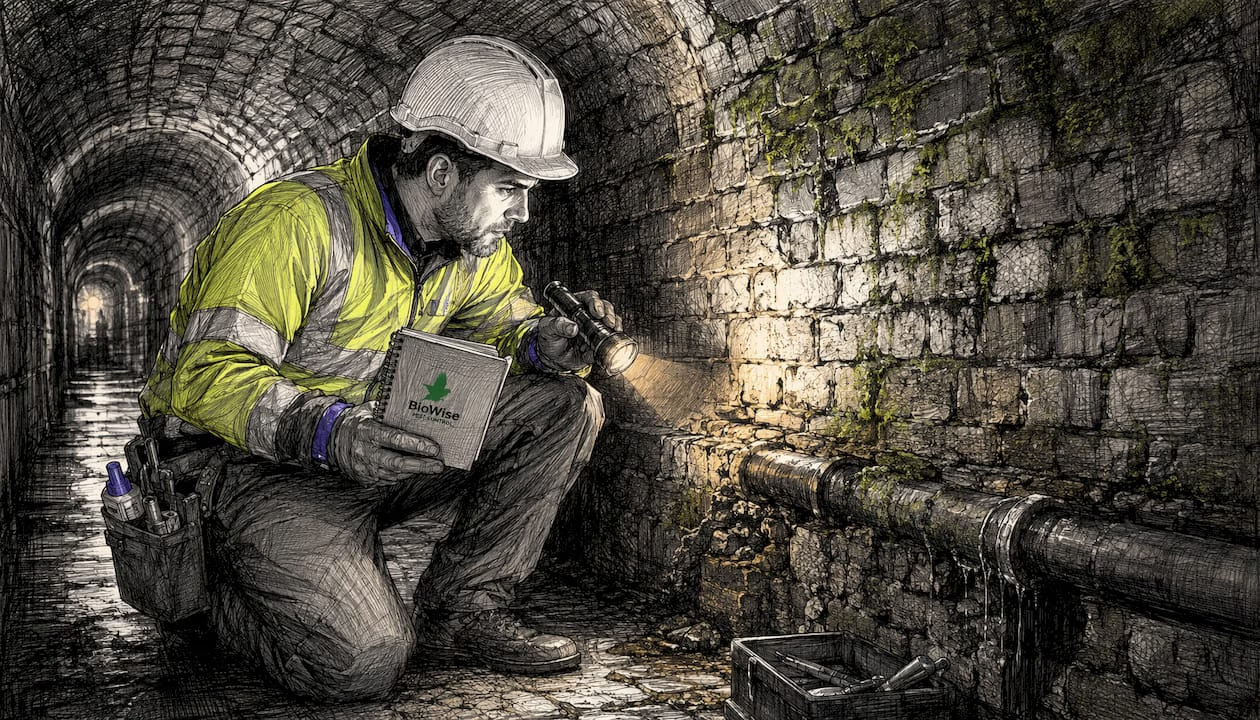
- The sewer network: much of central London’s sewer system dates from the Victorian era. Sewers give rats shelter, water and food, and defects in the older drains connected to them give rats a route into buildings.
- Food waste: restaurants, takeaways and markets produce large amounts of waste, and split bin bags, overflowing bins and street litter provide a steady food supply.
- Older, dense buildings: terraces, mansion blocks and converted commercial buildings have voids, shared walls and service runs that let rats move unseen between properties.
- Construction: excavation, demolition and drain works disturb established colonies and can push rats into neighbouring properties.
- Waterways and green space: the Thames, canals, parks and gardens offer extra cover and food.
Rats also move indoors more in autumn and winter, when food outside is harder to find, which is when many London properties first notice them.
Signs of rats in your property
Rats are mostly active at night, so you are more likely to find what they leave behind than see the rats themselves.
| Sign | What to look for | Where to check |
|---|---|---|
| Droppings | Dark, blunt, capsule-shaped, about 12-18mm long, often in groups | Along walls, behind appliances, in lofts, basements and bin stores |
| Smear marks | Dark, greasy marks where rats brush against surfaces | Skirting boards, pipe runs, joists and around holes |
| Gnawing | Chewed cables, timber, plastic pipes and food packaging | Kitchens, stores, service voids and door bottoms |
| Burrows | Holes in soil with smooth, well-used entrances | Beside walls, under sheds and decking, near drains and compost bins |
| Noises | Scratching, scurrying or gnawing at night | Ceilings, wall cavities and under floors |
| Smell and runs | A musty, ammonia-like smell; flattened tracks through vegetation | Enclosed voids and cupboards, along fences and walls |
Mouse droppings are much smaller, about 3-6mm and pointed, so size is the quickest way to tell the two apart. Our guide to mouse vs rat droppings explains the differences.
How rats get into London buildings
Most rat problems in London start in one of two ways, and the route decides the fix.
From the drains. Rats living in sewers get into buildings through broken pipes, displaced joints, redundant connections that were never capped and damaged inspection chambers. Occasionally they come up through toilets or floor gullies. Repeat activity in basements, kitchens or bathrooms close to drainage is a strong clue. Our guide to rats in drains explains what to do next.
Through the building fabric. Surface rats get in through gaps of about 15mm, roughly the width of a thumb: around pipes and cables, under doors, through damaged air bricks and via holes under decking, sheds and extensions. Once inside, they nest in roof voids, wall cavities, under floors and behind kitchen units. Doors are one of the easiest routes to close, as our guide on how to rodent-proof exterior doors shows.
What to do if you see signs of rats
- Remove food and water: keep bins closed, bag food waste, store food in sealed containers, clear spilt bird seed and do not leave pet food out overnight.
- Record what you find: photographs of droppings, gnawing and holes help a technician find the route quickly.
- Check the obvious routes: look for broken drain covers, gaps around pipes and daylight under doors.
- Do not block holes yet: sealing a hole while rats are inside can trap them in walls or push them into another part of the building.
- Keep children and pets away from affected areas. Clean up with gloves and disinfectant, and do not sweep or vacuum dry droppings.
- Get professional help early: tenants should report rats to their landlord in writing, and food businesses should act the same day, because rats in a food area are a serious hygiene risk.
What professional rat control involves
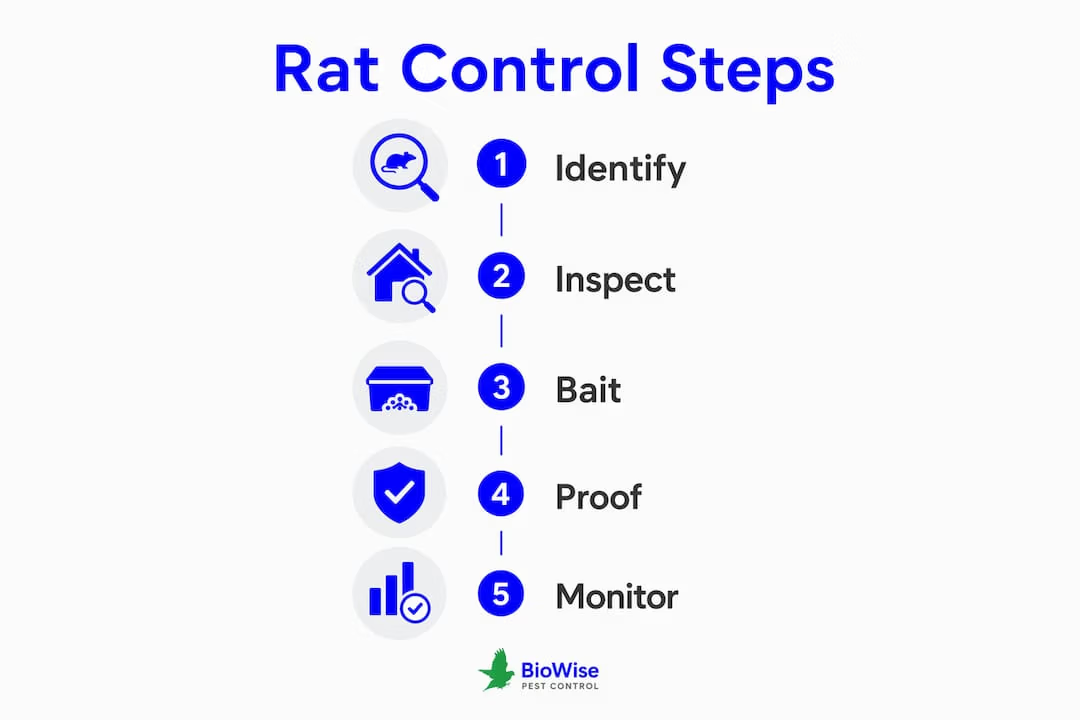
- Survey: a trained technician inspects inside and out to find entry points, runs, nests and the scale of activity.
- Treatment: traps and tamper-resistant bait stations are placed on active runs. Rats are wary of new objects, so placement and patience matter.
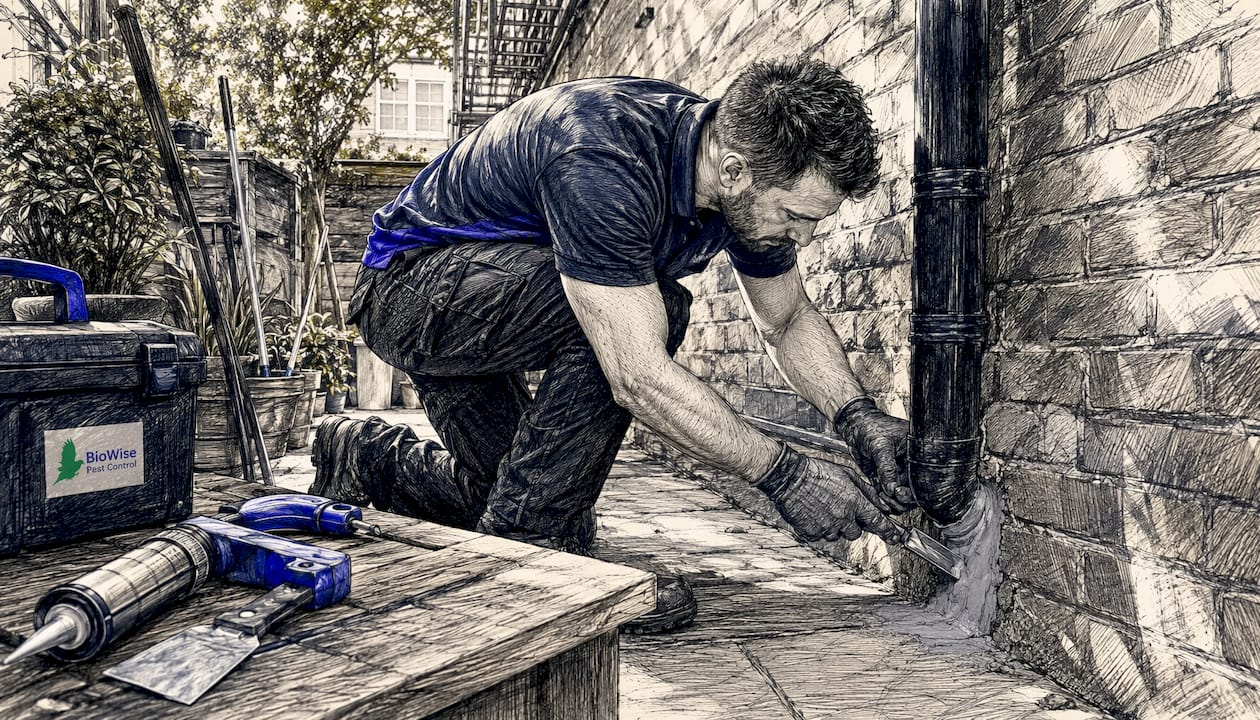
- Proofing: entry points are sealed with steel mesh, mortar, metal plates and bristle strips, and drain defects are repaired or fitted with rat blockers, one-way valves that stop rats coming up the pipe.
- Follow-up visits: the technician checks activity, removes carcasses and bait, and confirms the problem is resolved.
- Records: a written report sets out what was found, what was done and what still needs attention.
When rats keep coming back after treatment, it is usually a drain defect or a gap nobody has found yet. Baiting deals with the rats that are there, but proofing stops the next ones. On most London jobs I spend as much time finding the route in as I do on the treatment itself.
Ben, Lead Technician, BioWise
Why DIY rat control often fails
Shop-bought traps and poisons can deal with an occasional rat outdoors, but they rarely solve an established problem inside a building:
- Rats are wary of new objects and avoid badly placed traps and bait.
- Resistance to some anticoagulant rodenticides is widespread in UK rats, and resistant strains have been recorded in Greater London.
- Poisoned rats can die in wall cavities and under floors, causing odours and flies.
- DIY treatment rarely finds the entry route, so new rats replace the ones removed.
The rules are strict too. Since 1 January 2026, professional rodenticides can only be bought by people who show proof of competence, amateur products come in limited pack sizes and ready-to-use formats, and product labels are legally binding. Our guide to whether rat poison is legal in the UK explains the current rules.
Health risks from rats
Rats spread disease through their urine and droppings and by contaminating surfaces and food.
| Disease | How it spreads | What to know |
|---|---|---|
| Leptospirosis (Weil’s disease) | Infected urine in water or soil getting into cuts, eyes or mouth | Often mild but can be serious. See a GP if you get flu-like symptoms after possible exposure. |
| Salmonella and E. coli | Food and surfaces contaminated by droppings and urine | The main risk in kitchens and food businesses. |
| Seoul hantavirus | Contact with infected rat urine, droppings or saliva | Found occasionally in UK wild rats. UKHSA says the risk to the public is very low. |
| Rat-bite fever | Bites or scratches from infected rats, or contaminated food | Rare. Clean any bite and get medical advice. |
If you feel unwell after contact with rats or their droppings, speak to your GP or call NHS 111.
Who is responsible for dealing with rats?
Responsibility depends on who occupies the property and what caused the problem.
| Situation | Who usually acts | Key law |
|---|---|---|
| Rats on land in substantial numbers | The occupier must notify the council in writing. The council can serve notice requiring treatment or structural work, and can do the work itself and recover the costs. | Prevention of Damage by Pests Act 1949, sections 3 and 4 |
| Rented home with rats linked to disrepair or defects | The landlord, because the home must be fit to live in | Homes (Fitness for Human Habitation) Act 2018; HHSRS under the Housing Act 2004 |
| Rats caused by how a tenant uses the property | Can fall on the tenant, depending on the tenancy agreement | Tenancy agreement |
| Rats in a food business | The food business operator, immediately | Regulation (EC) No 852/2004; Food Safety and Hygiene (England) Regulations 2013 |
| Defective shared drain or lateral drain | Usually the water company, which took over most shared private sewers and lateral drains in October 2011 | Pipes serving only one property within its boundary remain the owner’s responsibility |
Councils also have powers of entry under the 1949 Act, and can act on statutory nuisance under the Environmental Protection Act 1990. In a food business, a serious infestation can lead to a hygiene emergency prohibition notice that closes the premises until the risk is removed. Landlords and managing agents will find more in our guide to pest control in property management.
For managing agents and landlords, the real cost of rats is rarely the treatment itself. It is the repeat call-outs, the complaints and the enforcement risk when the cause is never fixed. On our contracts we record every entry point we find and what was done about it, so there is a clear paper trail if the council or a tenant asks.
Matt Ochello, Sales Executive, BioWise
FAQ
Why are there so many rats in London?
London combines an extensive, ageing sewer network, large volumes of food waste, dense older buildings with shared voids and constant construction that disturbs colonies. Rats also move indoors in autumn and winter, which is when many London properties first notice them.
Can rats come up through the toilet?
It is uncommon but possible, because rats swim well and travel through drainage pipes. It is more likely where a drain is damaged or a connection is uncapped. If it happens, keep the lid down, check other drain points and have the drains surveyed so the defect can be repaired or a rat blocker fitted.
Do I have to tell the council if I have rats?
Under the Prevention of Damage by Pests Act 1949, occupiers of land other than agricultural land must notify the local authority in writing if rats or mice are living on or resorting to their land in substantial numbers. Dealing with the problem promptly through a professional is the practical first step.
Should I call the council or a private pest controller?
Some London councils run a domestic pest control service, often for a fee, and environmental health teams deal with complaints about neighbouring properties. Businesses, landlords and managing agents usually appoint a private contractor, ideally a BPCA member, who can survey, treat, proof and provide written reports.
How long does it take to get rid of rats?
It depends on the size of the problem and how the rats are getting in. Treatment usually involves an initial survey and several follow-up visits until activity stops. Drain-related problems continue until the defect is repaired or a rat blocker is fitted, which is why proofing matters as much as treatment.
How BioWise can help with rats in London
We have dealt with rats in London restaurants, offices, hotels, warehouses, managed blocks and homes since 2010, with same-day call-outs across every London borough, often within hours, and a 24/7 emergency response line. Our BPCA-certified technicians survey inside and out, treat on the first visit where possible, and find and proof the entry route, including drain proofing and rat blockers. Where a drain defect is suspected, we can arrange a CCTV drain survey.
For businesses and property managers, our contracts include a free initial survey, monthly visits with photo reports, digital service reports for audits, emergency call-outs and unlimited minor pest proofing. Visits are discreet and planned around trading hours, with unmarked vehicles on request. BioWise is a BPCA and NPTA member, CHAS accredited and SafeContractor approved.

See our rat control in London, commercial pest control and domestic pest control services, call 0800 988 3568 or contact us to book a visit.
BioWise Pest Control Maintenance
13 Hanover Square, London, W1S 1HN
Call 0800 988 3568 or email info@biowiseservices.com
Sources
- Hantaviruses: guidance – UKHSA, GOV.UK
- Leptospirosis (Weil’s disease) – NHS
- Prevention of Damage by Pests Act 1949 – legislation.gov.uk
- Rattled by rats? Advice sheet – BPCA