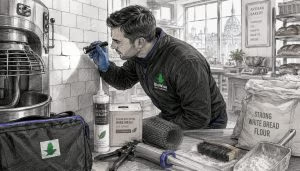


Eco-friendly pest management delivers four core advantages for UK property owners and managers: it protects local ecosystems, reduces chemical exposure risks for occupants and pets, prevents the development of resistant pest populations, and lowers long-term costs through preventative rather than reactive treatment. The gold standard approach underpinning all of this is Integrated Pest Management (IPM), formally endorsed by the UK National Action Plan for Pesticides 2025. The British Pest Control Association (BPCA) reinforces this framing, positioning pest management as a public health function rather than a reactive emergency service. Biowise Pest Control Maintenance Services operates within this framework, applying IPM principles across residential and commercial properties throughout London.
Key benefits at a glance:
- Reduced chemical load on soil, water, and non-target species
- Lower risk of pesticide exposure for occupants, children, and pets
- Prevention of resistance in pest populations
- Alignment with UK regulatory requirements under the Control of Pesticides Regulations 1986
- Long-term cost savings through proactive monitoring and structural prevention
- Support for biodiversity and natural predators such as ladybirds and ground beetles
What is eco-friendly pest management, and how does IPM underpin it?
Eco-friendly pest management is a systematic approach that prioritises prevention, monitoring, and targeted intervention over blanket chemical application. Rather than reaching for a spray at the first sign of activity, it asks why pests are present and addresses the root cause. IPM is the recognised framework for doing this in the UK, combining biological, physical, and limited chemical controls in a sequence that minimises environmental risk.
In practice, IPM for UK properties involves four stages:
- Prevention — proofing entry points, removing harbourage, managing waste storage, and maintaining drainage to make a property less attractive to pests in the first place.
- Monitoring — regular inspections and, where appropriate, trapping or sensor-based detection to establish whether pest activity is present and at what level.
- Threshold assessment — determining whether the level of activity genuinely warrants intervention, rather than treating as a precaution.
- Targeted intervention — applying the least-disruptive method first: physical traps, biological controls such as nematodes for vine weevil, or pheromone lures before considering chemical treatments.
Common eco-friendly techniques used in UK settings include:
- Exclusion proofing with stainless steel mesh and door brushes
- Pheromone monitoring traps for stored-product insects
- Nematode applications for soil-dwelling larvae
- Habitat management to support natural predators
- Precision spot treatments where chemical use cannot be avoided
The UK government’s IPM guidance describes IPM as a holistic, data-driven strategy requiring infrastructure improvements and evidence-based decision-making. Treating it as a one-off service rather than an ongoing commitment is the most common reason it underperforms.
How eco-friendly pest control protects health and the environment
The environmental case for sustainable pest control is well-evidenced. Pesticides negatively affected 70.5% of biodiversity measures for soil invertebrates in reviewed studies, according to the UK National Action Plan for Pesticides 2025. Switching to IPM reverses much of that pressure by protecting non-target species, including pollinators, ground beetles, and spiders that naturally suppress pest populations.
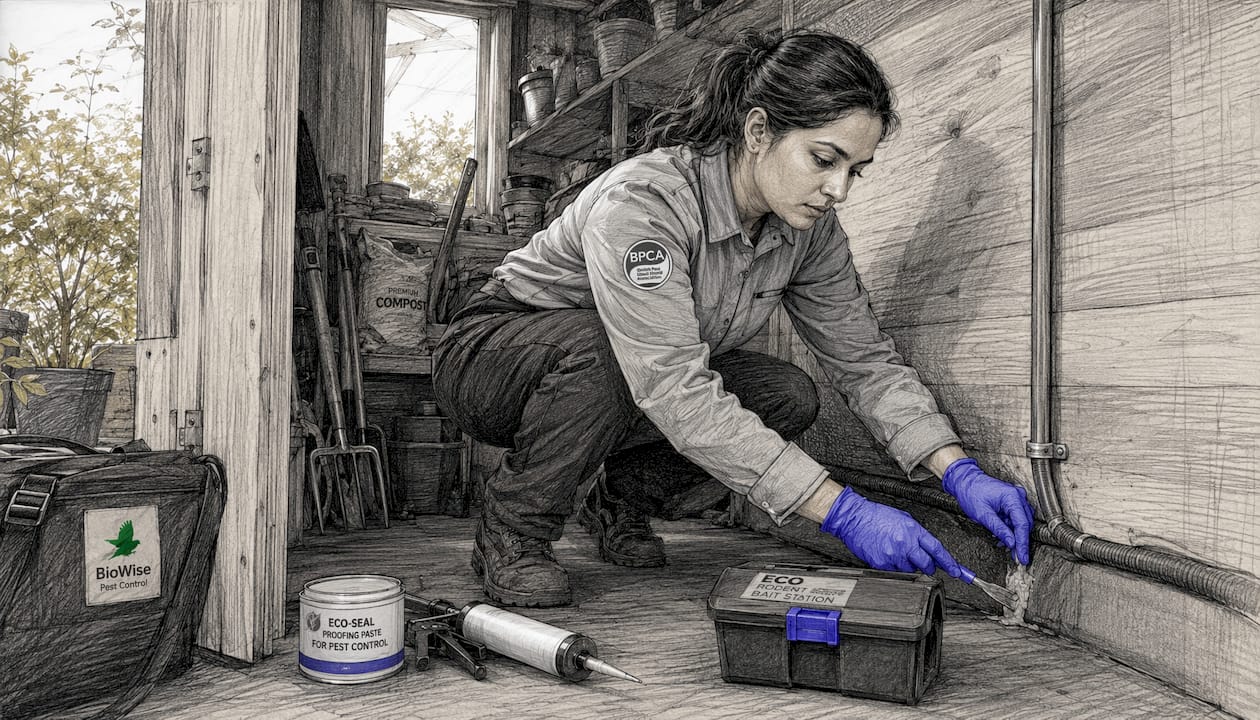
For property occupants, the health benefits are equally direct. Conventional pesticide residues can persist on surfaces, in soft furnishings, and in ventilation systems, posing particular risks to children and pets. Eco-friendly methods eliminate or sharply reduce this exposure. Overuse of broad-spectrum chemicals also drives resistance development, creating pest populations that are harder and more expensive to control over time. IPM disrupts pest lifecycles through varied methods, reducing the selection pressure that produces resistant strains.
From a biodiversity standpoint, encouraging natural predators through habitat management, such as flower-rich margins near commercial premises or green roofs on urban buildings, delivers measurable gains. IPM practices including field margins and natural predator encouragement have a documented positive impact on species abundance in UK environments.
Practical steps for UK property owners adopting eco-friendly methods
Adopting green pest management does not require a complete overhaul of your current arrangements. The most effective starting point is integrating pest control into routine property maintenance rather than treating it as a separate emergency service. The BPCA stresses precisely this point: proactive, scheduled management consistently outperforms reactive call-outs.
Pro Tip: Schedule a structural pest audit at least once a year, ideally before autumn when rodents begin seeking warmth indoors. Identifying and sealing entry points at this stage costs a fraction of what a full rodent treatment requires later.
A practical checklist for UK property managers:
- Seal gaps around pipework, cables, and airbricks with appropriate materials
- Fit door brushes and bristle strips to external doors
- Review waste storage and bin areas for harbourage opportunities
- Establish a monitoring log to track pest activity over time
- Consult your pest-proofing checklist before commissioning any treatment
On the compliance side, the Control of Pesticides Regulations 1986 requires that any pesticide used in a commercial context must be applied strictly in accordance with label instructions, and only by a competent person. Documentation of treatments and label adherence is not optional. For property managers overseeing multiple sites, working with a BPCA-assessed contractor provides assurance: members are audited to BS EN 16636 and carry a minimum of £2 million public liability insurance.
Cost is a common concern, but the economics favour prevention. Reactive treatments for established infestations, particularly rodents or bed bugs in multi-occupancy buildings, routinely cost several times more than a structured maintenance programme. Precision application technologies, including spot treatments and targeted bait stations, also reduce the volume of product used, cutting both material costs and environmental impact.
Why Biowise Pest Control Maintenance Services is the right partner in London
Biowise Pest Control Maintenance Services has been delivering eco-conscious pest management across London since 2010, building a client base of over 600 properties spanning residential homes, restaurants, hotels, and commercial offices. That breadth of experience matters: pest pressures in a Victorian terraced house in Peckham differ substantially from those in a commercial kitchen in Chelsea, and the approach needs to reflect that.
Every technician at Biowise Pest Control Maintenance Services is fully qualified and operates within the BPCA framework, applying IPM principles as standard rather than as an optional upgrade. Plans are tailored to the specific pest pressures, building type, and occupancy profile of each property, with regular pest control maintenance built into the service rather than bolted on after a problem emerges.
Biowise Pest Control Maintenance Services: eco-friendly pest control for London properties
Property owners and managers who want fewer chemical treatments, lower long-term costs, and genuine compliance with UK pest control regulations will find that Biowise Pest Control Maintenance Services delivers all three. Unlike a one-off treatment provider, Biowise Pest Control Maintenance Services structures its service around ongoing monitoring and prevention, which means infestations are caught early and structural vulnerabilities are addressed before they become expensive problems.

Whether you manage a single residential property or a portfolio of commercial sites, Biowise Pest Control Maintenance Services offers tailored domestic pest control and commercial pest control programmes built on IPM principles. Contact Biowise Pest Control Maintenance Services today to arrange a site assessment and receive a no-obligation quote for a maintenance plan suited to your property.
Key takeaways
Eco-friendly pest management, delivered through IPM, protects biodiversity, reduces chemical exposure, prevents resistance, and cuts long-term costs for UK property owners and managers.
| Point | Details |
|---|---|
| IPM is the UK gold standard | The UK National Action Plan for Pesticides 2025 endorses IPM as the primary sustainable pest control framework. |
| Biodiversity impact is measurable | Pesticides negatively affected 70.5% of biodiversity measures for soil invertebrates in reviewed studies. |
| Compliance is non-negotiable | The Control of Pesticides Regulations 1986 requires label adherence and competent application in all commercial settings. |
| Prevention beats reaction on cost | Structural proofing and routine monitoring consistently cost less than treating an established infestation. |
| Biowise Pest Control Maintenance Services | Delivers IPM-based maintenance plans for London residential and commercial properties, with BPCA-aligned technicians. |
FAQ
What is eco-friendly pest control?
Eco-friendly pest control uses prevention, monitoring, and targeted intervention to manage pests with minimal chemical use. Integrated Pest Management (IPM) is the recognised framework for this approach in the UK.
Does eco-friendly pest management actually work against serious infestations?
Yes. IPM combines biological controls, physical exclusion, and precision chemical application when necessary, making it effective against established infestations while reducing environmental impact.
Is eco-friendly pest control more expensive than conventional treatment?
Proactive IPM programmes typically cost less over time than repeated reactive treatments, particularly for rodent or insect infestations in commercial or multi-occupancy properties.
What regulations govern pest control in the UK?
The Control of Pesticides Regulations 1986 requires that pesticides are applied by a competent person, strictly to label instructions. BPCA membership provides additional assurance through BS EN 16636 auditing and a minimum of £2 million liability insurance.
Can Biowise Pest Control Maintenance Services handle both residential and commercial properties?
Yes. Biowise Pest Control Maintenance Services has managed eco-friendly pest solutions for over 600 London properties since 2010, covering homes, restaurants, hotels, and offices with tailored IPM-based plans.