

TL;DR:
- Rapid restaurant closures in London result from inadequate pest control workflows and documentation.
- Compliance involves accredited providers, thorough records, and proactive building preparations.
- Staff engagement and expert support are essential for effective, sustainable pest management in high-risk environments.
A single visit from a council environmental health officer can shut down a Central London restaurant within hours. That is not a rare occurrence. When pest evidence is found during a routine inspection, whether it is rodent droppings near food prep surfaces or cockroach activity behind kitchen equipment, the consequences range from immediate closure notices to substantial fines and permanent reputational damage. For hospitality and commercial operators across London, the difference between a swift resolution and a business-threatening incident often comes down to whether a well-designed pest control workflow is already in place and consistently followed.
Key Takeaways
| Point | Details |
|---|---|
| Compliance is non-negotiable | Using accredited providers and maintaining records is essential to avoid costly penalties. |
| Preparation prevents problems | Thorough building assessments and staff training dramatically enhance pest prevention. |
| Routine monitoring is vital | Frequent checks and precise reporting keep your business safe from infestations and legal risk. |
| Culture change beats checklists | Staff engagement and leadership commitment are critical to maintaining effective pest control. |
Understanding legal and compliance essentials
Compliance is not simply a box-ticking exercise. In London, pest control obligations are woven into food hygiene law, health and safety legislation, and the conditions attached to operating licences. The Food Safety Act 1990 and associated regulations require food businesses to take all reasonable precautions against contamination, and pest activity constitutes a direct breach. Local authorities enforce these obligations vigorously, and environmental health officers carry the authority to issue improvement notices, hygiene emergency prohibition orders, and prosecution proceedings.
For businesses operating in hospitality, healthcare, or food retail, the stakes are particularly high. A single rodent complaint posted publicly can spread across review platforms within hours, eroding customer trust that took years to build. Working through a compliance guide tailored to London’s regulatory landscape helps operators understand exactly what they are legally required to maintain.
The legal requirements for commercial kitchens include specific obligations around pest monitoring, treatment records, and corrective action documentation. These requirements are not advisory. They form part of the audit evidence that environmental health officers review when assessing a business’s food safety management system.
The New BPCA Codes of Best Practice recommend choosing BPCA or NPTA accredited providers to ensure compliance, trained technicians holding RSPH Level 2 qualifications, adequate insurance, and full adherence to Integrated Pest Management (IPM) principles. IPM prioritises prevention and monitoring over repeated chemical application, reducing environmental impact while achieving long-term pest suppression.
Key compliance requirements to address include:
- Using accredited pest control contractors with verifiable RSPH Level 2 or higher qualifications
- Maintaining dated, signed service reports for every visit and every treatment
- Keeping a pest activity log accessible for audit review at any time
- Ensuring corrective actions are documented with timescales and sign-off
- Meeting certification requirements that apply to your specific business category
“Businesses that maintain thorough, auditable pest control records are far better positioned to demonstrate due diligence during an inspection. The absence of documentation is treated as the absence of control.”
Treating compliance as the foundation of your workflow, rather than an afterthought, protects your operating licence, your staff, and your customers.
Preparing your building for effective pest control
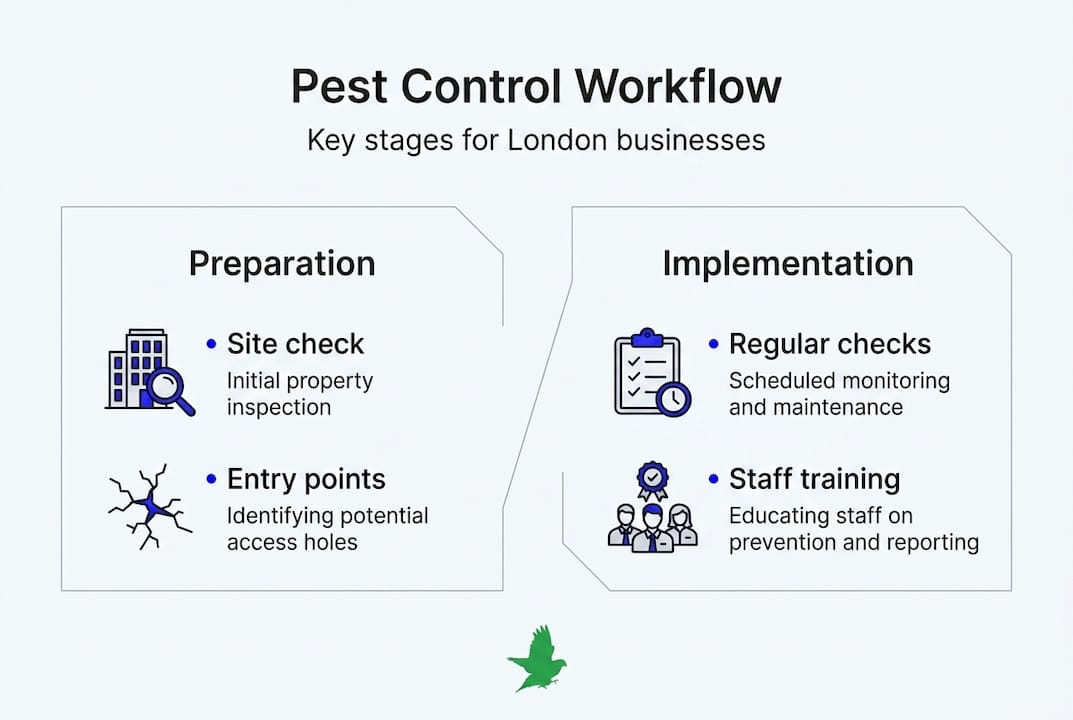
Legal knowledge alone does not protect your premises. Before any pest control programme can function effectively, your physical environment must be assessed and prepared. A structured site assessment identifies the conditions that make a property vulnerable, enabling targeted interventions rather than generalised reactive treatments.
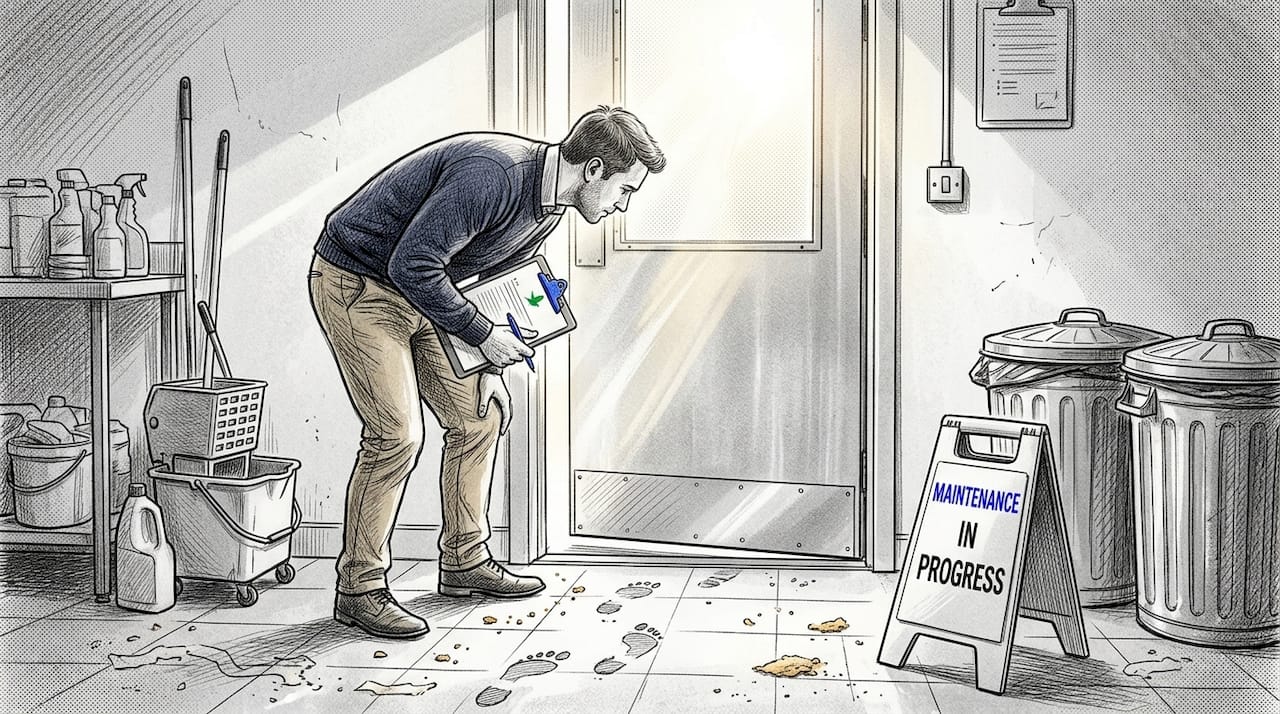
Site assessments typically examine entry points such as gaps around pipework, poorly sealed doors, drainage access, and roof voids. High-risk hot spots include refuse storage areas, delivery bays, staff break rooms, and food storage zones. A thorough assessment also considers external factors specific to London, such as proximity to the Thames, active construction sites nearby, or adjacency to food waste collection points, all of which elevate the risk of rodent pressure.
Understanding pest proofing options is an important preparation step. Structural proofing, such as installing stainless steel mesh over drainage openings and fitting door brush strips, provides ongoing passive defence that chemical treatments alone cannot replicate.
| Approach | Advantages | Limitations |
|---|---|---|
| Prevention first | Reduces long-term infestations, lower chemical use, cost-effective over time | Requires upfront investment and structural works |
| Reactive only | Addresses active problems quickly | Does not stop re-infestation, higher treatment frequency |
| Combined approach | Balances speed of response with sustained control | Requires coordination between proofing and treatment schedules |
The combined approach is consistently the most effective in London’s dense urban environment, where pest pressure is ongoing rather than seasonal. Prevention strategies for restaurants should form a core part of every hospitality operator’s workflow from day one.
Before scheduling a pest control visit, ensure the following preparations are made:
- Clear access to all service areas, including beneath equipment, inside cupboards, and around drainage
- Secure all loose food items and empty waste bins in affected zones
- Brief kitchen or facilities staff on the scheduled visit to avoid disruption
- Flag any areas of recent sightings or unusual activity to the technician in advance
- Review the previous service report to identify any outstanding corrective actions
Staff education is arguably the most undervalued preparation step. Your team are the first line of observation. Training them to recognise early warning signs, gnaw marks, grease trails along skirting boards, droppings near food storage, and to report these through a clear internal channel dramatically shortens the response time when activity begins.
Pro Tip: Laminate a simple pest sighting report sheet and post it inside delivery bays, bin stores, and staff rooms. A ten-second written note from a porter or kitchen hand could trigger a preventive visit before an infestation takes hold.
Good groundwork on a pest-free workspace makes every subsequent treatment more effective and significantly extends the period between active interventions.
Designing and implementing your pest control workflow
A workflow is only as strong as its structure. Vague intentions about “having someone check” periodically are not workflows. Effective commercial pest control requires clearly assigned responsibilities, scheduled activity, documented outputs, and a formal review cycle.
Follow these steps to build a workflow that holds up under audit conditions and delivers consistent results:
- Appoint a designated pest control lead. This is the individual responsible for scheduling visits, receiving reports, filing documentation, and escalating any identified risks to management. In smaller operations this may be the manager. In larger venues, it is typically the facilities or health and safety officer.
- Select an accredited pest control provider. Use the BPCA member directory or equivalent to verify credentials. Confirm that technicians hold RSPH Level 2 qualifications as part of your contractual agreement. The BPCA Codes of Best Practice provide a clear framework for what accredited service should include. Tips on choosing a pest control partner can help you evaluate providers objectively.
- Set a visit schedule appropriate to your risk profile. High-risk environments such as restaurant kitchens, hotel food storage areas, or food manufacturing sites warrant monthly inspections. Lower-risk commercial offices may operate on a quarterly schedule.
- Create a documentation system. Whether digital or paper-based, every inspection and treatment must generate a dated, signed record. This record should note findings, actions taken, and any outstanding recommendations.
- Build in a formal review. Schedule a quarterly review of all pest control activity, corrective actions completed, and any emerging trends. Adjust the visit schedule or scope of treatment if patterns indicate increased risk.
| Task | Frequency | Responsible role | Record type |
|---|---|---|---|
| Site inspection | Monthly or quarterly | Pest control technician | Signed inspection report |
| Pest activity log update | Ongoing | Pest control lead | Activity log entry |
| Corrective action review | After each visit | Facilities manager | Action completion sign-off |
| Staff awareness briefing | Quarterly | Health and safety lead | Attendance record |
| Full workflow audit | Annually | Senior management | Audit summary report |
Clear communication between your pest control provider and your internal team is critical. Industrial workflow strategies highlight that the businesses with the strongest compliance records are those where the contractor and the facilities team share information consistently, not just during a scheduled visit.
Pro Tip: Integrate your pest control workflow into your existing business management or facilities software. Scheduling inspections alongside equipment maintenance checks, fire alarm tests, and deep cleaning programmes reduces the risk of visits being overlooked during busy operational periods.
Monitoring, reporting, and continuous improvement
Implementing a workflow is only the beginning. The real measure of its effectiveness lies in what you track, how you report it, and what you change when results do not meet expectations. Monitoring transforms a passive schedule into an active management system.
Key metrics every commercial operator should track include:
- Number of pest sightings recorded per week or month, broken down by area
- Frequency of corrective actions required following each inspection
- Time taken to complete corrective actions from identification to resolution
- Number of re-infestation incidents within a given period
- Technician recommendations outstanding or unactioned
These figures tell a clear story over time. A rising sightings count in a specific area signals a structural vulnerability or a sanitation gap that needs addressing. A long lag between identification and corrective action resolution indicates a process failure, not a pest control failure.
Pest control reporting and compliance audits should follow a structured format that makes the data easy to review, whether internally or by an environmental health officer. Reports should include the date of visit, technician name and qualification, findings by area, treatments applied, materials used and quantities, and any follow-up actions required with suggested timescales.
“Regulatory authorities may audit your premises at any time, with or without prior notice. Your pest control documentation must be complete, current, and accessible within minutes of a request.”
Continuous improvement is the element that most businesses neglect. Reviewing records at the end of each quarter to identify patterns, adjusting visit frequency in response to seasonal pressure (London sees a marked rise in rodent activity from October through February), and updating staff training materials in response to new findings are all signs of a mature pest management culture.
An annual review of your entire workflow, including provider performance, documentation quality, and staff engagement levels, ensures the system remains relevant to your current operating environment. Businesses expand, premises change, and pest pressure evolves. Your workflow must evolve with it.
The overlooked truth about pest control workflows in London
Having worked with restaurants, hotels, and commercial properties across London since 2010, we have noticed a consistent pattern. The businesses that experience repeated pest problems are rarely those with inferior contractors or inadequate treatment products. They are the businesses where the workflow exists on paper but has never been embedded into daily operations.
A checklist on a wall is not a workflow. A contract with an accredited provider is not a workflow. A workflow is a living system, maintained by people who understand why it matters and have the confidence to act when something is wrong.
This is where most operators focus too much on the visible tools, the bait stations, the monitoring units, the service reports, and too little on the human layer underneath. Staff who are not engaged, who do not know what to look for or how to report it, create blind spots that no amount of sophisticated technology can compensate for.
Leadership sets the standard here. When a general manager or head of operations treats pest control documentation as a genuine business priority rather than a regulatory obligation, that attitude filters through the team. Briefings get taken seriously. Sightings get reported promptly. Corrective actions get completed on schedule. The value of contract pest control services for hospitality businesses is not simply about routine visits. It is about having an external expert who consistently reinforces the importance of the process to your whole team.
The businesses that maintain outstanding compliance records are not necessarily the ones spending the most on pest control. They are the ones where management has made pest awareness part of the culture, not just part of the contractor’s remit.
Optimise your workflow with expert support
Building a pest control workflow from the ground up takes time, expertise, and ongoing commitment. For many London operators managing multiple priorities, partnering with an experienced specialist removes the uncertainty and reduces the risk of gaps appearing in your compliance record.
At BioWise Pest Control Services, we have supported over 600 London businesses since 2010, providing commercial pest control solutions tailored to the specific risk profile and operational demands of each site. Whether you run a busy restaurant that needs monthly kitchen inspections or a multi-site hotel group requiring a standardised reporting framework, our fully qualified technicians deliver consistent, auditable service every visit. Our professional pest control for restaurants and long-term pest control contracts are designed to give you continuous compliance confidence, so your team can focus on the business rather than the paperwork. Get in touch today for a tailored assessment of your current workflow.
Frequently asked questions
What are the key compliance standards for pest control in London businesses?
Key standards include using BPCA/NPTA accredited providers, ensuring technicians hold RSPH Level 2 qualifications, maintaining adequate insurance, practising Integrated Pest Management, and keeping accurate, auditable pest control records.
How often should workplace pest control checks take place?
At minimum, quarterly checks are recommended for lower-risk commercial properties, though monthly inspections are advisable for high-risk hospitality environments such as restaurant kitchens and hotel food storage areas.
Who is responsible for pest control documentation in commercial properties?
The designated facilities manager or business owner typically holds responsibility for maintaining complete, current, and accessible pest control records in a commercial setting.
What should a pest control workflow include to be effective?
A robust workflow covers regular scheduled inspections, clearly defined role responsibilities, accurate and dated recordkeeping, prompt corrective actions with sign-off, and a formal quarterly or annual review process.
Why is staff engagement crucial for pest control success?
Staff are the first to notice early warning signs such as droppings, gnaw marks, or unusual odours, so their active participation ensures issues are reported promptly, protocols are followed consistently, and long-term prevention is achieved.