A family-run pest control firm suits London businesses because someone with their name on the company answers for the work, the same technicians usually return to your site, and they know how London buildings behave: old kitchens, shared bin stores, basements, flat roofs and Victorian drains. For a restaurant, hotel, office or housing block, that continuity matters more than a logo, because pest control is a long relationship, not a single visit. Below we rank BioWise first, for reasons we set out openly, then describe four other kinds of owner-led London firm, compare them in one table and show you how to verify a “family-run” claim yourself.
Key takeaways
- Owner accountability, the same technicians each visit and local knowledge are the three real advantages of a family-run firm. Check each one rather than assuming it.
- Under UK law the duty to keep premises pest-free stays with you as the proprietor, whoever you hire, so choose a contractor you can hold to a written specification.
- Membership of the British Pest Control Association (BPCA) can be checked online in a minute. Do it before signing anything.
- “Family-run” is a claim, not a certification. Companies House, the company’s own team pages and a direct question about who attends your site will tell you whether it is true.
Why a family-run firm suits London businesses
Large national operators have scale. Family-run firms offer something different, and for a single-site or small multi-site London operator it is often what you need.
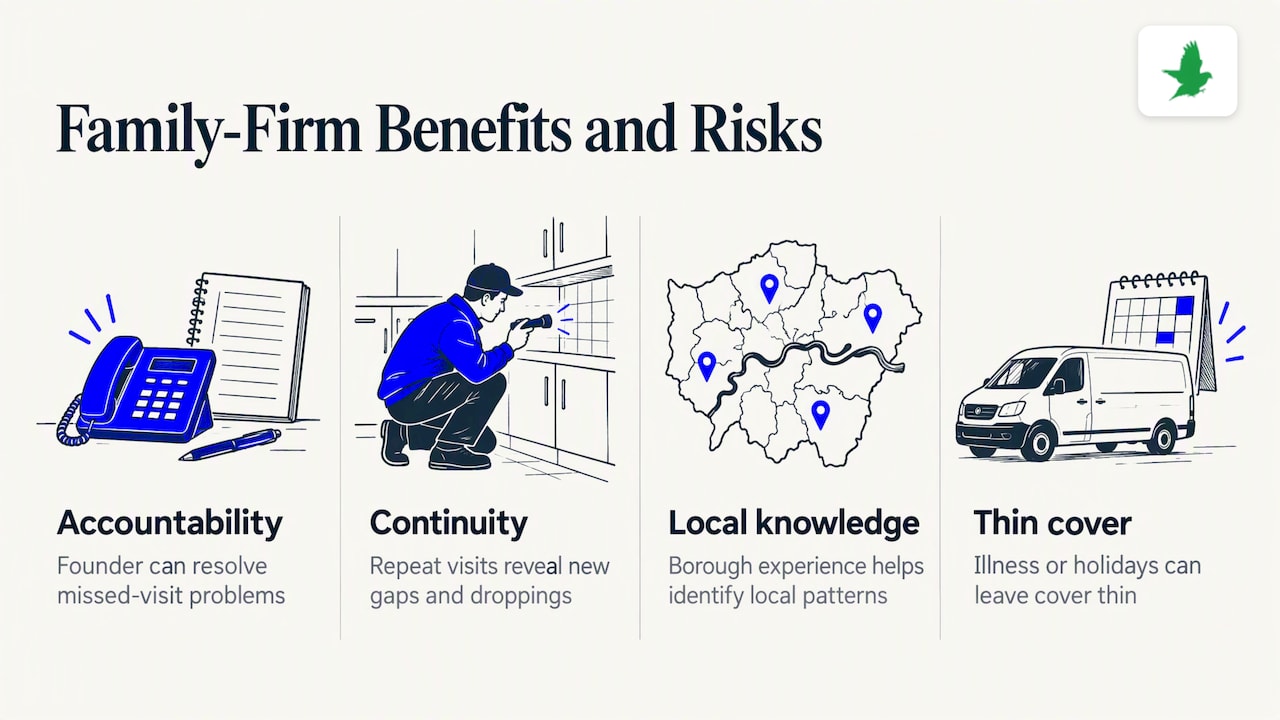
Owner accountability. When the person who founded the company is also the person you can phone about a missed visit, problems get resolved rather than ticketed. The reputation at stake is a family’s, not a regional manager’s quarterly target.
The same technicians each visit. A technician who has seen your kitchen three times notices what has changed: a new gap behind a fridge, a skip moved closer to the door, droppings in a spot that was clean last month. Pest control relies on small observations over time, and continuity makes them possible. Always ask a firm how it handles this, because no firm can promise it for ever.
Local knowledge. London pest pressure is not uniform. A restaurant in the West End shares walls and waste routes with neighbours, a Peckham mixed-use block has different access points from a Stratford office, and the City has its own mix of older buildings and new fit-outs. A firm that works in your borough every week already knows the patterns.
None of this makes a family firm automatically better. Some are small enough that cover during illness or holidays is thin, and some use “family” as a marketing word. That is why the verification section later in this article matters.
What the law expects of you, whoever you hire
Before comparing firms, be clear about what you are buying. The British Pest Control Association’s commercial guidance explains that food business proprietors have a statutory duty to keep premises free from pests and to demonstrate due diligence, under the Food Safety Act 1990, the Food Hygiene (England) Regulations 2013 and the Prevention of Damage by Pests Act 1949. The Food Standards Agency likewise expects premises to allow good hygiene practice, including protection against contamination and pest control.
Two practical consequences follow:
- Hiring a contractor does not hand the responsibility over. The BPCA’s position is that due diligence is ongoing, so you need to manage the relationship actively.
- Your contract should be specific. It should state which areas are covered (including non-food rooms, which can give pests harbourage and routes in), how often visits happen and what reporting you receive.
If you run a kitchen, our guide to legal pest control requirements for London commercial kitchens goes deeper, and our page on food business pest control in London shows how a compliant programme is structured. If your technicians use rodenticides or insecticides on site, see also our COSHH guide for London businesses.
How we chose and ranked the five
The owner-led firms in London vary widely, so we compare them on criteria that affect a business manager rather than on star ratings, which are hard to compare across platforms. The criteria are: who owns and runs the firm, whether it is a BPCA member, how it handles emergencies, the depth of commercial experience, and the method (prevention, monitoring or treatment only).
We have placed BioWise first. That is our own firm, so treat the ranking as our view and check the facts below. For the other four we describe types of independent firm rather than naming businesses, because the right independent for you depends on your borough and your premises. You can search BPCA’s member database for named options near you.
1. BioWise Pest Control: family-run since 2010
BioWise was founded in 2010 by Ana and Erviol and remains a family-run London company. We were named Most Trustworthy Family-Run Pest Control Enterprise, South East England 2024, and we are members of the BPCA and the NPTA. We work with more than 600 London clients across restaurants, hotels, offices, homes and housing associations, and our Google review score is 4.9.
What that looks like in practice:
- Commercial contracts. Commercial pest control plans start from £100 per quarter, with individual visits from £60 one-off. Your actual quote depends on premises, pest pressure and visit frequency.
- Emergency cover. We offer 24/7 emergency pest control in London for the infestation that appears on a Friday night before a busy weekend.
- Pest proofing. We favour eco-conscious proofing, which stops pests getting in, over repeated treatment alone. Our comparison of pest proofing and chemical pest control explains when each is right.
- Pests covered. Mice, rats, cockroaches, ants, bed bugs and pigeons are all part of our service, and we also treat homes through domestic pest control.
- One supplier for the building. We also provide building maintenance and commercial cleaning, which helps facilities teams who want fewer contractors.
Best for: restaurants, hotels, offices and housing associations that want one accountable family firm for pest control, with the option of maintenance and cleaning from the same team.
2. The East London family firm with wide reach
Several independent owner-run companies are based in East London and cover neighbouring areas too, often advertising seven-day availability across East and North London and into Essex. Their appeal is geographic: a van is usually close to a site in Hackney, Newham or Tower Hamlets.
Best for: businesses in East London that want fast local attendance. Ask whether the firm holds BPCA membership and whether commercial contracts, not just domestic call-outs, are a regular part of its work.
3. The Fulham-style firm with a walk-in office
Some family firms run from a physical office with a team you can meet. This is an unusually strong signal of accountability, because a business with a visible address, and staff on the premises, is easier to hold to account than a call centre. Check the address on the company’s registration and the team pages for named people.
Best for: owner-managers who value a face-to-face meeting to agree a written specification before the first visit.
4. The South East London specialist with bird-proofing roots
Some owner-led London firms grew from a particular specialism, such as bird proofing, and added general pest control later. Where a firm has installed bird deterrents on commercial buildings for years, it often brings real working-at-height and building-fabric knowledge, which matters for gulls and pigeons on roofs, ledges and signage.

Best for: buildings with persistent bird problems or complex roofs. Check that the same firm is equally strong on rodents and insects if your issue is inside the building.
5. The monitoring-led family firm
Some family-owned companies lead on technology. The BPCA has published a case study on technology at the heart of a pest control company, in which directors of family-run firms describe how 24/7 digital rodent monitoring gives real-time data, which is especially useful for sensitive sites such as food-handling facilities where prevention beats reaction.
Best for: larger or higher-risk sites, such as food production, historic buildings and multi-room hospitality venues, where remote monitoring adds evidence for your audits.
Comparison table
| Option | Best for | Family-run angle | Check before you sign |
|---|---|---|---|
| 1. BioWise Pest Control | London restaurants, hotels, offices, housing associations | Founded 2010 by Ana and Erviol; BPCA and NPTA member | Written scope, visit frequency and reporting in your quote |
| 2. East London family firm | East and North London sites needing quick attendance | Local owner-operators, often seven-day availability | BPCA membership; commercial contract experience |
| 3. Walk-in office firm | Owners who want to meet the team | Visible office, named staff | Registered address matches the website; who attends |
| 4. Bird-proofing specialist | Roofs, ledges, signage, pigeons and gulls | Trade-rooted owner-led business | Strength on rodents and insects too |
| 5. Monitoring-led firm | Higher-risk or audited sites | Directors involved in the technology | Who reads the data and how reports reach you |
Perspective: why we built BioWise as a family firm
We started BioWise in 2010 because London businesses told us the same thing: they did not know who would turn up, and they could not reach anyone who owned the problem. A pest contract is only as good as the attention it gets between visits, so we built the company around consistency. Where we can, the same technicians return to the same sites. When something goes wrong, the people who founded the company are the people you speak to.
Our view is that the best pest control is quiet. It looks like regular visits, a clear written scope, proofing that closes the gaps pests use, and reports that make sense to an environmental health officer. Emergencies still happen in a city this dense, which is why we cover them around the clock, but a well-run contract should make them rare.
We would also say this to any manager comparing us with another family firm: ask the same questions of everyone, including us. Check the membership, ask who will attend, read the scope line by line. A good family business is glad to be checked.
— Anna Hasula
How to check a firm is really family-run
A family-run label costs nothing to print. Use these five checks, in order.
- Check BPCA membership. The BPCA’s member checker confirms whether a firm is a member. According to the BPCA, members are audited, qualified and held to its codes of best practice, and you can also use its Find a Pest Controller search to see members near you.
- Look up the company. The government’s Find and update company information service makes company records free to search. See who the directors are and whether they match the names on the website. Family firms often have two or more directors sharing a surname, though not always.
- Look for named people. Team pages, vehicle signage and quotes should carry real names. If the website shows only stock photos and a phone line, ask why.
- Ask who will attend. A genuine owner-led firm can tell you who your technician will be, how it covers absence and who you escalate to. Vague answers are a warning sign.
- Ask about ownership if the firm has grown. Family firms are sometimes acquired and keep the name. Ask directly whether the company is still independently owned.
A firm that passes all five has earned its description. One that resists the questions has not.
What to put in the contract
Whichever firm you choose, take the BPCA’s advice on specification seriously. Its guidance for food businesses recommends specifying that contractors have appropriate professional standing, and membership of the BPCA is one way of doing that. Your written scope should cover:
- every area of the premises, including stores, offices, plant rooms and bin areas, not only the kitchen;
- the number of visits per year and what triggers an extra visit;
- the reports you will receive after each visit, and who receives them;
- what happens in an emergency, and who you ring;
- the proofing recommendations the firm will make and who carries them out.
Our article on what emergency pest response contracts must include is useful for facilities managers, and commercial pest control pricing in London explains what drives a quote up or down.
Local authorities can also act. Under the Prevention of Damage by Pests Act 1949 a council can require owners or occupiers to deal with rodent infestations, but as one council’s guidance on rats makes clear, that does not mean the council will carry out the treatment, and relying on an outside firm does not remove your own responsibility.
Book a London commercial pest control plan
If you manage a restaurant, hotel, office or residential block in London, we can set up a written commercial plan with regular visits, reports and 24/7 emergency cover. See our commercial pest control plans, from £100 per quarter, or contact us through the quote form on the page for a specification suited to your site.
Frequently asked questions
Is a family-run pest control firm better than a national company?
Not automatically, but it often suits a single-site or small multi-site London business that values continuity and direct access to the owner. National firms may suit large estates across many regions. Judge either on BPCA membership, a clear written scope and who actually attends.
How do I know a pest control firm is trustworthy?
Start with the BPCA’s member checker, which confirms membership. BPCA says members are audited against British Standard EN16636 and carry public liability insurance of at least £2 million, as set out on its member check page. Then ask about technicians, reporting and emergency cover.
Who is responsible if pests are found in my restaurant?
You are, as the food business proprietor. The BPCA’s commercial guidance says you must demonstrate due diligence, and using a contractor does not remove that duty. A written contract and records of visits are your evidence.
How much does commercial pest control cost in London?
At BioWise, commercial plans start from £100 per quarter and individual visits from £60 one-off. The final price depends on the size of the premises, the pests involved and the visit frequency, so we quote after understanding your site.
Sources
- BPCA: commercial pest advice
- Food Standards Agency: setting up your food business premises
- BPCA: check a member
- BPCA: Find a Pest Controller
- BPCA: technology at the heart of a pest control company
- BPCA: pest control procedures in the food industry
- Companies House: Find and update company information
- Nuneaton and Bedworth Borough Council: rats guidance