

TL;DR:
- Ant infestations in London commercial kitchens mainly involve black garden, ghost, and Pharaoh ants, each requiring different control methods. Proper identification is vital because mistaking species can lead to ineffective treatment and worsened infestations, especially with Pharaoh ants that need gel bait programs instead of sprays. Implementing integrated pest management, thorough documentation, and structural proofing help ensure food safety and compliance with environmental health standards.
An ant infestation in a commercial kitchen is defined as the presence of ant colonies actively foraging in food preparation, storage, or service areas, posing direct risks to food safety and regulatory compliance. In London, three species drive the majority of commercial kitchen pest issues: the black garden ant (Lasius niger), the ghost ant (Tapinoma melanocephalum), and the pharaoh ant (Monomorium pharaonis). Each requires a different control approach, and misidentifying the species is one of the most costly mistakes a kitchen manager can make. Effective pest management London operators rely on sits within an Integrated Pest Management framework, aligned to HACCP requirements and the expectations of Environmental Health Officers.
Which ant species infest commercial kitchens in London?
Correct species identification is the foundation of effective ant control in any commercial kitchen. Treating the wrong species with the wrong method wastes time, money, and can actively worsen the problem.
Black garden ant (Lasius niger)
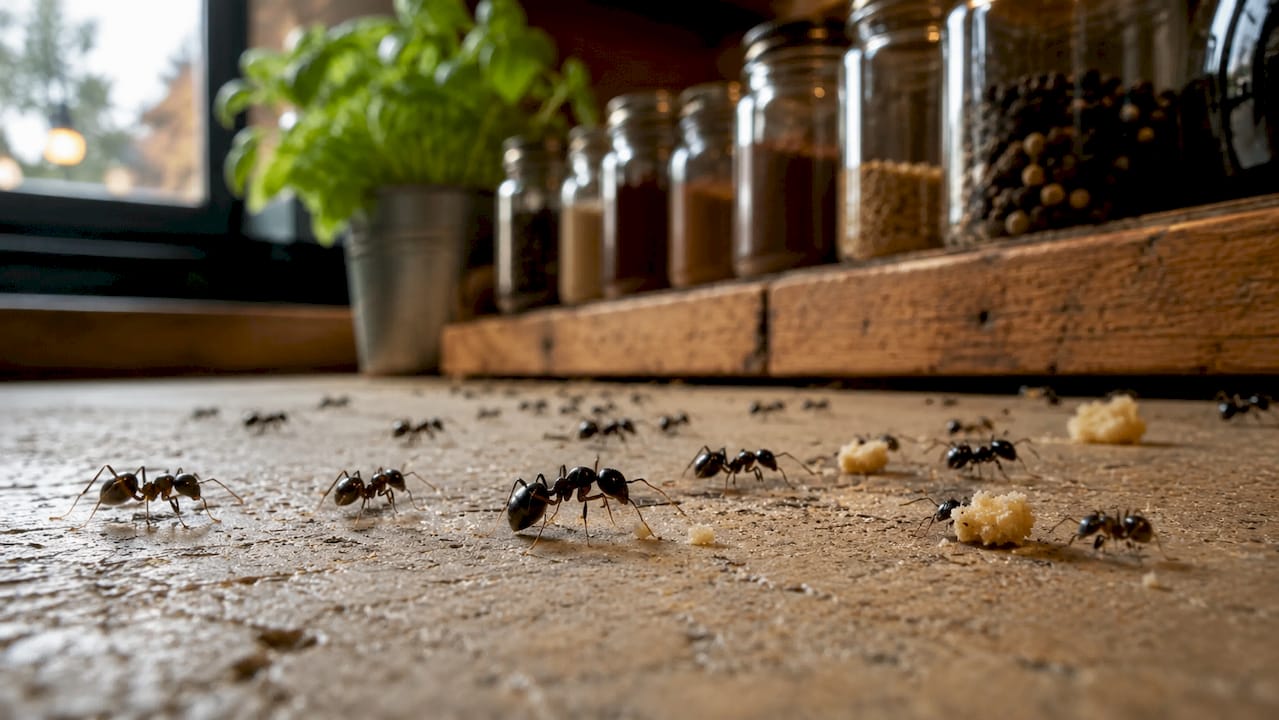
Black garden ants are the most commonly seen species in London commercial kitchens, particularly during summer months. Workers are 3–5mm long, uniformly dark brown to black, and follow well-defined trails to food sources. They typically enter through gaps around doors, windows, and service pipes. Their colonies are large but usually based outdoors, meaning infestations are often seasonal and linked to warm weather foraging. Controlling entry points and removing food attractants is usually sufficient to manage them.
Ghost ant (Tapinoma melanocephalum)
Ghost ants are far smaller at 1–2mm, with a pale, almost translucent abdomen that makes them difficult to spot on light-coloured surfaces. They are a tropical species that thrives in the warm, humid conditions found in commercial kitchens. Ghost ants nest indoors, often within wall voids, behind skirting boards, or inside electrical equipment. Their preference for sweet and greasy foods makes kitchen environments particularly attractive. Unlike black garden ants, ghost ant colonies can have multiple queens, which means they spread quickly and are harder to eliminate with simple surface treatments.
Pharaoh ant (Monomorium pharaonis)
Pharaoh ants are the most serious commercial kitchen pest issue in London. Workers are tiny at 1.5–2mm, yellow to light brown in colour, and almost invisible to the naked eye on food surfaces. They are notoriously difficult to control and are of particular concern in healthcare settings due to their ability to carry and transmit pathogens. In food businesses, their presence represents an immediate food safety risk. Pharaoh ant colonies contain multiple queens and multiple satellite nests, which is the key reason standard spray treatments fail so badly with this species.
Pro Tip: Photograph any ants you find and send the image to a qualified pest controller before attempting any treatment. Misidentification is the single most common reason ant infestations in London commercial kitchens escalate.
Why do pharaoh ants require specialist treatment?
Pharaoh ants behave differently from every other ant species found in London kitchens, and that difference has serious consequences if you reach for a spray.
When a pharaoh ant colony is disturbed by a residual insecticide spray, it does not die. It splits. The colony fragments into multiple satellite nests, each with its own queen, spreading the infestation to new areas of the building. Sprays scatter pharaoh ant colonies into dozens of smaller nests, making eradication significantly harder and more expensive. This process is called colony budding, and it is the reason that well-meaning DIY treatments so often turn a localised problem into a building-wide crisis.
The correct treatment for pharaoh ants is a slow-acting gel bait programme, applied by a qualified pest controller. The bait must be:
- Placed strategically along foraging trails and near nest sites, not sprayed or scattered.
- Slow-acting so that workers carry the toxic bait back to the nest and feed it to the queens before dying.
- Left undisturbed for the full treatment period. Cleaning around bait stations or applying other products simultaneously will break the cycle.
- Monitored regularly with bait replenished as needed until all foraging activity ceases.
- Documented with service reports as evidence of active pest management for Environmental Health Officer inspections.
“Incorrect use of sprays on pharaoh ants often backfires, leading to widespread infestation and significant difficulty of eradication. Non-bait, residual sprays cause scattering of colonies, requiring professional slow-acting gel bait methods instead.” — Pest Control in Food Businesses
The timeline for pharaoh ant eradication using gel bait is typically several weeks. Operators should plan for multiple visits and maintain strict hygiene protocols throughout to avoid competing food sources distracting ants from the bait.
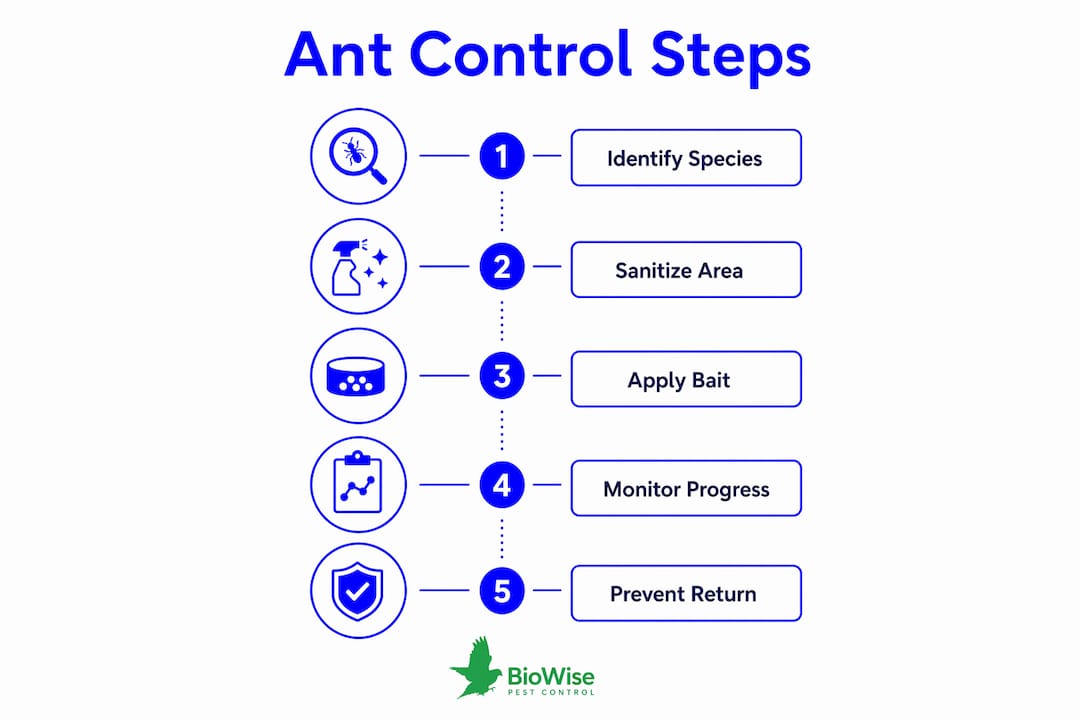
How to control an ant infestation in a commercial kitchen: step by step
A structured response protects your food safety rating and limits the risk of enforcement action. Effective ant pest control in UK food businesses relies on Integrated Pest Management embedded in HACCP systems, with documented risk assessments and monitoring.
-
Stop food production in affected areas immediately. Quarantine any product that may have been contaminated. Affected areas should not reopen until the infestation is controlled, entry points are sealed, and deep cleaning is completed with full documentation.
-
Identify the species. Contact a qualified pest controller to confirm whether you are dealing with black garden ants, ghost ants, or pharaoh ants. Treatment selection depends entirely on this step.
-
Commission a site-specific risk assessment. Your pest controller should produce a written assessment identifying infestation extent, entry points, and contributing factors such as food storage practices or structural gaps.
-
Implement targeted treatment. For black garden ants and ghost ants, residual insecticide treatments applied to trails and entry points are appropriate. For pharaoh ants, a gel bait programme is the only reliable method.
-
Seal entry points. Gaps around pipes, cables, and door frames must be filled with appropriate sealant. This is a physical proofing step that complements chemical treatment.
-
Deep clean the affected area. Remove grease, food debris, and moisture from all surfaces. Ants are attracted to residues that routine cleaning misses.
-
Set up a monitoring programme. Insect monitors placed at key locations provide early warning of reinfestation and form part of your compliance documentation.
-
Record everything. Keep service reports, monitoring logs, and corrective action records. Documentation of pest control activities demonstrates due diligence to EHOs during inspections.
| Action | Purpose | Compliance relevance |
|---|---|---|
| Species identification | Determines correct treatment method | HACCP risk assessment |
| Gel bait programme (pharaoh ants) | Eliminates colony without budding | Food safety requirement |
| Physical proofing | Prevents re-entry | EHO structural compliance |
| Monitoring logs | Tracks infestation status | Due diligence evidence |
| Service reports | Records corrective actions | EHO inspection readiness |
Pro Tip: Ask your pest controller to align their service reports directly to your HACCP documentation. EHOs prioritise evidence of active pest management implementation, not just contracts, during inspections.
How to prevent ants returning to your commercial kitchen
Prevention is significantly cheaper than treatment. The following measures reduce ant infestation risk and support ongoing compliance with food hygiene regulations.
Hygiene and food storage
- Clean all food preparation surfaces, floors, and equipment at the end of every service, paying particular attention to grease traps, drain covers, and areas beneath fixed equipment.
- Store all food in sealed, pest-proof containers. Never leave uncovered food on surfaces overnight.
- Manage waste daily. Bins with tight-fitting lids and regular collection remove the primary food source that attracts foraging ants.
- Keep drains clear and dry where possible. Ghost ants in particular are drawn to moisture.
Physical exclusion
- Seal all gaps around incoming pipes, cables, and conduits with appropriate filler or mesh.
- Fit door brushes and weather seals to external doors. Black garden ants commonly enter through gaps at ground level.
- Inspect and repair damaged window seals and ventilation covers regularly.
- Check deliveries for ant activity before bringing goods into the kitchen.
Monitoring and staff training
Staff training in pest awareness improves early detection and complements professional pest management visits. A designated internal contact who knows the signs of ant activity and can escalate issues promptly is a practical requirement for any busy London kitchen. Early detection prevents a minor foraging trail from becoming a full colony infestation.
| Prevention measure | Effective against | Frequency |
|---|---|---|
| Surface and drain cleaning | All species | Daily |
| Sealed food storage | All species | Ongoing |
| Gap sealing and proofing | Black garden ant, ghost ant | Quarterly review |
| Insect monitors | All species | Monthly check |
| Staff pest awareness training | All species | Annual minimum |
Routine monitoring and documented prevention measures also tie directly into your HACCP prerequisites and demonstrate to Environmental Health Officers that pest management is actively managed, not reactive. Keeping detailed service reports and corrective action records is the standard EHOs expect to see. For a full breakdown of what London food businesses must have in place, the pest compliance guide for London restaurants covers EHO and HACCP requirements in detail.
Key takeaways
Effective ant control in a London commercial kitchen requires correct species identification first, because pharaoh ants demand gel bait treatment while other species respond to standard residual methods.
| Point | Details |
|---|---|
| Species identification is critical | Black garden ants, ghost ants, and pharaoh ants each require a different treatment approach. |
| Never spray pharaoh ants | Residual sprays cause colony budding, spreading the infestation and making eradication far harder. |
| Gel bait is the correct pharaoh ant method | Slow-acting bait carried back to the nest eliminates queens and ends the colony. |
| Documentation protects your business | Service reports and monitoring logs demonstrate due diligence to EHOs during inspections. |
| Prevention reduces enforcement risk | Daily hygiene, physical proofing, and staff training are the most cost-effective long-term controls. |
What I have learned from years of ant infestations in London kitchens
Having worked with commercial kitchen operators across London since 2010, the pattern I see most often is this: a manager spots a trail of ants, reaches for a can of spray, and within two weeks has a pharaoh ant infestation in three rooms instead of one. The spray felt like action. It was, in fact, the worst possible response.
The uncomfortable truth is that most commercial kitchen pest problems are not pest problems at first. They are hygiene and structural problems that create the conditions for pests to thrive. A gap behind a dishwasher, a drain that never fully dries, a delivery that sat in a warm loading bay for too long. Ants do not appear randomly. They follow food, moisture, and warmth, and London kitchens provide all three in abundance.
What I advocate for is a shift from reactive to scheduled. Environmental Health Officers can issue emergency prohibition notices leading to closure if pests pose an imminent health risk, with confirmation by a Magistrates’ Court within three days. That is not a theoretical risk. It is a documented enforcement pathway that operators in London face. The businesses that avoid it are not the ones with the most expensive pest contracts. They are the ones whose staff know what to look for, whose documentation is current, and whose pest controller is integrated into their HACCP system rather than called in as a last resort.
Integrated pest management combining trained internal staff and qualified external service providers is the most effective approach available. That is not a marketing claim. It is the standard that EHOs measure you against.
— Ana Hasula
Biowise Pest Control Maintenance Services: expert ant control for London kitchens
London commercial kitchens face ant infestation challenges that require more than a one-off treatment. Biowise Pest Control Maintenance Services has been protecting food businesses across London since 2010, working with over 600 clients to deliver pest management plans that meet EHO and HACCP requirements.
Whether you are dealing with pharaoh ants requiring specialist gel bait treatment or black garden ants entering through structural gaps, Biowise Pest Control Maintenance Services provides species-specific treatment, physical proofing, and full compliance documentation. Monthly maintenance contracts and emergency response services are available across London. For tailored commercial pest control that protects your food safety rating and keeps your kitchen operational, contact Biowise Pest Control Maintenance Services today.
FAQ
What type of ants get into commercial kitchens?
The three species most commonly found in London commercial kitchens are the black garden ant (Lasius niger), the ghost ant (Tapinoma melanocephalum), and the pharaoh ant (Monomorium pharaonis). Pharaoh ants are the most serious due to their ability to spread pathogens and their resistance to standard spray treatments.
Are ants a food hygiene risk?
Ants are a direct food hygiene risk. They contaminate food and food contact surfaces by carrying bacteria as they forage, and pharaoh ants in particular are associated with pathogen transmission in sensitive environments.
How long does ant treatment take in a commercial kitchen?
Treatment duration depends on the species. Black garden ant and ghost ant treatments typically show results within one to two weeks. Pharaoh ant gel bait programmes require several weeks of monitored treatment across multiple visits to fully eliminate the colony.
Can I use over-the-counter sprays to treat ants in my kitchen?
Over-the-counter sprays are not suitable for pharaoh ant infestations and can actively worsen the problem by causing colony splitting. For all ant species in a commercial kitchen, a qualified pest controller should assess the situation and apply appropriate, food-safe treatments.
What do EHOs expect to see regarding ant control?
EHOs expect documented evidence of active pest management, including a site-specific risk assessment, treatment records, monitoring logs, and corrective action reports. A pest control contract alone is not sufficient without supporting compliance documentation.
Recommended
- Essential Steps for Opening a Commercial Kitchen in London – BioWise Pest Control London
- Pests causing food hygiene failures in london kitchens
- Mice in Commercial Kitchens: Ensure Your Business Passes Every Inspection – BioWise Pest Control London
- Kitchen pest control guide for London homes and properties