

Many business owners believe pest control is only necessary when infestations become visible. This reactive approach often leads to costly damage and compliance issues. Proactive pest control contracts reduce incidents by 30-40% compared to waiting for problems to emerge. For London businesses and property managers, preventive contracts offer significant advantages beyond simply eliminating pests. They ensure compliance with health and safety regulations, protect your reputation, and reduce long-term costs. This guide explores how pest control contracts work, their role in regulatory compliance, sustainable methods like Integrated Pest Management, and how to choose the right contract for your specific business needs.
Table of Contents
- How Pest Control Contracts Reduce Infestations And Costs
- Ensuring Compliance With Health And Safety Regulations
- Integrated Pest Management: Sustainable And Effective Pest Control
- Choosing The Right Pest Control Contract For Your Business
- Protect Your London Business With Expert Pest Control Contracts
- Frequently Asked Questions About Pest Control Contracts
Key takeaways
| Point | Details |
|---|---|
| Reduced incidents | Contracts reduce pest-related incidents by up to 40% through regular monitoring and prevention |
| Compliance assurance | They ensure adherence to UK health and safety laws including the Food Safety Act 1990 |
| Sustainable methods | Integrated Pest Management minimises chemical use whilst maintaining effectiveness |
| Tailored solutions | Contracts address specific business risks and common London pests like rodents and cockroaches |
How pest control contracts reduce infestations and costs
Pest control contracts transform pest management from reactive firefighting to strategic prevention. Rather than waiting for visible infestations, regular inspections identify vulnerabilities before pests establish themselves. This proactive approach delivers measurable results. Businesses with contracts experience 30-40% fewer pest incidents than those relying on emergency treatments.
The financial benefits extend far beyond the contract cost itself. Pest damage creates cascading expenses that many business owners underestimate. Rodents gnaw through electrical wiring, creating fire hazards and equipment failures. Cockroaches contaminate inventory, forcing costly disposal. Flies drive customers away from hospitality venues. Proactive pest control reduces damage and repair costs by up to 60% compared to reactive approaches.
Regular inspections form the backbone of effective contracts. Qualified technicians visit your premises monthly or quarterly, depending on risk levels. They examine entry points, check monitoring stations, and identify conducive conditions like moisture or food sources. Early detection allows minor issues to be addressed before they escalate into full infestations requiring extensive treatment.
London businesses face specific pest pressures that contracts must address:
- Rodents thrive in urban environments with abundant food sources and shelter
- Cockroaches exploit warmth and moisture in commercial kitchens and basements
- Flies breed rapidly in waste areas and food preparation zones
- Stored product insects damage inventory in warehouses and retail spaces
Tailored contracts account for these common threats based on your business type and location. A restaurant requires different monitoring than an office building. Warehouse pest control differs from hotel pest management. Understanding one-off versus monthly contract savings helps you make informed decisions about coverage levels.
Pro Tip: Review your contract to confirm it specifies guaranteed response times for emergency callouts and clearly lists included services versus additional charges. This transparency prevents disputes and ensures you receive expected value.
Research demonstrates that integrated monitoring systems significantly improve pest control effectiveness when combined with regular professional inspections.
Ensuring compliance with health and safety regulations
UK businesses face stringent legal obligations regarding pest control, particularly in food-related sectors. Non-compliance carries severe consequences. Fines range from £5,000 to £20,000, with serious violations potentially forcing business closure. Beyond financial penalties, pest-related health violations destroy reputations that took years to build. Social media amplifies negative incidents, turning a single inspection failure into widespread public knowledge.
Pest control contracts provide documented evidence of due diligence during regulatory audits. Inspectors from the Food Standards Agency and local authorities examine your pest management records. Contracts demonstrate that you take preventive measures seriously rather than ignoring the issue until problems arise. This documentation proves particularly valuable if disputes arise about when infestations began or what actions you took.
Several key regulations govern commercial pest control in the UK. The Food Safety Act 1990 requires food businesses to implement adequate pest control measures. The Prevention of Damage by Pests Act 1949 obligates property owners to keep premises pest-free. The Control of Substances Hazardous to Health Regulations 2002 govern pesticide use and worker safety during treatments.
Maintaining compliance requires systematic processes that contracts help establish:
- Schedule regular inspections at frequencies appropriate to your risk level
- Document all treatments, monitoring results, and corrective actions taken
- Maintain pest control logs accessible for inspector review
- Train staff to recognise pest signs and report issues promptly
- Review and update pest management procedures annually
- Verify contractor certifications and insurance coverage remain current
Documentation quality matters as much as the treatments themselves. Your pest control provider should supply detailed reports after each visit. These reports must record inspection findings, pest activity levels, treatment methods used, and recommendations for preventing future issues. Generic checklists provide little value during audits. Specific observations about your premises demonstrate genuine attention to your unique situation.
Pro Tip: Before signing any contract, verify that technicians hold relevant certifications from bodies like the British Pest Control Association. Request copies of their professional indemnity insurance and confirm they provide comprehensive written reports after each visit. This diligence protects you during audits and ensures service quality.
Professional certification standards vary across providers, making verification essential. Qualified technicians understand current regulations and apply treatments safely whilst minimising disruption to your operations.
Regulatory compliance extends beyond avoiding fines. It demonstrates your commitment to customer safety and employee wellbeing, building trust that translates into business success.
Integrated pest management: sustainable and effective pest control
Integrated Pest Management represents a paradigm shift from chemical-dependent approaches to comprehensive prevention strategies. IPM prioritises non-chemical methods, using pesticides only when necessary and in targeted applications. This philosophy aligns with growing environmental awareness whilst delivering superior long-term results. IPM programmes reduce pesticide use by up to 50% whilst maintaining effective control.
The IPM approach emphasises prevention, monitoring and minimal pesticide use through systematic processes. Rather than scheduled pesticide applications regardless of pest presence, IPM bases treatments on actual monitoring data. This evidence-based approach reduces unnecessary chemical exposure for employees and customers.
| Aspect | Traditional Chemical Methods | Integrated Pest Management |
|---|---|---|
| Primary approach | Scheduled pesticide applications | Prevention and monitoring first |
| Chemical use | Regular treatments regardless of pest presence | Targeted applications based on monitoring data |
| Environmental impact | Higher pesticide residues and resistance risks | Minimal chemical footprint and reduced resistance |
| Long-term effectiveness | Pests may develop resistance over time | Sustainable control through multiple tactics |
| Health considerations | Greater exposure risks for occupants | Reduced chemical exposure and health risks |
Core IPM strategies work together to create hostile environments for pests:
- Regular monitoring through traps and visual inspections identifies pest activity early
- Exclusion techniques seal entry points and eliminate access routes
- Sanitation improvements remove food sources and breeding sites
- Habitat modification addresses moisture issues and eliminates harbourage
- Biological controls use natural predators where appropriate
- Mechanical controls employ traps and physical barriers
- Chemical treatments apply targeted products only when monitoring indicates necessity
IPM proves particularly valuable for businesses in sensitive sectors. Food preparation facilities benefit from reduced pesticide exposure near consumables. Healthcare environments require minimal chemical use around vulnerable patients. Schools and childcare centres prioritise child safety whilst maintaining pest-free conditions. Hotels and restaurants protect guest experiences without compromising health standards.
Implementing IPM requires partnership between pest control providers and business operators. Your staff play crucial roles in maintaining sanitation standards and reporting pest signs promptly. Contractors provide expertise in monitoring techniques and treatment selection. Together, you create sustainable pest management that protects your business long-term. Understanding top strategies for industrial pest control helps larger operations implement comprehensive IPM programmes.
Modern IPM incorporates technology like remote monitoring sensors and data analytics. These tools provide real-time pest activity alerts, allowing rapid responses before minor issues escalate. Digital record-keeping simplifies compliance documentation whilst identifying patterns that inform preventive improvements.
Choosing the right pest control contract for your business
Selecting appropriate pest control contracts requires understanding your specific risks and operational needs. A one-size-fits-all approach fails because different businesses face vastly different pest pressures. Restaurant kitchens battle constant food pest threats. Warehouses manage stored product insects. Offices deal primarily with occasional rodent intrusions. Your contract must match these realities.

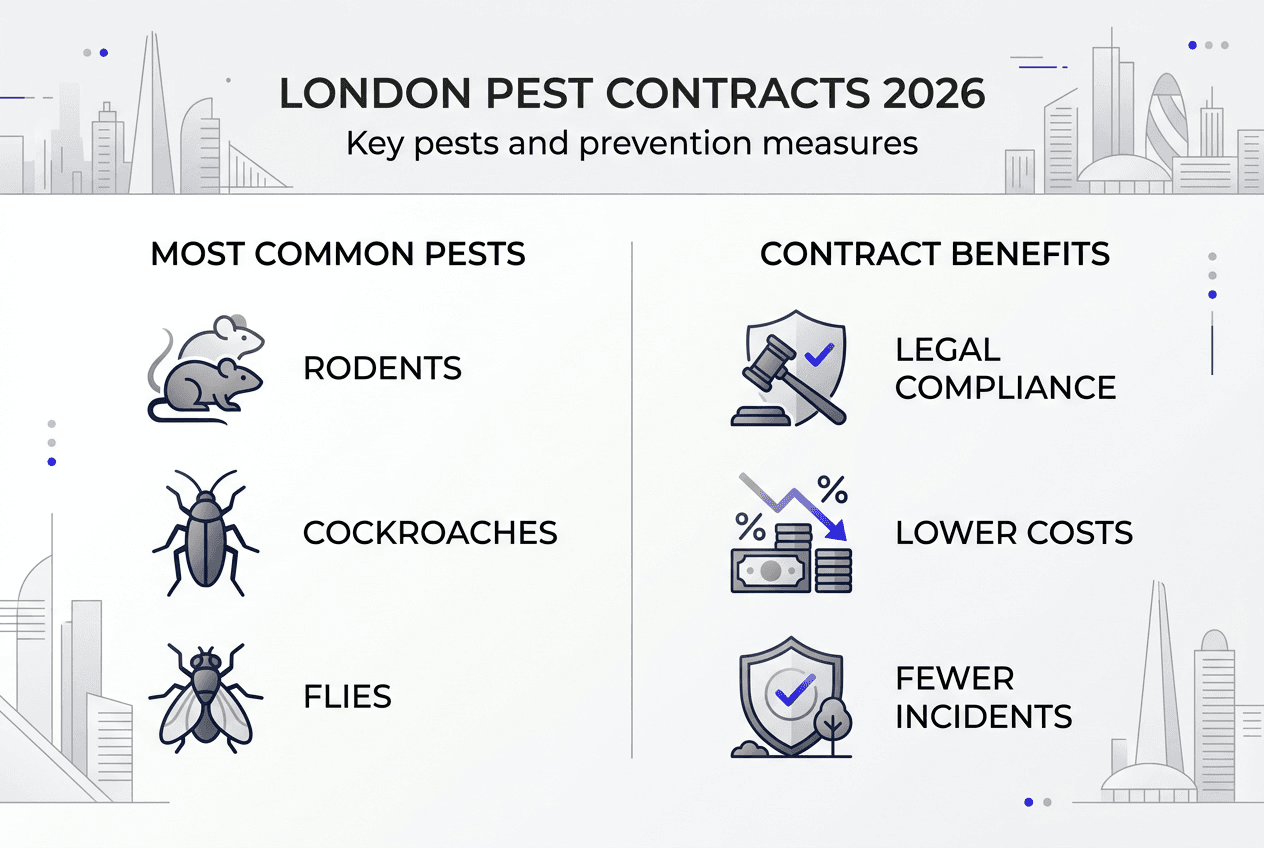
London businesses most commonly encounter rodents at 60%, cockroaches at 40%, and flies at 35% of commercial properties. Understanding which pests threaten your sector helps you evaluate contract coverage.
| Pest type | London prevalence | Typical control methods | Risk sectors |
|---|---|---|---|
| Rodents | 60% of businesses | Trapping, exclusion, monitoring stations | Food service, warehouses, offices |
| Cockroaches | 40% of businesses | Gel baits, monitoring, sanitation | Kitchens, healthcare, hospitality |
| Flies | 35% of businesses | UV traps, exclusion, waste management | Restaurants, food retail, hotels |
| Stored product insects | 25% of businesses | Monitoring, fumigation, temperature control | Warehouses, retail, food storage |
Several factors determine which contract suits your needs:
- Inspection frequency based on pest pressure and regulatory requirements
- Scope of coverage including which pests and treatment methods are included
- Response time guarantees for emergency callouts between scheduled visits
- Reporting detail and documentation quality for compliance purposes
- Technician qualifications and company certifications
- Contract flexibility allowing adjustments as your business evolves
- Clear pricing structures distinguishing routine services from additional charges
Common pitfalls undermine contract effectiveness when businesses overlook critical details. Choosing providers based solely on price often results in inadequate service. Unqualified contractors lack expertise to identify subtle pest signs or apply treatments safely. Vague contracts create disputes about what services are actually included. Poor documentation leaves you vulnerable during regulatory audits.
Multi-site businesses require coordinated pest management across locations. Your contract should provide consistent service standards whilst allowing site-specific adjustments. Centralised reporting helps you identify patterns and compare performance across properties. This overview proves invaluable for property managers overseeing multiple London buildings.
Pro Tip: When managing rental properties, clearly document whether landlords or tenants bear pest control responsibilities in tenancy agreements. This prevents disputes when infestations occur and ensures prompt action regardless of who pays. Ambiguity creates delays that allow minor problems to become major infestations.
Evaluating potential providers requires asking specific questions about their approach. How do they customise contracts for different business types? What certifications do their technicians hold? How quickly do they respond to emergency callouts? What documentation do they provide after each visit? Their answers reveal whether they understand your needs or simply sell generic packages. Resources on finding the right pest control company help you assess options systematically.
Protect your London business with expert pest control contracts
Implementing effective pest control contracts protects your business from costly infestations whilst ensuring regulatory compliance. The strategies covered in this guide demonstrate how proactive prevention delivers better results than reactive treatments. Professional contracts provide peace of mind that your premises remain pest-free and audit-ready.
BioWise Services specialises in tailored pest control solutions for London businesses and property managers. Since 2010, we have protected over 600 clients across hospitality, healthcare, retail, and commercial sectors. Our commercial pest control services combine Integrated Pest Management principles with comprehensive documentation that simplifies compliance. Whether you operate restaurants, hotels, offices, or warehouses, we design contracts matching your specific pest pressures and regulatory requirements. Our expertise in London hospitality pest control ensures your reputation remains protected. Discover how our family-run company delivers professional, reliable pest management by exploring our guidance on selecting the right provider for your needs.
Frequently asked questions about pest control contracts
What pests are most commonly covered in London pest control contracts?
Most contracts cover rodents, cockroaches, flies, and stored product insects as standard. These represent the primary threats to London businesses across sectors. Specialised pests like bed bugs or birds typically require additional coverage depending on your business type and location.
How often should inspections occur under a typical contract?
Inspection frequency depends on your risk level and sector. High-risk businesses like restaurants require monthly visits. Moderate-risk premises like offices typically need quarterly inspections. Your provider should recommend frequency based on pest pressure, previous activity, and regulatory requirements for your industry.
Can I customise my pest control contract to suit my business sector?
Reputable providers tailor contracts to your specific needs rather than offering generic packages. Customisation should address your premises layout, pest risks, operational hours, and compliance requirements. Discuss your unique situation during initial consultations to ensure the contract matches your actual needs.
What documentation should a pest control company provide for compliance?
Your provider must supply detailed reports after each visit documenting inspection findings, pest activity levels, treatments applied, and recommendations. Reports should be specific to your premises rather than generic checklists. Maintain these records for at least two years to demonstrate due diligence during regulatory audits.
Are eco-friendly pest control options available in commercial contracts?
Integrated Pest Management approaches prioritise non-chemical methods whilst maintaining effectiveness. Modern contracts incorporate monitoring, exclusion, and sanitation improvements before resorting to pesticides. When chemicals are necessary, targeted applications minimise environmental impact whilst controlling pests effectively.
Recommended
- City of London Pest Control – BioWise Pest Control London
- Commercial Pest Control Pricing in London: A Cost Breakdown for Businesses – BioWise Pest Control London
- The Best Solutions For Business Tackling Pest Control In London – BioWise Pest Control London
- London Commercial Pest Control – Safeguard Your Business